Theatre Junction’s 2016/17 Season Marks Two Major Anniversaries

Portraits in Motion - Volker Gerling 2 - Photo credit Franz Ritschel

Volker Gerling (pictured) shares his flip book portraits with the audience in Portraits in Motion, one of seven shows announced for Theatre Junction’s 2016/17 season. Photo Credit: Franz Ritschel.

This May, Theatre Junction announced its 2016/17 season. The company’s upcoming season marks two major anniversaries: Theatre Junction’s 25th anniversary and the 10th anniversary of Theatre Junction at the Grand Theatre.

Theatre Junction has undergone several changes in the years since Artistic Director Mark Lawes founded the company in 1991. After a successful campaign to save the historic building from demolition, Theatre Junction relocated to the Grand in 2006 from the Southern Alberta Jubilee Auditorium, where the company was based for 14 years. While the company could have continued with “a program that was really more along the lines of interpreting text,” Lawes felt that it was important for Theatre Junction to change its mandate when they took over the Grand.

“There was a lot of risk involved in that change,” said Lawes. “I saw the regional theatre model as coming of age and potentially declining. The audience was getting older. It wasn’t engaging for young people to go and see work. And that was really important for me to engage millennials in arts and culture.” 

Today, Theatre Junction presents local, national, and international creation-based artists from multiple disciplines. Theatre Junction GRAND has transformed into a “different kind of cultural space” that continues the Grand’s legacy of culturalizing Calgary, while also being contemporary.

“It’s a real junction,” said Lawes about the space, which is also home to the restaurant Workshop Kitchen + Culture. “A meeting place where people come together and not only see amazing works of art, but can meet new people and talk about arts and ideas.”

One of seven shows to be presented in Theatre Junction’s upcoming season is Volker Gerling’s Portraits in Motion. Gerling’s Portraits in Motion will be presented by Theatre Junction and One Yellow Rabbit as part of the 31st Annual High Performance Rodeo. After walking 3500 km throughout Germany, Gerling created flip book portraits of the people he met on his journey. Audiences will get to see these portraits and hear the stories behind them when Gerling comes to Theatre Junction in January 2017.

“He just decided to walk and meet people,” said Lawes. “For me, it’s a beautiful, simple act of humanity. It’s going back to something very basic about meeting someone. That’s something that we all crave and need.”

Lawes says that Gerling will walk around Calgary, meeting people when he arrives in the new year. This material will not be included in the production at Theatre Junction, he adds, since “the show is set” already.

In March, Theatre Junction will present Porte Parole and Crow’s Theatre’s The Watershed. Written by Montreal playwright Annabel Soutar, who travelled cross-country across Canada with her family, The Watershed is an investigation into the future of our natural resources that raises questions concerning the politics of water.

“[Soutar] has been making documentary theatre on subjects that are important to her and her family,” said Lawes about the theatre artist. “We presented Seeds two years ago, that was [about] the Monsanto versus Schmeiser trial…It really questioned who owns a seed, who owns life.”

Lawes says that Soutar was particularly concerned about the state of water in Canada under the Harper government. “She was really concerned with policy surrounding research: what was being researched, what wasn’t being published from scientists. Funds that were being cut for research.”

When asked what goes into programming a season, especially one that includes international work, Lawes confesses that “there’s really no secrets, but it is a very long, complicated process.”

“I go out to festivals every year and see a lot of work,” Lawes said. “I have a bunch of different partners across the country and in the United States that we also talk to see what’s touring and share ideas of work. So, some works come very quickly, you know I see something I really like and it happens to be touring.

He adds that it is also about “keeping [a] dialogue open with artists who have presented before,” like Japanese dancer and choreographer Hiroaki Umeda whose new work was seen by Lawes in Montreal.

“He happened to be touring in Mexico just before he’ll be presenting here, so he was on the continent, more or less, and on the same side of the continent. So, it made some sense for him to come up here. That’s one example of how that works.”

Umeda will return to Theatre Junction in October 2016 with two new solo performances, Intensional Particle/split flow.


For more information about Theatre Junction’s 2016/17 season, including how to purchase tickets, visit their website: www.theatrejunction.com

Project 404’s PrimorAgator Diaries Looks At A Life in Transition

image

Top to Bottom: Barbara England and Jill Henis in Project 404’s PrimorAgator Diaries. Imaged provided by Jill Henis.

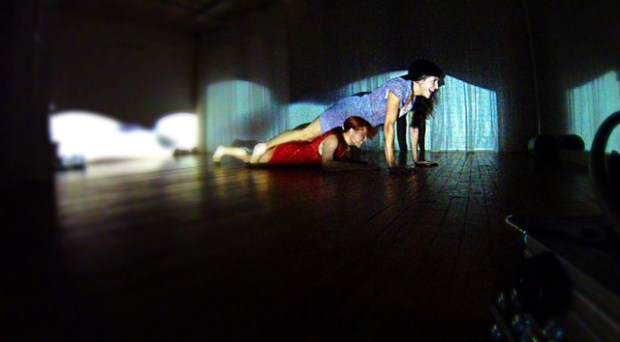
Project 404’s PrimorAgator Diaries is an original contemporary dance work informed by the writings of Jeanette LeBlanc, with the concept, choreography and sound design by Jill Henis. This site-specific piece is staged inside Henis’ downtown studio space, located inside a building where the top two floors accommodate working artists. Performed by Henis and collaborator Barbara England, PrimorAgator Diaries is a deeply intimate look at a life in transition.

Once the audience settles into their seats, Henis, lying nude on the floor, awakens. She is caged by three walls and a curtain of light fabric (that separates her from the audience). England, dressed with black heels, enters the space as Henis retreats away against the back wall, keeping herself hidden behind fabric. Roaring white noise is projected onto the walls (projection & visuals by Greg Debicki). England is ferocious with her movement, stomping loudly with her heels as she moves across the space.

Afterwards, Hennis, now dressed, takes a large roll of aluminum foil and rolls it out like a carpet. Carefully, she tries walking to the other end without wrinkling the foil or creating a disturbance of any kind. Anyone who has used foil before knows how tricky the material can be when handling. Henis’ effort doesn’t fare well.

The imagery created by the large studio mirror stage left is very striking. There’s this great triangular symmetry when Henis walks downstage (diagonal) on the foil. She comes down from the peak to the base, to the audience; she comes out of isolation.

England joins Henis in a ‘four-legged race’ to stage left, to the mirror. The dancers shuffle forward, becoming more and more competitive as the race goes on. So competitive, in fact, that England and Henis are soon grappling each other. What’s really funny are these moments where the two break and smile at the audience, like they were friends and this is only friendly competition, despite their contrary actions. We wonder, though, why these “friends” are tearing each other down rather than helping each other achieve their mutual goal? Is this a race towards self-improvement, where envy rules the roost?

The dancers enter a club where they enjoy loud, pumping music. There’s a big splash of colorful lights that hits the room as England and Henis lose themselves in the music. The scene is so very different than the ones before. Where the others were filled with anxiety and self-consciousness, this club scene is loose and without inhibitions.

Naturally, however, the party ends. (The party always ends). There’s an air of “what now?” between England and Henis.

Ultimately what happens to Henis is that England wraps her, from head to toe, in bubble wrap. A recorded interview with an old man plays, with this line jumping out “Have you thought how you want to spend the rest of your life?” Sure, Henis is safe in her bubble wrap cocoon, but she’s also trapped. She can’t move, her body at the mercy of England who starts to dance with the cocoon.

Eurythmics’ Sweet Dreams (Are Made Of This) begins to play. England drags Henis, still in the cocoon, across the floor as Henis softly repeats the lines of the song.

In these chapters of PrimorAgator Diaries, there’s an underlying fear and vulnerability that rises to the surface. Henis’ choreography observes someone trying to come out of their shell and connect with others while capturing some notion of self. In pursuit of trying to please other people, however, the self becomes lost, perhaps overtaken by this intense desire for belonging. And there seems to be no happy medium, or at least a capacity to reach some sort of in-between. Henis’ character is impeded by self-doubt, whereas England’s whole persona breathes confidence; the road map to this latter destination is non-existent.

Debicki’s projection work in this tight (unventilated) space really throws the audience into the frenetic headspace of the work, not to mention the audience’s close proximity to the dancers. The mirror that reflects the inner duality, conflict of Henis’ choreography is a strong visual element. It opens the space creatively, and Henis’ keen eye conjures great visual dynamics.

Henis and England are a dynamite team. They display great versatility (and some fun character work) in this piece that really feels like flipping through a diary, with all the juicy pieces coming alive. And what commitment in such a hot space, especially Henis whose breathing is restricted within the cocoon. Kudos to them for their visceral energy in this bold piece by Project 404.


Project 404’s PrimorAgator Diaries ran June 13 – 18.

2016 Calgary Theatre Critics’ Awards: A Celebration of Community

13048040_10100424624467167_4827026003664407590_o

The 2016 Calgary Theatre Critics’ Awards were hosted by Dave Kelly at Commonwealth Bar & Stage on June 6th. Nominees were chosen from any production performed in Calgary from June 2015 to May 2016, with the exception of Broadway Across Canada performances.

The 2016 Calgary Theatre Critics’ Awards was an evening full of anticipation and gratitude. The fifth annual event, hosted by Dave Kelly, was held at Commonwealth Bar & Stage where local theatre critics Stephen Hunt, Louis B. Hobson, Rodrigo Flores, and Jenna Shummoogum presented awards in 19 categories. Accepting the awards were both new and familiar faces from Calgary’s theatre community who took time to thank family, friends, and colleagues for their support.

Guests stayed afterwards to mingle and congratulate each other on another strong year of theatre in Calgary. 
____________________

Best Supporting Actress in a Musical

Louise Pitre – The Little Prince: The Musical – Theatre Calgary

Best Supporting Actor in a Musical

Tenaj Williams – The Paper Bag Princess: A Musical – StoryBook Theatre and Forte
Musical Theatre Guild

Best Supporting Actress in a Play

Amy Burks – Romeo and Juliet – The Shakespeare Company and Hit & Myth Productions

Best Supporting Actor in a Play

Karl Sine – The Boy’s Own Jedi Handbook – Ground Zero Theatre and Hit & Myth Productions

Best Touring Show

Flora & Fawna’s Field Trip! – Lunchbox Theatre, Darrin Hagen and Trevor Schmidt

Best Set Design

Cameron Porteous – The Crucible – Theatre Calgary

Best Technical Design

Jamie Nesbitt – Calamity Town – Vertigo Theatre

Best Creative Concept

The Fight or Flight Response – Verb Theatre

Best Actress in a Musical

Susan Gilmour – The Light in the Piazza – Theatre Calgary

Best Actor in a Musical

Ahad Mir – Naughty but Nice! – Forte Musical Theatre Guild

Best Solo Performance

Jamie Konchak – The Floating Mouse – Green Fools Theatre

Best New Script

Calamity Town – Joseph Goodrich – Vertigo Theatre

Best Actor in a Play

Tyrell Crews – Benefit – Downstage

Best Actress in a Play

Heather Pattengale – Outside Mullingar – Rosebud Theatre

Best Director of a Musical

Michael Shamata – The Light in the Piazza – Theatre Calgary

Best Production of a Musical

The Light in the Piazza – Theatre Calgary

Best Director of a Play

Craig Hall – Sherlock Holmes and The Case of the Jersey Lily – Vertigo Theatre

Best Ensemble

Book Club – Lunchbox Theatre

Best Production of a Play

The Crucible – Theatre Calgary

The Evans Award

StoryBook Theatre

  • The Evans Award recognizes outstanding contribution to the vibrancy of the theatre community in Calgary.

Nominees were chosen from any production performed in Calgary from June 2015 to May 2016, with the exception of Broadway Across Canada performances.

2016 Calgary Theatre Critics’ Awards: Nominees Announced

13048040_10100424624467167_4827026003664407590_o

The 2016 Calgary Theatre Critics’ Awards will be held on June 6th at Commonwealth Bar & Stage (731 10th Ave SW). The public awards ceremony starts at 8:00PM.

Calgary Theatre Critics, Stephen Hunt formerly of the Calgary Herald, Louis B. Hobson of Postmedia, Rodrigo Flores of Joyful Magpies and Jenna Shummoogum of Downtown Calgary Association are pleased to announce the nominees for the fifth annual Calgary Theatre Critics’ Awards.

Nominees were chosen from any production performed in Calgary between June 2015 and May 2016, with the exception of Broadway Across Canada performances. The winners will be announced at a free public awards ceremony. The ceremony starts at 8pm on June 6th at Commonwealth Bar & Stage, 731 10th Avenue SW.

Best Supporting Actress in a Musical

Jayne Lewis – Young Frankenstein – Stage West
Laura Gillespie – The Wizard of Oz – Rosebud Theatre
Louise Pitre – The Little Prince: The Musical – Theatre Calgary
Tracy Michailidis – The Light in the Piazza – Theatre Calgary
Dana Jean Phoenix – The Wedding Singer – Stage West

Best Supporting Actor in a Musical

Tenaj Williams – The Paper Bag Princess: A Musical – StoryBook Theatre and Forte Musical Theatre Guild
Andrew McGillivray – The Wedding Singer – Stage West
Andrew Legg – The Wizard of Oz – Rosebud Theatre
David Keeley – The Light in the Piazza – Theatre Calgary
Michael Torontow – The Light in the Piazza – Theatre Calgary

Best Supporting Actress in a Play

Amy Burks – Romeo and Juliet – The Shakespeare Company and Hit & Myth Productions
Sasha Barry – Of Mice and Men – Spirit Fire Theatre
Julie Orton – Goodnight Desdemona (Good Morning Juliet) – The Shakespeare Company, Handsome Alice and Hit & Myth Productions
Conni Mah – Ching Chong Chinaman – Iglesia Productions
Brianna Johnston – The Money Shot – Ground Zero Theatre and Hit & Myth Productions

Best Supporting Actor in a Play

Ryan Luhning – Romeo and Juliet – The Shakespeare Company and Hit & Myth Productions
David LeReaney – Of Mice and Men – Spirit Fire Theatre
Karl Sine – The Boy’s Own Jedi Handbook – Ground Zero Theatre and Hit & Myth Productions
Stafford Perry – In On it – Lunchbox Theatre
Joe Perry – The Circle – Alberta Theatre Projects

Best Touring Show

Life, Death and The Blues – One Yellow Rabbit & Alberta Theatre Projects
A Theatre Passe Muraille Production, in association with Hope And Hell Theatre Co.
evalyn parry’s SPIN – One Yellow Rabbit & Theatre Calgary
Flora & Fawna’s Field Trip! – Lunchbox Theatre, Darrin Hagen and Trevor Schmidt
Jack Charles V. The Crown – ILBIJERRI Theatre, Toured by Performing Lines and the High Performance Rodeo
Who Killed Spalding Gray? – One Yellow Rabbit and reWork Productions

Best Set Design

Scott Reid – The Turn of the Screw – Vertigo Theatre
Jennifer Behie-Ratzlaff – Shadowlands – Fire Exit Theatre and Hit & Myth Productions
Cameron Porteous – The Crucible – Theatre Calgary
Jennifer Arsenault – Goodnight Desdemona (Good Morning Juliet) – The Shakespeare Company, Handsome Alice Theatre and Hit & Myth Productions
Julia Wasilewski – Matt & Ben – Theatre Transit

Best Technical Design

Jamie Nesbitt – Calamity Town – Vertigo Theatre
Sean Nieuwenhuis – The Little Prince: The Musical – Theatre Calgary
Benjamin Toner, Lisa Floyd and Aidan Lytton – The Only Good Boy – Theatre BSMT
JP Thibodeau – The Boy’s Own Jedi Handbook – Ground Zero Theatre and Hit & Myth Productions
Matthew Waddell – Window – Ghost River Theatre & the University of Calgary’s School of Creative and Performing Arts

Best Creative Concept

What Happened to the Seeker – Theatre Junction
Berlin Waltz – Devon More – The Calgary Fringe Festival
The Fight or Flight Response – Verb Theatre
Concord Floral – Theatre Junction
Taste – Ghost River Theatre, Vertical City Performance and the River Cafe

Best Actress in a Musical

Anwyn Musico – The Light in the Piazza – Theatre Calgary
Susan Gilmour – The Light in the Piazza – Theatre Calgary
Jamie Matchullis – What Gives? – Lunchbox Theatre
Cassia Schramm – The Wizard of Oz – Rosebud Theatre
Elicia MacKenzie – The Wedding Singer – Stage West

Best Actor in a Musical

Louie Rossetti – The Light in the Piazza – Theatre Calgary
Aidan Desalaiz – The Wedding Singer – Stage West
Adam Brazier – The Little Prince: The Musical – Theatre Calgary
Ahad Mir – Naughty but Nice! – Forte Musical Theatre Guild
Scott Olynek – Naughty But Nice – Forte Musical Theatre Guild

Best Solo Performance

Elinor Holt – Shakespeare’s Will – Sage Theatre
Trevor Campbell – Baggage – The Calgary Fringe Festival
Jamie Konchak – The Floating Mouse – Green Fools Theatre
Cheri Maracle – Paddle Song – Lunchbox Theatre
Cliff Cardinal – Huff – High Performance Rodeo

Best New Script

Book Club – Meredith Taylor-Parry – Lunchbox Theatre
Calamity Town – Joseph Goodrich – Vertigo Theatre
Mercutio & Tybalt – Val Duncan and Celene Harder – The Calgary Fringe Festival
Benefit – Matthew MacKenzie – Downstage
The Circle – Geoffrey Simon Brown – Alberta Theatre Projects

Best Actor in a Play

Joel Cochrane – Shadowlands – Fire Exit Theatre and Hit & Myth Productions
Tyrell Crews – Benefit – Downstage
Chris Austman – Of Mice and Men – Spirit Fire Theatre
Nathan Pronyshyn – The Fight or Flight Response – Verb Theatre
Paul F. Muir – Outside Mullingar – Rosebud Theatre

Best Actress in a Play

Allison Lynch – Romeo and Juliet – The Shakespeare Company and Hit & Myth Productions
Anna Cummer – Macbeth – Vertigo Theatre, The Shakespeare Company and Hit & Myth Productions
Chantelle Han – Medea – Chromatic Theatre
Heather Pattengale – Outside Mullingar – Rosebud Theatre
Lois Anderson – Vanya and Sonia and Masha and Spike – Alberta Theatre Projects

Best Director of a Musical

Michael Shamata – The Light in the Piazza – Theatre Calgary
Valerie Ann Pearson – The Paper Bag Princess: A Musical – StoryBook Theatre and Forte Musical Theatre Guild
Morris Ertman – The Wizard of Oz – Rosebud Theatre
Dennis Garnhum – The Little Prince: The Musical – Theatre Calgary
Tim French – The Wedding Singer – Stage West

Best Production of a Musical

The Wedding Singer – Stage West
The Paper Bag Princess: A Musical – StoryBook Theatre and Forte Musical Theatre Guild
The Wizard of Oz – Rosebud Theatre
The Little Prince: The Musical – Theatre Calgary
The Light in the Piazza – Theatre Calgary

Best Director of a Play

R.H. Thomson – The Crucible – Theatre Calgary
Paul Welch – Of Mice and Men – Spirit Fire Theatre
Craig Hall – Sherlock Holmes and the Case of the Jersey Lily – Vertigo Theatre
Morris Ertman – Outside Mullingar – Rosebud Theatre
Kelly Reay – The Fight or Flight Response – Verb Theatre

Best Ensemble

Goodnight Desdemona (Good Morning Juliet) – The Shakespeare Company, Handsome Alice Theatre and Hit & Myth Productions
Calamity Town – Vertigo Theatre
King Kirby – Sage Theatre
Book Club – Lunchbox Theatre
The Mousetrap – Vertigo Theatre

Best Production of a Play

The Crucible – Theatre Calgary
Of Mice and Men – Spirit Fire Theatre
Outside Mullingar – Rosebud Theatre
Sherlock Holmes and the Case of the Jersey Lily – Vertigo Theatre
Romeo and Juliet – The Shakespeare Company, Hit & Myth Productions

In addition, the critics will be handing out the Evans Award, a special award recognizing outstanding contribution to the vibrancy of the theatre community in Calgary. The award recipient will be revealed on the night of the event. 


To attend the Calgary Critics’ Awards please RSVP to critterawards2016@gmail.com as soon as possible as there are a limited number of spots available. Doors open at 7pm, the awards will begin at 8pm and the celebration will continue until they kick us all out.

#ThisIsLife Explores Ups and Downs of Social Media

The cast of En Corps Dance Collective's #ThisIsLife. Photo Credit: Focus Sisters Photography.

The cast of En Corps Dance Collective’s #ThisIsLife. Photo Credit: Focus Sisters Photography.

Trying to explain social media is difficult. No really knows why they need minute-by-minute updates from just about everyone and anyone. Why anything goes viral is a mystery, even for so-called social media ‘gurus’. And who knows why people obsess over how many virtual affirmations i.e. Likes and Hearts they receive online. If there’s at least one thing everyone can agree on, it’s that social media, for better or for worse, is simply fascinating.

Presented at Mount Royal University’s Wright Theatre, En Corps Dance Collective’s #ThisIsLife journeys through the world of social media, exploring its ups and downs along the way. The multi-media production incorporates the use of video screens to help seek out and examine the various impacts of social media on daily life.

After the show’s big opening number “Dress Rehearsal”, choreographed by Kelsea Fitzpatrick, Lauren Miholic’s “Bros” takes the stage. There’s no doubt that social media has dramatically changed the way friends and family communicate. Miholic’s brisk, light-hearted piece focuses on social media as a tool to collect and store memories, staging four friends who connect online as well as offline. The piece ends on a happy note as the friends are able to take that connection from the online to the offline.

Next, Shondra Cromwell-Krywulak’s “Troll” stages an urgent message about cyber bullying. In this piece, one group of dancers are dressed in red – Hate – with the other group dressed in white – victims. The piece is set to Shayne Koyczan’s “Troll.” There’s this strange idea that the online and the offline are two separate worlds, that whatever is posted online has no real world consequences. Cromwell-Krywulak’s piece argues against the idea. Her dancers in red physically dominate the others, pushing them around until one dancer in white is pushed too far, taking her life as a result. The choreography is powerful in its ability to clearly communicate its narrative, while stirring reflection on tragic cases of cyber bullying e.g. Amanda Todd.

Christen Terakita’s “Parallel Play” explores another recent phenomenon, our careless disconnect with the physical world. The dancers walk onstage, distracted by their smartphones – their hands are cleverly illuminated by handlights. The choreography sees some dancers performing distracted, while others are more focused on the task at hand, switching periodically. Terakita’s choreography works marvelously in making its point about just how glued people are to their screens, even during moments where their attention is needed most. Although the dancers eventually realize they ought to pay more attention at the end, they soon go back to their old habits, or the new normal.

Katherine Mandolidis’ “Chatter” stages two friends trapped in a miscommunication caused by posts made to Facebook. Dancers fill in the space between the friends, who are standing far apart from each other on stage. The choreography is something like a modern game of telephone, where neither end is receiving the same message. Mandolidis’ piece ends as these type of disputes should: the two friends meet face-to-face and clear their miscommunication, laughing it off as the lights go down.

The first act ends with a steamy cabaret number based around popular dating sites and apps like Tinder – the “hook up” app. Susan Rowland’s “Crazy For You” stages a playful dance of seduction that proves no matter the method, the rules of the game never change.

Janelle Rae Ferrara’s “#filterthis” is all about the major impact of photo manipulation, popular on platforms like Instagram, on women and their self-confidence. Rather than search for imperfections, Ferrara argues women ought to celebrate their bodies, for they are beautiful just the way are. Ferrara’s piece is strongly reminiscent of a Beyoncé music video. The five dancers certainly channel their inner Queen B with their stunning performance that has the audience whooping and hollering by the end of it.

Misha Behnia brings the terror of cyberstalking to the stage with “Find You.” Someone has been obsessing over a young woman’s online activity recently, leaving comments that disturb her. While her stalker is anonymous, she suspects it’s someone close to her. Behnia has chosen slow renditions of You’re The One That I Want and One Way or Another to create a frightening atmosphere onstage. The lyrics to One Way or Another (“I’m gonna get ya”) take on a whole new dark meaning in this piece as a terrified dancer runs for safety amidst a sea of people, any of which could be her stalker. Behnia’s slow build in tension is genuinely unsettling.

A much lighter piece, Katherine Wilson’s “Just 5 More Minutes…” looks at the struggle of falling asleep at night now that the internet is just at our fingertips. Wilson’s piece starts with a young woman who decides to watch cat videos before going to bed. A rabbit hole, if ever there was any. The young woman soon finds herself surrounded by dancers dressed as cats, ears and all. The piece is absolutely hilarious as it goes from zero to sixty in the blink of an eye. The young woman finds herself searching for more videos to watch, landing on Janet Jackson’s “Rhythm Nation.” Dancers come out to recreate Jackson’s popular dance moves. The piece ends with our tired friend getting barely a second of sleep before her alarm goes off. (The struggle is real).

Mandolidis’ “Distraction” focuses on the deadly phenomenon of distracted driving and its aftermath. “Distraction” is an emotional piece, evoking a strong sense of grief and hurt as one dancer watches her friends lose their lives to an urge to always be connected, no matter the situation.

The night’s last number is “Count on Me,” choreographed by Emily Neuheimer and Susan Rowland. The final word about social media is that social media is not some strange, otherworldly entity, but something created by people, for people. When used responsibly, social media can benefit people in a lot of different ways.

While not clearly linked by an overarching narrative, the show’s dynamic multi-perspective look at social media is compelling nonetheless. The format makes sense considering social media is so versatile and elusive in its identity. Trying to cover the various dimensions of social media through some patchwork story would likely be disastrous. Here, each dimension is allowed to breathe and take on its own character to full effect, like Behnia’s “Find You.”

Through 11 choreographic works, En Corps Dance Collective’s #ThisIsLife taps into the pulse of modern life, delivering a fun, insightful production surrounding the impacts of social media on daily life.


En Corps Dance Collective’s #ThisIsLife runs Feb 4 – 6 at Mount Royal University’s Wright Theatre.

For more about the information, including how to purchase tickets, visit: http://www.encorpsdance.ca/#!-thisislife/c72f

Dress Rehearsal

Choreography: Kelsea Fitzpatrick
Music: Bonnie McKee – Bombastic
Filming and Editing: Kelsea Fitzpatrick and Valerie Stretch
Performed by: All Cast

Bros

Choreography: Lauren Miholic
Music: Wolf Alice – Bros
Performing by: Julia Mitchell, Katherine Mandolidis, Kiersten Penny, Kimberly Johnson

Troll

Choreography: Shondra Cromwell-Krywulak
Music: Shane Koyczan – Troll
Performed by: Allison Benson, Ashley Green, Erica Price, Jordana Trauh, Kiersten Penny, Stephanie Fuhrman, Sydney Suffron, Tasha Leibel

Parallel Play

Choreography: Christen Terakita
Music: Izzi Dunn – Oblivious
Performed by: Alex Keopraseuth, Emily Neuheimer, Jasmine Skirten, Katherine Wilson, Lauren Miholic, Stephanie Fuhurman, Susan Rowland

Chatter

Choreography: Katherine Mandolidis
Music: Joywave feat. Kopps – Toungues
Performed by: Ashleigh Cerny, Brianne Martin, Chelsea McEwing, Christen Terakita, Lauren Miholic, Madison Dixon, Misha Behnia, Shannon Sherston

#Goners

Choroegraphy: Tasha Leibel
Music: Twenty One Pilots – Goner
Performed by: Alex Keopraseuth, Emily Neuheimer, Jasmine Skirten, Jordan Wallan, Julia MItchell, Karen Vito, Katherine Mandolidis, Kendra McMurtry, Misha Behnia, Nicole Wasylenko, Shannon Sherston, Stephanie Ballie, Susan Rowland

Crazy For You

Choreography: Susan Rowland
Music: Adele – Crazy For You
Performed by: Ashleigh Cerny, Christina Robertson, Emily Neuheimer, Katherine Wilson

Mark My Words

Choreography: All Choreographers
Director/Concept: Susan Rowland
Film Editing: Valerie Stretch
Performed by: The Choreographers of #ThisIsLife and the En Corps Board of Directors
Music: Justin Bieber – Mark My Words

#filterthis

Choreography: Janelle Rae Ferrara
Music: HWLS – 004
Performed by: Brianne Martin, Jordan Wallan, Odessa Johnston, Shondra Cromwell-Krywulak, Tasha Leibel

Something in The Water

Choreography: Emily Neuheimer
Music: Pokey Lafarge: Something in The Water
Performed by: Ashley Green, Christina Robertson, Karen Vito, Katherine Wilson, Nicole Wasylenko, Susan Rowland

Find You

Choreography: Misha Behnia
Music: Until The Ribbon Breaks – One Way or Another, Lo Fang – You’re The One That I Want
Performed by: Alex Keopraseuth, Allison Benson, Ashleigh Cerny, Chelsea McEwing, Erica Price, Jordana Traub, Julia Mitchell, Katherine Mandolidis, Kendra McMurtry, Kimberly Johnson, Lauren Miholic, Madison Dixon, Nicole Wasylenko, Stephanie Ballie, Sydney Suffron

Just 5 More Minutes…

Choreography: Katherine Wilson
Music: Tick Tock Jungle, Meow Mix Song (EDM remix – Ashworth, Janet Jackson – Rhythm Nation, Hans Zimmer – Tick Tock.

Performed by: Allison Benson, Brianne Martin, Chelsea McEwing, Christen Terakita, Erica Price, Kiersten Penny, Madison Dixon, Naomi Lawson-Baird, Odessa Johnston, Shondra Cromwell-Krywulak, Stephanie Fuhrman, Sydney Suffron

Distraction

Choreography: Katherine Mandolidis
Music: Grace Potter and The Nocturnals – Falling or Flying
Performed by: Ashley Green, Christina Robertson, Jordan Wallan, Jordana Traub, Kimberly Johnson, Misha Behnia, Odessa Johnston, Stephanie Ballie, Tasha Leibel

Count On Me

Choreography: Emily Neuheimer and Susan Rowland
Music: Bruno Mars – Count On Me
Performed by: All Cast

Ready to Make Her Mark, Serenella Sol Launches SeSol Dance Projects

10648662_10204035643945610_1729438952313011762_o

Dancer & choreographer Serenella Sol, founder of SeSol Dance Projects. Photo Credit: Wojtek Mochniej.

Until recently, SeSol Dance Project’s debut production, which premieres this February, was simply titled Project 001. Now, the show’s full title has been revealed, and it is a title that resonates strongly with 26-year-old Serenella Sol.

Project 001: Coming of Age.

“There was something about turning 26 that you feel like, okay I’ve danced for a couple years and have done my own works. What’s the next thing I need to do?” said Sol who created SeSol Dance Projects as a vehicle for her choreographic work. “I just felt like it was time…I’ve been wanting to do it for a couple years, but it never felt right. This time felt like yes, I’m going to do it!”

With the support of W & M Physical Theatre, SeSol Dance Projects aims to create performance opportunities for contemporary dance artists in Calgary, and reach out to audiences who may not regularly engage with contemporary dance.

“Most of the good dancers [in Calgary] are gone, and the rest are working at Lululemon,” said Sol. “It’s a duty for me to create opportunities for talented dancers. The good people want to leave because there is nothing going on here. It’s really hard here in Calgary, but I firmly believe that if we fight and keep going the city will be different in ten years. And it’s going to be different because of artists like me and so many others who are trying to make something from nothing. We just have to keep going.”

Sol says that SeSol Dance Projects is a first step towards realizing her big dream, running a small company of her own. Her company would not only create job opportunities for dancers, but also contribute to the city’s cultural image.

“This is just, I feel like people should be excited about this. We are creating culture, people like me and so many other artists. We are creating Canadian culture. We are creating Calgarian culture.

“We’re more than the [Calgary Stampede], cowboys, and horses. I’m sick of it. That’s not us, we are more than that. I feel like it’s so important for me to be a part of that process. [I want to] be forty and be like, we have a better city because we struggled so much.”

“I’m not there yet, but that’s where I want to be,” said Sol.

Born in the United States, Sol grew up in Venezuela where she started dancing ballet at the age of three. Sol says she quit her ballet classes after Venezuela’s political landscape began shifting. “When I was thirteen, the political situation in my country switched, and that really influenced my upbringing in my teenage years. I was really politically involved in my country. I wanted to make a change. I wanted to become a lawyer.”

Sol’s parents applied for permanent residency, a process that can take between two to three years, when she was fourteen. At the age of seventeen, Sol and her family moved to Canada.

In Canada, Sol, still intent on becoming a lawyer, continued studying political science, but felt that something was missing in her life.

“I was really depressed for a while. I didn’t know why,” said Sol about living in Vancouver. “One day, I saw a sign for ballet classes [at Harbour Dance Centre], and I’m like maybe I should join. I hadn’t taken ballet classes for two years. I took a class and I couldn’t stop. I haven’t stopped. I realized that was the thing I was missing.”

“In Venezuela, you don’t see yourself – you cannot be a professional dancer,” said Sol. “There are no companies. There are no choreographers. It’s not even a possibility. For me, growing up, it was not even a possibility to become a choreographer. When I came [to Canada], it was actually a possibility to become a choreographer.”

In 2013, Sol graduated from the University of Calgary with a Bachelor of Arts in Political Science and Minor in Dance. Although she had changed her mind about becoming a lawyer, graduating from U of C’s Dance program would have taken longer than she preferred. “It was going to take me a longer time to finish dance than political science, because they took some courses I had in Venezuela.”

“[I thought] I don’t need to stay one more year. I don’t need a degree in dance to be a dancer. I just wanted to move onto the next stage of my life,” explained Sol.

After graduation, Sol traveled to Europe where she planned to begin her dance career. “I just wanted to go to Europe, that’s all I wanted to do. I wasn’t even focused on doing a career in Canada.”

She returned to Calgary after auditioning abroad did not go as planned.

“I came back and was super depressed. I had to get an office job. I was like, I’m going to quit dance! I hate this! The first couple months were really rough,” said Sol about the situation.

And then one day, Sol received an e-mail from Melissa Monteros about an opportunity with W & M Physical Theatre.

“I’m not a religious person, but that was one of the biggest moments in if my life that I was like if there is a God, that this was sent by him. Because I never saw it coming,” said Sol.

Sol met W & M Physical Theatre co-founders Monteros and Wojtek Mochniej while at university, as a student. Monteros’ e-mail came as a total surprise, Sol said, because she never considered herself as someone who stood out in their classes.

“To be honest, I never even thought they saw me as someone they could mentor, because they never cast me in any of their pieces,” said Sol. “I never saw it coming, because you see in class, you know, preference for students. You always kind of smell it. They like this person. I never felt anything like that with Wojtek and Melissa.

“I [am] very privileged, because Melissa and Wojtek have so much experience. They’ve been doing this for 40 years already. It’s amazing to have access to their brains. I’m really grateful for that, for sure.”

Sol has danced with W & M Physical Theatre since Spring 2013, appearing most recently in the company’s latest work “Waiting Rooms in Heaven.”

About her own choreographic pursuits, Sol says she feels her craft is something that can only improve through consistent practice. “Creativity is not a talent, it’s something you have to practice.”

“I see it as a more structure and repetitive thing. You need to do it several times to get better,” said Sol, explaining her own process. “For me, speaking and words are kind of hard, especially in English. So, I do better with movement…Even though there are no words, I can see the feelings. That’s also something I’m really interested in, finding new ways to move different things and see what reaction it has in you from the inside.”

“For me right now, I’m just trying different things and just exploring my own, you know, process and creativity,” continued Sol. “I feel like right now I should try different things and approaches, and then time will say what’s my style. I’m a young person, so I have a long way to go.”

If she has learned anything on her dance journey, Sol said, it is that young artists such as herself need to take their work in steps. “You don’t have the experience yet to know how to bring out [big, conceptual ideas] very well. My philosophy as an artist right now is to try and focus, [asking] what do I want to try and learn this time with this piece?”

SeSolEnsemble

The Ensemble, SeSol Dance Project’s Project 001: Coming of Age. Photo Credit: Stephanie Leann.

Looking back and now ahead to Project 001: Coming of Age, Sol says the title is fitting given her experiences as an emerging artist and the novel on which the project is based on – Jane Eyre by Charlotte Brontë, first published in 1847.

While the book forms the foundation of the piece, Sol says that the novel and its themes will be interpreted, not staged “scene by scene,” for the production. Project 001: Coming of Age will explore the novel’s rebellious tone, asking the audience to consider a variety of contemporary social and political issues.

“You see how she grows, as a woman,” said Sol about Jane Eyre. “Always struggling with feeling complete and loved, but also independent. At that age, she was such a rebel. She spoke her mind, both the character and author.”

Sol says the novel, considered a feminist classic, is appropriate given that all eight dancers are women. The dancers were each invited to apply for the show. Some are dancers whom Sol has worked with in the past, like Valentia Dimitriou; others are U of C dance students who stood out to her while assisting Monteros last year.

“I just want to say that, I just want to be a choreographer and dance and be able to create,” concluded Sol, grateful for the generous support she has received so far. “I really believe the arts make a better society. And I really want to be part of Calgary making more art.”

Project 001: Coming of Age runs February 19-20, 7:30pm, at the Big Secret Theatre. Tickets can be purchased online here.


For more information about Serenella Sol & SeSol Dance Projects, visit: http://www.serenellasol.com/

For more information about W & M Physical Theatre, visit: http://wmdance.com/

The Far, Far Edge of Theatre: Nadia Ross Talks What Happened to The Seeker


WH EXHIBIT PHOTO OF SECTION AS PROMO IMAGE 3.jpg

STO Union’s What Happened to The Seeker opens next Wednesday (Nov 25) at Theatre Junction GRAND.

Founded in 1992 by Artistic Director Nadia Ross, STO Union is a multidisciplinary art and performance company that explores new methods of theatre creation and production by bringing together artists from a variety of mediums. For their latest show What Happened to The Seeker, the company has brought together exhibition, video, and live performance to stage an experience unlike any other.

“We are the far, far edge of theatre,” Ross says, “even to the point where we’re not even sure theatre critics can review it…[but] that’s what STO Union does is explore, what else can you do in a venue? What are other ways to communicate? It’s bringing up questions we want it to bring up.”

What Happened to The Seeker tells the story of a middle-class, North American woman who embarks on a personal journey to reclaim the ideals of her youth. The journey is based on vivid experiences from childhood, intertwined with the history of the Seekers – youth of the 1960s who travelled the world to find spiritual enlightenment. The performance triptych, encapsulating the era from 1965 to 2010, takes the audience on a journey of their own as they piece together the story of the character’s fragmented life.

“There’s an underlying franticness in her because of her search, her desire to find some sort of place where she feels okay in the world,” says Ross about the character. “There’s also this huge underlying – it’s subtle, but it’s there – level of disappointment because there was so much anticipation, so much hope, so much belief. I mean, they were talking about climate change in the sixties. They were talking about plastics. They were talking about all of this stuff.

“[The character] realizes that change is very, very slow. She did not expect that by the time she was in her fifties that women would be still be paid so much less than men. She thought they would be equals, that’s what she assumed was going to happen.”

Ross adds that part of the danger when talking about the sixties is the nostalgia surrounding the period. “A lot of people say, that was the highlight, and we’ve gone downhill since then.”

The internationally acclaimed artist explains that the show’s structure is inspired by changes currently developing in the communication revolution. “I think with the internet, Facebook, and all that, it’s changed how we look at things. We’ve become far more visual. It’s all about the image. Language is sort of deteriorating.”

“What I did with this show is I’m trying to imitate what happens when you go online,” says Ross about bringing together three mediums to tell a story. “One minute you have this; the next you have that. You have totally different formats that you are exposed to very quickly. We don’t do it as fast as online, but that’s why we give you very different experiences. So, one moment you feel like you are in an art gallery, then the next moment you are watching a puppet movie, eating popcorn.

“So, it’s sort of an experiment into, can you do that? Can you pile things on top of each other that are different forms and still, in some way, have communication with the audience? [Can you] still keep that red thread going through the whole thing?”

Even with all our progress, Ross believes that what will always remain true about human beings is our desire not to change what is there in order to feel better. “Our search [for spiritual enlightenment] is like, buy your lotto ticket and get your million dollars.”

“[The character] goes through hundreds of boyfriends,” she says. “She goes through different things at work. She’s just kind of tearing through life in hopes that she’s going to find it, find that sweet spot… that’s what we want to look at, that eternal desire for something else, for something more, for something that’s going to hit the spot, and how we never find it.”

Although the show may be far from traditional, the experiments that are being staged may one day affect the mainstream. Ross hopes that people who are curious about what is on the horizon will come see the show when it opens next Wednesday at Theatre Junction GRAND.


STO Union’s What Happened to The Seeker runs Nov 25 -28 at Theatre Junction GRAND.

For more information about the show, including how to purchase tickets, visit: http://www.theatrejunction.com/portfolio/what-happened-to-the-seeker/

STO Union’s website: http://stounion.com/

A Waltz With History: Devon More on What She Learned From Berlin

Devon More's Berlin Waltz ran July 31 - August 8 as part of the 2015 Calgary Fringe Festival. Photo Credit: Petrocker Photography.

Devon More’s Berlin Waltz ran July 31 – August 8 as part of the 2015 Calgary Fringe Festival. Photo Credit: Petrocker Photography.

For singer-songwriter Devon More, live performance offers an invaluable opportunity to plant new ideas.

“I have a very active brain. I love to research, and I love to learn,” said the Vancouver-based artist. “I find that a lot of media and entertainment that we are exposed to is quite hollow, and I think what a shame…because entertainment value is the perfect way to educate or teach someone.”

And with endless information at our fingertips, live performance is more important than ever in this age of Web 2.0, says More.

“It’s amazing if people give you an hour of their time in a world where seven seconds into a Youtube video clip if it’s not entertaining, then you’re onto the next page, right? So, a full hour of time seems like a wasted opportunity to bring people into a room without trying to give them something… [that they] can marinate on later.”

Last month, More premiered her one-woman musical comedy Berlin Waltz at the Calgary Fringe Festival. Through original music and puppetry, More staged Berlin’s history during the Cold War, from the end of World War II to the fall of the Berlin Wall.

More felt inspired to develop Berlin Waltz after living in Germany’s capital city for four years.

“Everyone wants to know why I went to Berlin, but it was completely haphazard,” said More. “I had finished my first undergrad in Kamloops at Thompson Rivers University where I did a Bachelor of Arts in Theatre and Anthropology. So, naturally, I was still working a restaurant managerial job after I finished. And I thought, well I could do this somewhere cooler.”

“I had done a study exchange to the Netherlands years previous, so I already spoke Dutch. My slightly flawed logic was that German would be the next easiest language to pick up after that, and I could get a working holiday visa for Germany.”

With her best friend joining her, More set off for Germany. Upon arriving in Berlin, More and her friend attended an orientation session on how to navigate through German bureaucracy e.g. work permits, tax numbers.

“[We] figured we would probably end up getting seasonal work somewhere else in Germany, like at a ski resort. But when we got to Berlin, it was just…you could feel the energy of the city,” said More. “People are out and contributing to the city, taking part in the city. I just couldn’t think of a good enough reason to leave, even though unemployment at the time was at almost 20%. This was during the 2008/2009 Recession.”

Despite her limited German, More found work at a pub. Working and living in Berlin, More started to recognize something amazing about the city. Even after “witnessing all the extremes, all the worst possible outcomes” just decades before, Berlin still held the arts in high esteem.

“It’s the only place I’ve ever been where if someone asks you what you do, and you say I am an artist, their next question is not “What’s your real job?” It’s a very creative city,” said More. “And it’s a very beautiful thing as a creative person to be in a city that’s been basically slapped in the face by everything that happened in the 20th century and to see the priorities of the city be art and culture.”

More returned to Canada in 2012. Development on Berlin Waltz would begin after More’s 2014 fringe tour.

“The fringe is…I’ve never worked so hard for meager returns, but you know it’s amazing,” said More about the fringe experience. “Professional development pays for itself — so don’t make me seem like I’m money hungry! But you spend so much time on the fringe working, selling, trying to promote, trying to get people excited about your show…I just couldn’t…you really need to care about, at least I do, what you’re trying to sell to be able to maintain that level of involvement with it.”

With this in mind, More searched for a subject that she felt ready to invest all her time and energy into.

“In Berlin, I learned so much just by living there about what the sort of broad political, ideological ideas, terms, and decisions mean when they actually get down to the human level, to one person, to an individual. And it was a really important lesson for me to know that. And so, I thought, well that’s something i could spend a lot of time and energy on and feel good about.”

Although much of the show’s content comes from what she learned while in Berlin, More says research was necessary in order to accurately and properly contextualize the events that shaped Berlin and its people.

“Berlin is a very strange city. It’s contradictory, it’s not like most first-world capital cities,” said More. “If you don’t know why, if you don’t know what happened in history to create that, it’s kind of hard to understand, so I didn’t feel I could give people the broad strokes of Berlin without planting it in its history.”

More’s Berlin Waltz stands as a love letter to a city, an intimate encounter between biography and history, and also, a call for action. In her show, the artist encourages her audience to question actions taken by the Canadian government, specifically the introduction of invasive bills like the controversial Bill C-51.

“I learned a lot about the Cold War living in Berlin,” said More. “And then, I came back to Canada three years ago, and I was kind of astonished by what I felt like were some political mistakes we were making here. What happened in East Germany proved bad for the greater good. So, I was concerned. I thought, we already know this, we learned these lessons from history. We learned about intense surveillance of the population with the Stasi, and now that beast has morphed with online surveillance and all the beautiful implications of technology.”

More fears that the Cold War has become distant in the minds of Canadians, that the high-tension era which saw so much propaganda has “become history, rather than contemporary history.”

“At this vantage point of 25 years down the road after the victory of capitalism…of this quest for unlimited economic growth and what that entails for the environment and resources, it’s only really now that we know what that meant. I think rather than just blazing forward on the same path we’ve been on for 25 years since the wall fell, maybe it’s time to take inventory and say “could it be better?”…I think the answer is absolutely yes. We’re at a point where we don’t have enemies like the Soviets versus the US anymore.”

Looking ahead, More says she will perform Berlin Waltz again. She intends on using all the feedback she received to fine tune and polish the show. Ultimately, More says, she hopes to continue inspiring people to consider the parallels between what happened in East Germany and what is happening here at home.


Devon More’s Berlin Waltz ran July 31 – August 8 as part of the Calgary Fringe Festival.

Visit CBC Music’s profile on Devon More to learn more about the artist: http://music.cbc.ca/#!/artists/Devon-More

Devon More’s Bandcamp Page: http://devonmore.bandcamp.com/ 

Spotlight: Sarah Curts

Dancer, artist, and model Sarah Curts.

Dancer, artist, and model Sarah Curts.

26-year-old Sarah Curts’ dance career began at the age of four when her mother enrolled her into ballet at a local dance studio. The next year, the young dancer was enrolled into jazz. When asked by her mother which she wanted to do, Curts enthusiastically replied “both of them!”

“So, I did both of them. Every year I kept adding another class and another class,” said Curts.

A quiet child growing up, the Calgary-born dancer, artist, and model says what attracted her to dance was the freedom she found in being allowed to move and express herself without words.

At the age of twelve, Curts chose to pursue ballet professionally.

“That was the age where you had to decide whether or not you were serious about ballet,” Curts explained. “So, I started going to international summer schools — Royal Winnipeg Ballet, the Banff Centre, the American Academy of Ballet, and Alberta Ballet. I was always dancing.”

Navigating the ballet world was not easy, however, as expectations were high for students.

“This is what you’re doing, and this how you do it. And you have to do it perfectly. That was the ballet world,” Curts said. “You had to be perfect and better than that girl. Otherwise, you’re not going to get the part.”

Eventually, the pressure to succeed overwhelmed Curts as it began to affect other areas of her life.

“When I was twelve and decided I want to do ballet professionally, then it was like a really big push to ‘okay, let’s nail everything. Let’s be perfect. Let’s get higher grades. Let’s get higher legs’,” Curts said. “It became everything.”

“In high school, I was getting straight A’s, and I was still like, ‘what more can I do?’ When you’re at that level and you’re doing hundred percent, you shouldn’t have to do more. Sometimes…eighty percent is good enough.”

The classically trained dancer found support in her mother and ballet teacher, who she says was like a second mother to her. Apart from them, however, Curts says it was a struggle she largely took on alone since she did not have many close friends whom she could reach out to for help. With all her attention focused on school and dance, there was not much time to develop close friendships, Curts explained.

After graduating high school, Curts moved to Toronto, where she trained in contemporary and modern at The School of Toronto Dance Theatre. Living in Toronto, away from home, proved difficult for the emerging dancer.

“When I moved to Toronto, I was 17,” Curts said. “And that was…I wanted to get away and not like lash out, but [rebel] — get away from my mom and all these people. But then it was really hard because I had no social skills — because I was such a dancer! All I knew was dance. I was dancing with other dancers, but I didn’t know to interact with them, and they were all older than me. So, that was really hard.”

After two years in Toronto, Curts moved back home to Calgary. She completed a Bachelor of Fine Arts in Visual Studies, with a minor in Psychology, at the University of Calgary.

“I couldn’t decide what I wanted to do, so I started in Open Studies,” Curts said. “And then, I was like ‘let’s just paint,’ because I was always an artist as well as a dancer.”

The impact of Curts’ struggles can be seen in both her art and choreography, she says.

“All of this stuff has really influenced my visual art,” Curts said. “With my visual art, especially in university, all the works I did were based around depression, eating disorders, and loneliness… that’s what healed me in a way.”

“In terms of dance choreography, my first few works revolved around these topics of self-questioning and self-understanding. The works I’ve done in groups have been more movement-based, like really physical movement. But I guess, in a way, it all came back to struggling, like everyone’s got some sort of journey or struggle, but you’re all in it together.”

This idea that everyone has their difficulties is what motivates Curts to share herself “fully and authentically” with the world via Instagram. On the popular photo-sharing app, though, most people know Curts as Sarah Bella (Butterfly), a name she adopted four years ago while working as a Go-go dancer.

An intimate performance of self, Curts’ Instagram account features a variety of personal meditations on life, which are expressed through both words and movement. The account aims to demonstrate radical self-acceptance, Curts explains.

“The way I view it is that by being myself…I am encouraging others to do that as well,” Curts said. “Because really…you can get help from others, but no one can help you but yourself. I can tell them what worked for me or give them tools, but the only ones who can help them is them.”

People may also recognize Curts from the Arts Commons announcement video, which launched last December. (The performing arts centre was formerly known as the EPCOR Centre for the Performing Arts). Taking part in the video, though, raised interesting questions for Curts about Calgary’s dance community.

“I was asked to be part of the Arts Commons rebranding video…so, I was like pretty much the face for the dance community of Calgary,” Curts said. “But what does that mean? How many people actually know me? A lot of them probably do, but I’m not really involved in that much.”

Furthermore, Curts continued, to say that there exists a cohesive dance community in Calgary is problematic considering the sheer number of dance studios in the city. Instead, she says, there exists pockets, pockets like U of C’s dance community, which she has been involved with in the past.

Regardless, Curts feels that she does not belong to any one artistic community, as either a visual artist or a dancer. Curts considers herself an outsider, fleeting like a butterfly who is here one moment, then flies away the next.

” I think that may just be who I am,” concluded Curts. “I am okay with being myself, and I’m okay with being different.”


Recent credits: The Horse Dance Project (New Dance Horizons), Brendan Fernandes’ Still Move, and Absence (Fire Exit Theatre/Corps Bara Dance Theatre).

For more information about Sarah Curts, visit her website: http://www.sarahbellabutterfly.com/

To follow Sarah on Instagram: https://instagram.com/sarahbellabutterfly/

Radioheaded Three Rocks The Big Secret Theatre

Radioheaded 3

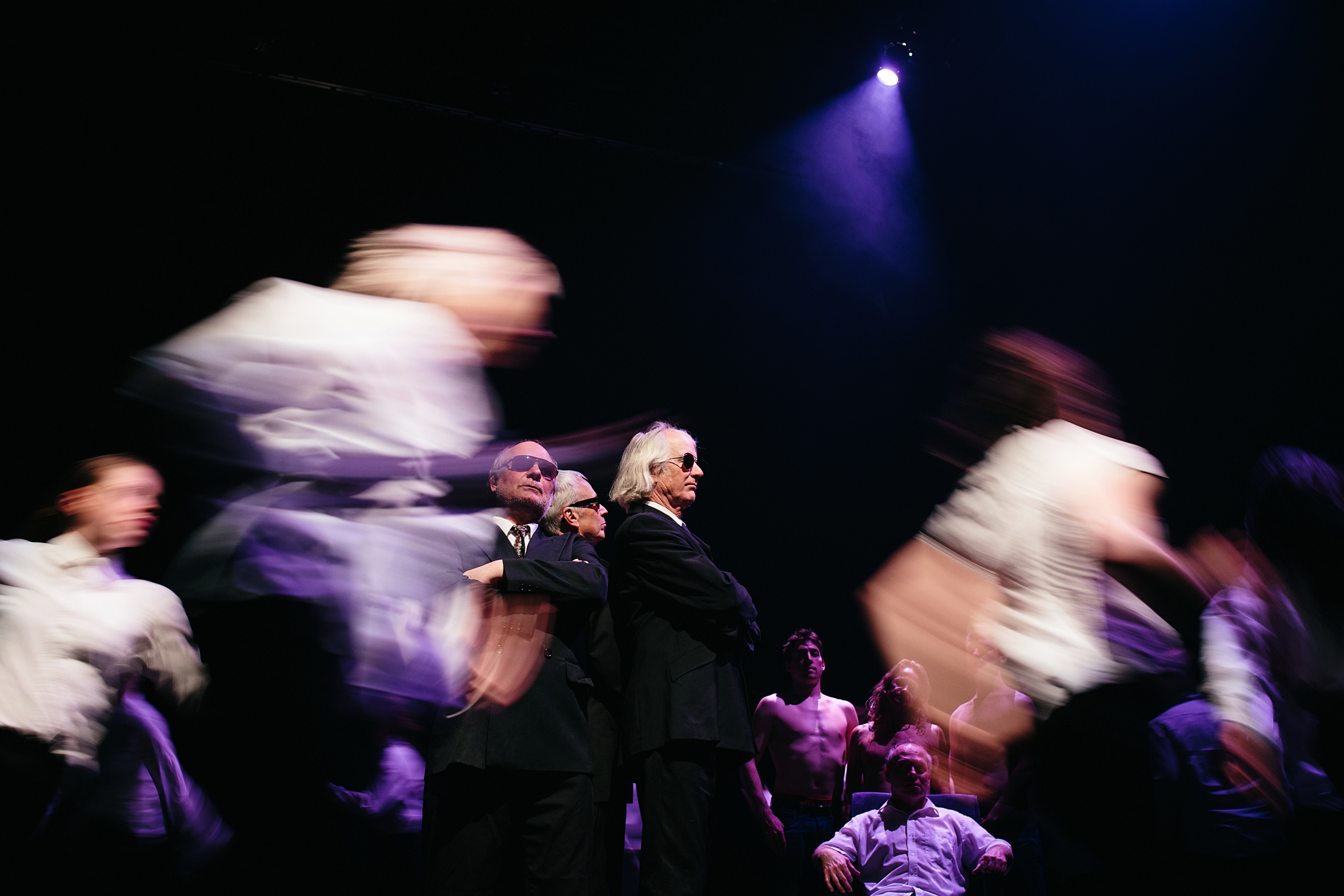
The Authorities (Doug MacLean, Kirk Miles, Bradley Struble) watch carefully over Denise Clarke’s beautifulyoungartists. Photo credit: Diane + Mike Photography.

Created and directed by Denise Clarke, Radioheaded 3: A Listening Party to Watch stages a vivid, politically charged interpretation of Radiohead’s 2003 album Hail to The Thief.

In its first few minutes, the show makes clear who its opponents are. Its opponents are the Authorities (Doug MacLean, Kirk Miles, Bradley Struble) – a trio of “capitalist assholes” in suits. Before he takes his seat, the group’s leader calls the audience a bunch of hippies “who probably voted for the NDP.” Yes, the three men are not far removed from the current political landscape.

A mad frenzy ensues as Clarke’s beautifulyoungartists enter the theatre. Almost immediately, the artists rush the audience in an effort to sell Happiness. “I need to fill my quota,” says one of the desperate artists in her sales pitch.

Corporate greed, social injustices, they are all fuel for rebellion, but no such uprising takes place here. Worked to the bone, the artists have no energy to revolt. Control and routine have subdued their anger, a fact the Authorities cherish.

Although, one man (Thomas Poulsen) holds out hope that change is possible. Trying to revive their spirits, he asks the artists not to give up and give in to the powers at hand. His efforts, however, are in vain. The one artist who rises up (Pamela Tzeng) is swiftly hammered down.

As the full album plays, the lyrics to every song are typed out on a large projection screen. Designed by Wil Knoll, the projected transcriptions feature typos, corrections, and other imperfections which complement the production’s overall raw qualities.

Though raw, the production never feels too loose, or out of control. Clarke’s beautifulyoungartists are a tight ensemble who demonstrate fearless commitment to the movement. (At one point, Poulsen’s bed spins wildly in circles centre stage with Tzeng hanging on one of its sides).

Where the production is weak is in its neon/glow-in-the-dark effects. The tape used to illuminate/outline the artists and props during one particular scene works only for a few, leaving some artists in the dark entirely. (Think of a series of bulbs where a handful are burnt out). So, while the idea is interesting, its execution leaves something to be desired.

Nonetheless, Radioheaded 3 is a visually exciting show that explores Hail to The Thief’s dread towards the future. Clarke holds a mirror to the audience and asks us to reflect on the conditions that make young people today feel so apprehensive about their futures.

Clarke’s Radioheaded 3 holds a tight grip on its audience from start-to-finish with its inspired movement that calls for action.


Produced by One Yellow Rabbit as part of Sled Island 2015, Denise Clarke’s Radioheaded Three: A Listening Party to Watch runs June 24 – 27 at the Big Secret Theatre (Arts Commons).

For more information about the show, visit: http://oyr.org/