Be…In Outer Space: Next Folding Theatre Company’s Fred Nebula is Purely New Brunswick

Fred Nebula is the latest production from Next Folding Theatre Company, and it’s really something different. The play is set in the vastness of outer space, and yet the characters are purely New Brunswick. It’s New Brunswickers…in space! With aliens, robots, and space cougars.

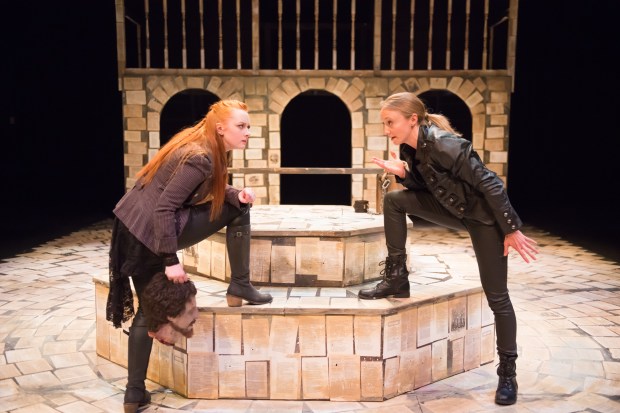
Presented inside St. Thomas University’s Black Box Theatre, Fred Nebula is a collaborative effort by eight writers, seven of whom also perform on stage. The episodic play, directed by Ryan Griffith, stages life on board a spaceship where the crew are beginning to miss home. Turns out that the novelty of space travel gets old after enough time away from friends and family. And so, the crew try to get along with each other because, well, who else are they going to spend time with?

The play’s opening scene sums up Fred Nebula very well. In it, members of the crew are seated around the table listening to Steve (Madeline Whalen / Rebekah Chassé) share a ghost story. Even in the far future people are not only still afraid of ghosts, but they also still like to tell stories.

Where Fred Nebula succeeds is the humanity at the core of its science fiction setting. Characters like Gabby (Kira Smith / Tilly Jackson) are grounded by common troubles. She is secretly in love with Eric (Corenski Nowlan) and wishes she had the courage to tell him. (Also, Eric is a robot). And then there’s the whole issue of eating the same meal day after day. Gabby doesn’t care if the crew’s meals follow Canada’s Food Guide, no one should have to eat the same meal over two hundred times.

Science fiction is no stranger to social commentary, look at Star Trek or episodes from The Outer Limits. Here, the prejudice is against citizens from Aia’s conflict-ridden home planet. When some of the crew members learn that Aia is from that planet, they suddenly start to see her differently and wonder if she’s just like “them” or an exception. What gives the scene impact is when Steve and Aia, away from the other crew, start to talk about their families. There’s a realization by Steve that they share a lot in common, leading the character to stand up for Aia when she’s not around.

Again, the strength of Fred Nebula is its focus on the human even in extraordinary circumstances. The main theme here is some things never change. Like peoples’ desire to belong or to feel respected, as one crew member shares during a team building exercise. The emphasis on community and ideas about belonging makes us think about where and who we are now, and the direction we are headed in. There’s a lot being said not only about communities in New Brunswick, but also life on our Pale Blue Dot. 

That doesn’t mean that Fred Nebula isn’t also delightfully weird. At one point, a character talks about adding a third samosa stand at the Farmer’s Market; the next there’s a dangerous space anomaly that threatens the crew. There’s even a fresh and hilarious take on the enduring New Brunswick cougar myth – a great scene by Whalen and Melissa McMichael who plays the Captain. So, there’s a refreshing mix of serious commentary and oddball humour.

Alien interference causes the human crew members to have new bodies when the play resumes in the second act, hence the dual credits for certain characters. The crew members, now being played by a different set of actors, are totally not okay with the changes. It’s a fun and clever way of fitting all 19 actors on stage.

Unfortunately, Fred Nebula‘s second act feels less cohesive and engaging than its first. The love triangle that emerges is an interesting development, but potential sabotage by one of the crew members? Oddly placed near the end of the play, so it feels inconsequential. Which really sticks out in a play that runs long at 2h 15min (excluding a 15-minute intermission). It’s too bad since the character dynamics from the first act are worthy of revisiting. 

The production embraces the vibe of a low-budget space opera, almost ideal for the type of stories staged here. Holmes-Lauder’s atmospheric light and sound design produces a feeling of travelling the stars. The cast’s acapella performances during scene transitions give the feeling of an intense serialized sci-fi drama (think Captain Kirk vs. Gorn). The spaceship, prop and set design by Samuel Crowell, feels as though this vessel has seen better, more vibrant days – like a certain province. Costume Designer Katherine Hall (who plays Sam, along with Telina Debly) delivers a great cheesy robot costume for Nowlan. It’s simple black clothing with thin material glued on to give the appearance of a metal body. The crew’s outfits are kept simple, as well, with plain casual clothing, which helps accentuate the more sci-fi elements of the production.

Fred Nebula is a space adventure that manages to be both fun and relevant to our current stardate.


Next Folding Theatre Company’s Fred Nebula runs March 2 – 4 at the Black Box Theatre.

Cast & Writing Team

Amelia Hay…Writer/Aia
Tilly Jackson…Writer/Gabby
Lee Thomas…Writer/Communications
Elizabeth Goodyear…Writer/Garrett
Neomi Iancu Haliva…Writer/Advisor Lexus
Madeline Whalen…Writer/Pilot
Kira Smith…Writer/Gunner
Alex Rioux…Writer
Jenn Flewelling…Ambassador Kardoso
Heather Stuckless…Overseer Jutuun
Rebekah Chassé…Steve
Telina Debly…Sam
Corenski Nowlan…Eric
Arianna Martinez…Jean
Robbie Lynn…Louis
Katherine Hall…Security
Melissa McMichael…Credits Music Composition/Captain
Michael Holmes-Lauder…The Second One

Theatre of Consequence Makes Its Debut with Wagner’s The Monument

The Monument Press Shots-The Monument Press Shots-0006.jpg

Theatre of Consequence presents Colleen Wagner’s The Monument at the Motel Theatre, June 15 – 18. Pictured: Jonathan Molinski (Stetko) and Karen Johnson-Diamond (Mejra). Imaged provided by Theatre of Consequence.

Winner of the 1996 Governor General’s Literary Award for Drama, Colleen Wagner’s The Monument is a dramatic play about the nature of war, conflict, and justice. Although set in an unnamed country during an unspecified time, the distinctly Eastern European flavour of Wagner’s drama bears many similarities to the Bosnian Conflict (1992-95). What makes Wagner’s dramatic work so powerful, however, is its relevance today in Canada.

Presented by Theatre of Consequence at the Motel Theatre, The Monument tells the story of a soldier named Stetko (Jonathan Molinski), a young man set to be executed for his heinous crimes. Stetko is guilty of raping and murdering 23 women, all of whom he buried in a forest. While awaiting his execution, Stetko is offered reprieve by a local woman named Mejra (Karen Johnson-Diamond) who demands he obey her unconditionally for the rest of his life, otherwise he can die in prison. Stetko accepts Mejra’s offer, despite not knowing what her intentions are, and goes to live her.

Director Conrad Belau has added a third character, played by Caitlyn O’Connor, to Wagner’s two-person drama. The Girl is neither seen or directly addressed by the characters. She is an unseen, but unshakeable presence in the show. In one scene, O’Connor plays a large rock that Mejra wants dug up from the garden; in another, she is the pet rabbit that Steko comes to care for above himself. She comes and goes like a painful memory from the past.

For Wagner, war is not so black and white like a game of Chess. There are opposing sides, yes, but the pawns thrown into battle are everyday people. Stetko tells us that if he had disobeyed orders to join the army, he would have been labelled a sympathizer, and likely killed as a result. Stetko’s obedience to authority is what has kept him alive, but has also pushed him to commit unspeakable crimes, condemning him for life as a war criminal. And while he recognizes that he is a criminal, Steko also believes himself to be a victim of war. Before the war, he lived a normal life with his family and girlfriend, both of whom he loved, but then all that changed when he was drafted. 

Mejra has no sympathy for Stetko. In fact, she has no respect for him as a human being, going so far as to cutting off his ear and viciously beating him (fight choreography by John Knight). Knowing full well that the world will forget what happened in her country, Mejra seeks out justice for herself and her daughter, one of Stetko’s victims.

What is justice, though? There is justice as defined by the legal system, and then there’s justice as defined by the court of public opinion. The Jian Gohemshi trial showed us that these definitions of justice can arise simultaneously, but that they cannot co-exist without issue. Mejra sees justice for the murdered women as Stetko not only confessing to his crimes, but also helping her make sure that none of the murdered women are forgotten. She makes him dig up all the bodies that he buried in the forest and help build a monument in memory of the 23 murdered women.

Here, the monument is a patchwork of dresses that rises above the dirt where they were buried. The image immediately brings to mind The REDress Project, created by Jamie Black. The monument is Mejra’s answer to the indifference of global politics and systemic oppression that marginalizes violence against women. It is all that Mejra feels she can do as an average citizen.

For Mejra, this is only symbolic justice. She nearly murders Stetko before realizing that violence is not the answer. Stetko proposes forgiveness, that maybe he and Mejra can live together since neither one of them has anyone else. Wagner leaves the future uncertain.

Belau displays a strong understanding of Wagner’s play and its universality, regardless of its parallels to the Bosnian Conflict. It is clear that Belau knew exactly what he wanted this production to achieve and say about violence against women, and that sort of confidence is key to such an impactful and challenging text. The end result is, a thoughtful, well-staged production grounded in today’s headlines.

Molinski and O’Connor are two actors that really ought to be on everyone’s radar. The actors share this very disturbing scene where Molinski recalls in painstaking detail the final moments of his most memorable victim, played by O’Connor (with her hands tied by rope, suspended in the air). Molinski unleashes something very dark in the character as he tells Mejra, with sinister glee, everything about that night. O’Connor’s heartbreaking terror and helplessness makes us want to retreat away from this emotionally charged scene. It is a truly fearless and mature performance from both Molinski and O’Connor.

Johnson-Diamond ventures into vast emotional territory as a sorrow-stricken mother whose moral compass is confused after meeting Stetko. Her vengeance is motivated by immense hurt, and not so much a thirst for blood, which is important given the character’s arc. It is a steady performance punctuated by moments of sheer brutality that Johnson-Diamond plays very well.

Theatre of Consequence’s debut production is a must-see.


Theatre of Consequence’s production of Colleen Wagner’s The Monument runs June 15-18  at the Motel Theatre (Arts Commons).

For more information about Theatre of Consequence, including how to purchase tickets, visit their Facebook page: https://www.facebook.com/theatreofconsequence/?fref=ts


Mudfoot Theatre Peers Over The Horizon in River: A Puppet Myth

IMG_7601.jpg

Genevieve Pare in Mudfoot Theatre’s River: A Puppet Myth, June 7-11 at the Joyce Dolittle Theatre. Photo Credit: Chantal Wall.

One day, perhaps sooner than later, the taps will shut off. Water will become a scarce commodity, if it isn’t already. In the future, sources of water like the Bow River will be relegated to the realm of myth.

Enjoying its world premiere at the Joyce Dolittle Theatre, River: A Puppet Myth is the latest from Mudfoot Theatre. The play, written by Co-Artistic Directors Ian McFarlane and Geneviève Paré, stages three explorers on a journey to find the Bow River. Stories of the Bow River, passed down through the generations, help guide the explorers on their journey, with an ancient scroll (coloured with pictographs) acting as a map of sorts.

With no signs of the river anywhere, Dha (Ali DeRegt) has doubts that the river still exists. Une (McFarlane) has faith that the river still flows, thinking that maybe the group hasn’t grasped the full meaning of the stories. Meanwhile, Ba (Paré) finds herself communicating with a grizzly bear named Griz (Erinn Watson), who gifts her different objects, at night. Her relationship with Griz is a kind of reconciliation with nature.

What created this post-apocalyptic world was the Hunger, a destructive force that devastated the planet. In one story, the audiences learns that Bison were once plentiful until the Hunger caused them to be overhunted. Man’s relationship with the bison, who he relied on for many things like warmth, was healthy until greed took over. Presumably, the Hunger caused humanity to exhaust the planet’s resources without taking into account long-term consequences, leading to irreversible climate change, hence the search for the Bow River.

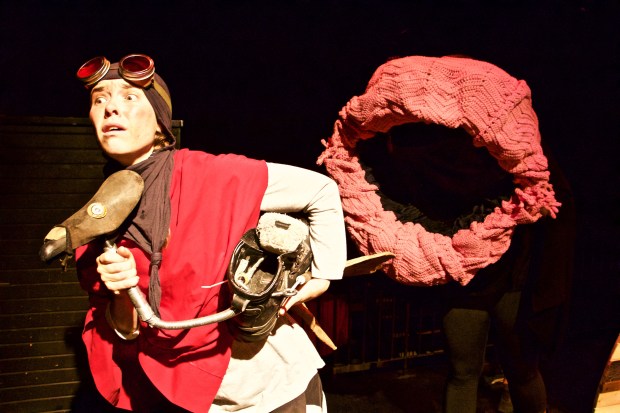
Appropriately, given the show’s environmentalist concerns, Mudfoot Theatre has constructed all its puppets from discarded materials. The large bison is made from a burlap sack, and the magpie has a bicycle seat for a head and large boot for a body. Other materials like a tin can (bent to create a ‘head’, dressed with hair and big eyes) are used for simpler puppets.

What’s really funky is this whole communication contraption that has McFarlane cranking a bike pedal by hand for power, Paré spinning a roof turbine adjusted to her helmet to receive incoming messages, and DeRegt tapping a makeshift morse code machine. It’s quite a sight when the group activates this wacky apparatus in the wasteland.

This act of staging ‘junk’ is a potent display of human carelessness and indifference to environmental issues. What a thing to have people confront (again) discarded objects, some of which may survive long after humans are gone. The productive use of discarded materials not only drives home not only how much people waste, but what can be achieved through recycling. One could interpret this act of staging ‘junk’ as a political statement under the guise of quirky, ‘harmless puppetry.

So, it’s too bad that the story fails to deliver the same impact.

Mudfoot Theatre’s ingenuity and effort in finding the local in a global issue are worthy of much praise, but the script is often incoherent. Somewhere here, there’s a message that our current habits are endangering the Earth, otherwise there wouldn’t be so many ‘junk’ on stage. The argument is that humanity needs to re-discover and re-establish its relationship with nature, or else face disaster. Unfortunately, the verbose, metaphor-laden language does little to support this argument as it produces more head scratching than nodding heads. Likewise, the in-world references are never fully explained, so the audience is alienated from knowledge useful to access this imagined future. Thankfully, the script doesn’t bang us on the head like other environmentalist fiction (see: Jetsons: The Movie), but some direction would be helpful to grasp its full intentions.

Ba cryptically processing memories from people and animals of the past who enjoyed (and experienced the destruction) of the Bow River would be interesting to see explored further. There is something both unsettling and intriguing about a future where the pain of the past still has roots in the ground.

Director Lindsey Zess-Funk really knows how to create some astounding visual moments. Something so simple as Griz walking through the explorers’ camp (set design by Lane Shordee) is given emotional weight through good pacing and movement with purpose. Zess-Funk displays a good understanding that these puppets are not just puppets, but creatures connected to a larger story and who play an important part in that bigger picture. The same can be said for these puppeteers, including Emily Schoen who maneuvers Bertha’s large eye in the mountainside. There is a physical language flowing in this show that captures the play’s essence.

Although highly creative and unique, Mudfoot Theatre’s River: A Puppet Myth is a lengthy, jumbled exploration of what lies on the horizon.


Mudfoot Theatre’s River: A Puppet Myth runs June 7 – 11 at the Joyce Dolittle Theatre (The Pumphouse Theatre).

For information about the show, including how to purchase tickets, visit: http://www.mudfoottheatre.com/projects.html

2016 Calgary Theatre Critics’ Awards: A Celebration of Community

13048040_10100424624467167_4827026003664407590_o

The 2016 Calgary Theatre Critics’ Awards were hosted by Dave Kelly at Commonwealth Bar & Stage on June 6th. Nominees were chosen from any production performed in Calgary from June 2015 to May 2016, with the exception of Broadway Across Canada performances.

The 2016 Calgary Theatre Critics’ Awards was an evening full of anticipation and gratitude. The fifth annual event, hosted by Dave Kelly, was held at Commonwealth Bar & Stage where local theatre critics Stephen Hunt, Louis B. Hobson, Rodrigo Flores, and Jenna Shummoogum presented awards in 19 categories. Accepting the awards were both new and familiar faces from Calgary’s theatre community who took time to thank family, friends, and colleagues for their support.

Guests stayed afterwards to mingle and congratulate each other on another strong year of theatre in Calgary. 
____________________

Best Supporting Actress in a Musical

Louise Pitre – The Little Prince: The Musical – Theatre Calgary

Best Supporting Actor in a Musical

Tenaj Williams – The Paper Bag Princess: A Musical – StoryBook Theatre and Forte
Musical Theatre Guild

Best Supporting Actress in a Play

Amy Burks – Romeo and Juliet – The Shakespeare Company and Hit & Myth Productions

Best Supporting Actor in a Play

Karl Sine – The Boy’s Own Jedi Handbook – Ground Zero Theatre and Hit & Myth Productions

Best Touring Show

Flora & Fawna’s Field Trip! – Lunchbox Theatre, Darrin Hagen and Trevor Schmidt

Best Set Design

Cameron Porteous – The Crucible – Theatre Calgary

Best Technical Design

Jamie Nesbitt – Calamity Town – Vertigo Theatre

Best Creative Concept

The Fight or Flight Response – Verb Theatre

Best Actress in a Musical

Susan Gilmour – The Light in the Piazza – Theatre Calgary

Best Actor in a Musical

Ahad Mir – Naughty but Nice! – Forte Musical Theatre Guild

Best Solo Performance

Jamie Konchak – The Floating Mouse – Green Fools Theatre

Best New Script

Calamity Town – Joseph Goodrich – Vertigo Theatre

Best Actor in a Play

Tyrell Crews – Benefit – Downstage

Best Actress in a Play

Heather Pattengale – Outside Mullingar – Rosebud Theatre

Best Director of a Musical

Michael Shamata – The Light in the Piazza – Theatre Calgary

Best Production of a Musical

The Light in the Piazza – Theatre Calgary

Best Director of a Play

Craig Hall – Sherlock Holmes and The Case of the Jersey Lily – Vertigo Theatre

Best Ensemble

Book Club – Lunchbox Theatre

Best Production of a Play

The Crucible – Theatre Calgary

The Evans Award

StoryBook Theatre

  • The Evans Award recognizes outstanding contribution to the vibrancy of the theatre community in Calgary.

Nominees were chosen from any production performed in Calgary from June 2015 to May 2016, with the exception of Broadway Across Canada performances.

2016 Calgary Theatre Critics’ Awards: Nominees Announced

13048040_10100424624467167_4827026003664407590_o

The 2016 Calgary Theatre Critics’ Awards will be held on June 6th at Commonwealth Bar & Stage (731 10th Ave SW). The public awards ceremony starts at 8:00PM.

Calgary Theatre Critics, Stephen Hunt formerly of the Calgary Herald, Louis B. Hobson of Postmedia, Rodrigo Flores of Joyful Magpies and Jenna Shummoogum of Downtown Calgary Association are pleased to announce the nominees for the fifth annual Calgary Theatre Critics’ Awards.

Nominees were chosen from any production performed in Calgary between June 2015 and May 2016, with the exception of Broadway Across Canada performances. The winners will be announced at a free public awards ceremony. The ceremony starts at 8pm on June 6th at Commonwealth Bar & Stage, 731 10th Avenue SW.

Best Supporting Actress in a Musical

Jayne Lewis – Young Frankenstein – Stage West
Laura Gillespie – The Wizard of Oz – Rosebud Theatre
Louise Pitre – The Little Prince: The Musical – Theatre Calgary
Tracy Michailidis – The Light in the Piazza – Theatre Calgary
Dana Jean Phoenix – The Wedding Singer – Stage West

Best Supporting Actor in a Musical

Tenaj Williams – The Paper Bag Princess: A Musical – StoryBook Theatre and Forte Musical Theatre Guild
Andrew McGillivray – The Wedding Singer – Stage West
Andrew Legg – The Wizard of Oz – Rosebud Theatre
David Keeley – The Light in the Piazza – Theatre Calgary
Michael Torontow – The Light in the Piazza – Theatre Calgary

Best Supporting Actress in a Play

Amy Burks – Romeo and Juliet – The Shakespeare Company and Hit & Myth Productions
Sasha Barry – Of Mice and Men – Spirit Fire Theatre
Julie Orton – Goodnight Desdemona (Good Morning Juliet) – The Shakespeare Company, Handsome Alice and Hit & Myth Productions
Conni Mah – Ching Chong Chinaman – Iglesia Productions
Brianna Johnston – The Money Shot – Ground Zero Theatre and Hit & Myth Productions

Best Supporting Actor in a Play

Ryan Luhning – Romeo and Juliet – The Shakespeare Company and Hit & Myth Productions
David LeReaney – Of Mice and Men – Spirit Fire Theatre
Karl Sine – The Boy’s Own Jedi Handbook – Ground Zero Theatre and Hit & Myth Productions
Stafford Perry – In On it – Lunchbox Theatre
Joe Perry – The Circle – Alberta Theatre Projects

Best Touring Show

Life, Death and The Blues – One Yellow Rabbit & Alberta Theatre Projects
A Theatre Passe Muraille Production, in association with Hope And Hell Theatre Co.
evalyn parry’s SPIN – One Yellow Rabbit & Theatre Calgary
Flora & Fawna’s Field Trip! – Lunchbox Theatre, Darrin Hagen and Trevor Schmidt
Jack Charles V. The Crown – ILBIJERRI Theatre, Toured by Performing Lines and the High Performance Rodeo
Who Killed Spalding Gray? – One Yellow Rabbit and reWork Productions

Best Set Design

Scott Reid – The Turn of the Screw – Vertigo Theatre
Jennifer Behie-Ratzlaff – Shadowlands – Fire Exit Theatre and Hit & Myth Productions
Cameron Porteous – The Crucible – Theatre Calgary
Jennifer Arsenault – Goodnight Desdemona (Good Morning Juliet) – The Shakespeare Company, Handsome Alice Theatre and Hit & Myth Productions
Julia Wasilewski – Matt & Ben – Theatre Transit

Best Technical Design

Jamie Nesbitt – Calamity Town – Vertigo Theatre
Sean Nieuwenhuis – The Little Prince: The Musical – Theatre Calgary
Benjamin Toner, Lisa Floyd and Aidan Lytton – The Only Good Boy – Theatre BSMT
JP Thibodeau – The Boy’s Own Jedi Handbook – Ground Zero Theatre and Hit & Myth Productions
Matthew Waddell – Window – Ghost River Theatre & the University of Calgary’s School of Creative and Performing Arts

Best Creative Concept

What Happened to the Seeker – Theatre Junction
Berlin Waltz – Devon More – The Calgary Fringe Festival
The Fight or Flight Response – Verb Theatre
Concord Floral – Theatre Junction
Taste – Ghost River Theatre, Vertical City Performance and the River Cafe

Best Actress in a Musical

Anwyn Musico – The Light in the Piazza – Theatre Calgary
Susan Gilmour – The Light in the Piazza – Theatre Calgary
Jamie Matchullis – What Gives? – Lunchbox Theatre
Cassia Schramm – The Wizard of Oz – Rosebud Theatre
Elicia MacKenzie – The Wedding Singer – Stage West

Best Actor in a Musical

Louie Rossetti – The Light in the Piazza – Theatre Calgary
Aidan Desalaiz – The Wedding Singer – Stage West
Adam Brazier – The Little Prince: The Musical – Theatre Calgary
Ahad Mir – Naughty but Nice! – Forte Musical Theatre Guild
Scott Olynek – Naughty But Nice – Forte Musical Theatre Guild

Best Solo Performance

Elinor Holt – Shakespeare’s Will – Sage Theatre
Trevor Campbell – Baggage – The Calgary Fringe Festival
Jamie Konchak – The Floating Mouse – Green Fools Theatre
Cheri Maracle – Paddle Song – Lunchbox Theatre
Cliff Cardinal – Huff – High Performance Rodeo

Best New Script

Book Club – Meredith Taylor-Parry – Lunchbox Theatre
Calamity Town – Joseph Goodrich – Vertigo Theatre
Mercutio & Tybalt – Val Duncan and Celene Harder – The Calgary Fringe Festival
Benefit – Matthew MacKenzie – Downstage
The Circle – Geoffrey Simon Brown – Alberta Theatre Projects

Best Actor in a Play

Joel Cochrane – Shadowlands – Fire Exit Theatre and Hit & Myth Productions
Tyrell Crews – Benefit – Downstage
Chris Austman – Of Mice and Men – Spirit Fire Theatre
Nathan Pronyshyn – The Fight or Flight Response – Verb Theatre
Paul F. Muir – Outside Mullingar – Rosebud Theatre

Best Actress in a Play

Allison Lynch – Romeo and Juliet – The Shakespeare Company and Hit & Myth Productions
Anna Cummer – Macbeth – Vertigo Theatre, The Shakespeare Company and Hit & Myth Productions
Chantelle Han – Medea – Chromatic Theatre
Heather Pattengale – Outside Mullingar – Rosebud Theatre
Lois Anderson – Vanya and Sonia and Masha and Spike – Alberta Theatre Projects

Best Director of a Musical

Michael Shamata – The Light in the Piazza – Theatre Calgary
Valerie Ann Pearson – The Paper Bag Princess: A Musical – StoryBook Theatre and Forte Musical Theatre Guild
Morris Ertman – The Wizard of Oz – Rosebud Theatre
Dennis Garnhum – The Little Prince: The Musical – Theatre Calgary
Tim French – The Wedding Singer – Stage West

Best Production of a Musical

The Wedding Singer – Stage West
The Paper Bag Princess: A Musical – StoryBook Theatre and Forte Musical Theatre Guild
The Wizard of Oz – Rosebud Theatre
The Little Prince: The Musical – Theatre Calgary
The Light in the Piazza – Theatre Calgary

Best Director of a Play

R.H. Thomson – The Crucible – Theatre Calgary
Paul Welch – Of Mice and Men – Spirit Fire Theatre
Craig Hall – Sherlock Holmes and the Case of the Jersey Lily – Vertigo Theatre
Morris Ertman – Outside Mullingar – Rosebud Theatre
Kelly Reay – The Fight or Flight Response – Verb Theatre

Best Ensemble

Goodnight Desdemona (Good Morning Juliet) – The Shakespeare Company, Handsome Alice Theatre and Hit & Myth Productions
Calamity Town – Vertigo Theatre
King Kirby – Sage Theatre
Book Club – Lunchbox Theatre
The Mousetrap – Vertigo Theatre

Best Production of a Play

The Crucible – Theatre Calgary
Of Mice and Men – Spirit Fire Theatre
Outside Mullingar – Rosebud Theatre
Sherlock Holmes and the Case of the Jersey Lily – Vertigo Theatre
Romeo and Juliet – The Shakespeare Company, Hit & Myth Productions

In addition, the critics will be handing out the Evans Award, a special award recognizing outstanding contribution to the vibrancy of the theatre community in Calgary. The award recipient will be revealed on the night of the event. 


To attend the Calgary Critics’ Awards please RSVP to critterawards2016@gmail.com as soon as possible as there are a limited number of spots available. Doors open at 7pm, the awards will begin at 8pm and the celebration will continue until they kick us all out.

The Only Good Boy Scrapes The Surface, Misses The Mark

IMG_0658

Left to Right: Wendy Froberg and David Sklar in Theatre BSMT’s The Only Good Boy by Chelsea Woolley. Photo Credit: Colton Holmes Photography.

Enjoying its world premiere at Theatre BSMT, Chelsea Woolley’s The Only Good Boy stages a tense reunion between 23-year-old Jacob Stevenson (David Sklar) and 43-year-old Monica Winters (Wendy Froberg). After finding her online on a dating website, Jacob invites Monica, a former school teacher, over for supper at his place. Jacob’s place, Monica notices, is very dirty as he’s in the middle of moving to Florida, so he says anyway. Monica ignores it, turning the discussion towards her outfit, then Jacob’s family. Years of hurt and regret surface as the two catch up.

Jacob tries and tries and tries to push Monica to recognize the trauma he has been burdened with for 10 years. He wants Monica to acknowledge that what happened between them was real and it ruined his life, but she dodges any mention of the past, running away from the truth she knows deep down inside. There is no major confrontation. Jacob and Monica call it a night, leaving Jacob painfully unsatisfied and Monica distressed.

Within the play’s first fifteen minutes or so, the nature of the traumatic experience that ties Jacob and Monica together reveals itself through subtle clues in the dialogue. The truth landing with a big thud soon after. Woolley’s handling of the subject matter is less than elegant. What is the playwright’s intention? Is it to shock? If it is, Woolley certainly succeeds in that with Monica’s three (uncomfortable) monologues that act as a window into her damaged psyche. Beyond that, however, what is the audience supposed to take away from this dramatic meeting between victim and perpetrator?

The characters operate independently from each other, trapped in their own minds. Jacob and Monica’s meeting almost seems like an excuse just for these characters to talk at us; to drop ideas and themes. Yes, the play focuses on the varied consequences of abuse and neglect, but that’s only one part of the equation. Dramaturgically, why are these characters meeting each other right now, right here other than to dance around the conflict at hand?

There is a very real and serious issue in Wolley’s drama, winner of the 2016 BSMT Dwellers Playwriting Competition, but unfortunately the playwright scrapes the surface of familiar territory. Not to dwell on what the play could be, but there is a sense that the play might function better as a slow-burn than a drama where all its cards are played prematurely.

All that aside, however, the construction of Woolley’s dialogue is fascinating. The rhythmic quality of Woolley’s dialogue hits home the desired emotional effects. While the play’s structure may be lacking, its dialogue certainly is not with its menace driven by the almost musical repetition of key phrases.

Thankfully, director Kyle Schulte has a sense, too, of the rhythm in Woolley’s dialogue as the show is well-paced.

There is menace, too, in Benjamin Toner’s set that sees Jacob’s living space, its walls lined with dirty moving boxes, collide with a floor full of mulch. Seriously. The entire floor is covered in mulch, which Sklar’s Jacob aggressively digs into over the course of the play, at one point finding old birthday cards from Monica. Sound Designer Aidan Lytton produces real anxiety in these revealing moments. There is a real serial killer vibe – like corpse stuffed inside an oil drum – given off by Toner’s swampy set, and Lisa Floyd’s brooding light work.

That’s also perhaps because Sklar delivers an unsettling performance as Jacob, switching back and forth between friendly and unhinged on the fly. Although, the unhinged side to Jacob is always present in the actor’s performance, but uncomfortably restrained. A strong performance. Froberg, too, finds these moments where she walks a fine line between Monica’s facade (an airhead) and her real self. She digs into a dark place for her character’s disturbing monologues with great success. Both actors make it difficult to know what exactly to make of their respective characters.

Although not explosive, Woolley’s The Only Good Boy is a worthy new drama of staging. There are elements that fall short, certainly, but then there are elements that really, really work. And Theatre BSMT demonstrate that they are the right company to stage the premiere of this play with their strong, articulate production.


Theatre BSMT’s The Only Good Boy by Chelsea Woolley runs May 17 – 21 at the Motel Theatre.

For more information about the show, including how to purchase tickets, visit: http://www.theatrebsmt.ca/Theatre_BSMT/Whats_On.html

Goodnight Desdemona (Good Morning Juliet) Roars With Wit and Humour

Goodnight Desdemona 0416 NB1_5424

Left to Right: Allison Lynch (Desdemona) and Julie Orton (Iago) in Anne-Marie MacDonald’s Goodnight Desdemona (Good Morning Juliet),  presented by The Shakespeare Company & Handsome Alice Theatre & Hit & Myth Productions. Photo Credit: Benjamin Laird Arts & Photography.

Co-presented with The Shakespeare Company and Hit & Myth Productions, Handsome Alice Theatre, formerly known as Urban Curvz Theatre, makes its debut with Anne-Marie MacDonald’s 1988 play Goodnight Desdemona (Good Morning Juliet). Winner of the Governor General’s Award for Drama, the Canadian play applies feminist theory to the works of William Shakespeare, namely Othello and Romeo & Juliet, critiquing academia and the patriarchy while doing so.

Directed by Kate Newby, Goodnight Desdemona (Good Morning Juliet) tells the story of Constance Ledbelly (Ayla Stephen), a doctoral student who believes Othello and Romeo & Juliet were originally intended as comedies. Her theory is based on the Gustav manuscript, a mysterious document that Constance has yet to decipher. Constance’s dissertation is ridiculed by Professor Claude Night (Mabelle Carvajal), whom she has a crush on. Professor Night’s news that he has accepted a position at Oxford University, the very same Constance was hoping to land, devastates the lowly academic. Heartbroken, Constance loses all hope for both her romantic and academic aspirations, deciding right there and then that she will die alone, forgotten by Professor Night.

From here, the play plunges straight down a rabbit hole, dropping Constance first into Othello then Romeo & Juliet. Our hapless heroine embarks on a quest through her subconscious to find her identity, meeting the characters of Shakespeare’s plays along the way. Constance’s presence, however, changes the plays from tragedies to comedies, fulfilling her theory, albeit with unintended results as she becomes too involved in the plots.

What stands out most in MacDonald’s subversive play is the influence of the male gaze on Shakespeare’s female characters. For one, Constance refers to characters by what male academics have written about them, which creates some dissonance when she actually meets them. And then, there’s Shakespeare himself who sees Desdemona (Allison Lynch) as a possession for Othello who has her life in his hands, not unlike Professor Night with Constance. Juliet (Geneviève Paré) is prepared to die for Romeo (Julie Orton), her self-worth tied to romantic love with a man, again not unlike Constance and her love for Professor Night.

And so, Constance’s journey of self-discovery is about reclaiming her identity from patriarchal subjugation.

MacDonald’s play is very funny, there’s no doubt about that, but it’s also very smart. The text is rich in commentary about sexuality, the glass ceiling for female academics, and male-centric interpretations of English literature, all of which the Canadian playwright delivers with a deft hand. Thankfully, the play’s quirky humour is able to breathe through all these layers. Sometimes, comedic plays with big ideas fall flat as they are neither very funny or very insightful, effectively crushed under the weight of their ambition. MacDonald’s play rises to the task of producing smart, entertaining theatre.

Under Newby’s direction, the production is wild and delightfully weird. The director has chosen to stage the play in the 1970s, the era of funk and free love. The production is certainly funky with its collection of disco tunes, like Do The Hustle (Anton de Groot, Light and Sound Designer). The era is appropriate given the gender-bending that occurs with not only the presence of an all-female cast, but also Romeo and Juliet’s cross-dressing to win Constance’s favour; liberation from the status quo.

Julie Arsenault’s set is simple, yet effective. A two-tiered structure sits in the middle with two trap doors on its top. There is a balcony at the back of the theatre. At first glance, the floor – and the balcony wall – has normal flooring tiles, but then upon closer examination the tiles are actually pages of text from Shakespeare’s plays! Arsenault’s detail really establishes the Shakespeare wonderland Constance finds herself in.

In this wacky wonderland, we have an all-star female cast firing on all cylinders. Orton is a genuine scene stealer, and that’s a tough statement given that the comedic talent here is simply astounding. Even Orton’s most miniscule physicalities as the scheming Iago are hilarious. Her knack for physical comedy is no doubt from her years of improv experience. And then there’s Stephen who plays the Constance as if she were a cat hoarder days away from appearing on some TLC reality show. It’s an understated performance that fits marvelously with the surrounding absurdity. Lynch channels her inner Xena, warrior princess, for Desdemona, and it’s fantastic. Paré plays the death-obsessed, if not suicidal, Juliet with zest – o happy dagger indeed! Carvajal plays brings plenty of meaty machismo to the male characters of Professor Night, Othello and Tybalt.

Handsome Alice Theatre’s debut production is ferociously funny. Goodnight Desdemona (Good Morning Juliet) is a near-perfect introduction to this company dedicated to unleashing the female voice.


The Shakespeare Company & Handsome Alice Theatre & Hit & Myth Productions present Goodnight Desdemona (Good Morning Juliet) by Anne-Marie MacDonald, May 12 – 21 at Vertigo Theatre’s The Studio.

For more information about the show, including how to purchase tickets, visit: http://www.shakespearecompany.com/current-season/goodnight-desdemona-good-morning-juliet/

Flora & Fawna’s Field Trip! Earns All The Badges

12540626_10156556011740724_1258765859919550983_n

Flora & Fawna’s Field Trip! by Darrin Hagen & Trevor Schmidt runs May 2 – 21 at Lunchbox Theatre. Pictured, left to right: Trevor Schmidt (Fawna) and Darrin Hagen (Flora). Photo Credit: Ian Jackson, EPIC Photography.

Given that I participated in Flora & Fawna’s Field Trip!, I figured I break away from the usual third-person to write about this hilarious, although very emotional comedy playing now at Lunchbox Theatre until the 21st.

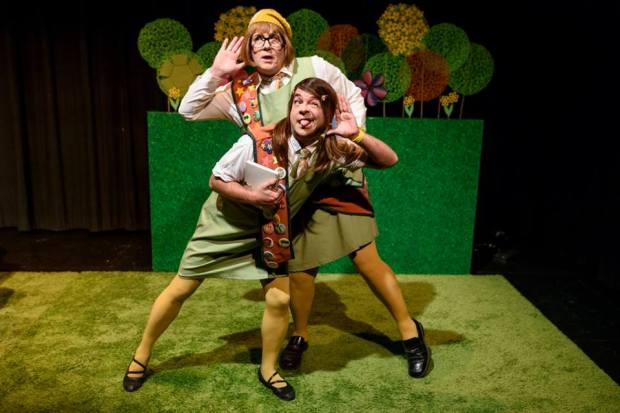
Created by Darrin Hagen & Trevor Schmidt, with Schmidt directing, Flora & Fawna’s Field Trip! is everything I wish my years in Cub Scouts had been. Hagen and Schmidt play two pre-teen girls named Flora and Fawna, respectively. Upset by the mean girls in their Girl Guide’s troop, Flora and Fawna have taken it upon themselves to form their own group called the NaturElles. The NaturElles is an all-inclusive group that welcomes everyone, except mean girls – like “Louise Hobson!” The only other member is Fleurette (Chris Enright), a young Francophone girl.

The audience participates in the NaturElle’s first membership drive, as a group and otherwise. I was pulled from my seat by Fawna to play a trivia game about wilderness survival, where I answered two of three questions correctly. What I learned from the experience is that I’m not very good at choking the chicken – we used rubber chickens as our buzzers.

Before this, Flora and Fawna asked the audience to take the friendships bracelets from the bags handed to them before the show and tie them around each other’s wrist. The circle widened, and it continued widening as the girls’ activities – like learning how to pee in the woods – brought everyone together through laughter, like laughing-so-hard-it-hurts laughter.

The show is a lot of like camp, well it’s more like the version of camp that adults promise you before shipping you off for the weekend. Personally, I hated my time in Cub Scouts, primarily because I was bullied by the other boys. Sure, we were asked to adhere to a set of golden rules, principles, and values, but none of that mattered when the adults weren’t around.

But it’s not just kids who are mean, but also adults. There are revealing moments that suggest that all is not right in Fawna’s home with her mom and step-dad. If you want to talk about risk, let’s talk about how Hagen and Schmidt, after nearly an hour of sexual innuendo and quirky humour, end the story on a very heavy note. There’s a place where fantasy and reality meet, and the two take the story there, on the precipice of adulthood.

And so, the show is about several things, but it’s mainly about the fantasies kids create to escape their problems. The NaturElles is a very real group for Flora and Fawna, because they need it to be.

Lunchbox Theatre has a knack for staging plays that hit something very real deep down inside, and Flora and Fawna’s Field Trip! is no different. Hagen and Schmidt have created a show that speaks to the kids inside all of us, and let’s us escape into a world of play. A must-see.


Darrin Hagen & Trevor Schmidt’s Floral & Fawna’s Field Trip! runs May 2 – 21 at Lunchbox Theatre.

For more information about the show, including how to purchase tickets, visit: http://www.lunchboxtheatre.com/flora-and-fawna/


World Premiere: MacKenzie’s Benefit Explores The Ethics of Charity


Downstage-Benefit-Preview-20

Left to Right: Tyrell Crews, Donna Soares, Barbara Gordon, and Duval Lang in Downstage’s production of Benefit, a play by Matthew MacKenzie. Photo Credit: Mike Tan.

There are over 80,000 registered charities in Canada advocating public support for a number of causes. With so many charities in competition for both public and private funds, how do they separate themselves from the rest? That question is answered in Albertan playwright Matthew MacKenzie’s Benefit, a compelling drama that explores the ethics of charity.

Enjoying its world premiere at Downstage in the Motel Theatre, Mackenzie’s Benefit stages an extravagant gala fundraiser hosted by an Albertan charitable foundation that supports young girls’ education worldwide. The play opens with an auction for rare orchids hosted by Fred MacDonald (Duval Lang), the founder and head of the foundation. His wife Cynthia (Barbara Gordon) joins him in playing up the exotic nature of the orchids. The evening’s true star, however, is Srey Norris (Donna Soares), a young woman from Cambodia who was the foundation’s first beneficiary. Srey works for the foundation now as a spokesperson, delivering speeches to politicians and other potential donors about the foundation’s work. The foundation’s future is threatened when Srey’s husband Greg Norris (Tyrell Crews), an orchidologist, discovers a dark secret from Fred’s past.

MacKenzie’s play highlights the importance of narratives that appeal to the public’s emotions. Fred recounts a time he thought the foundation was beat because someone’s ‘sob story’ about their people being killed for sport was a real doozy. Thankfully, Srey blew everyone else’s stories out of the water by tying each of their stories together and positioning education as the solution to the world’s problems. The cause doesn’t speak for itself, MacKenzie argues, it requires a story developed around it

In trying to outperform other narratives, however, charities risk degrading the people they are trying to help by engaging in poverty porn. Think about the children that UNICEF or World Vision use in their television commercials. The children are rarely shown living in sanitary conditions, instead they shown living in absolute “third-world” squalor. Certainly, the living conditions in certain areas of the world are not ideal, but charitable organizations make sure to show the worst of the worst, firmly establishing these negative images in the public’s mind overtime. If they didn’t, then the public might not think that the situation is dire enough for their support.

And so, using Srey as a spokesperson is a powerful tactic since she is a well-educated and well-spoken immigrant of colour; a new member of the first-world. Her presence proves the foundation’s effectiveness at lifting third-world children from dirt to civilization. Fred sees Srey as a daughter, yes, but he undoubtedly sees her as an important part of the foundation’s own narrative. So, how genuine is their relationship? How genuine is any working relationship between white philanthropists and people of colour recruited to help the cause? We are asked to consider the motives behind the promotion of diversity, especially within predominantly white organizations. Can charitable organizations only go so far without the (white) guilt that foreignness arouses?

MacKenzie’s play offers plenty to consider about the ethics of charity, like the hypocrisy of holding a lavish gala while millions can barely afford to live both domestically and abroad. And it’s all written marvelously with no easy answers, well no answers at all actually. The play presents its issues and leaves the audience, hopefully unsettled by the revelations that unfold, to think about what the greater good really means – how far is too far?

And it’s all impeccably staged by director Simon Mallett with great intimacy inside the 50-seat theatre. Alley staging puts the audience into close quarters with the actors. Deitra Kalyn’s set bleeds extravagance while remaining functional i.e. good sightlines. The beams get in the way occasionally, though, but only briefly. The audience’s seats have been designed to fit the hall’s aesthetics, so the theatre really feels like an extension of the hall itself. The set looks fantastic under Kathryn Smith’s lighting design.

Soares and Crews truly challenge each other as their characters grapple with the truth behind Fred’s past. Soares lights up the stage, with Crews responding beat for beat. Lang plays the wealthy philanthropist with gusto, adding in a nice touch of older relative who says racially insensitive things at the dinner table. Gordon is much more stiff upper crust, moving with poise across the stage, but she’s not so innocent. Lang and Gordon play very privileged white folk who are unaware of their privilege, and it’s equally delightful and aggravating. The veteran actors are a wonderful pairing, like wine and cheese.

Brilliantly written, MacKenzie’s Benefit is socially relevant theatre at its finest. A must-see.


Downstage’s Benefit runs April 13 – 30 at the Motel Theatre (Arts Commons).

For more information about the show, including how to purchase tickets, visit: http://www.downstage.ca/benefit.shtml


Tannahill’s Concord Floral Flourishes at Theatre Junction

ConcordFloral_Group_MichaelTrudeauPhotography-11.jpg

Theatre Junction presents Jordan Tannahill’s Concord Floral, April 13 – 16 at Theatre Junction GRAND. Photo Credit: Michael Trudeau.

Everyone’s asking, what are the kids saying these days? It’s not a new question, no. Teenagers have always puzzled parents, teachers – and themselves. Canadian playwright Jordan Tannahill is not only interested in what youth are saying, but what they’re doing when adults are totally absent.

Where do your children go at night?

Presented by Theatre Junction, Tannahill’s Concord Floral stages the complex lives of Calgary youth trying to outrun a plague. The supernatural terror starts when Nearly Wild (Michaela Friedland) and Rosa Mondy (Breanna Kennedy) discover classmate Bobbie James’ body (Kloee Huberdeau) at Concord Floral, an abandoned greenhouse where all the kids go to party and, in this case, smoke weed. Frightened, Rosa drops her iPhone into the body by accident, leaving it there along with the corpse. The two girls try to forget all about the body, but one night the lost phone makes a call from beyond the grave.

Tannahill’s play is not just about the ghost itself, but the haunting. What is it that haunts us today, asks Tannahill? What haunts us are tragic cases of bullying, the loss of innocent youth like Rehtaeh Parsons and Amanda Todd.  The plague may be metaphorical, but it’s still very real. None of the youth can sleep or function properly with the guilt of inaction and apathy weighing heavy on their conscious. Bystanders are not powerless nor are they removed from any responsibility, Tannahill argues.

Across the play’s ten chapters, there are vignettes that stage stories from the various neighborhood youth. One of the stories sees a young girl named Forever Irene (Lauren Marshall) using a showerhead for sexual pleasure, running out into her yard after her mom and brother barge in on her. She lies in the grass while her father mows the lawn, waiting to see if he will notice her or not. Another story sees Just Joey (Omar Rufti) searching for a quick hookup online, eventually meeting a classmate’s father at Concord Floral late at night. In these stories, Tannahill reflects on the need for contact and affirmation of self, noting how difficult it is for adolescents to belong when they don’t exactly know who they are. And so, exploration is necessary for confused youth to find some comfort of self, which can lead to good or bad outcomes.

In the show’s program, director Raphaele Thiriet draws attention to a frustrating paradox concerning young people. Teenagers are seldom heard despite prevalent cultural images of silenced youth. The acknowledgement of marginalization is not enough, it seems. For this production of Concord Floral, Theatre Junction has cast the members of its 2015-16 Mentorship Program to play the youth in social turmoil. The actors range between 16-21 years old, giving youth an actual presence on stage. In theatre, there are many acceptable substitutes, as the stage is a limited medium, but sometimes a subject group’s real presence is absolutely crucial as it is here with this emotional story about young people.

Speaking of authenticity, the 27-year-old playwright captures the youth voice masterfully. Tannahill’s young people are at times outspoken and brave, and other times shy and unsure of themselves. Sometimes, they don’t know what to say at all. But whatever the scenario, everything is treated as the most important thing in the world. Tannahill’s brilliantly rhythmic writing is elegant, but firm in its intentions.

Also, Tannahill has a playful sense of humour, humanizing inanimate subjects like the Greenhouse (Alyssa Latimer) or the Couch (Bandile Phiri) everyone drinks on. The effect draws us further into this world damaged from its roots, positioning the audience to see themselves as something larger than themselves. (And it’s also just really funny, too).

Under Thiriet’s sharp direction, the cast of young actors deliver earnest, understated performances. The actors are steady in their delivery and in tune with their stage partners, producing strong ensemble work. The production is rough in some areas with regards to timing and precision, likely due to the inexperience of its young actors, but the talent that shines from start to finish in this deceptively simple show make minor issues easily forgotten.

Ultimately, Tannahill’s Concord Floral is a fascinating piece of work that grants teens a platform to be heard. The presence of real youth elevates the play to a substantially emotional experience where its subject group are treated with respect and intelligence. Theatre Junction’s production of Concord Floral is one not to miss.


Theatre Junction’s Concord Floral by Jordan Tannahill runs Apil 13 – 16 at Theatre Junction GRAND.

Theatre Junction’s Concord Floral is directed by Raphaele Thiriet in collaboration with Erin Brubacher and the members of Theatre Junction’s 2015-16 season.

CAST:

Alyssa Latimer – Greenhouse
Bandile Phiri – Couch
Breanna Kennedy – Rosa Mondy
Emilee Shackleton – Fox
Eric Ollivier – John Cabot
Keith Boniol – Bobolink
Kloee Huberdeau – Bobbie James
Lauren Marshall – Forever Irene
Michaela Friedland – Nearly Wild
Omar Mufti – Just Joey

For more information about the show, including how to purchase tickets, visit: http://www.theatrejunction.com/portfolio/concord-floral/