
Stage West Turns Back The Clock With Legends of Rock ‘n’ Roll

Neil Diamond

Gaelan Beatty (centre) plays Neil Diamond in Stage West’s Legends of Rock ‘n’ Roll. Left to right, background: Tiera Watts and Chelsey Duplak. The Band: Konrad Pluta (Musical Director/Keyboards), Jeff Fafard (Drums/Percussion), Brad Steckel (Guitar), and Rob Vause (Bass). Photo Credit: John Watson.

Playing now at Stage West until September 4th, Legends of Rock ‘n’ Roll is a fun reunion of the biggest names in rock ‘n’ roll history. Created by director/choreographer Liz Gilroy and musical director Konrad Pluta, the show brings rock legends Buddy Holly (Al Braatz), Neil Diamond (Gaelan Beatty), Tom Jones (Luke Marty), and Elvis Presley (Matthew Lawrence) together under one roof for a dazzling reminder of why these artists and their music have endured for decades.

Before each rock legend enters onstage, the show presents a brief highlight reel of their personal life and professional career. It is a nice touch and chance to learn something new about these household names.

The funny thing about rock legend Buddy Holly is that he was a little bit of a geek, although his thick-rimmed glasses remain popular today with young men. Braatz delivers Buddy’s sweet, sorta dorky southern charm very well in songs like “That’ll Be The Day” and “Peggy Sue.” And yes, there’s a whole lot of Buddy’s signature hopping from Braatz who came ready with his proverbial dancing shoes.

Neil Diamond takes the stage next with “America,” an anthem for immigrants landing in the land of opportunity. Beatty’s big voice really delivers the rousing feeling that the song’s lyrics aim for. The performer truly makes the stage his own with his cool persona and winning smile. The audience jumps at their opportunity to join Beatty in singing “Sweet Caroline.”

Sharing the stage with the rock legends are backup singers and dancers Chelsey Duplak and Tiera Watts. Beatty performs “You Don’t Bring Me Flowers Anymore” with Duplak in what is an absolutely stunning duet. The song, which Neil famously sung with Barbra Streisand, soars thanks to Duplak’s gorgeous, powerful voice that brings a lot of weight to this tale of estranged lovers.

Opening the second act is Luke Marty as Tom Jones. Marty plays Tom with real gusto and vibrance, ideal for numbers like “What’s New Pussycat” and “Love Me Tonight.” The performer’s big stage presence and dance moves really light up the stage, along with his very funny banter with the audience. Marty’s delightful performance of “It’s Not Unusual” has the audience ready to bust-a-move in their seats.

Elvis is the final legend of the night, and the only artist to have a costume change during his act. Dressed in a leather jacket, Lawrence brings out Elvis’ bad boy charm for songs like “Hound Dog / All Shook Up” and “Jailhouse Rock.” In between these two animated songs, he shows the King’s softer side with “Love Me Tender.”

Duplak and Watts perform “Amazing Grace” as a duet while Lawrence changes costume backstage, and no doubt catches his breath after an energetic first half. It is a beautiful duet that makes us want more from Duplak and Watts, both of whom are simply fantastic in their roles.

The second half starts strong as Lawrence not only comes out dressed in Elvis’ signature white jumpsuit, but also performs “Viva Las Vegas” with the kind of high roller enthusiasm such a fun number deserves.

Introduced back to the stage one at a time by Duplak and Watts, who start the final number off, all four legends come out for an ensemble performance of “Johnny B. Goode” and “Whole Lotta Shakin’ Going On” to finish the night. It is an electric conclusion to this journey through rock ‘n’ roll history.

There’s something special that happens when an old, familiar tune comes on the radio. Memories of people and places, sights and sounds burst with life again as the drive home from work suddenly becomes a trip down memory lane. Stage West’s latest production captures this nostalgia with its stellar musical direction and talented performers.

Costume Designer Rebecca Toon has an eye for costumes that truly pop and reflect the character of each rock artist. Set Designer Sean D. Ellis has created a set that frames the action very well, giving the performers a chance to truly stride across and take the stage as needed.

Gilroy’s lively direction injects a lot of energy and humour into this showcase of rock ‘n’ roll legends, making for an enjoyable night out at the theatre.


Stage West’s Legends of Rock ‘n’ Roll runs July 1 to September 4.

For more information about the show, including how to purchase tickets, visit: http://stagewestcalgary.com/legends-of-rock-n-roll/

Only a handful of songs from the performance were mentioned here. The full song list is available on Stage West’s website via the playbill for Legends of Rock ‘n’ Roll.

 

Theatre of Consequence Makes Its Debut with Wagner’s The Monument

The Monument Press Shots-The Monument Press Shots-0006.jpg

Theatre of Consequence presents Colleen Wagner’s The Monument at the Motel Theatre, June 15 – 18. Pictured: Jonathan Molinski (Stetko) and Karen Johnson-Diamond (Mejra). Imaged provided by Theatre of Consequence.

Winner of the 1996 Governor General’s Literary Award for Drama, Colleen Wagner’s The Monument is a dramatic play about the nature of war, conflict, and justice. Although set in an unnamed country during an unspecified time, the distinctly Eastern European flavour of Wagner’s drama bears many similarities to the Bosnian Conflict (1992-95). What makes Wagner’s dramatic work so powerful, however, is its relevance today in Canada.

Presented by Theatre of Consequence at the Motel Theatre, The Monument tells the story of a soldier named Stetko (Jonathan Molinski), a young man set to be executed for his heinous crimes. Stetko is guilty of raping and murdering 23 women, all of whom he buried in a forest. While awaiting his execution, Stetko is offered reprieve by a local woman named Mejra (Karen Johnson-Diamond) who demands he obey her unconditionally for the rest of his life, otherwise he can die in prison. Stetko accepts Mejra’s offer, despite not knowing what her intentions are, and goes to live her.

Director Conrad Belau has added a third character, played by Caitlyn O’Connor, to Wagner’s two-person drama. The Girl is neither seen or directly addressed by the characters. She is an unseen, but unshakeable presence in the show. In one scene, O’Connor plays a large rock that Mejra wants dug up from the garden; in another, she is the pet rabbit that Steko comes to care for above himself. She comes and goes like a painful memory from the past.

For Wagner, war is not so black and white like a game of Chess. There are opposing sides, yes, but the pawns thrown into battle are everyday people. Stetko tells us that if he had disobeyed orders to join the army, he would have been labelled a sympathizer, and likely killed as a result. Stetko’s obedience to authority is what has kept him alive, but has also pushed him to commit unspeakable crimes, condemning him for life as a war criminal. And while he recognizes that he is a criminal, Steko also believes himself to be a victim of war. Before the war, he lived a normal life with his family and girlfriend, both of whom he loved, but then all that changed when he was drafted. 

Mejra has no sympathy for Stetko. In fact, she has no respect for him as a human being, going so far as to cutting off his ear and viciously beating him (fight choreography by John Knight). Knowing full well that the world will forget what happened in her country, Mejra seeks out justice for herself and her daughter, one of Stetko’s victims.

What is justice, though? There is justice as defined by the legal system, and then there’s justice as defined by the court of public opinion. The Jian Gohemshi trial showed us that these definitions of justice can arise simultaneously, but that they cannot co-exist without issue. Mejra sees justice for the murdered women as Stetko not only confessing to his crimes, but also helping her make sure that none of the murdered women are forgotten. She makes him dig up all the bodies that he buried in the forest and help build a monument in memory of the 23 murdered women.

Here, the monument is a patchwork of dresses that rises above the dirt where they were buried. The image immediately brings to mind The REDress Project, created by Jamie Black. The monument is Mejra’s answer to the indifference of global politics and systemic oppression that marginalizes violence against women. It is all that Mejra feels she can do as an average citizen.

For Mejra, this is only symbolic justice. She nearly murders Stetko before realizing that violence is not the answer. Stetko proposes forgiveness, that maybe he and Mejra can live together since neither one of them has anyone else. Wagner leaves the future uncertain.

Belau displays a strong understanding of Wagner’s play and its universality, regardless of its parallels to the Bosnian Conflict. It is clear that Belau knew exactly what he wanted this production to achieve and say about violence against women, and that sort of confidence is key to such an impactful and challenging text. The end result is, a thoughtful, well-staged production grounded in today’s headlines.

Molinski and O’Connor are two actors that really ought to be on everyone’s radar. The actors share this very disturbing scene where Molinski recalls in painstaking detail the final moments of his most memorable victim, played by O’Connor (with her hands tied by rope, suspended in the air). Molinski unleashes something very dark in the character as he tells Mejra, with sinister glee, everything about that night. O’Connor’s heartbreaking terror and helplessness makes us want to retreat away from this emotionally charged scene. It is a truly fearless and mature performance from both Molinski and O’Connor.

Johnson-Diamond ventures into vast emotional territory as a sorrow-stricken mother whose moral compass is confused after meeting Stetko. Her vengeance is motivated by immense hurt, and not so much a thirst for blood, which is important given the character’s arc. It is a steady performance punctuated by moments of sheer brutality that Johnson-Diamond plays very well.

Theatre of Consequence’s debut production is a must-see.


Theatre of Consequence’s production of Colleen Wagner’s The Monument runs June 15-18  at the Motel Theatre (Arts Commons).

For more information about Theatre of Consequence, including how to purchase tickets, visit their Facebook page: https://www.facebook.com/theatreofconsequence/?fref=ts


Mudfoot Theatre Peers Over The Horizon in River: A Puppet Myth

IMG_7601.jpg

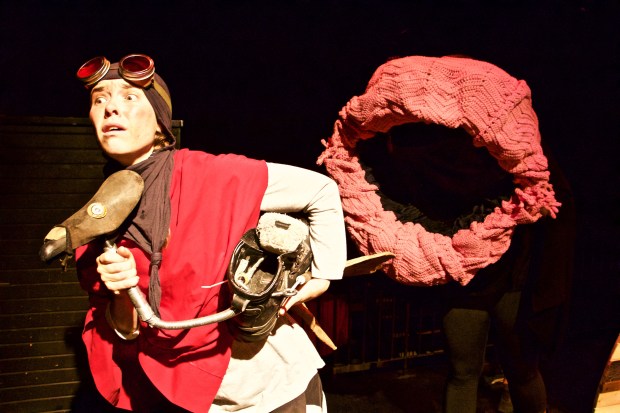
Genevieve Pare in Mudfoot Theatre’s River: A Puppet Myth, June 7-11 at the Joyce Dolittle Theatre. Photo Credit: Chantal Wall.

One day, perhaps sooner than later, the taps will shut off. Water will become a scarce commodity, if it isn’t already. In the future, sources of water like the Bow River will be relegated to the realm of myth.

Enjoying its world premiere at the Joyce Dolittle Theatre, River: A Puppet Myth is the latest from Mudfoot Theatre. The play, written by Co-Artistic Directors Ian McFarlane and Geneviève Paré, stages three explorers on a journey to find the Bow River. Stories of the Bow River, passed down through the generations, help guide the explorers on their journey, with an ancient scroll (coloured with pictographs) acting as a map of sorts.

With no signs of the river anywhere, Dha (Ali DeRegt) has doubts that the river still exists. Une (McFarlane) has faith that the river still flows, thinking that maybe the group hasn’t grasped the full meaning of the stories. Meanwhile, Ba (Paré) finds herself communicating with a grizzly bear named Griz (Erinn Watson), who gifts her different objects, at night. Her relationship with Griz is a kind of reconciliation with nature.

What created this post-apocalyptic world was the Hunger, a destructive force that devastated the planet. In one story, the audiences learns that Bison were once plentiful until the Hunger caused them to be overhunted. Man’s relationship with the bison, who he relied on for many things like warmth, was healthy until greed took over. Presumably, the Hunger caused humanity to exhaust the planet’s resources without taking into account long-term consequences, leading to irreversible climate change, hence the search for the Bow River.

Appropriately, given the show’s environmentalist concerns, Mudfoot Theatre has constructed all its puppets from discarded materials. The large bison is made from a burlap sack, and the magpie has a bicycle seat for a head and large boot for a body. Other materials like a tin can (bent to create a ‘head’, dressed with hair and big eyes) are used for simpler puppets.

What’s really funky is this whole communication contraption that has McFarlane cranking a bike pedal by hand for power, Paré spinning a roof turbine adjusted to her helmet to receive incoming messages, and DeRegt tapping a makeshift morse code machine. It’s quite a sight when the group activates this wacky apparatus in the wasteland.

This act of staging ‘junk’ is a potent display of human carelessness and indifference to environmental issues. What a thing to have people confront (again) discarded objects, some of which may survive long after humans are gone. The productive use of discarded materials not only drives home not only how much people waste, but what can be achieved through recycling. One could interpret this act of staging ‘junk’ as a political statement under the guise of quirky, ‘harmless puppetry.

So, it’s too bad that the story fails to deliver the same impact.

Mudfoot Theatre’s ingenuity and effort in finding the local in a global issue are worthy of much praise, but the script is often incoherent. Somewhere here, there’s a message that our current habits are endangering the Earth, otherwise there wouldn’t be so many ‘junk’ on stage. The argument is that humanity needs to re-discover and re-establish its relationship with nature, or else face disaster. Unfortunately, the verbose, metaphor-laden language does little to support this argument as it produces more head scratching than nodding heads. Likewise, the in-world references are never fully explained, so the audience is alienated from knowledge useful to access this imagined future. Thankfully, the script doesn’t bang us on the head like other environmentalist fiction (see: Jetsons: The Movie), but some direction would be helpful to grasp its full intentions.

Ba cryptically processing memories from people and animals of the past who enjoyed (and experienced the destruction) of the Bow River would be interesting to see explored further. There is something both unsettling and intriguing about a future where the pain of the past still has roots in the ground.

Director Lindsey Zess-Funk really knows how to create some astounding visual moments. Something so simple as Griz walking through the explorers’ camp (set design by Lane Shordee) is given emotional weight through good pacing and movement with purpose. Zess-Funk displays a good understanding that these puppets are not just puppets, but creatures connected to a larger story and who play an important part in that bigger picture. The same can be said for these puppeteers, including Emily Schoen who maneuvers Bertha’s large eye in the mountainside. There is a physical language flowing in this show that captures the play’s essence.

Although highly creative and unique, Mudfoot Theatre’s River: A Puppet Myth is a lengthy, jumbled exploration of what lies on the horizon.


Mudfoot Theatre’s River: A Puppet Myth runs June 7 – 11 at the Joyce Dolittle Theatre (The Pumphouse Theatre).

For information about the show, including how to purchase tickets, visit: http://www.mudfoottheatre.com/projects.html

Wilde Fun: Sherlock Holmes Cracks The Case at Vertigo Theatre

Sherlock 0075 NB1_5708.jpg

Left to Right: Chantal Perron, Paul Welch, Karl Sine, and Haysam Kadri in Katie Forgette’s Sherlock Holmes and The Case of The Jersey Lily, playing now at Vertigo Theatre. Photo Credit: Benjamin Laird Arts & Photo.

Oscar Wilde walks into Sherlock Holmes’ office and – no, it’s not the set-up of a joke, but rather the premise of Katie Forgette’s Sherlock Holmes and The Case of The Jersey Lily, playing now at Vertigo Theatre.

Sherlock Holmes (Haysam Kadri) meets Irish playwright Oscar Wilde (Paul Welch) and famed Victorian actress Lily Langtry (Chantal Perron) in Forgette’s comedic play that blends reality and literary fantasy. With the help of his assistant Dr. John Watson (Karl Sine), Sherlock sets out to retrieve Lily’s private letters to the Prince of Wales, letters that threaten to destroy both her’s and the crown’s reputation. The case of blackmail turns deadly when Sherlock’s nemesis Professor Moriarty (Christian Goutsis) reveals himself to be the mastermind behind the plot against Lily.

Directed by Craig Hall, Vertigo Theatre’s production can be best described as goofy, campy fun. Who will enjoy the production most are literary nerds who will undoubtedly pee themselves laughing at jokes like the working title for Oscar’s latest play, The Importance of Being Forthright. But it’s Hall’s staging that really brings the production alive as the script itself is so-so on serving an interesting Sherlock Holmes mystery. Halls’s eye for theatricality, like Moriarty’s absurdly dramatic entrance, elevates this literary farce to a howling night out.

And David Fraser’s sets are simply striking. Sherlock’s office reflects the detective extraordinaire’s refined tastes, while also hinting at the character’s eccentric persona. Likewise, Moriarty’s lair teeters on  “cartoonish supervillainy” – to quote Mr. Smithers from The Simpsons, especially with Fraser’s dramatic lighting.

Vertigo Theatre, as it often does, has brought in a superb group of actors for this farce. Kadri’s Sherlock is cool and collected, but very cocky. Why shouldn’t he be? The man is practically a supercomputer (which sucks some fun out of the play, honestly). Sine’s Watson is a bit of a bumbling, yet capable, assistant, especially when Lily is involved. The banter between Kadri and Sine’s star-struck Watson is highly amusing.

Perron plays Lily, an actress with plenty of secrets to her name. Perron’s tough persona is impenetrable, with her upright posture and sharp delivery, proving a real challenge for the oafish conspirators John Smyth (Michael Tan) and “Mrs. Irma Tory” (Natascha Girgis). Goutsis’ comically evil Moriarty is a formidable opponent – when he’s not struggling to open giant steel doors, that is.

And then, there’s Welch as Oscar Wilde, a foppish character if ever there were any. The character has perhaps the best lines in the play, and Welch’s comedic prowess knocks them out of the park.  Welch’s performance is the cherry on top of this deliciously fun production.

Vertigo Theatre’s Sherlock Holmes and The Case of The Jersey Lily is farce done right. A must-see.


Vertigo Theatre’s Sherlock Holmes and The Case of The Jersey Lily runs May 14 – June 14.

For more information about the show, including how to purchase tickets, visit: http://www.vertigotheatre.com/mystery-series/#sherlock-holmes


The Only Good Boy Scrapes The Surface, Misses The Mark

IMG_0658

Left to Right: Wendy Froberg and David Sklar in Theatre BSMT’s The Only Good Boy by Chelsea Woolley. Photo Credit: Colton Holmes Photography.

Enjoying its world premiere at Theatre BSMT, Chelsea Woolley’s The Only Good Boy stages a tense reunion between 23-year-old Jacob Stevenson (David Sklar) and 43-year-old Monica Winters (Wendy Froberg). After finding her online on a dating website, Jacob invites Monica, a former school teacher, over for supper at his place. Jacob’s place, Monica notices, is very dirty as he’s in the middle of moving to Florida, so he says anyway. Monica ignores it, turning the discussion towards her outfit, then Jacob’s family. Years of hurt and regret surface as the two catch up.

Jacob tries and tries and tries to push Monica to recognize the trauma he has been burdened with for 10 years. He wants Monica to acknowledge that what happened between them was real and it ruined his life, but she dodges any mention of the past, running away from the truth she knows deep down inside. There is no major confrontation. Jacob and Monica call it a night, leaving Jacob painfully unsatisfied and Monica distressed.

Within the play’s first fifteen minutes or so, the nature of the traumatic experience that ties Jacob and Monica together reveals itself through subtle clues in the dialogue. The truth landing with a big thud soon after. Woolley’s handling of the subject matter is less than elegant. What is the playwright’s intention? Is it to shock? If it is, Woolley certainly succeeds in that with Monica’s three (uncomfortable) monologues that act as a window into her damaged psyche. Beyond that, however, what is the audience supposed to take away from this dramatic meeting between victim and perpetrator?

The characters operate independently from each other, trapped in their own minds. Jacob and Monica’s meeting almost seems like an excuse just for these characters to talk at us; to drop ideas and themes. Yes, the play focuses on the varied consequences of abuse and neglect, but that’s only one part of the equation. Dramaturgically, why are these characters meeting each other right now, right here other than to dance around the conflict at hand?

There is a very real and serious issue in Wolley’s drama, winner of the 2016 BSMT Dwellers Playwriting Competition, but unfortunately the playwright scrapes the surface of familiar territory. Not to dwell on what the play could be, but there is a sense that the play might function better as a slow-burn than a drama where all its cards are played prematurely.

All that aside, however, the construction of Woolley’s dialogue is fascinating. The rhythmic quality of Woolley’s dialogue hits home the desired emotional effects. While the play’s structure may be lacking, its dialogue certainly is not with its menace driven by the almost musical repetition of key phrases.

Thankfully, director Kyle Schulte has a sense, too, of the rhythm in Woolley’s dialogue as the show is well-paced.

There is menace, too, in Benjamin Toner’s set that sees Jacob’s living space, its walls lined with dirty moving boxes, collide with a floor full of mulch. Seriously. The entire floor is covered in mulch, which Sklar’s Jacob aggressively digs into over the course of the play, at one point finding old birthday cards from Monica. Sound Designer Aidan Lytton produces real anxiety in these revealing moments. There is a real serial killer vibe – like corpse stuffed inside an oil drum – given off by Toner’s swampy set, and Lisa Floyd’s brooding light work.

That’s also perhaps because Sklar delivers an unsettling performance as Jacob, switching back and forth between friendly and unhinged on the fly. Although, the unhinged side to Jacob is always present in the actor’s performance, but uncomfortably restrained. A strong performance. Froberg, too, finds these moments where she walks a fine line between Monica’s facade (an airhead) and her real self. She digs into a dark place for her character’s disturbing monologues with great success. Both actors make it difficult to know what exactly to make of their respective characters.

Although not explosive, Woolley’s The Only Good Boy is a worthy new drama of staging. There are elements that fall short, certainly, but then there are elements that really, really work. And Theatre BSMT demonstrate that they are the right company to stage the premiere of this play with their strong, articulate production.


Theatre BSMT’s The Only Good Boy by Chelsea Woolley runs May 17 – 21 at the Motel Theatre.

For more information about the show, including how to purchase tickets, visit: http://www.theatrebsmt.ca/Theatre_BSMT/Whats_On.html

Goodnight Desdemona (Good Morning Juliet) Roars With Wit and Humour

Goodnight Desdemona 0416 NB1_5424

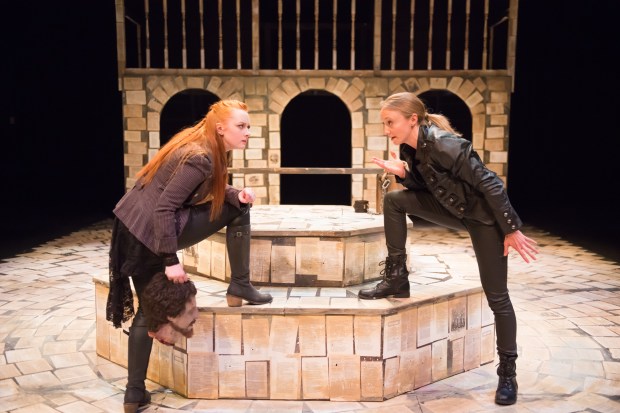
Left to Right: Allison Lynch (Desdemona) and Julie Orton (Iago) in Anne-Marie MacDonald’s Goodnight Desdemona (Good Morning Juliet),  presented by The Shakespeare Company & Handsome Alice Theatre & Hit & Myth Productions. Photo Credit: Benjamin Laird Arts & Photography.

Co-presented with The Shakespeare Company and Hit & Myth Productions, Handsome Alice Theatre, formerly known as Urban Curvz Theatre, makes its debut with Anne-Marie MacDonald’s 1988 play Goodnight Desdemona (Good Morning Juliet). Winner of the Governor General’s Award for Drama, the Canadian play applies feminist theory to the works of William Shakespeare, namely Othello and Romeo & Juliet, critiquing academia and the patriarchy while doing so.

Directed by Kate Newby, Goodnight Desdemona (Good Morning Juliet) tells the story of Constance Ledbelly (Ayla Stephen), a doctoral student who believes Othello and Romeo & Juliet were originally intended as comedies. Her theory is based on the Gustav manuscript, a mysterious document that Constance has yet to decipher. Constance’s dissertation is ridiculed by Professor Claude Night (Mabelle Carvajal), whom she has a crush on. Professor Night’s news that he has accepted a position at Oxford University, the very same Constance was hoping to land, devastates the lowly academic. Heartbroken, Constance loses all hope for both her romantic and academic aspirations, deciding right there and then that she will die alone, forgotten by Professor Night.

From here, the play plunges straight down a rabbit hole, dropping Constance first into Othello then Romeo & Juliet. Our hapless heroine embarks on a quest through her subconscious to find her identity, meeting the characters of Shakespeare’s plays along the way. Constance’s presence, however, changes the plays from tragedies to comedies, fulfilling her theory, albeit with unintended results as she becomes too involved in the plots.

What stands out most in MacDonald’s subversive play is the influence of the male gaze on Shakespeare’s female characters. For one, Constance refers to characters by what male academics have written about them, which creates some dissonance when she actually meets them. And then, there’s Shakespeare himself who sees Desdemona (Allison Lynch) as a possession for Othello who has her life in his hands, not unlike Professor Night with Constance. Juliet (Geneviève Paré) is prepared to die for Romeo (Julie Orton), her self-worth tied to romantic love with a man, again not unlike Constance and her love for Professor Night.

And so, Constance’s journey of self-discovery is about reclaiming her identity from patriarchal subjugation.

MacDonald’s play is very funny, there’s no doubt about that, but it’s also very smart. The text is rich in commentary about sexuality, the glass ceiling for female academics, and male-centric interpretations of English literature, all of which the Canadian playwright delivers with a deft hand. Thankfully, the play’s quirky humour is able to breathe through all these layers. Sometimes, comedic plays with big ideas fall flat as they are neither very funny or very insightful, effectively crushed under the weight of their ambition. MacDonald’s play rises to the task of producing smart, entertaining theatre.

Under Newby’s direction, the production is wild and delightfully weird. The director has chosen to stage the play in the 1970s, the era of funk and free love. The production is certainly funky with its collection of disco tunes, like Do The Hustle (Anton de Groot, Light and Sound Designer). The era is appropriate given the gender-bending that occurs with not only the presence of an all-female cast, but also Romeo and Juliet’s cross-dressing to win Constance’s favour; liberation from the status quo.

Julie Arsenault’s set is simple, yet effective. A two-tiered structure sits in the middle with two trap doors on its top. There is a balcony at the back of the theatre. At first glance, the floor – and the balcony wall – has normal flooring tiles, but then upon closer examination the tiles are actually pages of text from Shakespeare’s plays! Arsenault’s detail really establishes the Shakespeare wonderland Constance finds herself in.

In this wacky wonderland, we have an all-star female cast firing on all cylinders. Orton is a genuine scene stealer, and that’s a tough statement given that the comedic talent here is simply astounding. Even Orton’s most miniscule physicalities as the scheming Iago are hilarious. Her knack for physical comedy is no doubt from her years of improv experience. And then there’s Stephen who plays the Constance as if she were a cat hoarder days away from appearing on some TLC reality show. It’s an understated performance that fits marvelously with the surrounding absurdity. Lynch channels her inner Xena, warrior princess, for Desdemona, and it’s fantastic. Paré plays the death-obsessed, if not suicidal, Juliet with zest – o happy dagger indeed! Carvajal plays brings plenty of meaty machismo to the male characters of Professor Night, Othello and Tybalt.

Handsome Alice Theatre’s debut production is ferociously funny. Goodnight Desdemona (Good Morning Juliet) is a near-perfect introduction to this company dedicated to unleashing the female voice.


The Shakespeare Company & Handsome Alice Theatre & Hit & Myth Productions present Goodnight Desdemona (Good Morning Juliet) by Anne-Marie MacDonald, May 12 – 21 at Vertigo Theatre’s The Studio.

For more information about the show, including how to purchase tickets, visit: http://www.shakespearecompany.com/current-season/goodnight-desdemona-good-morning-juliet/

A Tale of Imaginary Cities: Ordinary Objects Come to Life in Théâtre de la Pire Espèce’s Cities

Villes3_Mathieu_Doyon.jpg

Olivier Ducas in Theatre de la Pire Espece’s Cities. Photo Credit: Mathieu Doyon.

Normal everyday objects can and do say a lot about a person. Think about a bookshelf, sometimes people look at a someone’s bookshelf to gather an idea of that person. Or, consider what photos people take the time to frame and put on display in their homes. Objects carry meaning, and they form a larger narrative, curated by the individual.

Presented by Theatre Junction, Théâtre de la Pire Espèce’s Cities is a series of imaginary cities, as conceived by writer/director Olivier Ducas and scenographer Julie Vallée-Léger, dissected onstage. The cities are organized in seven categories, from Sand Cities to Pocket Cities to Dual Cities. Ducas presents each city’s story to the audience by using a camera to focus on particular aspects of a city, supposedly revealing its soul in the process.

The city of Myriam, for example, has plans to replicate into near-infinity, seemingly with no originality in its plans. The main concern is growth, governed by conformist policies. Ducas starts with two red blocks, embedded vertically in a box of sand, then begins to place mirrors around the blocks to create the illusion of infinity.

For the city of Maxine, which is labelled under Ghost Cities, Ducas takes out a large wooden block with tall, slim blocks compacted together. He uses semi-opaque dividers to transform the cities’ towers into different graphs of data, explaining what each set of data says about the people living in Maxine. However, the city, Ducas tells us, has chosen to present only positive data, keeping less-than-favorable statistics about its residents hidden – at this point, a light turns on at the block’s base to reveal a negative bar graph.

The objective is subjective.

An idea of interest given that the federal government is currently asking Canadians to complete the national census, or else face fines and/or jail time. Data can be manipulated to tell or support any number of narratives. Human bias cannot be separated from the equation.

Even Ducas’ presentation of these imaginary cities is corrupted by human bias. The audience is only ever given Ducas’ interpretation of what he considers the true nature of these cities. What reference does the audience have to confirm the truth any of what Ducas says? None, not only because the cities are imaginary to begin with, but also because the audience has never visited these cities. The show should be seen as a collection of tourist propaganda, so to speak, not inherent truth.

Setting aside the problematic notion of objective truth, Cities is interesting as there is no dramatic tension that develops. The show is a journey through one man’s collection of imaginary cities. And yet, the show is oddly compelling. One reason for that is the spectacle of assembling regular objects, like sugar cubes and coffee beans, to create an intimate portrait of a city, but another is the psychology behind collecting that Ducas discusses in monologues. Why do people collect? What happens when collections are completed, when the seeking ends? Ducas suggests that for some people, collecting is less of a hobby and more of an activity in purpose seeking and fulfillment.

Interestingly, the majority of Ducas’ cities have female names (Cassandra, Gloria, Scarlett, Sylvia, Cathy, and nearly a dozen more). What comes to mind are sailors who, lonely at sea, would name their ships after wives or girlfriends. Thinking about that, what assumptions can we make about Ducas and his mostly female cities? The very same we make when we enter someone’s apartment for the first time and analyze their walls and shelves for information.

Profoundly imaginative, Théâtre de la Pire Espèce’s Cities is an intimate journey through the alleys of human rationality and emotion.


Théâtre de la Pire Espèce’s Cities ran May 4 – 7 at Theatre Junction GRAND.

For more information about the show, visit: http://www.theatrejunction.com/portfolio/cities-2/

Flora & Fawna’s Field Trip! Earns All The Badges

12540626_10156556011740724_1258765859919550983_n

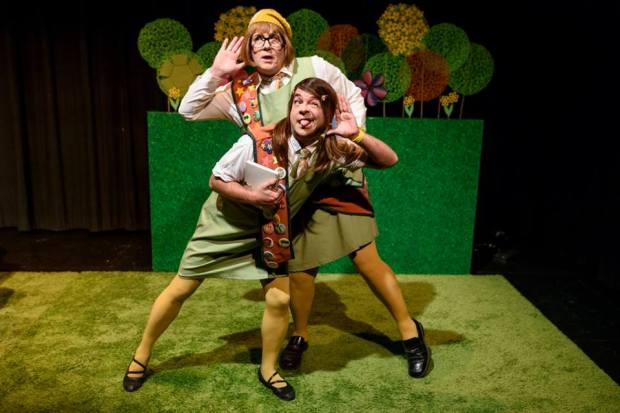
Flora & Fawna’s Field Trip! by Darrin Hagen & Trevor Schmidt runs May 2 – 21 at Lunchbox Theatre. Pictured, left to right: Trevor Schmidt (Fawna) and Darrin Hagen (Flora). Photo Credit: Ian Jackson, EPIC Photography.

Given that I participated in Flora & Fawna’s Field Trip!, I figured I break away from the usual third-person to write about this hilarious, although very emotional comedy playing now at Lunchbox Theatre until the 21st.

Created by Darrin Hagen & Trevor Schmidt, with Schmidt directing, Flora & Fawna’s Field Trip! is everything I wish my years in Cub Scouts had been. Hagen and Schmidt play two pre-teen girls named Flora and Fawna, respectively. Upset by the mean girls in their Girl Guide’s troop, Flora and Fawna have taken it upon themselves to form their own group called the NaturElles. The NaturElles is an all-inclusive group that welcomes everyone, except mean girls – like “Louise Hobson!” The only other member is Fleurette (Chris Enright), a young Francophone girl.

The audience participates in the NaturElle’s first membership drive, as a group and otherwise. I was pulled from my seat by Fawna to play a trivia game about wilderness survival, where I answered two of three questions correctly. What I learned from the experience is that I’m not very good at choking the chicken – we used rubber chickens as our buzzers.

Before this, Flora and Fawna asked the audience to take the friendships bracelets from the bags handed to them before the show and tie them around each other’s wrist. The circle widened, and it continued widening as the girls’ activities – like learning how to pee in the woods – brought everyone together through laughter, like laughing-so-hard-it-hurts laughter.

The show is a lot of like camp, well it’s more like the version of camp that adults promise you before shipping you off for the weekend. Personally, I hated my time in Cub Scouts, primarily because I was bullied by the other boys. Sure, we were asked to adhere to a set of golden rules, principles, and values, but none of that mattered when the adults weren’t around.

But it’s not just kids who are mean, but also adults. There are revealing moments that suggest that all is not right in Fawna’s home with her mom and step-dad. If you want to talk about risk, let’s talk about how Hagen and Schmidt, after nearly an hour of sexual innuendo and quirky humour, end the story on a very heavy note. There’s a place where fantasy and reality meet, and the two take the story there, on the precipice of adulthood.

And so, the show is about several things, but it’s mainly about the fantasies kids create to escape their problems. The NaturElles is a very real group for Flora and Fawna, because they need it to be.

Lunchbox Theatre has a knack for staging plays that hit something very real deep down inside, and Flora and Fawna’s Field Trip! is no different. Hagen and Schmidt have created a show that speaks to the kids inside all of us, and let’s us escape into a world of play. A must-see.


Darrin Hagen & Trevor Schmidt’s Floral & Fawna’s Field Trip! runs May 2 – 21 at Lunchbox Theatre.

For more information about the show, including how to purchase tickets, visit: http://www.lunchboxtheatre.com/flora-and-fawna/


Bellissima: A Lonely Heart Finds Home in Theatre Calgary’s The Light in the Piazza

The Light in the Piazza RODRIGO2

Left to Right: Susan Gilmour and Anwyn Musico in The Light in the Piazza, playing now at Theatre Calgary. Photo Credit: Trudie Lee.

For its last show of the 2015/16 season, Theatre Calgary whisks audiences away to Italy with the Tony award-winning musical The Light in the Piazza.

Based on the 1960 novella of the same by Elizabeth Spencer, The Light in the Piazza tells the story of 26-year-old Clara Johnson (Anwyn Musico) and her mother Margaret (Susan Gilmour) who are away on holiday in Florence, Italy. While out exploring the city with her mother, Clara runs into a young Italian man named Fabrizio Naccarelli (Louie Rossetti), and it is love at first sight. Margaret pulls Clara away from Fabrizio, insisting that the two go their separate ways. In what seems like destiny, Fabrizio runs into Clara and her mother twice more, eventually inviting them to meet his family for tea.

At every turn, Margaret insists that Clara does not get involved with Fabrizio. Fabrizio’s father Signor (David Keeley) sees nothing wrong with their relationship, even if it is all very sudden. What Fabrizio’s family doesn’t know about Clara is that a head injury sustained on her 12th birthday negatively affected her mental and emotional development. Margaret fears that if Fabrizio were to find out the truth about her daughter, he would run away just like all the others, which would devastate Clara. Margaret is conflicted, however, when she sees how happy Clara and Fabrizio are together, and how taken the Naccarrelis are with her.

With the musical opening a week away from Mother’s Day, Margaret’s conflict over letting go of her only child is particularly relevant. Margaret wants only the best for Clara, that is she wants to see her daughter happy. The problem is, there are a number of risks in allowing Clara to be with Fabrizio. Is it her decision, though? When, if ever, do her responsibilities as a mother end? What if the doctors were wrong about Clara, says Margaret to her husband Roy (Christopher Hunt) over the phone.

Meanwhile, Clara is eager to fly free from her overprotective mother and live a fulfilled life, like any young person her age.

What’s interesting about the musical score (music and lyrics by Adam Guettel) is the presence of both English and Italian in the lyrics, with some songs sung entirely in Italian. The book (by Craig Lucas) also features both languages, although with broken english from the Naccarelis added into the mix. As well, the score is majorly influenced by opera, borrowing elements for a less than traditional musical.

For those wondering, there are no translations provided. The lack of translations may seem intimidating, but director Michael Shamata’s effective staging makes clear what the Italian-speaking characters are expressing.

The musical score is magnificently interpreted by musical director Jonathan Monro, who also plays piano in the band. The band is positioned onstage, behind the actors, for a concert feel. The score captures the wonder and innocence of young love, and the pains of old love, splendidly; It’s like a candlelit dinner on the shores of the Mediterranean Sea.

Speaking of which, the production is a feast for the eyes. Set designer Christina Poddubiuk has seemingly airlifted the splendor of Florence into the Max Bell Theatre. The stage rotates to create the illusion of walking along the streets of Florence, and to allow for fluid scene changes. Lighting designer Alan Brodie hits Poddubiuk’s set with an array of warm lights, casting the stage in a romantic softness.

Audiences will fall in love with Musico as the bright-eyed Clara. The young actress brings tremendous vibrancy and vulnerability to her character. Gilmour succeeds in playing a variety of shades as Margaret, a parent who acts only out of love. Rossetti has a lot of fun as Fabrizio, a harmless puppy in love. His charming smile can be seen rows and rows away from the stage. Rosetti and Musico share a delightful chemistry together, making for an adorable stage couple.

From its beautiful musical score to superb performances to strong aesthetics, there’s a lot to love about Theatre Calgary’s production of The Light in the Piazza. The story of a young American woman whose heart finds a home in Italy is told with such grace and elegance that it should not be missed.


Theatre Calgary’s The Light in the Piazza runs April 26 – May 22.

For more information about the show, including how to purchase tickets, visit:
https://www.theatrecalgary.com/2015-16/the-light-in-the-piazza

Young Frankenstein Comes Alive (Well, Sort Of) At Stage West

Frau Blucher.JPG

Left to Right: Frau Blucher (Jayne Lewis),  Dr.Frederick  Frankenstein (Kevin Dennis), and Inga (Amanda Struthmann). Young Frankenstein, now playing at Stage West until June 26. Photo provided by Stage West.

The hit 1979 film Young Frankenstein, written by Mel Brooks and Gene Wilder with Brooks directing, parodied Mary Shelley’s gothic horror novel Frankenstein all the way to the bank. Nearly three decades later, the film was turned into a Broadway musical with Brooks writing the music and lyrics, and the book with Thomas Meehan.

And now, the musical has landed in Calgary at Stage West, albeit with some loose nuts and bolts.

Directed by J. Sean Elliott, Young Frankenstein stages the story of Victor von Frankenstein’s grandson, Dr. Frederick Frankenstein (Kevin Dennis). Living in New York City is perfect for Frederick who wants nothing to do with his grandfather’s legacy of creating monsters. All that changes, however, when Frederick receives news that he has inherited his family’s estate in Transylvania. Frederick travels to Transylvania, leaving behind his fiancee Elizabeth (Adrienne Merrell), and soon befriends Igor (Greg Pember), the grandson of Victor’s own sidekick. The scientist finds a new lab assistant in Inga (Amanda Struthmann), a beautiful young woman with a degree in Laboratory Science.

Tormented by the ghosts of his ancestors, Frederick sets out to create a monster of his own, much to the delight of his grandfather’s former girlfriend Frau Blucher (Jayne Lewis). Unable to contain his creation, The Monster (Adam Stevenson) runs amok in Transylvania.

Young Frankestein features plenty of Broadway flair with its catchy, although not very memorable, musical numbers, choreographed by Phil Nero. Flair alone is not enough to carry the show. Young Frankenstein is a throwback to classic Broadway musicals, but infused with Brooks’ obscene, often deadpan humour that audiences either laugh at or shrug their shoulders. The jokes either sometimes lack subtlety and/or are just plain offensive.

The Monster’s entire schtick is that he was given an ‘abnormal’ brain (instead of a renowned scientist’s brain), resulting in a low intelligence that makes it difficult for him to speak or articulate words properly. The humour of “Puttin’ On The Ritz” (by Irvin Berlin) relies entirely on The Monster’s shouting and screaming of the lyrics. The musical number becomes very uncomfortable when you realize the whole joke is focused on laughing at someone with a disability.

And then there’s the whole bit with the blind hermit that pours hot soup on The Monster…

If audiences can overlook show’s questionable humour, the musical is fairly entertaining thanks to its talented cast. Dennis and Pemper are quite the team as scientist and sidekick, delivering big laughs as they bumble their way through the scientific method together. Struthmann’s pipes make “Roll in The Hay” a fun hayride, yodelling and all. Dressed with large boots, Stevenson stands very tall as The Monster, making his dancing all the more impressive (it’s a long way down!). Lewis really steals the show as Fran Blucher, though, who she plays like a lustful, much sterner Morticia Addams – yes, the horse gag is present, by the way.

Leslie Robinson-Greene’s bright, eye-popping costume designs for the production are marvelous, as are Leon Schwesinger’s set designs. The production looks great under JP Thibodeau’s dynamic stage lighting.

Audiences expecting the film translated beat for beat on the stage will be sorely disappointed as Brooks’ show is an entirely different beast altogether. The fault is not with Stage West, but the adaptation itself. Brooks’ musical numbers do little to sustain the show, besides allowing time for scene changes. The show is not much of a creative departure from the film. Add in the show’s offensive humour, and Young Frakenstein becomes even less appealing. So, what is it? Call it an unnecessary adaptation only fans of Brooks’ signature humour will truly appreciate.

Audiences can miss Stage West’s Young Frankenstein.


Stage West’s Young Frakenstein runs April 22 – June 26.

For more information about the show, including how to purchase tickets, visit: http://stagewestcalgary.com/young-frankenstein-the-musical-by-mel-brooks/