A Pure Delight: Smee’s Secret Wins Over Audience at Calgary Fringe Festival

DSC_0134

Smee’s Secret won Outstanding Production at the 32nd Annual Calgary One Act Play Festival. (Pictured: Olive (Emma Sinclair) and Pistachio (Kelly Malcolm) with Smee, their cardboard box friend) Photo Credit: Kathryn Smith.

What a task to describe The Tighty Whities’ latest show Smee’s Secret. For sure, the clown duo’s award-winning show is nothing short of wonderful.

The genius of Smee’s Secret lies in its deceptively simple premise: two clowns help their cardboard box friend complete his bucket list. One moment, Olive (Emma Sinclair) and Pistachio (Kelly Malcolm) are caught up in their child-like sense of wonder and imagination; the next their friend Smee feels very ill. Massage, medication, nothing the clowns try appear to help Smee. The total suddenness of it all drives the clowns to figure out something, anything. Uncertainty, desperation, anger, Olive and Pistachio’s emotional journey might ring familiar for any who have experienced loss in their own lives.

By dealing with the topic of loss under the guise of a silly clown show, Sinclair and Malcolm catch the audience by surprise, but it is not the sort of surprise that clunks the audience over the head. The reason is that Smee’s Secret is, at its core, a story about friendship. What does it mean to be a friend, especially during hard times? Olive and Pistachio learn that while everything else may fail, the strength of friendship always remains. Sometimes the most important thing we can do for our friends is simply be there for them. So, this is not a show about loss per se; it is a show about how we love and say goodbye to the ones we care the most about.

There is plenty of fun, too, in the mix. Through the power of montage (set to the tune of Hall & Oates’ You Make My Dreams Come True), Olive and Pistachio clear the items off Smee’s list in no time. Outside help from the audience is required at one point as the clowns invite an audience member to sit down for a romantic date with Smee. Olive and Pistachio act as chaperones, giving the two pointers along the way in what is a charming little scene.

Olive and Pistachio are so easy to fall in love with because of the sincerity Sinclair and Malcolm bring to the stage. And so, it is no surprise that the audience send Olive and Pistachio off to their next adventure with enthusiastic applause.

Imaginative, magical, Smee’s Secret delights with its special blend of humour and heart.


The Tighty Whities’ Smee’s Secret ran July 31st – August 8th as part of the 2015 Calgary Fringe Festival.

For more information about The Tighty Whities, visit: http://www.thetightywhities.com/

Trillo and Arnista’s Perpetual Wednesday Entertains

WhiteCollarCrimes-PerpetualWednesday-p5

From left to right: Walter (Jacob Trillo) and Bruce (Anthony Arnista) are in big trouble after their magic act turns deadly in White Collar Crimes’ Perpetual Wednesday.

When two-bit magicians Walter (Jacob Trillo) and Bruce (Anthony Arnista) mess up, boy do they really mess.

White Collar Crimes’ Perpetual Wednesday, created by Arnista and Trillo, follows Walter and Bruce after a disastrous magic act where they may or may not have shot a man in the face. Walter insists it was all part of the act, that the audience volunteer is perfectly fine. Bruce isn’t so sure, after all the blood and the body he chopped up seemed pretty real to him.

Trillo and Arnista’s hyper-energetic act makes for a very sweaty performance inside the hot Lantern Church Sanctuary. Shadow theatre, dance, and off-colour humour, the actors’ amusing variety show has it all. Trillo and Arnistra’s showmanship is impeccable. The show, unfortunately, loses momentum once it dives straight into the rabbit hole.

One moment Walter and Bruce are the sort of sleazy magicians you might find at a Las Vegas lounge, the next it turns out they’re actually immortals who struck a deal with the ancient Egyptian god Anubis. The joke that Walter and Bruce were actually some of history’s iconic figures, while fun at first, becomes tired. The two in time come around to settle the matter of the dead man, but by then the whole ordeal has collapsed under its own weight. The audience is left with an abrupt, less than satisfying ending.

Ultimately, Trillo and Arnista’s Perpetual Wednesday entertains, despite some script issues that hold back its full comedic potential.


White Collar Crimes’ Perpetual Wednesday runs July 31st – August 8th as part of the 2015 Calgary Fringe Festival.

For more information about the show and how to purchase tickets, visit: http://see.calgaryfringe.ca/events/476-perpetual-wednesday

A Woman of a Certain Age’s Honest Commentary Troubled by Script Issues

Wendy Froberg's A Woman of a Certain Age runs as part of the 2015 Calgary Fringe Festival.

Wendy Froberg’s A Woman of a Certain Age runs as part of the 2015 Calgary Fringe Festival.

For playwright/actor Wendy Froberg, age is just not a number, especially not for women. The more a woman ages, Froberg argues, the more she becomes flawed in the eyes of society. Seldom are women allowed to grow old without their self-worth being diminished in the process.

Presented by Archetype Productions, Froberg’s one-woman show A Woman of a Certain Age chronicles the lives of six mature women as they deal with their families, marriages, and careers.

The play’s central character is Gwen Randall, a mother of two who is caught shoplifting at the local mall. The criminal act has seemingly come out of nowhere considering Gwen is an upstanding member of the community with a good career. All eventually comes to light as we learn more about Gwen’s hidden troubles at home and with her widowed mother who has dementia.

Around Gwen there are other women, too, trying to cope with aging, specifically the loss of status. Gwen’s mother, who lives in a nursing home, feels a loss of self now that her children are grown up with lives of their own, and her husband has passed on. No longer a mother, no longer a wife, what defines Gwen’s mother in her old age?

Froberg proposes that older women are defined by their appearance. Like Gwen’s mother, once women reach a certain age, they are largely ignored, that is unless they have aged well. But what does that mean, to age well? Here, Froberg defines aging well as not just being (normatively) capable both physically and mentally, but also being free of any signs that mark old age. Although, as she points out, women and men are not held to the same standards. Men grow old without worry, while women are pressured to be wrinkle-free.

Froberg’s commentary is derailed drastically by the analogy Gwen’s European Esthetician draws between North America’s “War on the Face” and World War II. The second World War, the Esthetician believes, instilled (all?) Europeans with socially progressive attitudes towards aging and beauty. Having never experienced any such trauma, North Americans are, therefore, incapable of recognizing inner beauty. (REAL blemishes are caused by artillery explosions). The whole scene is perplexing, and Froberg’s poor attempt at a “European” accent does little to help.

What else might confuse audiences are Froberg’s messy character transitions. Froberg is not up to task on presenting six, distinct characters. In fact, she may simply be working with more characters than necessary. Some of the other character storylines, like Gwen’s sister who has a son with special needs, wander aimlessly until the end where Froberg rushes to close them with a nice feel-good ribbon. The result is a play that know what it wants to say, but then tries to fit in as much else as it can, making for a very obvious one-hour run time.

Overall, Froberg’s A Woman of a Certain Age speaks hard truths about women, aging, and beauty, but not without some major bumps along the way.


Presented by Archetype Productions, Wendy Froberg’s A Woman of a Certain Age runs July 31 – August 8th as part of the 2015 Calgary Fringe Festival.

For more information about the show and how to purchase tickets, visit: http://see.calgaryfringe.ca/events/468-a-woman-of-a-certain-age

Mercutio & Tybalt Impresses at Calgary Fringe Festival

MAndT_CalgaryFringe2015_byChrisTait_web-0148

From left to right: Tybalt (Celene Harder) and Mercutio (Val Duncan) bring their side of the story to life in Valour & Tea’s Mercutio & Tybalt. Photo Credit: Chris Tait.

William Shakespeare’s Romeo and Juliet has seen its fair share of adaptations and retellings, but none, Mercutio (Val Duncan) says, have come even close to the truth. For how many know that Mercutio and Tybalt (Celene Harder) were actually close friends? That is the premise of Valour & Tea’s newest work Mercutio & Tybalt, a hilarious reimagining of Shakespeare’s most popular play.

Written and directed by Duncan and Harder, Mercutio & Tybalt catches up with the titular characters in the afterlife. Still bitter about the fact that the story of two dumb, hormone-crazed teenagers has endured the last 400 years, Mercutio and Tybalt decide it’s time that they share their story with the world. What follows is an epic tale of bromance, full of puppetry and swordplay, that weaves in and out of familiar scenes from Romeo and Juliet.

Duncan and Harder stay true to the Bard’s style by performing the show entirely in iambic pentameter, with modern slang included in the mix. In doing so, Mercutio and Tybalt’s vaudeville-inspired antics are given a natural, if not musical, rhythm for the actors to follow.

Duncan and Harder have crafted a wildly fun show that works for both friends and acquaintances of the Bard. Harder’s bad-tempered Tybalt is the perfect foil to Duncan’s immature, yet sharp tongued Mercutio. The pair work brilliantly together, delivering a charming performance abundant in wit and attitude.

Mercutio & Tybalt captures the spirit of its source material, while delivering something fresh and vibrant at the same time. Audiences will find much to enjoy here, guaranteed.


Val Duncan and Celene Harder’s Mercutio Tybalt runs July 31st – August 8th as part of the 2015 Calgary Fringe Festival.

For more information about the show and how to purchase tickets, visit: http://see.calgaryfringe.ca/events/464-mercutio-tybalt

Gomes and Haight’s Now What? Shows Weight of Relationship Dynamics

Brian and Marina

Now What? stages the key moments of Jared and Isabel’s (Brian Haight and Marina Gomes) relationship out of chronological order. Photo credit: Helen Tansey

How much does pain weigh? How light does love make us feel? These are the questions that Marina Gomes and Brian Haight’s play Now What? explores through a physical form of theatre known as Contact. Through contact acting, Gomes and Haight give weight to both the emotional and physical impact of relationships, delivering something unique in the process.

During their morning routine, Jared and Isabel, played by Haight and Gomes respectively, lean on and share each other’s weight as they brush their teeth. The couple perform the sort of acrobatics that only two people who love and trust each other would ever dare execute together.

When a car accident leaves Jared unable to walk, Jared and Isabel’s relationship becomes strained as they try to deal with the new dynamic between them. Isabel carries Jared on her back as she tries to complete their morning routine, but the weight of her unhappiness and Jared’s anger is too much. She and Jared fall to the ground.

Gomes and Haight stir a deep, emotional response with the simplicity and honesty of their movement. They successfully capture the sort of intimate connection that makes two lovers at a loss for words when they try explaining to friends what they share or how the other makes them feel.

However, while the play’s Contact elements are interesting,  the writing leaves something to be desired in terms of delivering a tight, cohesive narrative. Jared and Isabel are a means for Gomes and Haight to showcase what contact acting can achieve in terms of expressing the indescribable. Everything else exists only to help Gomes and Haight reach the brilliant concepts they have written the script around. The result is a weak script that tries in earnest to pull all its elements together.

Gomes and Haight’s Now What? displays exciting thought and perspective on the nature of relationships. Script issues aside, Gomes and Haight’s experiment with Contact is a serious effort that ultimately delivers its audience a powerful experience.


Presented by Girl Meets Boy Theatre Company, Marina Gomes and Brian Haight’s Now What? runs July 31 – August 8th as part of the 2015 Calgary Fringe Festival.

For more information about the show and how to purchase tickets, visit: http://see.calgaryfringe.ca/events/466-now-what

Helmut’s Big Day Charges Forward, Stumbles

Helmut_Calgary_Postcard_Side1

James Wade’s Helmut’s Big Day is one of 27 shows running at the 2015 Calgary Fringe Festival.

The Empire is good, God is great, and the uncivilized, Cat-Demon worshipping Barbarians call the Barren Plain home. Sabir (Alan Johnson) knows these three things for sure, except…well, the Barren Plain is the one with the small bush, right?

Presented by Red Phone Theatre, James Wade’s Helmut’s Big Day is a satirical comedy that pokes fun at notions of empire and conformity. The play blends hijinks and philosophy for a breezy, though sometimes sluggish, critique of political ideologies.

Atop the wall separating the Empire from the Barren Plain, Sabir keeps a vigilant eye over the Great Plain which he is sworn to protect. While marching back and forth may not be glamorous, Sabir is compelled to serve the Empire because, according to the army’s manuals, God is watching – always watching. Lonely at his post, Sabir finds a friend in Helmut, a soldier’s helmet he converses with.

Sabir’s troubles begins when Helmut “asks” him to identify what the difference is between the two Plains. (After all, they’re both plain!) The question, at first taken with confidence, makes Sabir uneasy as what he actually sees, which is no discernible difference at all, stands at odds with the narratives fed to him by the Empire. As the contradiction disturbs Sabir, he suddenly spots riders approaching from both sides. Which is the enemy, which is the ally, the problem of the Plains worsens with every passing second.

The nature of Sabir’s blind loyalty to the Empire reveals itself further when Katar (Emma Sinclair) comes to check on her comrade. Also confused by the Plains, Katar proposes the idea that morality is subjective, that maybe the Barbarians see themselves as good and the Empire as evil. Either that, Katar says, or life is random and all action, like guarding the wall, is meaningless. (God, Cat-Demon, makes no difference in the end). Sabir dismisses Katar’s foolish ideas, despite being confronted by the falseness of the Empire head on.

What emerges from the total confusion of these two lowly soldiers is sheer buffoonery. Sabir and Katar’s ‘best’ judgement leads to disastrous results.

While fun, Wade’s expression of these philosophical ideas is largely cumbersome. The script has difficulty weaving the play’s big ideas and physical humour together without resorting to mouthfuls. The ideas land heavy and, as a result, interrupt Johnson and Sinclair’s comedic antics.

Director/Designer Kathryn Smith’s clean, simple set helps the action flow neatly. Smith’s remedies the sometimes stagnant pace of the script by employing the two wall borders to create and thrust the audience into the panicked frenzy shared between Sabir and Katar. The use of the wall borders to show different dimensions of both the wall and the action is smart.

The snappy chemistry between Johnson and Sinclair is enjoyable, though not so much until later in the show when the script gives the actors more room to play. Sinclair’s performance as the oblivious ‘wise fool’ plays well against Johnson’s condescending, but utterly foolish character.

Ultimately, Helmut’s Big Day satirical bite is bogged down by clumsy dialogue. The play delivers fun, physical humour, but its commentary struggles to have a sharp presence in the mix.


Presented by Red Phone Theatre, James Wade’s Helmut’s Big Day runs July 31st – August 8th at the 2015 Calgary Fringe Festival. 

For more information about the show and how to purchase tickets, visit: http://see.calgaryfringe.ca/events/473-helmuts-big-day

Mir & Andrews’ ‘A Picture With A Bull’ A Mixed Effort

Ruben (Ahad Mir) loves his friends, that he knows for sure. Everything else, well, everything else he just doesn’t know about anymore. Ever since his best friend Nico (Chad Hamilton Andrews) started dating Lisa (Courtney Charnock), Ruben’s life has been a weird mess.

A comedy co-written by Mir and Andrews, A Picture With A Bull asks if adulthood and friendship can ever mix. What audiences will find here is certainly a mix: a lengthy mix of crude humour and cliché under the guise of something meaningful.

The play begins with Ruben taking us back to before all the trouble began, the trouble of girlfriends, responsibility, and nostalgia. Every year, Ruben, Nico, and Greg (Alex Peters) go on a trip together to bond and get away from life. For Ruben, what makes the trip special is that it’s always just him and his bros – no girls allowed. This year, though, Ruben’s friends have a different idea for the trip: what if Lisa and Ruben’s girlfriend Diana (Natasha Strickey) came along too? Ruben outright rejects the idea. He refuses to betray tradition, a tradition only he seems to really care about.

Ruben’s stubbornness eventually leads the guys to question their friendship, career paths, and ultimate end goals; the usual frustrations of twenty-somethings in a 9-5 world.

Mir and Andrews’ play is set up much like a sitcom. In fact, the audience can identify almost right away the usual personalities. Lisa is something like the Phoebe of the group, quirky and artsy. Greg is the Funny Guy/Slacker who is good for a laugh, but not much else (like character development). Ruben is the charismatic Cool Guy, the clever one who has a comeback for everything. And they all work in the professional fields of law, healthcare, and business – except for Lisa who is a dancer, naturally.

Like a sitcom, the writing is (over)stuffed with zingers and risqué jokes. At the same time, too, there are real concerns about adult friendships, about relationships being work rather than things that simply happen. The balance between the two is uneven, to say the least. What unfolds is a messy demonstration of the ensemble’s comedic chops. The play’s more serious commentary exists largely as an afterthought.

When the play exhausts its cheap laughs, the show settles on presenting in full its dramatic side. What follows is a forgettable conclusion – forgettable because the characters never earn anything beyond that – that abruptly ends on a less than hopeful note.

The ensemble’s strength is their charming chemistry which invites the audience into this group of friends, allowing them to laugh along plenty at Mir’s sharp tongued performance and Peters’ wacky antics. The ensemble, however, is allowed to be too much at ease with each other. Brett Tromburg’s relaxed direction takes the punch out of some of the play’s more witty exchanges.

There is no denying that Mir and Andrews have written a funny, if uneven, script. The problem is that not much stands out to make this play particularly memorable. The characters, along with the comedy, are flat, and the drama is undercooked.

Despite having its moments, Mir and Andrews’ A Picture With A Bull is ultimately a mixed effort that offers nothing new that hasn’t been done before.


Ahad Mir and Chad Hamilton Andrews’ A Picture With A Bull ran July 22 – July 25 at the Motel Theatre (Arts Commons) as part of the Common Ground Festival. The full festival runs until Aug 1st.

For more information about the festival, visit: http://www.commongroundyyc.com/

Ryan Gray’s Beneath The Skin Travels a Dark, Compelling Path

How far would you go in search of the truth? How well do we know our limits, our boundaries that keep us from being consumed by a hungry darkness? Ryan Gray explores these questions in Beneath The Skin, a thriller/mystery that boldly ventures into the abyss.

Directed by Jenna Rodgers, Gray’s Beneath The Skin stages reporter Carmin Morgan’s (Justine Westby) exclusive interview with convicted murderer Colton Cassio (Justin Michael Carriere), better known as the Portrait Killer. Colton’s long violent history – a history that started at a young age – fascinates Carmin who will stop at nothing to learn as much as she can about him and his victims. Carmin quickly learns, however, that is just not Colton’s crimes that make him a dangerous man, but also his charisma which threatens to take her down a path she never intended to travel.

The focus of Carmin’s interview is centered around Erin (Claire Bolton), Colton’s first victim whom he fell deeply in love with. Via flashbacks, the audience sees how an awkward 20-year-old Colton (Jacob Lesiuk) eventually came to befriend and then murder Erin while away at university.

Gray skillfully creates tension between Colton and Carmin by rarely letting one person hold power too long between them. While Carmin sees herself locked in a game of wits against Colton, Colton sees the two engaged in a more emotional game, a game of wills. And that is what makes Colton so dangerous, he has nothing to lose; he has given himself over to the darkness that calls him inside. Yet, victory is not so assured, Colton comes to realize, as Carmin’s determination for the truth reveals itself to be something more than a professional obligation.

Colton and Erin’s young love, though sometimes a bit too sweet, is crafted very well by Gray. There is a certain sadness in knowing Erin’s eventual fate, but never dulled anticipation. The interplay between the past and present delivers just enough information to maintain our attention. And then, Gray hits the audience with the inevitable which is both very creative and disturbing. (The audience gasps in horror as the scene becomes obvious).

Where the production fails the script is in its blocking. Noticeably challenged by the limited space available inside the Motel Theatre, the rising tension of the play breaks periodically when Carriere and Westby have to stand and carry the table and their seats to the side in order to make way for a flashback scene, sometimes while fully lit. The whole business seriously throws off the established atmosphere.

Despite the proximity of the audience to the actors (the Motel Theatre has a 50 seat capacity), there is no warning for the audience about the use of live smoke. The sudden inhalation of cigarette smoke distracts from the play’s dramatic conclusion.

Carriere and Westby are truly a force together. Carriere displays an unsettling, yet alluring confidence that make very real the presence of danger, to which Westby responds to with an exhilarating tenacity. Westby is truly firm in her character’s resolve, and that makes her performance all the more exciting to watch.

Bolton and Lesiuk share a pleasant chemistry on stage. Bolton is very easy to like as the cheery, good-natured Claire. Lesiuk plays the young, unassuming Colton with ease. There is a bit of a strain, though, when Lesiuk’s character begins to embrace his more sinister side, but the script is more at fault here than Lesiuk. Lesiuk’s performance during his final scene will have audience members abuzz in the lobby afterwards.

Ryan Gray’s Beneath The Skin is a thrilling piece of work that leaves an impression on any who dare step into the darkness.


Ryan Gray’s Beneath The Skin runs July 22 – July 28 at the Motel Theatre as part of the Common Ground Festival. The full festival runs until Aug 1st.

For more information about the Common Ground Festival, visit: http://www.commongroundyyc.com/

Spotlight: Sarah Curts

Dancer, artist, and model Sarah Curts.

Dancer, artist, and model Sarah Curts.

26-year-old Sarah Curts’ dance career began at the age of four when her mother enrolled her into ballet at a local dance studio. The next year, the young dancer was enrolled into jazz. When asked by her mother which she wanted to do, Curts enthusiastically replied “both of them!”

“So, I did both of them. Every year I kept adding another class and another class,” said Curts.

A quiet child growing up, the Calgary-born dancer, artist, and model says what attracted her to dance was the freedom she found in being allowed to move and express herself without words.

At the age of twelve, Curts chose to pursue ballet professionally.

“That was the age where you had to decide whether or not you were serious about ballet,” Curts explained. “So, I started going to international summer schools — Royal Winnipeg Ballet, the Banff Centre, the American Academy of Ballet, and Alberta Ballet. I was always dancing.”

Navigating the ballet world was not easy, however, as expectations were high for students.

“This is what you’re doing, and this how you do it. And you have to do it perfectly. That was the ballet world,” Curts said. “You had to be perfect and better than that girl. Otherwise, you’re not going to get the part.”

Eventually, the pressure to succeed overwhelmed Curts as it began to affect other areas of her life.

“When I was twelve and decided I want to do ballet professionally, then it was like a really big push to ‘okay, let’s nail everything. Let’s be perfect. Let’s get higher grades. Let’s get higher legs’,” Curts said. “It became everything.”

“In high school, I was getting straight A’s, and I was still like, ‘what more can I do?’ When you’re at that level and you’re doing hundred percent, you shouldn’t have to do more. Sometimes…eighty percent is good enough.”

The classically trained dancer found support in her mother and ballet teacher, who she says was like a second mother to her. Apart from them, however, Curts says it was a struggle she largely took on alone since she did not have many close friends whom she could reach out to for help. With all her attention focused on school and dance, there was not much time to develop close friendships, Curts explained.

After graduating high school, Curts moved to Toronto, where she trained in contemporary and modern at The School of Toronto Dance Theatre. Living in Toronto, away from home, proved difficult for the emerging dancer.

“When I moved to Toronto, I was 17,” Curts said. “And that was…I wanted to get away and not like lash out, but [rebel] — get away from my mom and all these people. But then it was really hard because I had no social skills — because I was such a dancer! All I knew was dance. I was dancing with other dancers, but I didn’t know to interact with them, and they were all older than me. So, that was really hard.”

After two years in Toronto, Curts moved back home to Calgary. She completed a Bachelor of Fine Arts in Visual Studies, with a minor in Psychology, at the University of Calgary.

“I couldn’t decide what I wanted to do, so I started in Open Studies,” Curts said. “And then, I was like ‘let’s just paint,’ because I was always an artist as well as a dancer.”

The impact of Curts’ struggles can be seen in both her art and choreography, she says.

“All of this stuff has really influenced my visual art,” Curts said. “With my visual art, especially in university, all the works I did were based around depression, eating disorders, and loneliness… that’s what healed me in a way.”

“In terms of dance choreography, my first few works revolved around these topics of self-questioning and self-understanding. The works I’ve done in groups have been more movement-based, like really physical movement. But I guess, in a way, it all came back to struggling, like everyone’s got some sort of journey or struggle, but you’re all in it together.”

This idea that everyone has their difficulties is what motivates Curts to share herself “fully and authentically” with the world via Instagram. On the popular photo-sharing app, though, most people know Curts as Sarah Bella (Butterfly), a name she adopted four years ago while working as a Go-go dancer.

An intimate performance of self, Curts’ Instagram account features a variety of personal meditations on life, which are expressed through both words and movement. The account aims to demonstrate radical self-acceptance, Curts explains.

“The way I view it is that by being myself…I am encouraging others to do that as well,” Curts said. “Because really…you can get help from others, but no one can help you but yourself. I can tell them what worked for me or give them tools, but the only ones who can help them is them.”

People may also recognize Curts from the Arts Commons announcement video, which launched last December. (The performing arts centre was formerly known as the EPCOR Centre for the Performing Arts). Taking part in the video, though, raised interesting questions for Curts about Calgary’s dance community.

“I was asked to be part of the Arts Commons rebranding video…so, I was like pretty much the face for the dance community of Calgary,” Curts said. “But what does that mean? How many people actually know me? A lot of them probably do, but I’m not really involved in that much.”

Furthermore, Curts continued, to say that there exists a cohesive dance community in Calgary is problematic considering the sheer number of dance studios in the city. Instead, she says, there exists pockets, pockets like U of C’s dance community, which she has been involved with in the past.

Regardless, Curts feels that she does not belong to any one artistic community, as either a visual artist or a dancer. Curts considers herself an outsider, fleeting like a butterfly who is here one moment, then flies away the next.

” I think that may just be who I am,” concluded Curts. “I am okay with being myself, and I’m okay with being different.”


Recent credits: The Horse Dance Project (New Dance Horizons), Brendan Fernandes’ Still Move, and Absence (Fire Exit Theatre/Corps Bara Dance Theatre).

For more information about Sarah Curts, visit her website: http://www.sarahbellabutterfly.com/

To follow Sarah on Instagram: https://instagram.com/sarahbellabutterfly/

Radioheaded Three Rocks The Big Secret Theatre

Radioheaded 3

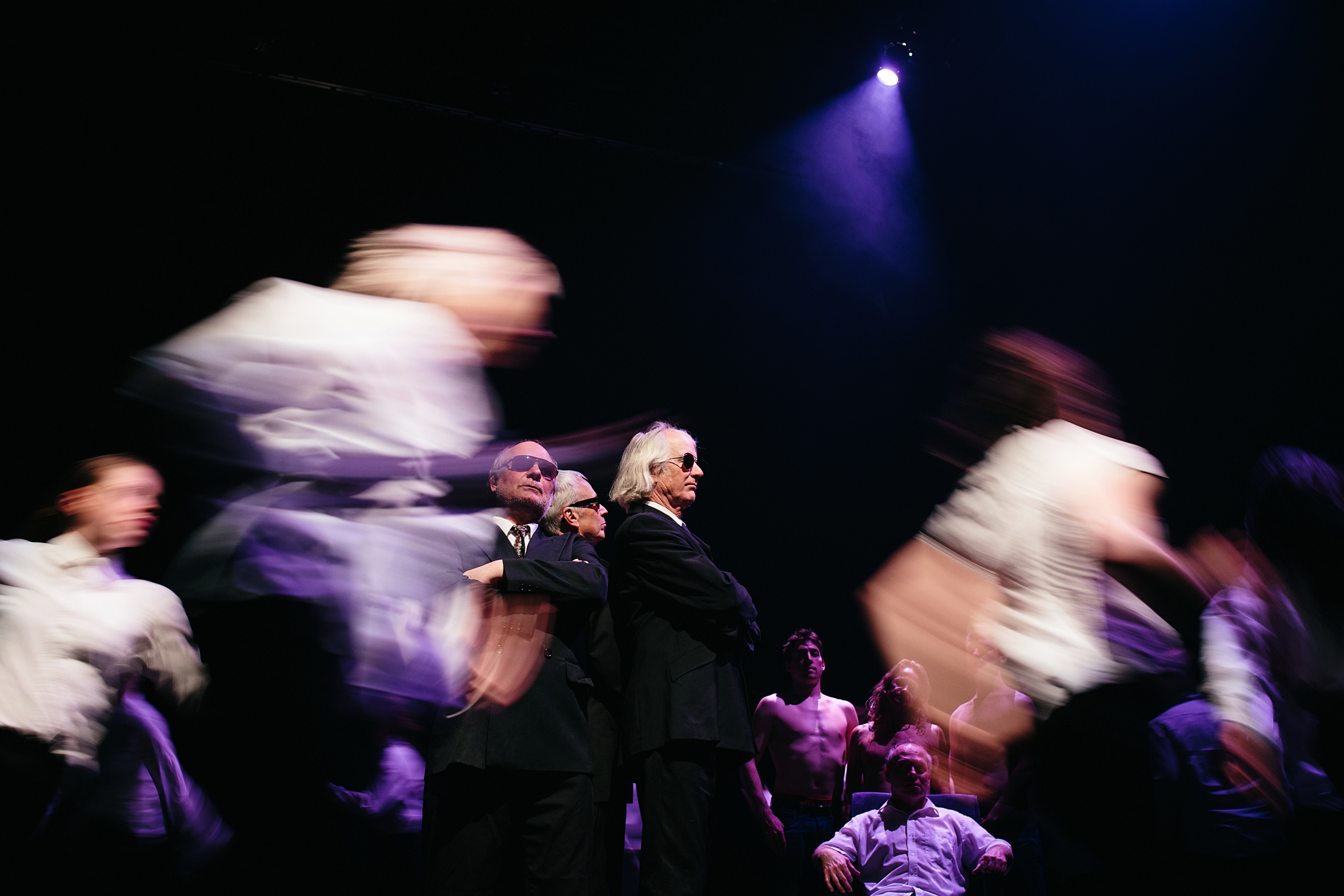
The Authorities (Doug MacLean, Kirk Miles, Bradley Struble) watch carefully over Denise Clarke’s beautifulyoungartists. Photo credit: Diane + Mike Photography.

Created and directed by Denise Clarke, Radioheaded 3: A Listening Party to Watch stages a vivid, politically charged interpretation of Radiohead’s 2003 album Hail to The Thief.

In its first few minutes, the show makes clear who its opponents are. Its opponents are the Authorities (Doug MacLean, Kirk Miles, Bradley Struble) – a trio of “capitalist assholes” in suits. Before he takes his seat, the group’s leader calls the audience a bunch of hippies “who probably voted for the NDP.” Yes, the three men are not far removed from the current political landscape.

A mad frenzy ensues as Clarke’s beautifulyoungartists enter the theatre. Almost immediately, the artists rush the audience in an effort to sell Happiness. “I need to fill my quota,” says one of the desperate artists in her sales pitch.

Corporate greed, social injustices, they are all fuel for rebellion, but no such uprising takes place here. Worked to the bone, the artists have no energy to revolt. Control and routine have subdued their anger, a fact the Authorities cherish.

Although, one man (Thomas Poulsen) holds out hope that change is possible. Trying to revive their spirits, he asks the artists not to give up and give in to the powers at hand. His efforts, however, are in vain. The one artist who rises up (Pamela Tzeng) is swiftly hammered down.

As the full album plays, the lyrics to every song are typed out on a large projection screen. Designed by Wil Knoll, the projected transcriptions feature typos, corrections, and other imperfections which complement the production’s overall raw qualities.

Though raw, the production never feels too loose, or out of control. Clarke’s beautifulyoungartists are a tight ensemble who demonstrate fearless commitment to the movement. (At one point, Poulsen’s bed spins wildly in circles centre stage with Tzeng hanging on one of its sides).

Where the production is weak is in its neon/glow-in-the-dark effects. The tape used to illuminate/outline the artists and props during one particular scene works only for a few, leaving some artists in the dark entirely. (Think of a series of bulbs where a handful are burnt out). So, while the idea is interesting, its execution leaves something to be desired.

Nonetheless, Radioheaded 3 is a visually exciting show that explores Hail to The Thief’s dread towards the future. Clarke holds a mirror to the audience and asks us to reflect on the conditions that make young people today feel so apprehensive about their futures.

Clarke’s Radioheaded 3 holds a tight grip on its audience from start-to-finish with its inspired movement that calls for action.


Produced by One Yellow Rabbit as part of Sled Island 2015, Denise Clarke’s Radioheaded Three: A Listening Party to Watch runs June 24 – 27 at the Big Secret Theatre (Arts Commons).

For more information about the show, visit: http://oyr.org/