The Truth, or Some Version of It: Theatre BSMT Stages Drader’s Liar at Motel Theatre

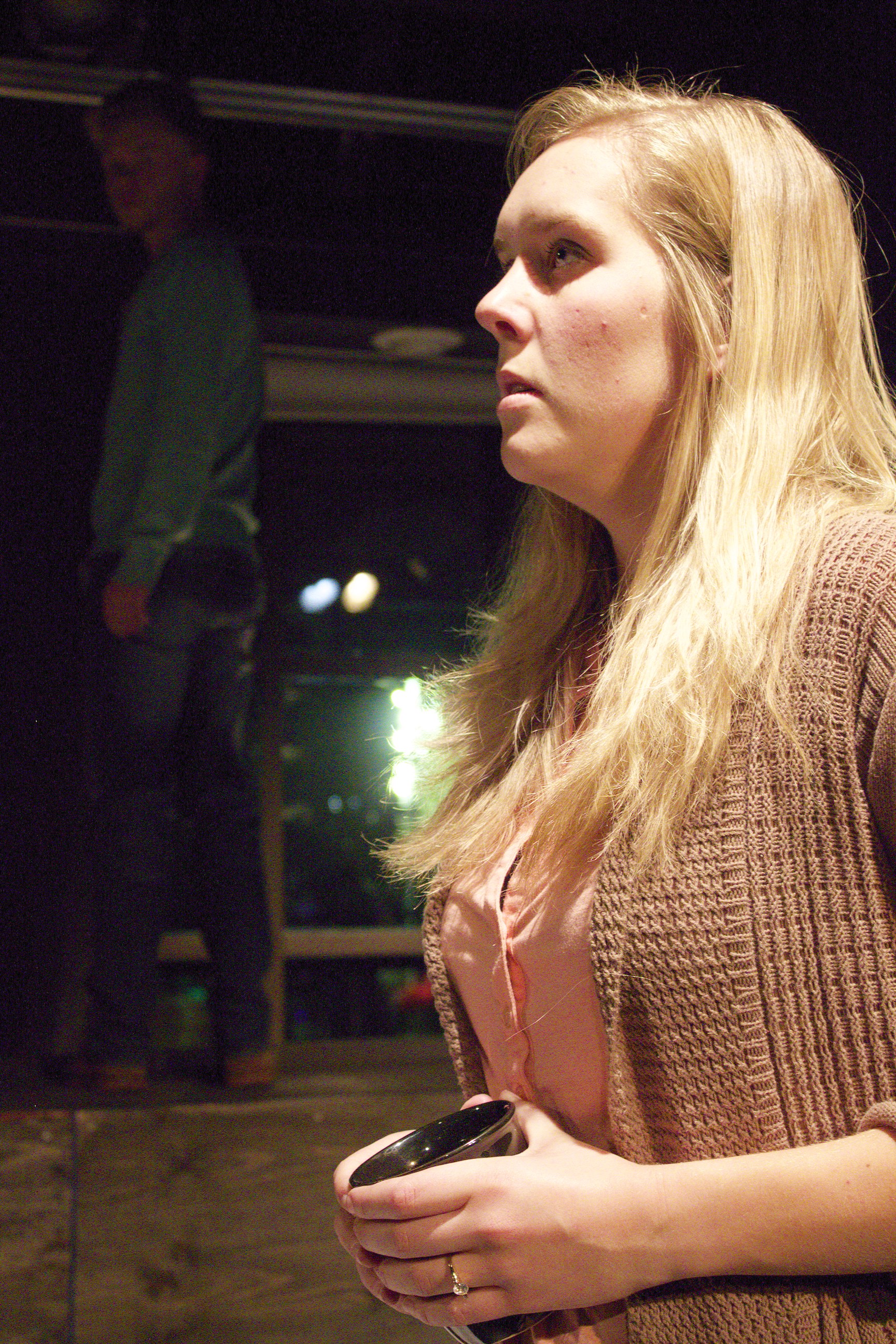
Theatre BSMT's season opener Liar, by Brian Drader, ran October 6 - 10 at Motel Theatre. Pictured: Carolyn Ruether (Sherri) with Simon Tottrup (Jeremy) in background. Image provided by Theatre BSMT.

Theatre BSMT’s season opener Liar, by Brian Drader, ran October 6 – 10 at Motel Theatre. Pictured: Carolyn Ruether (Sherri) with Simon Tottrup (Jeremy) in background. Image provided by Theatre BSMT.

The truth is invaluable, or at least we like to think it is. There are times when honesty is not the best policy because sometimes, the truth is unkind. When truth becomes displaced, white lies make lofty nests. And as Ben and Sherri Ingles (Grayson Ogle, Carolyn Ruether) discover in Brian Drader’s Liar, these nests are lined with patient thorns.

Presented by Theatre BSMT, Drader’s Liar tells a compelling story about family, loss, and the lonely journey towards closure. And it begins one night at a gay bar where Sherri’s estranged brother Jeremy (Simon Tottrup) meets a strange drifter named Mark (Corey Joyce). And maybe the reason why Jeremy joins Mark on the roof of a building for some beers is that he seems harmless enough, despite leading Jeremy on.

The next morning, Jeremy is found dead, and only Mark can answer the question of whether he fell or jumped.

Ben and Sherri’s marriage is in trouble, the love that was once there is just an act these days. Ever since their four-year old son disappeared, Ben and Sherri have never been the same. And so, Sherri becomes desperate to establish a relationship with the person who was there for her brother’s last hours in order to find closure. Unfortunately, the closure Mark provides is dishonest. Mark was neither Jeremy’s boyfriend, nor a co-worker at the hospital where he worked. Slowly, good intentions reveal themselves as something more sinister.

The Canadian playwright demonstrates the shattering effect of loss on the human psyche. Ben is quick to suspect Mark has ulterior motives, especially as he starts entering deeper and deeper into the couple’s personal lives, while Sherri takes anything this stranger has to say about Jeremy (and himself) as gospel. The audience may find Sherri gullible, if not totally irrational, but is she really? Consider how psychic mediums claim to have the gift of communicating with the deceased, and the fellowship they amass by those who so desperately want to believe. From the outside, the whole idea is nonsense, but to those affected by loss it is something, which is easier to accept than the complete absence of a person.

And it is this vulnerability that Mark preys upon. What makes Mark such a threat is that, as a drifter, he has nothing to lose, and everything to gain. Given this, Mark can be anything anyone wants him to be, as he shows with Ben who he wins over by becoming his new drinking buddy. In Mark, Drader reflects the malleability of truth, the versions of truth we seek out and, sometimes to our own peril, lose ourselves in.

Unfortunately, DJ Gellatly’s direction feels too relaxed for such a gripping narrative. If the production’s pace were tighter, then perhaps the pauses and silences would be more effective than they are. As it is, Gellatly traps himself and his actors within a fairly limited range where these breaks have little significance in the face of the menace and anger from which they are born from.

Where Gellatly has some success in the staging of this play is in keeping the actors actively involved at various periods within this web of broken truths on stage. Something so simple as having Ogle review his tapes downstage while a scene plays out upstage behind him benefits the dramatic tension by adding layers to the action.

Ruethers’ has some difficulty capturing the emotional nuance of her characters’ arc, effectively lacking punch when the script calls for it, but there are moments where the young actress really digs inside and shines. Ogle is very expressive as Ben whose emotions read clear across his voice, face and gestures. The actor moves with tremendous purpose, even when the character is unclear of the situation. And that makes it all the more unsettling how such a strong-willed character is won over by a mysterious stranger. Jeremy, who appears briefly throughout, is played well by Tottrup who delivers as a troubled youth in need of presence.

Joyce has the challenge of playing a manipulative character ready to change persona at the turn of a dime, and ultimately it does prove too challenging for the actor. A part of the problem is that Joyce rarely shows the same genuineness with Ben and Sherri that he does in scenes with Tottrup’s Jeremy. The audience is never given the chance to doubt Ben’s suspicions about Mark, to be surprised when Mark’s true colors are revealed. Joyce’s performance as the evening’s catalyst for emotional ruin leaves much to be desired.

The use of the Motel Theatre’s windows as both the city’s nightscape and Ben and Sherri’s house windows is smart given the theatre’s limited space. Lisa Floyd’s atmospheric lighting design makes the theatre space feel intimate, if not deeply personal.

Although it may fall short in some areas, Theatre BSMT’s production of Liar still manages to provoke its audience to consider the many ways we lie to each other and ourselves, and what that means in the long run. And no doubt audiences will think about this on their way home from the theatre.


Theatre BSMT’s production of Brian Drader’s Liar ran Oct 6 – 10 at Motel Theatre.

For more information about the show, visit: http://www.theatrebsmt.ca/Theatre_BSMT/Whats_On.html

Totally Rad: The Wedding Singer Comes to Stage West

Sammy (Ian Ronnigen), Robbie (Aidan Desalaiz), and George (Andrew McGillivray) are a hit at all the weddings in New Jersey. Image provided by Stage West.

Sammy (Ian Ronnigen), Robbie (Aidan Desalaiz), and George (Andrew McGillivray) are a hit at all the weddings in New Jersey. Image provided by Stage West.

From the loud colours to the big hair and questionable fashion, there is no doubt that the 1980s were truly outrageous. The 80s were also a lot of fun thanks to pop culture icons like Eddie Murphy, Madonna, Pac-Man, and the ever puzzling Rubik’s Cube. And now, Stage West Theatre Restaurant brings back, in full force, these memories of the 80s with The Wedding Singer, a totally rad musical comedy.

First produced on Broadway in 2006, The Wedding Singer is a musical based on the hit 1998 film of the same name, which starred Adam Sandler in the titular role. This quirky comedy tells the story of Robbie Hart (Aidan Desalaiz), a popular wedding singer from New Jersey. When his fianceé Linda (Sarah Horsman) dumps him at the altar, Robbie becomes disillusioned with love. All that changes, however, when Robbie falls for Julia Sullivan (Elicia MacKenzie), a waitress at the reception hall where he and his bandmates Sammy (Ian Ronnigen) and George (Andrew McGillivray) perform. Unfortunately, Julia is engaged to Glen Guglia (Kellan Ziffle), an obnoxious Wall Street banker.

For sure, The Wedding Singer (book by Chad Beguelin & Tim Herlihy) is light on character development and heavy on cliché, but is it ever a good time regardless. And a lot of that is thanks to director/choreographer Tim French and the talented cast of actors at his disposal.

Right away, French’s vibrant choreography for the musical’s opening number (“It’s Your Wedding Day”) captures the audience’s attention. Leslie Robinson-Greene’s bright, eye popping costume design is an attention grabber, too. And musical director Konrad Pluta and his band deliver a great sound for the production’s catchy musical numbers (music by Matthew Sklar and lyrics by Beguelin).

Desalaiz’s Robbie, a romantic sap to begin with, is played much like a lost puppy, although this puppy has serious (and hilarious) bite as heartbreak shows. Playing opposite Desalaiz is MacKenzie who brings a charming dorkiness to her role. And both actors really dig into the fact that their characters are in love with love, giving us an innocent clumsiness between the two as they come to slowly realize their feelings for one another.

And surrounding Desalaiz and MacKenzie are a group of oddball characters. Marcia Tratt delights as Rosie, Robbie’s rapping/breakdancing grandmother. (Yes, really). Dana Jean Phoenix plays Julia’s friend Holly, a spunky Madonna-esque character who dances like a maniac. (The bucket of water from Flashdance makes a cameo). And McGillivray who wins the audience over as a very flamboyant Boy George.

But what’s a shame about the great character work, by the ensemble too, is that pieces of dialogue are hard to hear, if not totally lost, over the sound system. The issue may be with the wireless microphones, but certainly the troubled dialogue does take the audience out of the action a bit.

Nonetheless, French knows how to stage a spectacle, to fill the stage with big, exciting movement. The actors make the most of otherwise flat characters by pouring their hearts into their performances. And really, issues aside, it’s hard not to feel a smile grow on your face in this lighthearted, outrageous throwback to the 80s.


Stage West’s The Wedding Singer runs September 4 – November 8.

For more information about the show and how to purchase tickets, visit: http://stagewestcalgary.com/the-wedding-singer/

I’ll Be Back Before Midnight Conjures Up Big Laughs, Big Scares

Ah yes, there’s nothing quite like the isolation of an old farmhouse to help calm the nerves. Who cares about the grisly murder from years ago, the ghost that haunts the home, and the madman still on the loose, they’re just stories, right? Well, time will tell.

Vertigo Theatre, in association with Western Canada Theatre, presents Canadian playwright Peter Colley’s I’ll Be Back Before Midnight as its 2015/16 season opener. Celebrated as one of Canada’s most widely produced stage plays, Colley’s I’ll Be Back Before Midnight conjures up big laughs and big scares in this thrilling tale of sanity and spirits.

Directed by Daryl Cloran, I’ll Be Back Before Midnight tells the story of Jan (Brieanna Blizzard) and Greg Sanderson (David van Belle), a married couple reunited in the country after Jan’s nervous breakdown. Greg, an archeologist, has rented the farmhouse so Jan can recover while he pursues his studies at the nearby quarry. Unfortunately for her, farmer George (Paul Cowling) has plenty of gruesome stories to share about the area and the house itself, disturbing an already spooked Jan. And when Greg’s manipulative sister Laura (Alana Hawley) comes to visit, Jan’s situation only goes from bad to worse.

With the play being set in the early 1980s, audiences will immediately notice the lack of modern technologies to not only debunk the supernatural (through an effective Google search), but also provide comfort, say via Skype, in this remote setting. And so, like campers around a fire, the audience is drawn into a world at the mercy of nature, the supernatural, and whatever horror lurks in the darkness of rural Ontario. The terror of the unknown is alive and well within these walls of a supposedly haunted house.

And there are plenty scares to be had, especially with the uncertainty surrounding Jan’s state of mind. Colley steers the audience between reality and fantasy in this narrative ripe with twists and turns. And there is no greater (stomach) turn than the unsettling relationship between Greg and Laura, which raises the eyebrows inside the theatre very high as it unfolds. Audience members will have fun deciphering the clues and questions that surface, though some might find the ending unsatisfying given the buildup.

The scares are made more effective by the humour found in Colley’s script. One moment, the audience enjoy the good, if slightly odd, nature of farmer George, played wonderfully by Cowling; the next – well, that would be a spoiler, but be assured that it is a visually exciting moment that has the audience jumping out their seats. Colley’s ability for both humour and horror, and the interplay between the them, is top-notch.

Precise direction by Cloran keeps the action light on its feet inside set designer Scott Reid’s cozy farmhouse. Jonathan Lewis’ sound design contributes greatly to the evening’s creepy atmosphere with its measured control.

Hawley delivers both menace and an eerie allure as Laura, a most unwanted house guest. Van Belle’s vitamin-obsessed, rational thinking Greg is played with superb timing and gesture. (Perhaps Van Belle will keep his truly retro running attire since he seems so confident in them!). Unfortunately, Blizzard has difficulty in riding the emotional ups and downs of her character, lacking the sort of nuance needed in such a dynamic script as this. Blizzard does shine, though, is in her scenes with Cowling, which are real gut busters, thanks to their great chemistry together.

Overall, Vertigo Theatre’s production of Colley’s I’ll Be Back Before Midnight is an enjoyable romp full of thrills and laughter. Colley proves himself a fine storyteller, demonstrating why this play is so widely produced. Those looking for a strong, early start to Halloween need look no further than Vertigo Theatre’s I’ll Be Back Before Midnight.


Vertigo Theatre’s I’ll Be Back Before Midnight runs September 19 – October 18th at Vertigo Theatre’s Playhouse.

For more information about the show and how to purchase tickets, visit: http://www.vertigotheatre.com/ill-be-back-before-midnight/

Medea Boldly Reimagined by Chromatic Theatre

Chromatic Theatre presents Euripides' Medea, its sophomore production. Pictured, left to right: Justin Michael Carriere, Carly McKee, Artistic Director Jenna Rodgers, Chantelle Han, Makambe K. Simamba, Ali DeRegt, in rehearsal. Photo Credit: Mike Tan.

Chromatic Theatre presents Euripides’ Medea, its sophomore production. Pictured, left to right: Justin Michael Carriere, Carly McKee, Artistic Director Jenna Rodgers, Chantelle Han, Makambe K. Simamba, Ali DeRegt, in rehearsal. Photo Credit: Mike Tan.

None can deny that the past few years have seen an increase in racial(ized) tension, particularly in the United States. The nation’s attention has been captured by recorded incidents of police brutality against African Americans, and the failure of the courts to serve justice. And so, none can be surprised that the marginalized have taken to demonstrations in order to spread the dehumanizing reality people of color face daily.

And one such demonstration is Chromatic Theatre’s bold production of Euripides’ Medea.

Directed by Alyssa Bradac, this ancient Greek tragedy tells the story of Medea (Chantelle Han), wife of Jason (Justin Michael Carriere), whose husband abandons her and their two sons for the daughter of King Creon (Carly McKee). The political marriage drives Medea to seek violent revenge against Jason, his bride-to-be, and her father.

Those familiar with the mythology surrounding Medea will know that she is a barbarian, a term used to identify non-Greeks. Medea’s foreignness puts her at a social disadvantage among the Greeks, a major reason why Jason wants to marry into Greek royalty as it would benefit him socially. And this marginalization is made worse by Medea being a woman.

In Greek society, Medea tells us, the husband rules his wife. Women are expected to stay home with the children, live private lives while their husbands engage with the public sphere. And worse still, Medea says, is that a woman cannot divorce without attracting disgrace. For Medea, it is an injustice that women lose independence, the capacity to act freely, upon marriage.

Given this understanding of the character, the audience struggles to reconcile both their sympathy and disgust for Medea when she murders her own children as part of her vengeance against Jason. And this reconciliation is made more difficult by Chromatic Theatre’s artistic choice to cast Medea as a person of color and Jason as a white man. For the colour conscious casting introduces new politics onstage, politics that its modern audience have seen unfold across the media in recent years.

From the beginning, we see develop the sort of oppressive conditions that encourage marginalized groups to gather and protest in order to make their issues known. At the same time, the audience sees how easy unrest can turn violent, as it did in Ferguson or during the 1992 Los Angeles riots, and that when it does there are no winners. Everyone loses, but none lose more than our children, the next generation who now inherit a prolonged history of hate and violence. The immediate sadness that washes over Han in the play’s final moments is not just for the loss of her two sons, but the possibility for peace which she has threatened with her actions.

Certainly, prejudice pushes Medea towards the edge, but what truly hurts her is the failure to properly dialogue with Jason who fails to grasp her perspective. Here, we are asked to question how often the public tries contextualizing the frustrations and anger of protesters? How often news media goes beyond simplified terms like ethnic violence or racial conflict and employs an intersectional approach to social issues? As we see, it is never just one thing, but multiple, interdependent factors e.g. race, class, gender. This particular staging of the play serves as both a call for understanding and a warning of the path we continue to travel down.

Bradac’s direction is strong, displays the sort of energy such a production requires. The Chorus (McKee, Jenna Rodgers, Ali DeRegt, and Makambe K. Simamba) is kept in fluid motion, involved in the horror of Medea’s revenge plan. Although, the use of pocket flashlights by the Chorus is awkward. The Chorus members shine light on whomever is making a character change, like McKee into King Creon or DeRegt into Aegeus. Besides the brief pause created by taking time to shine (a flimsy) light on someone, the flashlights feel unnecessary considering the effective change in tone and gesture the actors employ.

Han commands the stage as Medea, playing the character with great urgency. Truly, the actress gives a captivating performance as she makes immediate Medea’s desire for revenge, at the same revealing the hurt that motivates her vengeance. Carriere’s Jason is played with the most infuriating arrogance, well deserved for such a despicable, narrow minded character. What a treat it is for the audience when Han, an unstoppable force, meets Carriere, an immovable object, onstage. Simamba establishes a determined presence as Nurse. DeRegt has the misfortune of playing a character who appears for the sake of plot convenience. To her credit, the actress does what she can with what is given to her, unfortunately there is simply not much here. Though brief, McKee does well as Creon.

While yes, the production is a contemporary staging, it remains difficult to identify a clear aesthetic choice in Benjamin Toner’s costume design. The costumes are unclear in terms of what sort of setting or period they are supposed to reflect. In contrast, Kathryn Smith’s set evokes an earthy, at odds with both the natural and supernatural world feel, which is strongly emphasised by Miquelon Rodriguez’s ethereal sound design.

Ultimately, the experience of marginalized peoples comes alive in Chromatic Theatre’s thought provoking, socially relevant production of Medea. The company reimagines the politics of its tragic heroine for an age disturbed by profound, complex levels of dehumanization. A must see.


Chromatic Theatre’s Medea ran September 24 – October 3rd, 2015 at the Motel Theatre (Arts Commons).

For more information about the show, visit: chromatictheatre.ca

Misery Loves Company: Vanya and Sonia and Masha and Spike Opens ATP’s 2015/16 Season

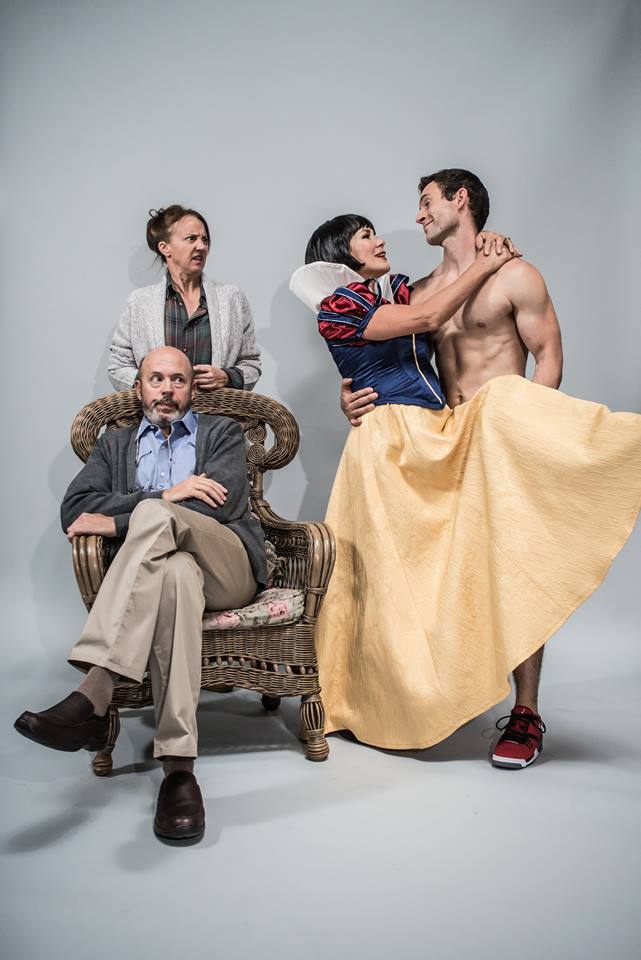
Directed by Glynis Leyshon, Christopher Durang's absurd comedy Vanya and Sonia and Masha and Spike opens Alberta Theatre Projects 2015/16 season. Left to right: Christopher Hunt, Lois Anderson, Sonja Smits, and Stafford Perry. Image courtesy of Alberta Theatre Projects.

Directed by Glynis Leyshon, Christopher Durang’s absurd comedy Vanya and Sonia and Masha and Spike opens Alberta Theatre Projects’ 2015/16 season. Left to right: Christopher Hunt, Lois Anderson, Sonja Smits, and Stafford Perry. Image courtesy of Alberta Theatre Projects.

Morning. Vanya and Sonia’s family home.

Unemployed and lacking purpose in their lives, middle-aged siblings Vanya (Christopher Hunt) and Sonia (Lois Anderson) indulge in self-pity, and listen to what prophecies their cleaning lady Cassandra (Nadien Chu), who no ever believes, has for them today. The day is set to be like every other day, that is until their sister Masha (Sonja Smits) makes a surprise visit home.

Opening Alberta Theatre Projects’ 2015/16 season is Christopher Durang’s Vanya and Sonia and Masha and Spike, an absurd comedy about three (im)mature siblings caught adrift in disappointment. Durang evokes elements of Russian playwright Anton Chekhov’s writing for this oddly touching, albeit flat, story of siblings trying to reconcile with each other and life’s what-ifs.

For 15 years, Vanya and Sonia cared for their parents, now deceased, while Masha made something of her life as a film actress. And despite their parents, whose love for community theatre led them to name their children after Chekhov characters, being gone, Vanya and Sonia’s lives remain in pause, burdened by discontent over what could have been. Thankfully, Masha’s film career has not only been able to pay for the home and all the bills, but also a small living stipend for her brother and adopted sister.

Underneath the shiny veneer of her film career, Masha’s life is rife with disappointment, too. After five failed marriages, Masha has landed herself Spike (Stafford Perry), a dumb-as-rocks boy toy who ‘almost’ got cast in the sequel to Entourage. Masha’s sense of superiority over her siblings is largely a facade to hide her own insecurities – which only worsen when the neighbor’s young niece Nina (Lara Schmitz), an aspiring actress, enters the picture.

Director Glynis Leyshon has the difficult task of staging Durang’s bloated script, which runs here two hours with a 20 minute intermission. The first act is certainly good. Sonia’s resentment over being adopted and ignored all her life makes tense her relationship with Masha, and uneasy Vanya who is caught between them. Anderson, Hunt, and Smits squabble as only siblings do, making for rich comedic moments as the strained dynamic between their childish characters develops. The dysfunctionality comes to a boil when Smit’s insensitive Masha tells Vanya and Sonia that she intends on selling the family home, effectively leaving them homeless. Like a rifle hanging on the wall, the audience waits to see what drama unfolds in the second act.

Misfire.

The second act sees the audience restless in their seats, which is too bad considering Leyshon finds something genuine for both Sonia and Vanya.

Over the phone, Sonia manages to develop a connection with someone she met at the neighbor’s costume party. Anderson’s timid vulnerability runs through excitement, self-doubt, and then self-affirmation, earning her well-deserved applause from the audience. Meanwhile, Hunt’s Vanya, disgusted by Spike’s ‘millennial’ ignorance, delivers an impassioned rant about the past, technology, and our increasingly isolated 21st century lives. Hunt’s convictions falter, however, as he slowly realizes that the past had its share of flaws too, eventually confronting the depressing idea that life has never been good. Regret for what was lost turns to regret for what can never be gained. Applause.

Beyond these two standout moments, the play’s second act feels hastily thrown together, almost like a mishmash of ideas. Certainly, Durang is something of an acquired taste, but here even those familiar with his work will feel dismayed by the playwright’s dull writing. Leyshon, as mentioned, does make it work to some degree, but unfortunately the script is too laden with Chekhovian decline.

Plain, but sophisticated with its fireplace and tall book shelves, Catherine Hahn’s rustic set is simply gorgeous. Hahn’s set embodies a pristine, frozen in time quality that reflects well the state of the characters whose discontent line the antiquated walls.

Really, ATP’s production of Vanya and Sonia and Masha and Spike is fun, thanks to the talent of its cast. Perry has plenty fun flaunting his sculpted physique as the underwear clad Spike. Chu hams it up to great effect for the crazed, prophesy spewing Cassandra. Schmitz’s peppy, doe eyed Nina plays a molecule in a ridiculous play-within-a-play about climate change. Unfortunately, a sluggish second act fails to deliver, leaving the audience ready to exit before curtain.


Alberta Theatre Projects’ production of Christopher Durang’s Vanya and Sonia and Masha and Spike ran September 15 – October 3rd, 2015.

For more information about the show, visit: http://atplive.com/whats-on/vanya-and-sonia-and-masha-and-spike/

Lemoine’s What Gives? Sweeps Audience Off Their Feet

Stewart Lemoine's What Gives? opens Lunchbox Theatre's 2015/16 season. From left to right: Niel Minor, Jamie Matchullis, Katherine Fadum, Mathew Hulshof. Photo Credit: Benjamin Laird Arts & Photo.

Stewart Lemoine’s What Gives? opens Lunchbox Theatre’s 2015/16 season. From left to right: Niel Minor, Jamie Matchullis, Katherine Fadum, Mathew Hulshof. Photo Credit: Benjamin Laird Arts & Photo.

Pip Furlong (Matthew Hulshof) and Everett L. North (Neil Minor) are going to write a hit Broadway musical! Yes sir, you betcha they are! The songs just have to leap off the pages, that’s all. And they will, in time. Hopefully.

Opening Lunchbox Theatre’s 2015/16 season is Stewart Lemoine’s musical comedy What Gives?, with original songs by Gary Lloyd and R.J Smart. A spirited homage to silver screen musicals of the 1930s, Lemoine’s What Gives? promises a smile on every face with its catchy musical numbers that whisk us away to a bygone era.

Directed by Mark Bellamy, What Gives? sees struggling songsmiths Pip and Everett trying to write a musical about an enchantress who turns men to pigs. The idea is a hard sell, but the two men really think they can make something of it. The only problem is, they’re going nowhere fast. Everett firmly believes the two should leave their run down Manhattan loft and find inspiration, while Pip thinks they should stay put and keep away from all distraction.

Enter adventuress Venice Drake (Jamie Matchullis) and her companion Allure Potemkin (Katherine Fadum), two glamorous women from Canada who, by fate it seems, happen to know a thing or two about musicals.

Despite being light on plot, as musicals of the time were, those familiar with the movie musicals Lemoine pays homage to will find plenty to embrace here. Lemoine, enraptured by nostalgia, keeps it simple by delivering the romance and flirty, playful dialogue one expects from these musical affairs. Lloyd and Smart’s vibrant musical score, brought alive by musical director Joe Slabe, captures the heart of those sounds from the past.

And it is especially hard not to fall in love in with this show when you have an ensemble who shine as bright as Fred Astaire’s smile. Matchullis dazzles as the blonde bombshell, and Fadum delights with her sassy attitude. Hulshof and Minor display great charisma and timing with their brotherly banter.

The action moves briskly and seamlessly from one number to the next thanks to Bellamy’s clear direction. The show’s 45 minute runtime comes up almost too soon as a result, unfortunate for those wanting to spend a little more time with these characters.

Ultimately, Lemoine’s What Gives? is a wonderfully bright and well-rounded trip down memory lane. With plenty of fun for everyone, audiences will be sure not to miss Lunchbox Theatre’s season opener.


Lunchbox Theatre’s What Gives? runs September 12 – October 3.

For more information about the show and how to purchase tickets, visit: http://www.lunchboxtheatre.com/what-gives/

LaBute’s The Money Shot Takes Aim at Hollywood, Fame

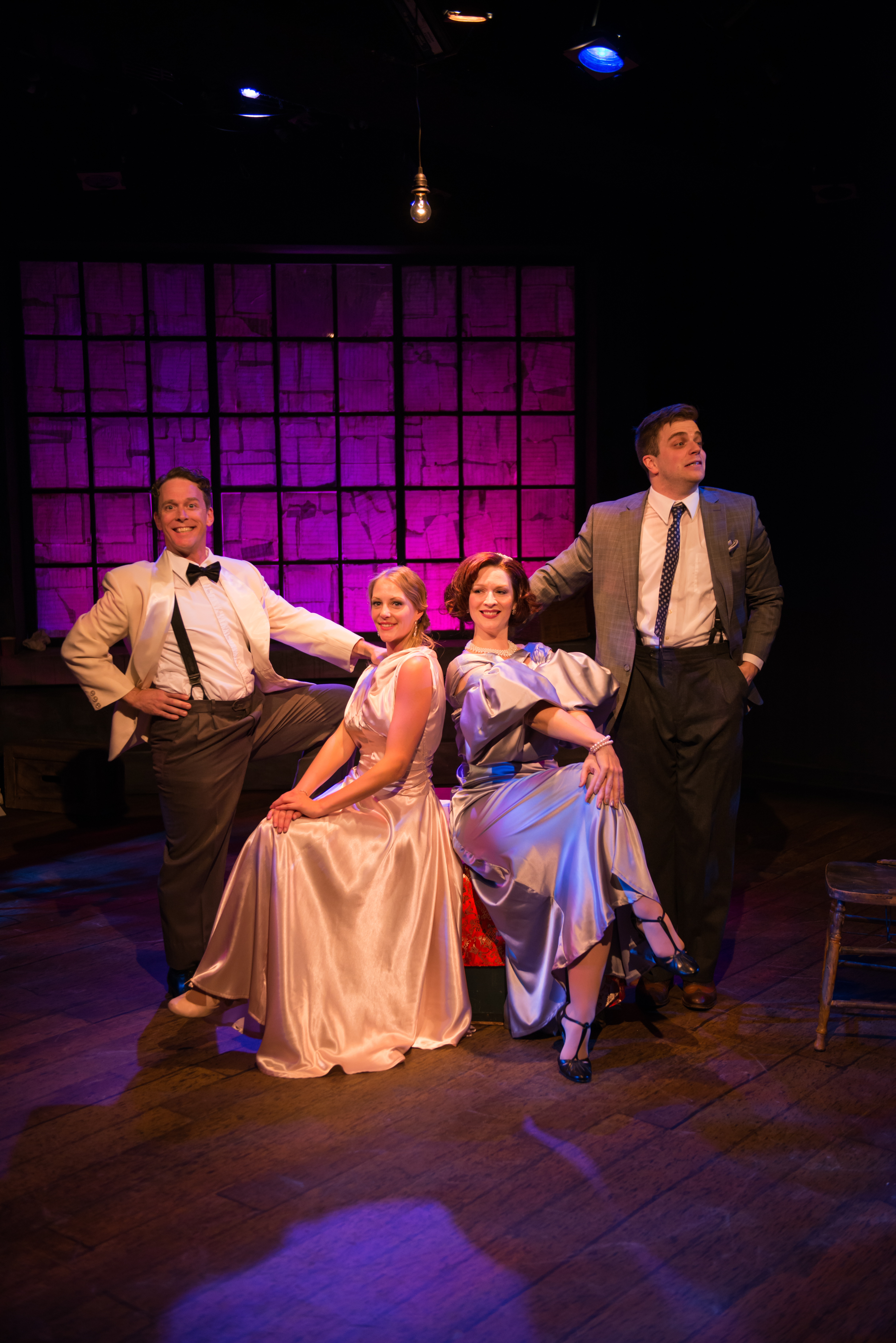
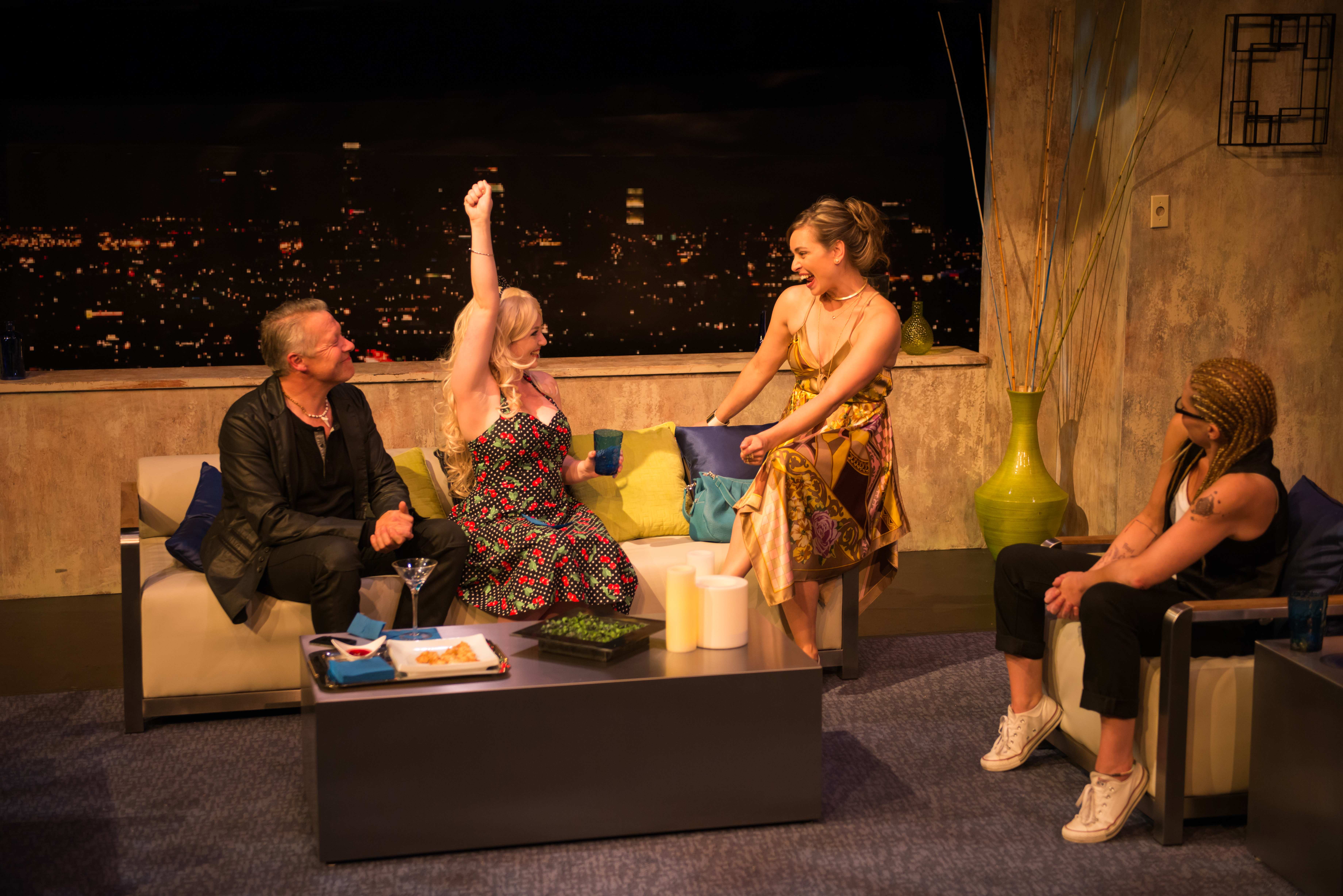
Ground Zero Theatre and Hit and Myth Production bring Neil LaBute's Hollywood satire The Money Shot to Calgary. From left to right: Joel Cochrane, Brianna Johnston, Daniela Vlaskalic, and Chantal Perron. Photo Credit: Benjamin Laird Arts & Photo.

Ground Zero Theatre and Hit & Myth Production bring Neil LaBute’s Hollywood satire The Money Shot to Calgary. From left to right: Joel Cochrane, Brianna Johnston, Daniela Vlaskalic, and Chantal Perron. Photo Credit: Benjamin Laird Arts & Photo.

Hollywood, the home of American cinema and celebrity. The average person can only dream of the sort of lavish lifestyles that the stars enjoy. But all that glitters is not gold, especially not in Tinseltown.

A vicious satire of Hollywood, Neil LaBute’s The Money Shot stages two aging movie stars desperate to make a comeback by any means necessary. The question is, is a comeback possible in such a toxic industry?

Directed by Ron Jenkins, The Money Shot sees Steve (Joel Cochrane), a greying action star, and his 24-year-old wife Missy (Brianna Johnston) visiting Karen (Daniela Vlaskalic) and Bev (Chantal Perron) at their luxurious Hollywood Hills home. The purpose of the visit is to discuss Steve and Karen’s latest film project which calls for the actors to have real sex on camera. Going that far for their art would undoubtedly revive their careers, say Steve and Karen to their respective partners, hoping to gain their approval.

And the audience might have sympathy for Steve and Karen if it were not for the fact that they both represent the worst of Hollywood stardom. Neither shows any grasp on reality, nor any capacity to think about anyone besides themselves. However, there is an important difference between the two actors in that Karen’s problems largely stem from the entertainment industry’s double standards against women

Ever since she came out as bisexual, Karen’s career has never been the same. Nowadays, Karen spends less time acting and more time trying to stay relevant through her lifestyle blog and advocacy, really any opportunity to have her name appear somewhere. And as the years pass, she feels herself fading from a world where all opportunity was once at her fingertips. Her world now belongs to young, beautiful starlets like Missy – even if they are as talentless as they are clueless.

In contrast, old age has ‘rewarded’ Steve with a wife half his age, executive producer credits, and an inflated ego. Although he may not get the parts he used to, Hollywood has shown itself to be much kinder to Steve than Karen, despite Steve being a downright despicable human being. Steve’s misogynistic, homophobic, and racist remarks are so brazen that one has to wonder if anyone besides Bev has ever dared challenge him. The sense is no, considering Steve doesn’t blink at the idea of physically defending his male privilege.

LaBute perhaps enjoys too much indulging in that which he criticizes, but Jenkins is careful to remind us of the play’s satirical nature. The characters in the room meet Cochrane’s utmost conviction in what he says with bewilderment, disbelief that someone could be that stupid. Jenkin’s attentive direction offers relief for the audience who might otherwise feel uncomfortable at the barrage of vulgarity LaBute launches our way. (Though, Jenkins has some difficulty keeping our interest near the end of the play’s two hour run).

In finding some nuance in LaBute’s brash, unapologetic script, Jenkins and company are able to draw big laughs from the audience.

Vlaskalic carries herself as if she’s on the Today Show, trying to peddle the latest fad with whatever sincerity Karen has left in her. Add in the dramatics of Norma Desmond (“I am big!”), and you have a stellar performance. Johnston plays Missy, the bubblegum actress (with the mouth of a sailor) with delight. Perron commands the stage as Bev with just the strength of her demeanor, and her eroding willpower to sit as the only sane person in this room flooded with narcissism. And these great performances give Cochrane plenty of room to play, buttons to push as he charges into each scene with Top Gun levels of confidence.

And JP Thibodeau’s exquisite set serves as a fitting backdrop for the blockbuster disaster that befalls the entire evening.

Ultimately, LaBute’s The Money Shot sinks its teeth into Hollywood, and takes a bite out of an industry that celebrates itself at any opportunity. Audiences will burst at the seams when they enter LaBute’s world of washed up talent and biting zingers. Ground Zero Theatre and Hit & Myth Productions deliver an uproarious evening at the theatre.


Ground Zero Theatre and Hit & Myth Production’s The Money Shot runs September 10 – 19 at Vertigo Theatre’s The Studio.

For more information about the show and how to purchase tickets, visit: http://www.groundzerotheatre.ca/upcoming.html

The Shoplifters’ Canadian Premiere Fizzles

The Shoplifters

Morris Panych’s The Shoplifters premiered last year at Arena Stage in Washington, D.C. (From left to right: Anna Cummer, Stephan Hair, Jeff Lillico, and Nora McLellan). Photo Credit: Trudie Lee.

Theft, it’s a victimless crime, at least for veteran shoplifter Alma (Nora McLellan) it is. Because really, in the grand scheme of things, who’s going to miss two juicy cuts of steak?

Enjoying its Canadian premiere at Theatre Calgary, Morris Panych’s The Shoplifters stages questions about theft in a world ruled by the almighty dollar. For what is a five-finger discount compared to global corporate greed, the sort of which devastates poor regions of the world?

Directed by Haysam Kadri, The Shoplifters sees Alma and her mousy associate Phyllis (Anna Cummer) waiting to be released by security for stealing two steaks. Eager to put away the two criminals, rookie security guard Dom (Jeff Lillico) spares no effort trying to break Alma and Phyllis in hopes of gaining a written confession. Dom’s efforts are in vain, however, when Alma proves to be a worthy, unyielding opponent. Phyllis, who could have spent the day at her unfulfilling job, is not so keen on defying the law any further, risking her and Alma’s release.

For boy scout Dom, the law is black and white; criminals are criminals. Dom’s textbook knowledge of the law is challenged by Otto (Stephan Hair), a weathered security guard, who sees things differently. Otto argues that criminals are not always bad people, that sometimes people break the law not because they want to, but because they have to. For Otto, who Dom will be replacing, thinking about the law in terms of black and white does little to help the people it is supposed to protect.

As far as Alma is concerned, anyone and everyone at the bottom is being taken advantage of on a daily basis. Everyday, the average person is made a victim of theft by the outrage prices they have to pay in order to satisfy a basic human need. Shoplifting might be wrong, but what big chain supermarkets do daily is even worse.

Indeed, Panych gives plenty to chew on, but unfortunately there is little to support his arguments beyond hypotheticals and grand statements.

Alma’s acerbic charm is without substance. We gain only glimpses of Alma’s personal history and inner motivations, and rarely are these glimpses made known by her personally. Alma’s elusiveness is maybe taken too far for the character’s own good. And what’s strange is that Panych lets the fact that Alma has cancer float around, rather than pursue that angle in the interest of justifying her worldview. Perhaps the playwright feels that sickness needs no further exploration beyond its initial introduction, that it simply speaks for itself.

After developments occur between Otto and Alma, the play looks to Dom as its main antagonist. In order to fulfill that role, Panych has Dom turn from boy scout to religious nut. The character’s fanaticism is exasperating; a joke savagely run into the ground.

Really, Panych almost seems to lose interest in what the play has to say just by the way he over stuffs the second act with stale physical gags. The playwright’s sharply written dialogue slides into broad strokes, effectively losing focus on both the characters and bigger picture at hand.

Nonetheless, Cummer delights as Phyllis, winning the audience over nearly every time she plays onstage. The audience roars with laughter as Phyllis retrieves an absurd amount of grocery items from under her dress, eventually bursting into applause for what is a genuinely hilarious moment.

Set designer Ken MacDonald’s immense wall of boxes is visually striking, and a strong reminder of the imposing corporate influence Alma so very much detests.

Ultimately, Panych’s The Shoplifters has difficulty sustaining its big ideas without resorting to over the top, slapdash antics. A weak start to Theatre Calgary’s 2015/2016 season.


Theatre Calgary’s The Shoplifters runs September 1 – 27 at the Max Bell Theatre (Arts Commons).

For more information about the play and how to purchase tickets, visit: https://www.theatrecalgary.com/2015-16/the-shoplifters

Hoodlum Theatre’s Debut Production Impresses

Forsooth, My Lovely

David Belke’s Forsooth, My Lovely marks Hoodlum Theatre’s first company outing. From left to right: Andrew Burniston, Bianca Wu, Thomas Rayment, Griffin Cork, and John Tasker. Centre: Malik Elassal, Jane Wishart. Photo Credit: Benjamin Laird.

When Detective Birnam Wood (Griffin Cork) is on the case, everyone in the city of Padua is a suspect. Yes, everyone including Romeo Montague (Malik Elassal), Katherine Minola (Jane Wishart), and even the prudish Malvolio (Thomas Rayment).

A clever parody of film noir and the Bard’s best works, David Belke’s Forsooth, My Lovely imagines a seedy, corrupt world inhabited by Shakespeare’s most well-known characters. With dames, swords, and strong performances, Hoodlum Theatre’s inaugural production sets the bar high for the young company.

Directed by Karen Johnson-Diamond, Belke’s Forsooth, My Lovely follows Birnam Wood as he sets out to solve a case of blackmail that threatens to ruin a rich merchant’s family. In his search for answers, however, Birnam comes across a gallery of Shakespearean characters who make it obvious that something more sinister is afoot in Padua. Twists and turns in the case eventually see Birnham caught in a dangerous web of deception.

The manner in which Belke presents film noir’s defining elements – heavy disillusionment, moral decay at the heart of an urban centre, trench coats and trilbys – within a world where the characters speak in blank verse, but dress in 1940s fashion, is marvelous. The juxtaposition of styles makes for cheeky moments of self-awareness, which the ensemble is careful not to overdo. For that is the success of such a production, a clear understanding of the genre and what it is the playwright is parodying.

And none – which is a tough evaluation considering the talent present – demonstrate a better understanding of the genre than Wishart. Wishart plays the ‘shrewish’ Katherine with the edge of a femme fatale; independent, subversive. Wishart speaks as if engaged in a sparring match where she intends on coming out victorious.  At the same time, too, there is a vulnerability underlying Wishart’s performance which reveals itself in full form near the play’s end. Add in Wishart’s aptitude for accents, and you have an all-around stunning performance.

Belke’s script does require a certain degree of familiarity with Shakespeare’s collection of works in order to truly appreciate the playwright’s numerous winks and nods. (And the same could be said about film noir, but to a lesser degree). Those not so much in the know will still find the show very enjoyable, but may feel left out of the loop at times.

The production sees some issues in the way of actors tripping over dialogue. Fight sequences are loose and sluggish. And Cork’s toothpick is more a distraction than anything else. (A toothpick may work on film, but not on stage where every movement, no matter how small, is picked up by the audience).

Those issues aside, the tight-knit ensemble under Johnson Diamond’s sharp direction carry the two-hour long show well, which is made more impressive considering the multiple characters each actor (except for Cork) plays throughout the show.

What makes Belke’s Forsooth, My Lovely ideal as an inaugural production is that it offers plenty for actors to sink their teeth into. And the young talent here have done so boldly in the interest of proving themselves as emerging artists.

Hoodlum Theatre’s debut shows great promise for the company moving forward.


Hoodlum Theatre, in association with Calgary Young People’s Theatre, presented David Belke’s Forsooth, My Lovely at the West Village Theatre, Aug 19 – 23.

For more information about Hoodlum Theatre, visit: http://www.hoodlumtheatre.com/

A Pure Delight: Smee’s Secret Wins Over Audience at Calgary Fringe Festival

DSC_0134

Smee’s Secret won Outstanding Production at the 32nd Annual Calgary One Act Play Festival. (Pictured: Olive (Emma Sinclair) and Pistachio (Kelly Malcolm) with Smee, their cardboard box friend) Photo Credit: Kathryn Smith.

What a task to describe The Tighty Whities’ latest show Smee’s Secret. For sure, the clown duo’s award-winning show is nothing short of wonderful.

The genius of Smee’s Secret lies in its deceptively simple premise: two clowns help their cardboard box friend complete his bucket list. One moment, Olive (Emma Sinclair) and Pistachio (Kelly Malcolm) are caught up in their child-like sense of wonder and imagination; the next their friend Smee feels very ill. Massage, medication, nothing the clowns try appear to help Smee. The total suddenness of it all drives the clowns to figure out something, anything. Uncertainty, desperation, anger, Olive and Pistachio’s emotional journey might ring familiar for any who have experienced loss in their own lives.

By dealing with the topic of loss under the guise of a silly clown show, Sinclair and Malcolm catch the audience by surprise, but it is not the sort of surprise that clunks the audience over the head. The reason is that Smee’s Secret is, at its core, a story about friendship. What does it mean to be a friend, especially during hard times? Olive and Pistachio learn that while everything else may fail, the strength of friendship always remains. Sometimes the most important thing we can do for our friends is simply be there for them. So, this is not a show about loss per se; it is a show about how we love and say goodbye to the ones we care the most about.

There is plenty of fun, too, in the mix. Through the power of montage (set to the tune of Hall & Oates’ You Make My Dreams Come True), Olive and Pistachio clear the items off Smee’s list in no time. Outside help from the audience is required at one point as the clowns invite an audience member to sit down for a romantic date with Smee. Olive and Pistachio act as chaperones, giving the two pointers along the way in what is a charming little scene.

Olive and Pistachio are so easy to fall in love with because of the sincerity Sinclair and Malcolm bring to the stage. And so, it is no surprise that the audience send Olive and Pistachio off to their next adventure with enthusiastic applause.

Imaginative, magical, Smee’s Secret delights with its special blend of humour and heart.


The Tighty Whities’ Smee’s Secret ran July 31st – August 8th as part of the 2015 Calgary Fringe Festival.

For more information about The Tighty Whities, visit: http://www.thetightywhities.com/