Drip, Drip, Drip: Vertigo Theatre Wades Through The Turn of The Screw

Turn of the Screw 0098 NB1_9712.jpg

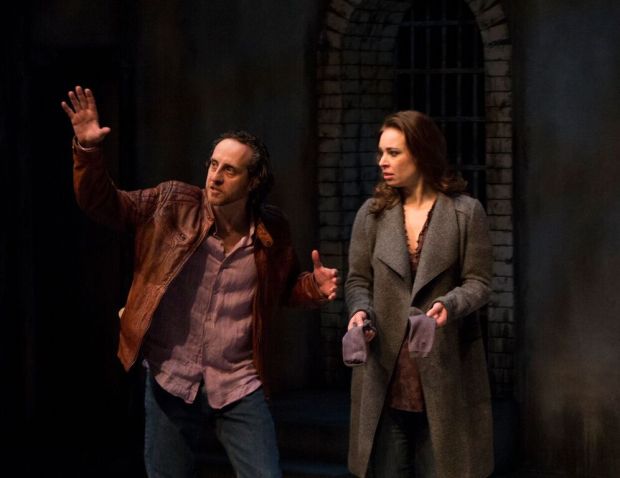
Myla Southward and Braden Griffiths in Vertigo Theatre’s The Turn of The Screw. Photo Credit: Benjamin Laird Arts & Photo.

Henry James’ 1898 ghost story The Turn of The Screw is steeped in ambiguity. Are there spirits alive in the countryside or are the demons more psychological in nature? Both explanations are terrifying, but unfortunately the terror of James’ tale is watered down at Vertigo Theatre.

Adapted for the stage by Jeffrey Hatcher, The Turn of The Screw tells the story of a young governess (Myla Southward) hired to take care of two orphaned children living in their uncle’s country home. The children’s uncle (Braden Griffiths) asks the governess not to bother him in London with any sort of communication. Given total charge, the inexperienced governess does the best she can with Miles, a troubled boy discharged from school, and Flora, a young girl who chooses not to speak. Strange events begin not long after the governess’ arrival, namely the appearance of ghosts. The housekeeper Mrs. Grose confesses that the previous governess, Miss. Jessel, died on the grounds, along with her lover Peter Quint. Fearing the children’s safety, the governess tries solving the mystery of the apparitions before evil overtakes the household.

Common to ghost stories, the wilderness hides many evil things, and here it is no different. The supernatural lurks in the garden and outer limits of the estate. Set designer Scott Reid has constructed a unique set where the gothic estate shares space with a flooded downstage area. The presence of live water works marvelously in showing the encroaching wilderness, or darkness. Narda McCarroll’s striking lighting work adds layers to the water by making it appear soft and still in some moments, then hard and violent in others. Yes, the actors become absolutely drenched by the end of it, and that’s delicious symbolism for any English majors in the audience. The trouble is, the inventive staging does little for Hatcher’s weak adaptation.

Hatcher’s stage adaptation calls for only two actors, with the male actor taking on multiple roles. Griffiths plays the uncle, Miles, Flora, and Mrs. Grose. Griffiths goes on his knees to play schoolboy Miles, then leaps up to play Mrs. Grose, a shrill old woman. The actor’s character transitions are more comical than anything, winning (perhaps) unintended laughs from the audience. They also become messy as the narrative nears its climax, since now all the characters come into play together.

And with fewer players, the narrative’s possible outcomes become limited too, taking away some of James’ original ambiguity.

Director Ron Jenkins keeps the action moving at a brisk pace, but even still the story never quite hits its groove. Hatcher’s adaptation has difficulty bringing together all its elements in a cohesive, compelling manner. The payoff rests in the spectacular visuals than in the plot. Nonetheless, Jenkins displays a good eye for blocking actors and producing frights.

Southward delivers a strong performance as the young governess thrust into a world of spirits, demons of the past. A little water does little to stifle Southward’s intensity as her character’s own sanity starts to crack under pressure. Transitions aside, Griffith plays the menace well here with his deep, booming voice. He stalks and creeps like a shadow.

Hatcher’s adaptation suffers from a limited cast of actors, and a loose delivery of James’ classic ghost story. Vertigo Theatre’s production of The Turn of The Screw delivers in the visual department, but fails to produce intrigue worthy of a visit.


Jeffrey Hatcher’s The Turn of The Screw runs March 12 – April 10 at Vertigo Theatre (The Playhouse).

For more information about the show, including how to purchase tickets, visit: http://www.vertigotheatre.com/mystery-series


A Knockout: Cseke’s The Fight or Flight Response Enters The Ring

20160308 Fight or Flight RG 08.jpg

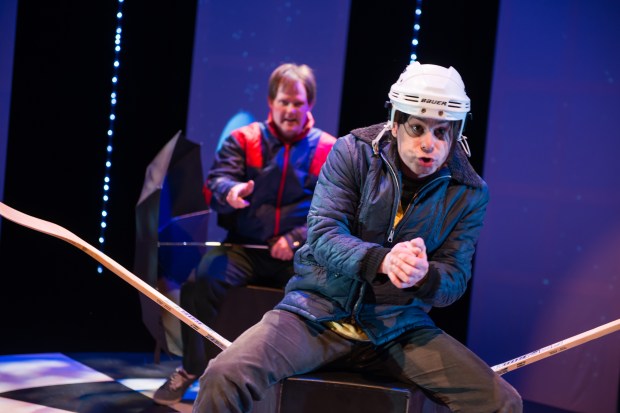
Verb Theatre presents The Fight or Flight Response by Col Cseke, March 10-19 at the Joyce Dolittle Theatre. Pictured, L to R: Justin Michael Carriere and Nathan Pronyshyn. Photo Credit: Rob Galbraith.

On its surface, Col Cseke’s The Fight or Flight Response is about two guys trying to escape their unfulfilling lives.

By day, Kevin (Justin Michael Carriere) is an Assistant Manager at Subway; by night he is a mixed martial arts fighter training for his first professional MMA fight. On the verge of turning thirty, Kevin sees the fight as his last first experience ever, a thought that motivates him even more to win and climb the professional ladder.

On the flip side, Kevin’s long-time friend Doug (Nathan Pronyshyn) is struggling to get away from the MMA scene altogether. Doug’s problem is that he has very little experience with anything outside of fighting. Before working full-time at Mohammed’s MMA Gym, the thirty-two year old slung coffee at Tim Hortons. Doug knows he wants to do something else with his life, but he just doesn’t know what that something else looks like. Paralyzed by fear and indecision, Doug hopes for some external force to move him in one direction or another.

This Verb Theatre production is staged inside the Joyce Dolittle Theatre, a small but malleable space. Costume and Set Designer Victoria Krawchuk has transformed the space into a MMA gym, equipment and all. The theatre’s brick walls add to the grittiness of the space, and the drama that unfolds during very real and brutal fight sequences (Fight choreography by Karl Sine with Pronyshyn and Carriere).

As mentioned, Cseke’s play is in some parts about these two friends trying to turn their lives around, but really the play is about the many problems with traditional masculinity, namely the emotional disconnect that young men experience. Traditional masculinity dictates that young men ought to keep their emotions bottled inside, that showing emotion is a sign of weakness. About the nature of fighting, Kevin muses that guys like fighting because it’s the only time when human contact between men is acceptable. Guys can’t touch other guys otherwise, he says, unlike girls who can make contact with other girls whenever. And so, following these lines, young men remove themselves emotionally in two ways, from the self and from others.

So, it’s no surprise that the men in Cseke’s play have such a hard time not only describing what they’re feeling, but then sharing that with someone else. For them, the only thing that makes sense is fighting, knowing that someone wins and someone loses at the end of a match. Support, not competition, it’s a novel idea.

Director Kelly Reay pursues this awkwardness between Kevin and Doug by having both actors never quite engaging each other directly, not until the heated finale anyway. Maybe the best way to describe Reay’s direction is by comparing it to when people walk aimlessly around their homes while on the telephone. The actors play or distract themselves with the various equipment laying around the gym while digging deep into their character’s emotional well. It’s a funny thing at first, but then we realize that these distraught characters would need to distract themselves in order to be so open about their emotions. And the actors are most usually talking to each other from afar, growing that emotional distance even further. Excellent direction by Reay who succeeds in pulling the actors and action together at the end.

Pronyshyn and Carriere display tremendous vulnerability in this raw, engaging production. The actors speak volumes through their movement alone. It’s fascinating just how much non-verbal communication is expressed during the training periods, and other blows exchanged between the two. What’s exciting, too, is the sense of immediacy that the actors draw from their characters’ seemingly hopeless lives. The big life changes, they have to happen now or never. Time is not something people can fight, but only accept.

A riveting piece of work by Cseke, and a knockout production from Verb Theatre.


Verb Theatre’s The Fight or Flight Response by Col Cseke runs March 10 – 19 at the Joyce Dolittle Theatre (Pumphouse Theatres).

For more information about the show, including how to purchase tickets, visit: http://www.verbtheatre.com/season/


Cockroach Crawls Under Canada’s Skin

unspecified-1

Haysam Kadri and Daniela Vlaskalic in Jonathan Garfinkel’s Cockroach, based on the novel by Rawi Hage, running now at Alberta Theatre Projects (March 1 – 19). Photo Credit: Kara Sturk.

Based on the 2008 novel of the same by Canadian author Rawi Hage, Jonathan Garfinkel’s Cockroach is a story about failure, namely the failure of multiculturalism in Canada. Uncomfortable truths come to surface in this play that rips the seams of our nation’s beloved cultural mosaic during a time of heightened awareness around newcomers and refugees.

Enjoying its world premiere at Alberta Theatre Projects, Cockroach stages the journey of an unnamed Middle Eastern immigrant (Haysam Kadri) in 1990s Montreal. The play opens with The Narrator waiting patiently for Shohreh (Daniela Vlaskalic), a troubled young woman from Tehran, in the dingy basement of the restaurant where he works, as a busboy. Through flashbacks, the audience learns more about the Narrator’s past  in his home country, and his experience living in Canada as an immigrant. More about the Narrator’s life is revealed during his state-mandated therapy sessions with Genevieve (Carmen Grant), a psychiatrist whose privilege as a white Canadian stands as an obstacle between the two.

Gun in hand, the Narrator continues waiting for Shohreh in the present, preparing himself for a decision that will change his life forever.

Addressing the Syrian Refugee Crisis, Garfinkel writes (in his Playwright’s Notes) that Cockroach is not about the debate surrounding whether or not to let refugees into Canada, but about life after arrival for immigrants. The play goes beyond the feel-good propaganda of multiculturalism, choosing to present instead a less-than-glamorous portrayal of a predominantly white society where racial prejudice and discrimination exist, whether the Canadian public wants to believe it or not.

From the bottom looking upwards, the Narrator sees Canada as a nation of hypocrites. Lying underneath Canada’s “perfect white skin” is a history of cultural genocide, systemic racism and fear of the Other – which presented itself in full force during the 2003 SARS Outbreak. Genevieve buys into the myth of Canadian multiculturalism, while the Narrator lives its failed promises everyday, making their relationship tense as a result. Although he may be uneducated and afflicted by mental health issues, the Narrator’s difficulty adjusting to life in Canada is not made any easier by living in the slums of a country steeped in inequality.

Interestingly, the very thing that ties the Narrator home is what help him survive on a daily basis – storytelling. Sometimes, stories are all immigrants really have when they arrive, and it’s through metaphor that the Narrator can make sense of the world he lives in.

The problem with Garfinkel’s Cockroach is that the play falters in the middle, loses steam from an otherwise strong beginning. Kadri’s devilish charm adds plenty of punch to his character’s zippy one-liners about Canada, but even his charm can’t help the problems that come from relying on a narrator and flashbacks to tell a story. The show has a little more in common with an audiobook than a fully staged production. Events in the narrative are relayed primarily through the Narrator, with occasional glimpses to the events themselves. The narrative suffers from this abundance of talk that acts as a wall between itself and the audience, resulting in an experience that is somewhat difficult to invest into emotionally.

Director Vanessa Porteous, artistic director of ATP, brings a keen sense of space to the production, a premiere of a new Canadian play. Kadri’s character identifies, intimately, with cockroaches, insects that are known as survivors of even the worse conditions (like nuclear wastelands, a popular myth). Most importantly, the cockroach is mobile. Porteous’s direction sees a strong sense of displaced movement onstage, the type of movement expected from an outsider in a hostile environment. Porteous gives the actors breathing room to react big and almost candidly (well, as candid as can be for a scripted show). Even still, the play’s lengthy narrations remain spatially uninteresting, and that’s likely due to the limited cast available to give the story more dimension, both dramaturgically and spatially.

Narda McCaroll’s appropriately ‘grimey’ set is cast in layers of shadows by Anton de Groot’s lighting design. Groot’s lighting work is important to distinguishing the social tiers Kadri’s character visits, by legal means and otherwise, over the course of the play. The higher he travels, the more light there is on stage, and vice versa. Cockroaches flood the stage thanks to clever projection design by Amelia Scott and Joel Adria.

Again, Kadri’s charm gives energy to the play. The Narrator is deeply flawed, engaging in misogyny and theft at every corner, but Kadri makes us root for the underdog, hope that the character’s inner-goodness – the kind that betrays good-natured people – pulls through. Meanwhile, Vlaskalic plays her character with a defensive edge, an edge with many sides. She and Kadri share great chemistry as they encounter each other from such different, but not distant emotional levels. Vlaskalic shines in the play’s final moments, delivering an intense performance. The well-intentioned Genevieve is not such a straight-forward role as it may seem. It’s not just a psychiatrist assessing the mental state of a Middle Eastern immigrant, but a person of privilege reassessing the state of their country’s imagined national identity. Grant successfully brings out these dimensions as she plays Genevieve with just a hint of ignorance, and a feigned sense of relation to the Narrator.

Issues aside, Garfinkel’s Cockroach is a play that deserves our attention as it offers insight into Canada’s cultural landscape from an often ignored perspective. Or, if not ignored, a perspective taken over by well-meaning (white) Canadians. ATP’s production of Cockroach is relevant, bold, and likely to ruffle a few feathers.


Jonathan Garfinkel’s Cockroach, based on the novel by Rawi Hage, runs March 1 – 19 at Alberta Theatre Projects.

For more information about the show, including how to purchase tickets, visit: http://atplive.com/whats-on/cockroach/

An earlier version of the review incorrectly credited Anton de Groot for the cockroach projection work. The review has been updated to credit co-projection designers Amelia Scott and Joel Adria appropriately.


Hijinks Galore: Suite Surrender Lands At Stage West

Diva Wars

Michael McKeever’s Suite Surrender runs Feb 12 – April 17 at Stage West. Pictured, left to right: Chantal Perron, Charlie Gould,  Kevin Hare, Elizabeth Stepkowski Tarhan, and Trevor Rueger. Photo Credit: John Watson.

The war comes home when Hollywood rivals Claudia McFadden (Elizabeth Stepkowski Tarhan) and Athena Sinclair (Chantal Perron) land at the Palm Beach Royale Hotel in Michael McKeever’s Suite Surrender.

That’s what Bernard Dunlop (Kevin Hare), the Palm Beach Royale’s general manager, fears at least, that total war will break out with Claudia and Athena staying in the same hotel. The two divas are at the Palm Beach Royale for a USO fundraiser, and have been given separate rooms, on separate floors, on totally opposite ends of the hotel. All good and well until Bernard realizes that, through some mix up, Claudia and Athena are booked to stay in the same room, the presidential suite.

Uh oh.

Trying to keep the two singers out of each other’s sight is a Herculean task, one that drives Bernard nearly mad. To make matters worse, the Navy is run amok in the hotel, setting ‘small’ fires in the lobby among other mischief. The USO’s fundraiser sponsor Mrs. Everett P. Osgood (Susan Johnston-Collins) tells Bernard to let the boys be, that they’re just blowing off steam. Not exactly what Bernard wants to hear, especially when bumbling bellhops Francis (Adrian Sherpherd) and Otis (Scott Olynek) are doing little to help the situation.

Suite Surrender is a breezy comedy of errors that demands a lightning-fast pace, and director J. Sean Elliott brings exactly that and more to this excellent Stage West production. Once all the pieces fall in place, the show takes off like a fighter jet and delivers non-stop laughs. In fact, the energy is so overwhelming that the set, designed by David Smith, wobbles almost every time a door is shut.

The set has four doors: two for the bedroom, one for the closet, and then the entrance door. As the show’s stakes escalate higher and higher, so does the movement on stage. The actors run in and out of the doors, shutting the doors firmly behind them. The first mishap comes when Hare’s Bernard breaks the closet door, with an unconscious Dora Del Rio (Natascha Girgis) behind it, taking the door off some hinges. The second mishap, one of the bedroom doors is shut and causes drinking glasses to fall high from the adjacent shelf, resulting in broken glass onstage. Very strange that no one thought to better secure the glasses given the onstage action.

The ensemble deals with the mishaps very well, a testament to their talent. Unfazed, the ensemble continue delivering superb performances. Tarhan and Perron are exquisite in their respective roles, each a force to be reckoned with. Perron’s man-hungry Athena pulls attention everywhere she goes with her sultry voice, while Tarhan’s Claudia commands attention with her booming voice and dominating presence. Trevor Rueger’s meek Mr.Pippet, Claudia’s assistant, is a hilarious contrast to Tarhan’s character. (Tarhan, Sherpherd, and Rueger share a great “this is not what it looks like” moment). Hare plays Bernard, the anchor to all the madness, with great delight as he descends further and further into desperation.

Olynek and Sherperd make a great pair together, and always shine in their scenes. Athena’s assistant Murphy is played with a sweet demeanor by Charlie Gould, an actress with great facial expressions. And let’s not forget about the cute dog who plays Mr. Boodles, barks and other dog noises provided by sound designer Michael Gesy, and behaves without issue.

McKeever’s Suite Surrender is a real gut buster. Audiences looking for an uproarious evening at the theatre will not want to miss its run at Stage West. Under Elliott’s direction, the ensemble deliver a whirlwind experience where big, hearty laughs escalate to the kind of laughs that leave people gasping for air.


Stage West’s production of Michael McKeever’s Suite Surrender runs Feb 12 – April 17.

For more information about the show, including how to purchase tickets, visit: http://stagewestcalgary.com/suite-surrender/


U of C’s SCPA Knocks Molière’s The Learned Ladies Out of The Park


TQN_3202.jpg

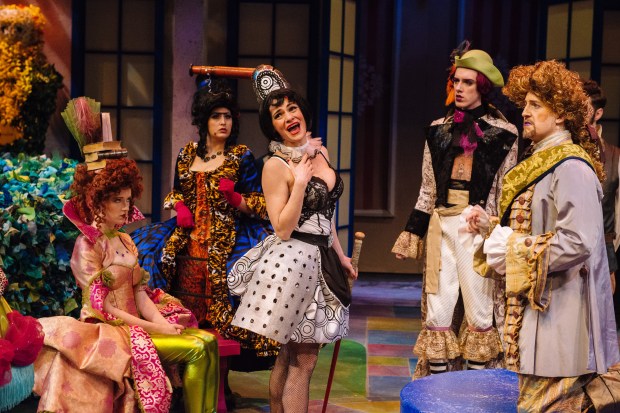
The University of Calgary’s School of Creative and Performing Arts presents The Learned Ladies by Moliere, runs Feb 16 – 27. Pictured, left to right: Vanessa Wenzel, Vanessa Jette, Pryscil Daigle, Connor Pritchard, and Logan Teske. Photo Credit: Citrus Photography.

Everything about the University of Calgary’s School of Creative and Performing Arts’ production of Molière’s The Learned Ladies is big, bright, and savagely funny. A master of the form, comic dramatist Molière’s scathing satire of pompous academics and pretentious learning finds a home in the most appropriate of places, a university. And here, inside the University Theatre, the laughs are plentiful, and the social commentary as sharp as a fine blade.

Directed by Inouk Touzin, The Learned Ladies tells the story of Henriette (Natasha Strickey), a young woman whose ‘learned’ family makes her life unbearable. Henriette’s sister Armande (Vanessa Wenzel) is obsessed with cultivating her mind through books and philosophy. Armande becomes furious at her sister when Henriette tells her she plans to marry Citandre (Andy Weir), or give into base desires as Armanda sees it. Henriette’s overbearing mother Philaminte (Onika Henry) disapproves of the marriage, preferring instead that her youngest daughter marry Trissotin (Connor Pritchard), a haughty scholar and poet revered by Philaminte and her sister-in-law Bèlise (Vanessa Jetté).

Henriette’s father Chrysale (Logan Teske) and his brother Ariste (Dylan Forkheim) are her and Citandre’s only allies in the household. Unfortunately for the young lovers, Chrysale is more mouse than man, especially when it comes to dealing with his wife Philaminte.

Molière’s disdain for so-called intellectuals brings to mind Woody Allen’s 1977 film Annie Hall. In the film, Allen’s character Alvy Singer retreats away from a stuffy cocktail party to watch the Knicks on TV, telling his  wife later: “it’s one thing about intellectuals, they prove that you can be absolutely brilliant, but have no idea what’s going on.” Molière’s intellectuals in The Learned Ladies are exactly that, brilliant but unable to see what is right under their nose. Bèlise – who ironically wears a telescope on her head – thinks that Citandre telling her that he is in love with Henriette is some sort of ruse to hide his true feelings for her, despite him repeatedly telling the desperate woman otherwise. Armande is unable to understand why Citandre stopped courting her and then fell in love with her down-to-earth sister Henriette. Armande fails to see the incompatibility between herself and Citandre, displaying a lack of emotional intelligence on her part.

Touzin stages a fun BDSM affair between Chrysale and Martine (Pryscil Daigle), a house servant. Philaminte charges into the garden, angry that Martine is still around after committing such a severe crime – a crime worse than theft. The crime? Bad grammar. Here, Teske’s Chrysale shows great relief that Philaminte doesn’t know about the scandal right in front of her, and also frustration (sexual and otherwise) that such a capable servant is being dismissed for illegitimate reasons.

April Viczko’s gorgeous set and costume design, an explosion of colour “designed in punk-rococo style,” reflects Molière’s cautious attitude towards the pursuit of knowledge. Not all learning is bad, Molière argues, but not all teachers are right. On the outside, the pursuit of knowledge is a glossy, wonderful thing – which is why so many young people are encouraged to attend university, even if it’s not for them – but once inside, it is filled with insufferable frauds, like Trissotin who has more interest in money than poetry, and self-important people. Viczko’s bright costume colours mask the ugliness of learned people whose true colours are yet to be revealed.

Under Touzin’s robust direction, the ensemble brings to life madcap garden antics that elevate Molière’s satire. Henry brings a larger-than-life presence to matriarch Philaminte, a woman who none in her household dare defy, making her and Teske dynamic all the more hilarious. Dressed with a comically-sized unibrow (the hungry caterpillar, anyone?), Jetté’s physical comedy shines in every scene as she animates Bèlise with sickly, exaggerated expressions that win big laughs from the audience. Daigle is a real treat to watch onstage as she plays Martine with a mix of flirtatious poise and unyielding resolve. Daigle, too, brings plenty of bite to the character by speaking Chiac – a major contrast to the learned ladies’ elegant, grammatically correct French.

Pritchard plays Trissotin with the most hateful arrogance, animating the despicable character as someone who celebrates every single thought they vomit into existence. Pritchard’s portrayal is like a nightmare between Lady Gaga and that annoying know-it-all freshman student whose ‘genius’ is misunderstood.

Strickey’s Henriette is considerably less of a loud-mouth than the learned ladies around her. Still, Henriette is not afraid to speak her mind, and Strickey delivers the heat with cool confidence. Wenzel demonstrates a needed insecurity behind Armande’s snobbish behaviour, as Armande is the most ‘human’ of the learned ladies – the other two are largely caricatures. Armande’s insecurity really comes when Wenzel and Weir’s Citandre clash. Weir does very well playing the audience’s outlet for their frustration towards the pseudo-intellectuals.

Brilliant direction, visually striking design, and strong performances make the SCPA’s production of Molière’s The Learned Ladies a smashing success.


The University of Calgary’s School of Creative and Performing Arts’ production of Molière’s The Learned Ladies runs Feb 16 – 27 at University Theatre.

For more information about the show, including how to purchase tickets, visit: https://scpa.ucalgary.ca/events/learned-ladies


Ground Zero Theatre Summons The Force For ‘Boy’s Own Jedi Handbook’

Boys Own Jedi Handbook 0487 NB1_7067.jpg

Karl Sine and Christian Goutsis in Stephen Massicotte’s The Boy’s Own Jedi Handbook, presented by Ground Zero Theatre. Photo Credit: Benjamin Laird Arts & Photo.

Forty years after the original movie’s release, and Star Wars continues to dominate our galaxy. Star Wars: The Force Awakens, the seventh and latest entry in the sci-fi series, has smashed box-office records, earning $2 billion worldwide, and proved that the cultural phenomenon is not going away anytime soon.

Given the recent awakening of The Force, Ground Zero Theatre could not have picked a better time to stage Stephen Massicotte’s The Boy’s Own Jedi Handbook, running now at Vertigo Theatre’s Studio.

The year is 1977, and The Kid (Christian Goutsis) has just had his mind blown away by Star Wars: A New Hope. Star Wars is all the 10-year-old can talk about, much to the annoyance of his mother. Lucky for him, his obsession with Star Wars makes him a new friend in detention. James (Karl Sine) and The Kid bond over their love of Star Wars, recreating the movie the best they can with burlap sack jedi robes, cardboard tube lightsabers, and other junk laying around.

For anyone familiar with The Complete Works of William Shakespeare (Abridged), imagine almost exactly that but with Star Wars. Goutsis and Sine win howling laughter from the audience as they blow through just about every iconic scene from the original movie, voices and all. The madcap action is brilliantly directed by Ryan Luhning, artistic director of Ground Zero Theatre.

Massicotte’s play is not just about Star Wars, of course. The play is largely a coming of age story about a lonely boy who survives moving to a new city and going to a new school with help from The Force. Massicotte goes beyond Star Wars as a cultural juggernaut and explores why so many have fallen in love with the franchise. For The Kid, Star Wars is not just a movie, but a world he can escape into where the good guys win. A needed escape from the trials and tribulations of grade 4.

The second half sees James and The Kid now in junior high. Junior high is a different beast altogether, as boys and girls are going around town. Star Wars: The Empire Strikes Back is just around the corner, but this time James and The Kid have company. Kerry (Amber Bissonnette) and Mandy (Sarah Wheeldon) ‘bump’ into the boys at the movie theatre, later inviting them to go roller-skating for a (disastrous) double date.

The young romance is all kinds of sweet and awkward, as the characters dance around the obvious. (Jedi training doesn’t say anything about first kisses!).

The genius of Massicotte’s play is its universality, despite being grounded in Star Wars fandom.  Audiences will likely be thrown back to their own wonder years, for better or for worse, by this fun, compelling story about friendship and growing up in an era far, far away. Children, too, will enjoy this wildly imaginative production that bridges generations of Star Wars fans together.

Sine’s fight choreography is made even more epic by JP Thibodeau’s striking lighting design. (Yes, that scene between Darth Vader and Luke happens, and it is glorious). The choreographed fights are a sight to see, along with the creative use of different materials to re-construct big set pieces from the movies.

With something for everyone, including young padawans, The Boy’s Own Jedi Handbook is a must-see.


Ground Zero Theatre’s The Boy’s Own Jedi Handbook runs Feb 11 – 21 at Vertigo Theatre’s Studio.

For more information about the show, including how to buy tickets, visit: http://www.groundzerotheatre.ca/


It’s Always Wine O’Clock at Book Club


Book Club 0636 NB1_6512.jpg

The cast of Meredith Taylor-Parry’s Book Club at Lunchbox Theatre. Pictured (left to right): Anna Cummer, Cheryl Hutton, Kira Bradley, Arielle Rombough, Kathryn Kerbes. Photo Credit: Benjamin Laird Arts & Photo.

Moms go wild in Meredith Taylor-Parry’s Book Club.

Enjoying its world premiere at Lunchbox Theatre, Book Club stages a group of moms who meet weekly to talk about some book no one ever bothers to read. The thing about book club, it’s just an excuse to have a glass of wine (or two) in the afternoon. Everyone’s in the loop except for Ellen (Anna Cummer), an uptight helicopter parent whose children follow a strict gluten-sensitive diet.

This week’s meeting is hosted by Lisa (Cheryl Hutton), an easy going mom with a not-so-easy time cleaning up her house for the ladies. Ellen arrives with her mother Mary (Kathryn Kerbes) just as Lisa finishes cleaning the kitchen floor with baby wipes. A very pregnant Kathy (Kira Bradley) arrives soon after, a relief for Lisa who can’t tolerate Ellen’s bragging about her perfect children. To the group’s surprise, Jenny (Arielle Rombough) is late. Supermom Jenny is never late.

A couple of drunk texts later from Jenny, and the women are off to find their missing friend in all of the unlikeliest places – a strip club, a tattoo parlour, and the airport.

Taylor-Parry’s Book Club is a comedy of familiarity, of knowing nods and quiet agreement from its mainly female audience. Lisa’s frustration at trying to tidy up while keeping an eye on her mischevious children draws big laughs as it’s one of those “yup, been there, done that” moments. For Taylor-Parry, however, it’s not just about showing the stresses of motherhood, but also talking through them, no matter how difficult the conversation.

Beneath the play’s rich humour are layers of anxiety and insecurities towards motherhood. Even Ellen doubts her parenting, and she does everything by the book, or whatever research study is trending. As the women discover, there is no manual for mothers and mothers-to-be. A lot of it is trial and error, that’s how it was for Mary whose “old school ways” were exactly that. With this uncertain territory comes a need for support, ideally in the form of friendship and maybe not a glass of wine (or two) in the afternoon.

Taylor-Parry’s serious concern for mothers and their mental health is beautifully expressed by Rombough in the play’s last moments. Rombough’s erratic, party girl behaviour is anchored by a genuine sincerity that offers plenty reflection on the work-life balance some mothers struggle with daily.

Director Shari Wattling is gifted with a truly outstanding cast for this book club meeting that’s anything but boring. There’s plenty of great things going on, from Cummer’s signature hyper-neuroticism running against Kerbes’ elegant maturity to Hutton’s splendid talent for physical comedy. Add in Bradley’s hilarious maneuvering of her comically-sized belly (costume design by Deitra Kalyn), and the laughs are non-stop. Watting’s snappy direction gives the actors room to play, while also being mindful of the final destination. Excellent direction for a ‘journey play’, which can sometimes drag and lose the audience along the way.

Scenic & Lighting Designer Anton de Groot’s versatile set changes from messy kitchen to strip club to rough street area with ease. Allison Lynch’s robust sound design brings the club alive with heart-pounding beats.

A brilliant script, strong direction, and outstanding cast make Meredith Taylor-Parry’s Book Club worth signing up for.


Meredith Taylor-Parry’s Book Club runs Feb 8 – 27 at Lunchbox Theatre.

For more information about the show, visit: http://www.lunchboxtheatre.com/book-club


World Premiere: Vertigo Theatre Visits Calamity Town

Tyrell Crews as Ellery Queen in CALAMITY TOWN by Vertigo Theatre's BD&P Mystery Theatre Series_CREDIT Tim Nguyen

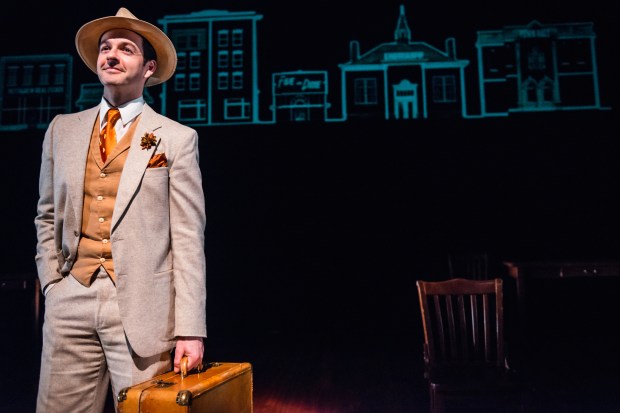
Tyrell Crews as Ellery Queen in Joseph Goodrich’s Calamity Town, based on the novel “Calamity Town” by Ellery Queen. Calamity Town is part of Vertigo Theatre’s BD & P Mystery Theatre Series. Photo Credit: Tim Nguyen.

Based on Ellery Queen’s 1942 novel of the same name, American playwright Joseph Goodrich’s Calamity Town is everything idyllic about small-town America with the exception of one small thing – murder.

Enjoying its world premiere at Vertigo Theatre, Calamity Town tells the story of mystery author Ellery Queen (Tyrell Crews) who travels to the fictional town of Wrightsville, USA to work on a new novel. In order to properly study the community and its residents, Ellery uses the name Ellery Smith to conceal his true identity from the townspeople. (In real life, Ellery Queen is itself a pseudonym for cousins Frederick Dannay and Manfred Bennington Lee!).

Once in town, Ellery decides on renting Calamity House for the duration of his visit, fascinated by the history behind the supposedly jinxed home. The story goes, Jim Haight (Curt McKinstry) ran out on Nora Wright (Julie Orton) on the couple’s wedding day, disappearing for years. Ever since then, Calamity House, a name given by the townspeople, has sat empty beside the Wright family home.

Empty until Jim returns, unannounced, after three years away.

Jim and Nora marry, much to her mother’s chagrin, but their marriage is soon disturbed by a sinister discovery. Ellery and Nora sister’s Patty (Lindsey Angell) find letters that suggest someone is going to poison Nora.

Directed by Craig Hall & Nathan Pronyshyn, Goodrich’s adaptation of Calamity Town feels very similar in tone to Our Town by Thornton Wilder, a contemporary of Queen. Like the people of Grover’s Corner, the cast, acting like a chorus, establish details about the town of Wrightsville, and other narrative points. John Webber’s minimalist set reinforces the similarity between both works, as does Jamie Nesbitt’s slick projection work. In place of set pieces, Nesbitt’s projections display the various locales around town, zooming in for interior scenes when necessary. The projections are not only visually fascinating, but also effective in creating smooth, cinematic scene transitions.

While Ellery and Patty’s investigation is central to the plot, there is a strong emphasis on the various relationships between characters – much like Our Town. Audiences expecting a drab murder-mystery will be pleasantly surprised by the show’s genuine humour, which a few times leans awfully close to sit-com territory.. A good deal of the play’s humour comes from Ellery’s Big Apple wit, or arrogance depending who you ask, that fails to properly adjust itself for life in the easygoing town of Wrightsville.

Although the mystery itself is fairly thin, Hall & Pronyshyn manage to stage Queen and Patty’s investigation in a highly engaging manner. At various points, details of the investigation are examined via tableaux, or frozen picture, where Queen points to the particulars of the scene. Hall & Pronyshyn’s direction is abundant in theatrical play, with hints of cinematic influence, resulting in an enchanting production that hooks the audience from the start.

Crews’ charm is certainly a highlight in this group of outstanding talent, but it’s Angell who really stands out in the mix. Angell’s pep as the youngest Wright daughter is reminiscent of another fictional small-town character – Scout Finch from Harper Lee’s To Kill A Mockingbird. Patty is much older, of course, but the same rebel energy is there. In any case, Angell is wonderfully entertaining, especially when she plays against Kyle Jespersen’s hot-headed Carter Bradford. Angell and Crews make an exquisite pairing. Chris Hunt and Karen Johnson-Diamond are delightful as John and Hermione Wright. Both veteran actors really get a chance to display their comedic chops in not just their primary roles, but also secondary roles. (Johnson-Diamond gets right just about every dance/drama teacher ever).

Contrary to its name, Calamity Town is anything but disastrous. What Vertigo Theatre has here is a real winner. Gifted with a stellar cast, Hall & Pronyshyn’s ingenious staging add layers of theatrical excitement to an already brilliant adaptation by Goodrich.  A must-see.


Joseph Goodrich’s Calamity Town runs Jan 23 – Feb 21 at Vertigo Theatre.

For more information about the show, including how to purchase tickets, visit: http://www.vertigotheatre.com/calamity-town/


Life, Death and The Blues Stages a Musical Conversation About Culture

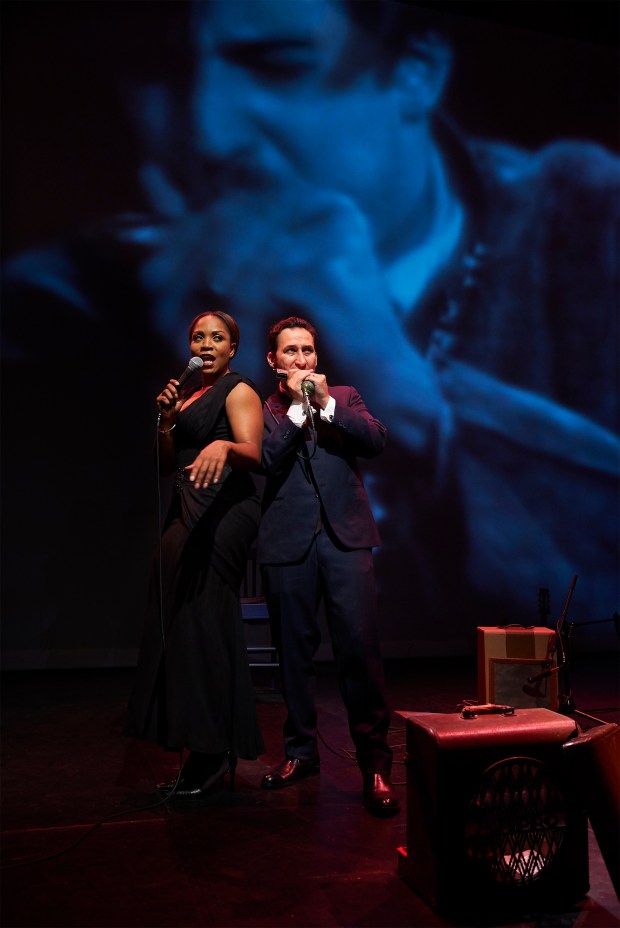
LDB - Divine Brown and Raoul Bhaneja - Michael Cooper.jpg

Divine Brown & Raoul Bhaneja in Life, Death and The Blues. Photo Credit: Michael Cooper.

Raoul Bhaneja lives and breathes the blues. Actually, one might say Bhaneja is something of a blues nerd. Ask him about the history of the blues, and he’ll share with you all sorts of facts and information about the greats. Bhaneja is also quite talented at playing the harmonica, or mississippi saxophone. Not a big surprise given that he fronts Raoul Bhaneja and The Big Time, an award-winning Canadian blues band active since 1998.

The question is, does Bhaneja truly understand the blues?

A Theatre Passe Muraille production, in association with Hope and Hell Theatre Co., Life, Death and The Blues is a night of social commentary splashed with music. Bhaneja, who wrote and conceived the show, is joined by Juno-award winning R & B and Soul singer Divine Brown. Together, Bhaneja and Brown stage a dialogue concerning cultural ownership.

Bhaneja is not black, and therefore he can’t understand the blues, argues Brown, a woman of color. Born to an Indian father and Irish mother, Bhaneja’s experience as a ‘beige’ man is not comparable to that of a black man. The blues, Brown says, tell a long history of racial inequality in America and struggle that persists today. The African-American experience is the blues, and vice versa. Experience is not something so easily taken away from any book, or trip down south visiting important blues figures.

As part of their (hit-and-miss) banter, Brown tells Bhaneja to let the music speak, than him jabber on like a textbook, the show’s biggest problem. The music isn’t given room to sufficiently breathe. Moreover, Brown isn’t given that much room either to showcase her tremendously powerful voice. Thankfully, the second act is much better at showcasing Brown’s talent than the first. Even still, Brown isn’t really given that much else to do while Bhaneja goes full steam ahead on with the history of the blues.

That being said, the narrative, staged in documentary form, is fairly interesting. Bhaneja does a good job of demonstrating how the blues is born from and intrinsically linked to black culture. The questions raised don’t necessarily lead to an engaging long-form conversation, but they succeed in stirring thought towards the social character of music genres, and self-identification.

The personal element doesn’t kick in until the second act, where the blues and Bhaneja’s biography come together. The blues becomes less of a simple fascination, and more of an escape to a common ground. The blues takes on a more universal character that goes beyond racial inequality and to struggle itself.

And then, Bhaneja and Brown pay tribute to Montreal rapper Bad News Brown, an emerging harmonica talent who was murdered in cold blood. The narrative struggles to transition smoothly into Bad News Brown’s death and those of other young black men like Trayvon Martin. The message is clear, the black experience continues to be shaped and influenced by violence. While true and important, this part of the show feels slightly out of place because it isn’t as well developed as the previous portions. Nonetheless, the tribute is sung beautifully by Brown, earning her a cascade of applause. Truly the most breathtaking performance at this year’s High Performance Rodeo.

The night ends with a community jam where the three-piece blues band onstage (Upright Bass: Chris Banks; Drums: Tom Bona; Guitar: Jake Chisholm) is joined by a local blues legend to play music. Greg Demchuk is the night’s invited guest, and what a performance! Demchuk and the band bring the house down. An electric jam that ends the show with a bang.

Presented by Alberta Theatre Projects & One Yellow Rabbit, as part of the 30th Annual High Performance Rodeo, Life, Death and The Blues is a show that more or less hits the right notes. The wealth of musical talent onstage alone is enough, really. It’s just too bad that the narrative and music don’t mesh very well. Regardless, audiences will not leave unsatisfied.


Raoul Bhaneja’s Life, Death and The Blues runs Jan 19 – 31 at the Martha Cohen Theatre, as part of the 2016 High Performance Rodeo.

For information about the show, including how to purchase tickets, visit: https://www.hprodeo.ca/2016/life-death-and-the-blues

The Little Prince Fails to Stick The Landing

LittlePrince498-JENNAS

Adam Brazier (The Pilot), Sarah Caraher (The Prince), Louise Pitre (The Snake). Photo Credit: Trudie Lee.

If any book should not be judged by its cover, it’s The Little Prince by Antoine de Saint-Exupéry. At first glance, the novella appears to be a children’s story, an imaginative tale about a young boy who travels the stars. Then, the reader is hit with deep, solemn meditations on love, friendship and growing up. Many have fallen in love with the story’s poetic elegance and universal themes, so much so that Saint-Exupéry’s novella is the fourth most-translated book in the world.

Imagine then, the excitement surrounding the world premiere of The Little Prince – The Musical at Theatre Calgary, in association with Lamplighter Drama.

Adapted by Nicholas Lloyd Webber and James D. Reid, The Little Prince tells the story of a Pilot (Adam Brazier) who crashes his plane in the Sahara Desert. Here, in the sweltering heat, he meets The Little Prince (Sarah Caraher), a boy who has left behind his asteroid and beloved Rose (Elicia MacKenzie) to travel the universe, eventually landing on Earth. The Pilot befriends The Prince after meeting a Snake (Louise Pitre) who tells him he can help fix his plane. Unbeknownst to The Pilot, The Snake has other, more sinister, plans for The Prince.

The first act is magnificent with its stunning visuals and catchy musical numbers – book, lyrics and original compositions by Webber and Reid. Director Dennis Garnhum stages what looks and feels like a storybook. The big production number ‘Welcome to My World’ is marvelous, a real crowd-pleaser. Bretta Gerecke’s costume designs for the six Men of The Planets are deliciously elaborate and colorful, as are most her creations for the show, ideal for the musical number’s circus-feel.

Of course, the show’s lightheartedness is underscored by musings on the human spirit. These musings eventually make their way to the forefront, and this is where the production stalls and flounders.

The trouble with this stage adaptation is, the novella can be a deeply personal experience. Saint-Exupéry’s story is enigmatic, something like a Gordian Knot that the reader has to decipher. The production mimics that quality, as demonstrated by The Pilot’s constant confusion, but then chooses to tediously unpackage and spell out the story’s various allegories through song. (If you didn’t get it the first time, you’ll likely get it the second time, or third time…)

Garnhum claims that the production is perfect for both adults and children alike, but some audience reactions say otherwise. There are children restless in their seats, while a few adults seem to simply lose interest once the glitz passes. The second act’s dull pace is a major factor, as it hangs its hat at the end and calls it a night. The finale sums up the show’s ultimate message, then quietly slips into the background. An underwhelming finale, to say the least.

From start to finish, the music is absolutely delightful. The soundtrack is an eclectic mix of styles, going from quirky, funky fun to emotionally riveting ballads. Brazier’s vocals are on point, although not showcased enough. Caraher struggles with the high range that rests just a touch outside her abilities. In a more comfortable range, Caraher’s clear, emotive voice knocks it out of the park. Speaking of emotive, Pitre is simply wonderful as The Snake with her sultry, sinister voice that could entangle any prey, our ears in this case. Jennie Neumann is bright and peppy as The Fox, and MacKenzie is a real treat as the Rose.

With that being said, there’s a strong sense that this show would work better as a concept album, than a big-budget musical production.

Hardcore fans of The Little Prince will want to fly in and check out the latest musical from Theatre Calgary. Those curious about the show, perhaps taken by dazzling production stills, should check it out, but hold their expectations steady. Others, well it’s a difficult sell. Audiences will certainly feel good watching The Little Prince, but how long that effect will last is questionable.


Theatre Calgary’s The Little Prince – The Musical runs Jan 19 – Feb 28 at the Martha Cohen Theatre (Arts Commons).

For more information about the show, including how to purchase tickets, visit: https://www.theatrecalgary.com/2015-16/the-little-prince-the-musical