Theatre and Biography Meet In Mike, Karen, Karen, Mike

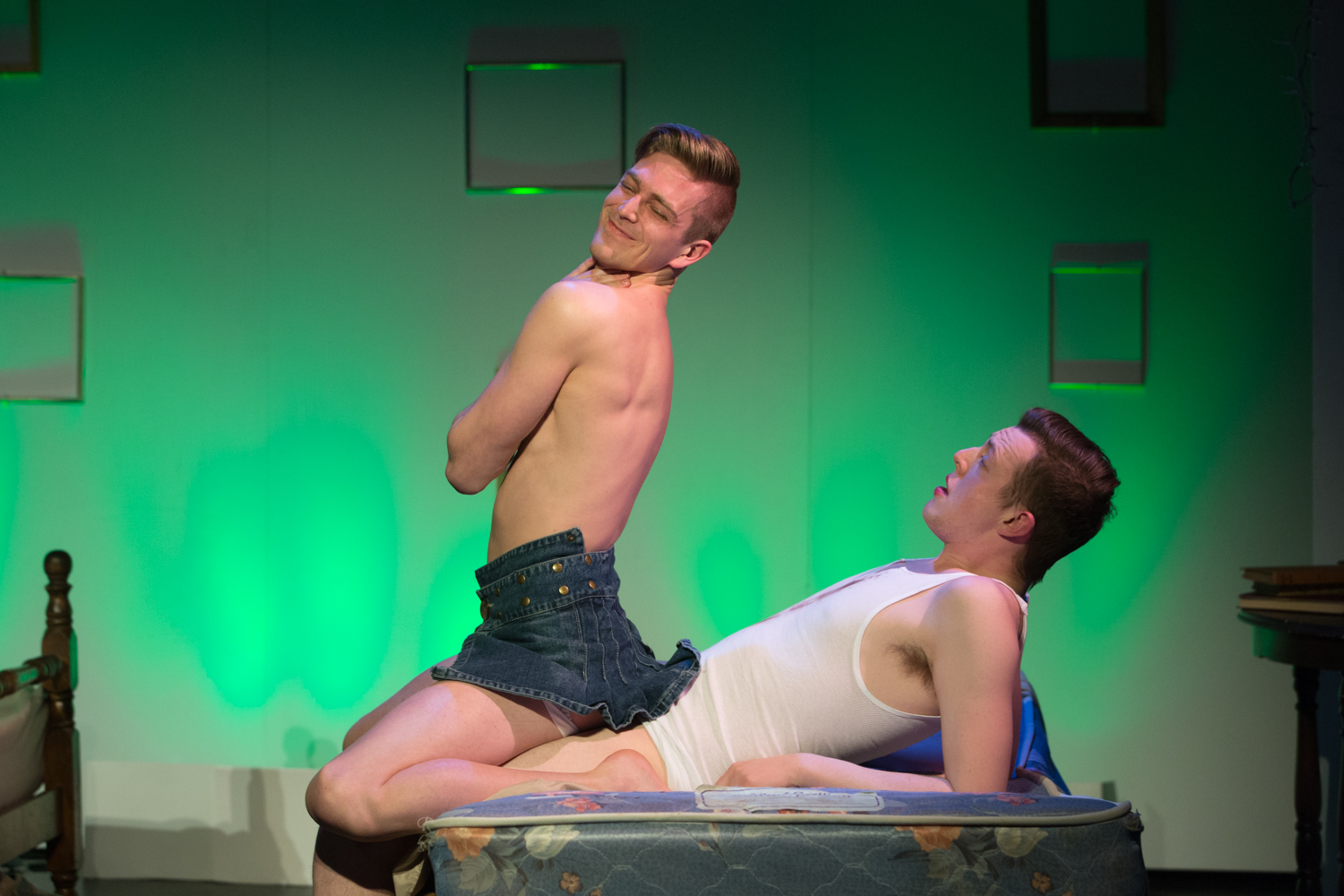
Mike Keir and Karen Johnson-Diamon. Imaged supplied by Verb Theatre.

Mike Keir and Karen Johnson-Diamond. Imaged supplied by Verb Theatre.

Mike Keir has a story to tell. Actually, he has many stories to tell.

A co-production between Verb Theatre and Inside Out Theatre, Mike, Karen, Karen, Mike: A Soap Opera is, at its core, a compelling blend of theatre and biography.

Inside Motel Theatre, Keir is joined by director Col Cseke and Karen Johnson-Diamond (co-artistic director of Dirty Laundry). Cseke sits beside Keir, interviewing him about his past. Meanwhile, Johnson-Diamond waits on the side to improvise scenes with Keir  – a long-time fan of Dirty Laundry.

Keir, who has cerebral palsy, starts his story with an incident that happened between him and a counselor at a camp for youth with disabilities. From this incident, a larger story of abuse, sexuality, and fear unfolds.

Keir’s story, however, is not one that can be told in ordinary linear fashion because, unlike stage dramas, real life events cannot be so easily isolated in time and place. There are many ‘characters’ that need to be introduced; relationships that have to be defined; histories that need to be explained. That is why Keir is adamant on backtracking, so that he can give proper context to the events that follow.

And as Keir’s story grows larger in its scope, so too does the connection between audience and storyteller. We become involved in this story that is, at times, difficult, but nonetheless engrossing. Keir captures our attention with his frankness, along with his sense of humour. And that humour is a reflection of Keir’s belief that telling a story enough times weakens it. In other words, telling these stories is Keir’s way of overcoming the experiences that have had far-reaching effects on his life.

And so, we remember that the stage can mean many different things to many different people. Here, Keir’s stage is one of healing, transformation – moving on. Mike, Karen, Karen, Mike: A Soap Opera is theatre for the soul.


Mike, Karen, Karen, Mike: A Soap Opera runs May 13 – 16 at Motel Theatre.

For information about the show, visit:
http://www.verbtheatre.com/season/
http://insideouttheatre.com/in-performance/

Dads in Bondage Breathes Enthusiasm, Delights

Left to Right: Kirk (Eric Wigston), Charles (Doug McKeag), and Joey (JP Thibodeau),

Left to Right: Kirk (Eric Wigston), Charles (Doug McKeag), and Joey (JP Thibodeau), “A Fistful of Pampers.” Photo Credit: Nicole Zylstra.

Robert More’s Dads in Bondage, with music by Tom Doyle, returns to Lunchbox Theatre where it was first produced in 1988. Relevant, hilarious, and heartwarming, Dads in Bondage will make audiences smile from ear-to-ear.

For Charles (Doug McKeag), Joey (JP Thibodeau), and Kirk (Eric Wigston), staying at home with the kids will be a piece of cake. Why? Because they’re ‘millennium men’ who know what they’re doing! Well, that’s what the men tell themselves, anyway. Little do they know that bravado alone is no match for stinky diapers and baby colic.

Directed by Glenda Stirling, Dads in Bondage is a ‘fish out of water’ story about three new fathers turned stay-at-home dads when they find themselves suddenly unemployed. Charles and Kirk, an oil executive and construction worker respectively, have been laid off as a result of sinking oil prices. Joey, a nervous Latin teacher, is placed on stress leave to remedy his burn out. Quickly, dreams of ‘having it all’ fill their heads as they take on their new roles. But it is not too long afterwards that Charles, Joey, and Kirk realize what a task it is to raise children.

The men navigate through fatherhood by themselves, then together as they join in their common cause. Knowing murmurs and outbursts of laughter are heard as More presents experiences that parents in the audience may have encountered at some point themselves. Of course, the story More tells is one with a twist, a play on traditional roles.

Much of the show’s humour grows out of the masculine pride that begins so strongly, then falls apart as the stress of parenthood piles on. The men try their best to fool their wives into thinking that nothing is wrong when in fact everything is a disaster. Charles, for example, is completely sleep deprived, while Joey is at his wit’s end trying to handle twins. But for their wives’ sake, and to save face, the men keep silent about their difficulties.

To great effect, More turns antiquated notions of masculinity into something more human. The men eventually get a hold on fatherhood. What was once strenuous and taxing becomes a privilege, a source of joy. The ultimate lesson More leaves the audience with is that being a ‘successful man’ is not what’s important, it’s being a loving parent that is.

McKeag, Thibodeau, and Wigston are a whole lot of fun to watch on stage. There is a lot of great character work by the actors who dive into infectious musical numbers like “A Fistful of Pampers” with gusto. Each contributes significantly to the upbeat, zany nature of the show. Vanessa Sabourin, who plays the men’s three wives and other characters, is a fun addition to the show as well. Although she does not share the stage as much, Sabourin brings plenty of laughs with each appearance.

(And the puppets – they’re something too!)

An enthusiastic musical comedy about stay-at-home dads, Dads in Bondage is sure to delight and entertain audiences.


Robert More’s Dads in Bondage, with music by Tom Doyle, runs at Lunchbox Theatre, May 4 – 23.

For more information about the show, visit: http://www.lunchboxtheatre.com/calendar/2015/4/27/dads-in-bondage-by-robert-more-with-music-by-tom-doyle?view=calendar

Before The Night Takes Us Lurks, Bumps

Kas Nixon as Alison in Ryan Reese's Before The Night Takes Us. Photo Credit: Colton Holmes.

Kas Nixon as Alison in Ryan Reese’s Before The Night Takes Us. Photo Credit: Colton Holmes.

Alison (Kas Nixon) hasn’t been sleeping well lately. Nightmares of grisly murders torment the frustrated clarinetist who has all but lost her ability to play. When Ray (Joel David Taylor), a telepathic pianist, walks into Alison’s life, she is soon thrown into something more sinister than she could ever expect.  For Alison, things are only going to get worse (and weirder) before they get better.

Presented by Theatre BSMT, Ryan Reese’s Before The Night Takes Us is a suspense-filled drama that trips over its paranormal premise.

For a character whose abilities are even a mystery to him, Ray sure seems to have a lot of answers, or a lot of good guesses. Part of that is due to Reese being quick to change/expand the rules of Ray and Alison’s telepathy when convenient. Of course, Reese is faced with the challenge of both establishing ground rules to adhere by and fleshing out a whole story within 120min, so wild assumptions by the characters are to be expected. Still, one cannot help but feel that the drama is undermined by fluctuations in the play’s logic.

Thankfully, Amy (Samantha Duff), a no-nonsense detective, gives the play immediacy, a sense of danger. While Amy trusts Ray’s abilities, Amy also needs answers now. She can’t wait on Ray to unlock the secrets of Alison’s dreams, especially not when there is a serial killer loose in the city. For Amy, the clock is ticking, and every minute that goes by is another minute where someone’s life is in danger.

But again, there are some problems with the play’s logic that are hard to ignore. The truth about Alison’s dreams raise questions about what kind of office Amy is working in that none of her colleagues or superiors would notice something off about one of their top detectives. And despite having access to her case files, in addition to her mind, Ray fails to recognize any inconsistencies with the investigation.

These issues aside, Reese intrigues with the general greyness of the characters – greyness in terms of his characters’ true motives, their murky pasts, and their relationships with one another. As we become more acquainted with Alison, Ray, and Amy, the loneliness of these characters become more apparent; the search for a connection more potent. And that is mainly what carries our interest through to the end: the fate of these characters thrown together against strange circumstances.

Unfortunately, the play proceeds at a choppy pace, mainly due to its scenes of varying lengths and their hard transitions. When the lights come down, so too does the energy. The dip in pace is partly due to the odd configuration of just one entrance/exit. Director Kyle Schulte might have opted for a set-up that allows better flow between scenes, rather than one where there is a good amount of unused physical space (which would feel emptier if it were not for some instruments laying around).

Taylor rises to the task of playing the piano live on stage. He and Nixon share good energy together on stage. Though Duff is who most catches our eye with her menacing presence. Fortunately, Nixon holds her own in her clashes with Duff. The two are a sharp pair that respond to each other effectively.

A murdery mystery with a paranormal twist, Reese’s Before The Night Takes Us catches our attention with its grey characters, but then loses us with its thin logic.


Theatre BSMT’s Before The Night Takes Us runs May 6 – 9 at Motel Theatre (Arts Commons).

For more information about the show, visit: http://www.theatrebsmt.ca/Theatre_BSMT/Whats_On.html

World Premiere: Meg Braem’s A Worthy Opponent Delivers Big Laughs

An abandoned drug den turned trendy street-themed restaurant. Maybe not the best place to bring your fiance’s mother…and maybe not the best place to break the news that you’re marrying her only son.

Enjoying its world premiere at Lunchbox Theatre, Meg Braem’s A Worthy Opponent is a delightful new comedy that is as smart as it is hilarious.

Ivy (Allison Lynch) loves Nathan and wants to marry him, that she knows for sure. But then again, Ivy’s never really stuck to anything, like acting school or even her own name. And that for Helen (Elinor Holt) is cause for concern. An accomplished entomologist, Helen is not so sure about her son Nathan, a grad student, marrying Ivy who works at a hair salon.

It’s not that Helen hates Ivy, despite Ivy thinking so, or that she is completely opposed to their union, it’s just that she’s worried. And it’s not just Nathan that she’s worried about, it’s Ivy too. Of course, the truth only comes out after the two women have had a ‘couple’ drinks and traded barbs with one another.

Ivy and Helen’s all-out battle of wits sees lots of potent insults, some more subtle than others, that one can feel from their seat. Accordingly, their waiter Eric (Brett Dahl) makes sure to quickly disappear after serving them their drinks. And yes, there are plenty of drinks served.

Braem’s lively, sharp tongued characters breathe wit and fresh air into the ‘horrible mother-in-law’ trope so often repeated across various media. But it is not just their ability to ‘dish it out’ that makes this work feel refreshing, it is also their dimensions which Braem explores to the fullest.

Contrary to what Ivy thinks, Helen is not just a cold, unfeeling academic. No, she is also a mother, as Helen reminds Ivy, a mother who raised her son alone. And the thought of Nathan marrying and leaving her behind is not one Helen is so ready to accept. So, Nathan cannot just marry anyone, let alone someone who is not so sure about where their own life is headed.

And so, after all the drinks and hostility, Braem brings the play to a heartfelt moment where the two women reconcile their differences and finally see eye-to-eye. So moving are the play’s final moments, in fact, that quiet sobs can be heard from the audience.

Holt and Lynch meet what the other brings to the table in terms of impeccable comedic timing and energy. Although, Holt noticeably trips over several lines of dialogue during the course of the show. Though easy to overlook the first time, Holt’s line flubs occur just enough that the steadfast pace of her and Lynch’s exchanges dip as a result. Otherwise though, Holt is a great opposite to the sweet, but fiery Lynch.

Sharp and refreshing, Meg Braem’s A Worthy Opponent delivers big laughs while celebrating mother-in-laws everywhere.


Meg Braem’s A Worthy Opponent runs at Lunchbox Theatre April 6 – 25, 2015.

For more information about the show, visit: http://www.lunchboxtheatre.com/calendar/2015/3/30/a-worthy-opponent-by-governor-general-award-nominee-meg-braem?view=calendar

Shawn’s A Thought in Three Parts Bares All, Misses The Mark

Judy (Brett Dahl) and Dick (Craig McCue), "Youth Hostel." Photo Credit: Jaime Vedres Photography.

Judy (Brett Dahl) and Dick (Craig McCue), “The Youth Hostel.” Photo Credit: Jaime Vedres Photography.

“You will see penises, you will see asses and tits and vaginas,” warns Theatre Outré’s Artistic Director Jay Whitehead in the program notes to Wallace Shawn’s A Thought in Three Parts.

Of course, audiences would expect nothing less from a play that was accused of being ‘pornographic’ and morally offensive during its initial run in 1976. But surprisingly, full-frontal nudity and simulated sex acts are what least offend in Theatre Outre’s production of Shawn’s provocative play.

Presented at Motel Theatre, A Thought in Three Parts stages three vignettes that explore loneliness, the desire for intimacy in its various forms, through different sexual dynamics.

The first, “Summer Evening,” sees a sexually frustrated couple returning to their hotel room. Lost in their respective inner monologues, David (Ryan Reese) and Sarah (Samantha Jefferey) seem to say everything but what they truly want to share with their partner, that is their utmost intimate desires. Sarah’s violent fantasies are deflected by David who, despite craving Sarah’s sensual touch, attempts to satisfy his partner with other activities like reading.

In saying just about anything to bury his own desires, David’s discomfort towards sex inhibits Sarah’s ability for sexual expression. Sarah’s fantasies eek out overtime as she bypasses the guilt of wanting pleasure. Sarah claiming voice at the end is a vital step in Shawn’s march towards sexual revolution whereupon communication between the sexes is untethered from oppressive social values.

Shawn and Whitehead lose the audience in “The Youth Hostel.”

Here, in this second vignette, four turbulent youth run between each others’ rooms, engaging in various sexual acts. Beyond the thrill of participation, the sex means little for the emotionally detached youth.

The sexual mischief is over-the-top and becomes increasingly so as the scene goes on. Whitehead’s direction leaves the audience with no room to collect themselves during the mischief. But as the action becomes more and more outlandish, Shawn’s writing begins to show its age.

40 years ago, Shawn undoubtedly set out to ruffle feathers with A Thought in Three Parts. Shawn’s intent to offend being part of this campaign to challenge repressive attitudes towards sex. But with sexuality in mainstream media becoming increasingly normalized and the internet beginning anew once stifled conversations, the playwright’s aggressive tactics feel stale, irrelevant in the modern age. And Whitehead’s frantic direction of “The Youth Hostel” highlights the fact in the way it tries to divert our attention away from the lack of substance in Shawn’s script.

There is still this real message that genuine human connection is complicated, if not interrupted, by the politics of sex as Shawn demonstrates in a moment that causes pause.

When all the fun and games are done, Judy (Brett Dahl) retreats to her room where her abusive boyfriend Tom (Samuel Benty) joins her. Judy follows a script when she talks to Tim, making sure to say the right things as to not offend Tom, who is unemployed. When she says the wrong thing, Tim hits her; Judy’s body becomes a territory Tim (re)asserts his control over.

It is a powerful moment where Shawn laments our patriarchal society and the abuses perpetrated by its unfair politics. But it is a brief moment, one that offers respite from Shawn’s pageantry of shock.

“Mr. Frivolous” ends the evening with a solitary figure (Jay Whitehead) caught reminiscing about a lost romance. A quieter scene, “Mr. Frivolous” brings around the evening’s central theme of loneliness, the need for presence in our lives.

Whitehead, again in the program notes, seems so sure that the play is more relevant than ever in this age of hook up apps and sexting, of social disconnect. And maybe it is, but unfortunately the weight of antiquated novelty crushes the potential for relevant social commentary. The playwright’s critical voice is lost amidst a crude script that aims to offend first, engage second. A missed opportunity certainly, but not totally as Shawn does manage to plant seedlings in our minds by the end.

Wallace Shawn’s A Thought in Three Parts swings in every direction, every once in awhile landing a hit, but ultimately tires itself out.


Theatre Outré’s production of Wallace Shawn’s A Thought in Three Parts ran at Motel Theatre, Mar 31 – Apr 4, 2015.

For more information about the show, visit: http://www.theatreoutre.ca/season/a-thought-in-three-parts/

World Premiere: Ambition Leads to Rough Waters in The Last Voyage of Donald Crowhurst

In 1969, nine men set off on what was at the time the first round-the-world yacht race. A widely covered event, the Sunday Times Golden Globe Race excited the public at large. And Donald Crowhurst was among those caught up in the excitement. Crowhurst, an amateur sailor, sought to defy the odds and capture victory against well-seasoned competitors. The Teignmouth Electron, a boat of Crowhurst’s own design, would be the vessel to deliver Crowhurst to the finish line.

Crowhurst did not return home.

It is this story of ambition, the pursuit of greatness, that Alberta Theatre Projects, in association with Ghost River Theatre, stages in The Last Voyage of Donald Crowhurst.

Written by David van Belle & Eric Rose, with Rose directing, The Last Voyage of Donald Crowhurst is concerned with the fine line between ambition and obsession. There is nothing particularly special about Crowhurst (Braden Griffiths). He is a husband and father of four who runs a small, failing business. What sets Crowhurst apart is his astounding confidence in that he is destined for greatness. And he makes us believe it too with his grandiose speeches.

But failure looms on the horizon when Crowhurst’s boat experiences serious issues during the race, and an unexpected storm wreaks havoc on the vessel. Failure, though, does not mean simple defeat. In exchange for the necessary funds to construct his boat, Crowhurst signed a deal with the condition that should he lose the race he will have to pay everything back in full. For Crowhurst, failure means the total loss of everything he and his family owns.

And that is why Crowhurst sees no other option than to cheat by falsifying his race progress.

The presentation of Crowhurst’s story is fascinating with its use of video projection and live effects. The production features creative techniques like filming Crowhurst and his wife Clare (Vanessa Sabourin) standing against two separate ‘beds’, then joining the images together on-screen to show them lying in the same bed. As well, documentary footage of the real-life Crowhurst overlaps on-screen with Griffiths’ portrayal. And, the play’s first act ends with a violent storm on stage where large sheets simulate waves and buckets of water drench Griffiths.

Unfortunately, the first act is where the excitement ends. The production runs dry in its second act where an otherwise compelling human drama becomes a disjointed bore.

One specific offense is the scene where Crowhurst meets an Argentinian couple who he asks to help him in the way of supplies. The humour attempted here falls flat, and little happens to justify the scene’s inclusion. The scene stalls the pace of the play.

From where the play starts to where it ends is a significant distance. After the initial awe produced by the first act’s visual feats, one realizes there is not much else carrying the show. And certainly a part of that is the challenge of what do you do when your main character is stranded miles away from human contact? Van Belle and Rose do their best to make the journey to Crowhurst’s final moments interesting, but the path there is one that not even the biggest smoke and mirrors could disguise what it really is: a disappointment.

The Last Voyage of Donald Crowhurst is an ambitious, visually stunning production that ultimately disappoints due to weak characterization and a less-than satisfying second act.


Alberta Theatre Projects’ The Last Voyage of Donald Crowhurst, in association with Ghost River Theatre, ran at The Martha Cohen Theatre, February 24 – March 14, 2015. 

For more information about the show, visit: http://www.atplive.com/2014-2015-Season/Last-Voyage/index.html


The Old Trouts Spare No Puppet in Famous Puppet Death Scenes

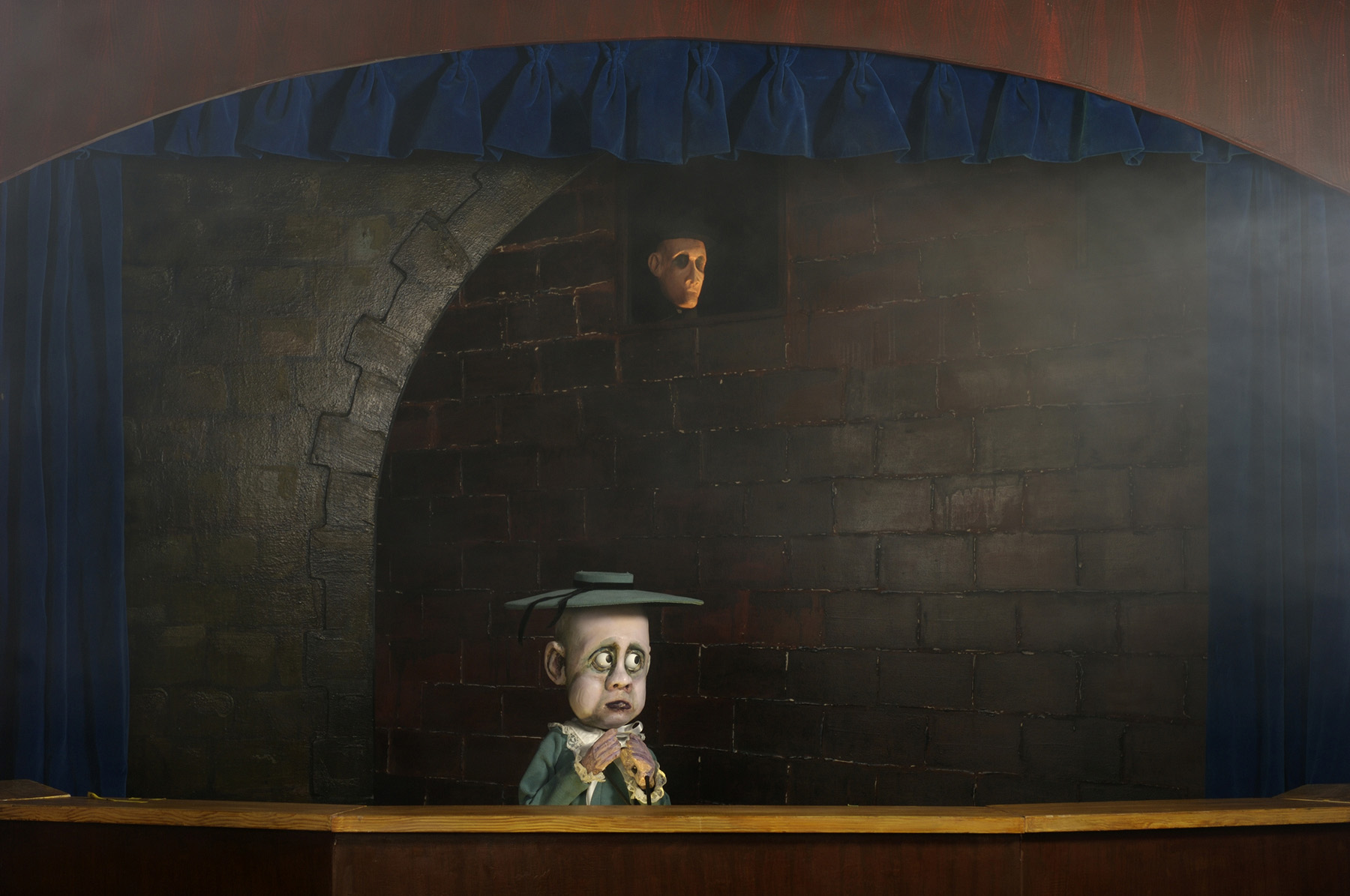
Pictured, The Beast of Muggditch Lane by August Stainbrook: Act 1, Scene 1. Image supplied by Theatre Junction GRAND.

The Beast of Muggditch Lane by August Stainbrook: Act 1, Scene 1. Image supplied by Theatre Junction GRAND.

Death.

A taboo subject in our society, and why not? ‘Not being here’ one day is an unpleasant idea that some would rather not think about, much less openly discuss. Others are more keen on the subject, like Nathanial Tweak, host and curator of Famous Puppet Death Scenes.

Created by The Old Trout Puppet Workshop, Famous Puppet Death Scenes recreates death scenes from history’s greatest (fictional) puppet shows. Tweak, a puppet himself, has amassed this grand collection in hopes that the scenes reveal something to us about the nature of life and death.

One of the first things we learn is that death is random. One minute, we may find ourselves enjoying some fresh air, then the next we are crushed under the weight of a giant fist (The Feverish Heart by Nordo Frot – Act 1, Scene 3). Or, powerful gusts of winds blow us apart, limb by limb (The Forgotten Dish by Sterling Lowry; “The Winds of Fate”). Sometimes though, it’s just a matter of picking the wrong door (Das Bipsy Und Mumu Puppensiel by Freuliecher Friedrich – Episode 43 “Bipsy’s Mistake”).

Other times too, our poor decisions invite death; poor decisions like dressing up as a deer in the middle of the forest (The Ballad of Edward Grue by Samuel Groanswallow: Act 4, Scene 6).

But perhaps the evening’s most resonant lesson is that death simply happens.

Taking a pause from the absurd, The Last Whale by Grover Bellick features a giant whale’s eye that opens, then closes very slowly. That’s it. Even the mightiest creature on Earth cannot outrun death’s grip.

Lucille Arabesque by Agathon Finley is no different. An old woman rests on her deathbed, taking what are perhaps her last breaths. There are no moving last words. Only an unsettling silence, a confrontation with our fragile mortality.

And yet, despite everything, Tweak insists there is such a thing as The Perfect Death Scene. In the play’s final moments, we wonder whether or not Tweak himself learned anything in the process.

The Old Trouts are at their finest in this spectacular display of grisly humour and puppetry. The depth of dramatic styles and periods explored is quite remarkable. Not to mention the inventive staging that takes us across such a variety of fictional works, which each feel distinct in both voice and aesthetic.

And the audience is right there for every moment of it. Joy, shock, pity, you can hear it all in the theatre. The reactions from the audience almost lend a ‘musical’ quality to the production. That is the strength of the work by
the puppeteers (Nick Di Gaetano, Pityu Kenderes, Viktor Lukawski) who really make us feel for the ill-fated puppets.

Dark and funny at one moment, then haunting the next, Famous Puppet Death Scenes is a brilliant show that will stay with audiences long after its finale. A standing ovation truly earned.


Co-presented by Theatre Junction GRAND and The International Festival of Animated Objects, The Old Trout Puppet Workshop’s Famous Puppet Death Scenes runs at Theatre Junction GRAND, March 13 – 28, 2015.

For more information on the show and how to buy tickets, visit: http://www.theatrejunction.com/1415season/fpds/

Laughter is The Best Medicine in Ivanka Chews The Fat

Lunchbox Theatre welcomes back Slobjev’s funniest export, Ivanka, for her one-woman show Ivanka Chews The Fat.

Written and performed by Jo-Ann Waytowich, Ivanka Chews The Fat is a fun, light-hearted approach to better living.

And what is life without a good sense of humour? For Ivanka, humour is everything. We worry about too much in our lives, like growing old and staying in shape. Instead, Ivanka says, we ought to embrace who we are and learn to love ourselves. Turn the negatives into positives. And where we can start is in taking life a little less seriously.

Perhaps Ivana’s message of positive change is best pronounced when the actor opens up about her recovery from Bell’s Palsy. In this moment, Waytowich puts life in perspective and reminds us just how important laughter is as not only something we do, but something we give.

While the show’s humour is best suited for an older audience, Ivanka still delivers plenty of laughs for all with her hilarious antics. Ivanka has no filter and does as she pleases, much to the embarrassment of her silent accompanist Marucia (Marcella Smithers). But in the things that she says, no matter how inappropriate they might be, there lie gems of truth. That is what makes Ivanka such an endearing character.

After the show, an audience member enthusiastically thanked Waytowich for bringing him back to his childhood, to memories of his grandmother. And maybe we know an Ivanka in our own lives. We would be lucky to.

Led by the delightful Waytowich, Ivana Chews The Fat is a show full of heart. A crowdpleaser for sure.


Lunchbox Theatre’s Ivanka Chews The Fat runs Mar 9 – 28th, 2015.

For information on the show and how to buy tickets, visit: http://www.lunchboxtheatre.com/calendar/2015/3/9/special-presentation-ivanka-chews-the-fat-by-jo-ann-waytowich?view=calendar


Fire Exit Theatre & Corps Bara Dance Theatre Search For God in Absence

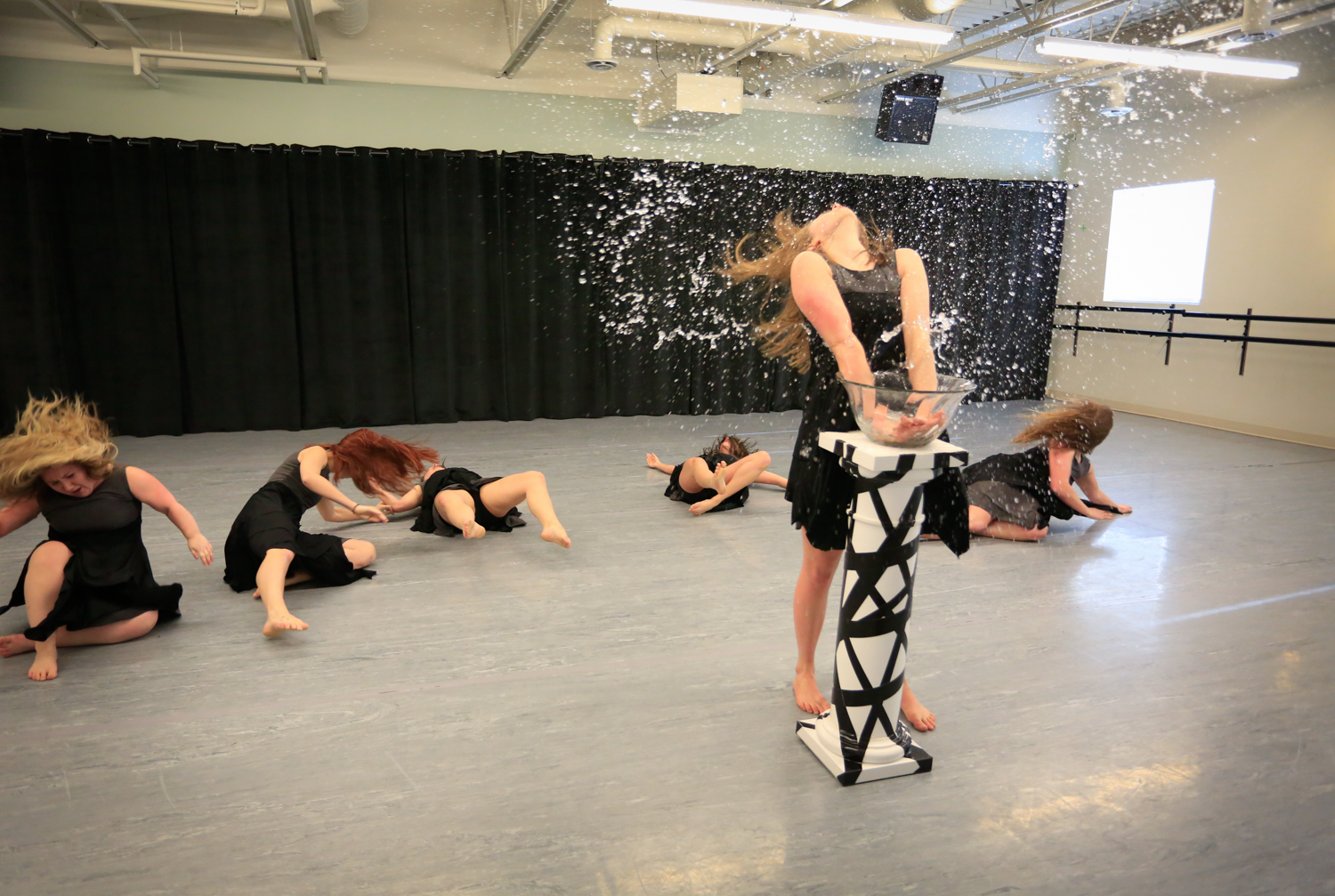
Corps Bara Dance Theatre rehearsing "Cleansing," one of six dance pieces in Absence. Photo Credit: Char G. Photography

Corps Bara Dance Theatre rehearsing “Cleansing,” one of six dance pieces in Absence. Photo Credit: Char G. Photography

What is the value of faith in a world full of injustices? This is one of many tough questions Fire Exit Theatre and Corps Bara Dance Theatre fearlessly tackle in Absence. Blending theatre and dance, Absence explores the doubt, fear, and perhaps even anger that some experience in their personal relationship with God.

Written and directed by Val Lieske, Absence stages three characters (played by Brendan Andrews, Jennifer Beacom, and Sarah Irwin) who feel utterly overwhelmed by the world. So overwhelmed by the world, in fact, that they are spiritually exhausted. For if God is everywhere, as he claims to be, then why do bad things continue to happen in our world today?

For these socially conscious youth, it is the poor and the downtrodden who suffer the most from God’s absence. And what frustrates the youth is that the marginalized are asked to remain firm in their faith. But how can one, the youth ask, trust in God when he has failed them, and so many others at home and abroad?

And their shared frustration reflects a larger phenomenon regarding youth and traditional teachings. For youth, of what relevance does the Bible have today in our chaotic world? How can we apply its teachings to unprecedented levels of disaster and conflict? And this scrutiny extends to the church where youth retention is a very present issue. What can the church do to help alleviate the dissatisfaction youth feel towards the Bible and its inadequacy to make sense of their everyday experiences? Lieske suggests that the church needs to modernize and acknowledge current affairs. Singing gospels can only get one so far in their spiritual journey, especially when there are so many questions to be asked. And so, the church needs to welcome and foster critical discussions where youth feel they can raise questions that challenge the foundations of faith.

Unfortunately, Absence lacks a central narrative to tie its main arguments together. The characters simply debate amongst themselves various positions regarding God’s inexplicable absence in the world. And they do so by making vague, heavy handed observations on politics, crime, and the media. So when there is a truly potent question raised, it has no support to carry it where it needs to go in order to have a real stimulating effect. Instead, the question becomes engulfed in an exasperating amount of talk.

Where the production does manage to hold our interest is in its six dance pieces led by Corps Bara’s dance ensemble (Laura Barcelo, Jessalyn Britton, Sarah Curtis, Valentia Dimitriou, Jason Galeos, Natalka Lewis, Sylvie Maquin, Caitlin Unrau). The reason being is that each piece is focused on one or two central ideas.

One particular piece that stands out is Cleansing, choreographed by Amy Meyers. Downstage centre, there is a bowl of holy water atop a pedestal. And the dancers each try to bring themselves to it, but they cannot for they feel unworthy. Externalized here is the spiritual agony that doubt creates. And it reads across the dancers’ faces and bodies as they frantically circle the holy water. The piece ends when finally, a dancer gives herself over and smashes the water with her hands. It is a striking image that brings the first act to a close.

And then, there is Cinch, choreographed by Krysten Blair. Setting up this piece is talk surrounding the debate between faith and reason; religion and science. And this piece explores this conversation with a recurring phrase of movement where the dancers pull apart threads or, depending on your perspective, split atoms. For once we apply scientific rationality to religious beliefs, we fall into an almost infinite series of questions that only lead to more questions.

These physical meditations of the soul are executed gracefully by the dancers.

But regardless, the sort of dramatic interest needed to fill an approx. two-hour run time is not here. The elements of the show operate in segments that result in a bland pattern of “acting/dancing/acting” and so on. There is no cohesion between the acting and dance segments until the end, but then it is too late. The audience is ready to exit the theatre.

Absence suffers from pacing issues and clumsy dialogue. While its dance pieces are exciting, the overall production lacks the necessary momentum to truly leave an impact on its audiences.


Fire Exit Theatre in partnership with Corps Bara Dance Theatre presented Absence at the Lantern Community Church, Feb. 25 – Mar 1, 2015.

For more information on
Fire Exit Theatre, visit: https://www.fireexit.ca/
Corps Bara Dance Theatre, visit: http://www.corpsbara.com/

Storytelling At Its Finest: Kyall Rakoz’s Ludwig & Lohengrin Enchants

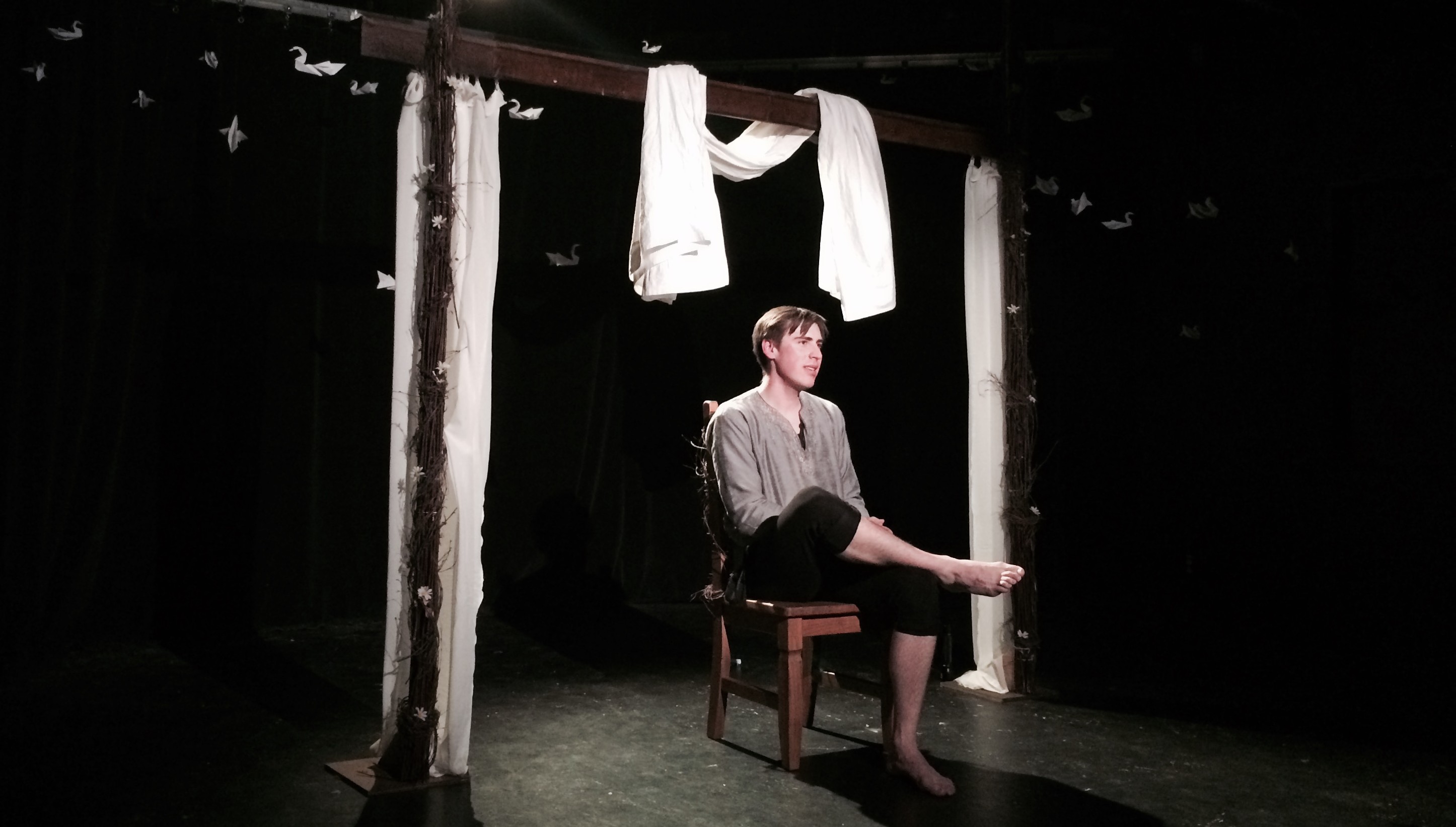
Kyall Rakoz's Ludwig & Logengrin runs at Motel Theatre, Feb 24 - 28, 2015.

Kyall Rakoz’s Ludwig & Logengrin runs at Motel Theatre (Arts Commons), Feb 24 – 28, 2015. Photo Credit: Jonathan Brower

Why do we escape to the theatre? To see shows like Kyall Rakoz’s Ludwig & Lohengrin.

Presented at Motel Theatre, Rakoz’s one-man show stages the story of King Ludwig II who reigned over Bavaria in the late 1800s, but was himself ruled by an obsession with the fantastical. Ludwig was particularly enthralled by the story of the Swan Knight, the subject of Wagner’s opera Lohengrin. The king would, in fact, go on to be Wagner’s patron, giving way to a relationship only best described as complicated.

And that is one reason why Rakoz does not allow the audience to meet Ludwig. For how is it one could portray a man who sought to remain an enigma? Instead, Rakoz reveals Ludwig to the audience via the perspective of others.

Playing these multiple characters, some of whom were real people in Ludwig’s life, the actor gives the audience an idea of what was being said about this eccentric king. Questions surrounding his sanity were among the whispers travelling around the castle. But these were not quiet rumbles. Ludwig’s fixation on building elaborate, ‘fairytale’ castles deeply disturbed his cabinet ministers as the castles were a financial burden on Bavaria. One way or another, the ministers figured, Ludwig’s ludicrous spending had to end.

What is important to note is that this story is not about Ludwig as a king. Rakoz goes beyond the royal veil to humanize Ludwig as a complicated man who had the misfortune of being king. Had he been an everyman, the actor suggests, Ludwig would have fared much better than he did. Ludwig, whose sexuality attracted speculation from many, would have been able to follow his heart’s desires without the public damning him for it.

Rakoz’s show fascinates with its inventive staging that is nothing short of magical. Rakoz’s shadow play is particularly dazzling. Watching it, one cannot help but feel totally absorbed in the drama of the Swan Knight. Then, the actor escapes into 17 different characters who each feel alive in their own right. Certainly, the brain does take awhile to catch up sometimes, but never to a point where one feels lost in the story.

Really, there is so much here that has to be seen. Nearly every moment Rakoz paints on stage is simply beautiful. And such beauty makes our hearts tremble when the play nears its end. The audience wastes no time to rise to their feet and applaud Rakoz.

Set designer Leon Schwesinger’s set is both very earthy and elegant in its presentation. The paper swans hung from the ceiling are a nice touch.

Third Street Theatre did well to bring Kyall Rakoz’s Ludwig & Lohengrin to Calgary audiences. Rakoz’s ability to capture both our hearts and imaginations makes for an incredibly moving evening at the theatre. Those fortunate enough to catch Ludwig & Lohengrin during its limited run are in for something truly special. This is storytelling at its finest.


Kyall Rakoz’s Ludwig & Lohengrin runs at Motel Theatre (Arts Commons), Feb 24 – 28, 2015. 

For more information on the show, visit: 
http://thirdstreet.ca/2014-2015-season/ludwiglohengrin/
http://ludwigandlohengrin.com/