JUNO Nominee Alison Young on So Here We Are and Learning to Let Go of Perfection


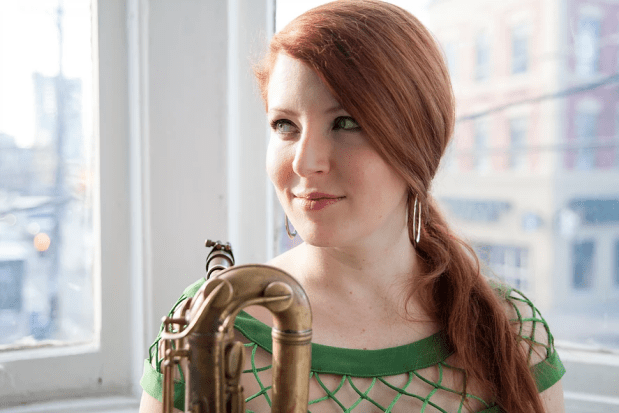
Alison Young, saxophonist.

Alison Young’s So Here We Are is up for Jazz Album of the Year: Solo at the 2019 JUNO Awards. Photo Credit: Lisa MacIntosh Photography.

In January, saxophonist Alison Young earned a JUNO nomination for her debut album So Here We Are. The album is up for Jazz Album of the Year: Solo at the 2019 JUNO Awards. The Toronto-based jazz artist remembers feeling shocked when the news broke.

“Initially I thought, that’s got to be a mistake,” Young said. “It’s my first album, and that it got nominated is a big deal for me. The recognition is so meaningful to me. It feels really important to be acknowledged like that.”

“You never know if you are going in the right direction or if people like what you are doing. You feel heard.”

The Ottawa native has been active in Toronto’s jazz scene since the early 2000s. She studied music at the University of Toronto, and since then has toured across North America, Europe, and South America.

Young describes So Here We Are as a “musical hello” and an amalgamation of all the music she likes to play.

“I’ve been wanting to put out an album for years,” Young said. “I’ve been trying to talk myself into it for five or six years. It’s easy to get distracted from my own projects.”

Movement on the album began when recording engineer Jeremy Darby of Canterbury Music Company offered Young studio time.

“The way it happened was Jeremy Darby gives away a day of free recording time to people he thinks deserves it, “ Young said. “It was a real push, him awarding that to me. That really forced me to get the band together and actually lay it down.”

“I felt like I wasn’t ready. I felt stressed out. It was hard to make decisions about how the songs should be presented,” Young said about recording the album. “By the time we did the second session, it was a lot more fun and cool and not as stressful.”

Young recorded the album with her band the Alison Young Quintet. The band has played together since 2012. “We are all friends and have played together in various bands and also as a band. It’s a good hang. It’s good musical chemistry there.”

Young has learned many things over the years as a jazz artist, but perhaps the most important lesson she has learned is to let go of perfection.

“I actually quit playing after going to university, because I over thought everything so much. I thought I needed to make music more complicated than it needed to be.”

“You just have to start. You’re always going to learn as you go. Let go of the idea of ever attaining any kind of perfection,” Young said. “The more you know, the more you don’t know. Be okay with it always having to be a learning process. That’s the thing about music, it’s really beautiful and daunting, but you never get there.”

What’s next for Young after the JUNO Awards? In June, Young is going on the road with Corey Hart, the latest inductee into the Canadian Music Hall of Fame. After the tour, Young says she hopes to play music festivals with her band.


The 2019 JUNO Awards will be live from Budweiser Gardens in London, ON on Sunday, March 17 at 8 PM ET and broadcast live on CBC, CBC Radio One, CBC Music, the free CBC Gem streaming service, and globally at cbcmusic.ca/junos.

Learn more about Alison Young at alisonyoungmusic.com

Follow Alison on Facebook and Instagram.


Meet Laura-Beth Bird, Founder and Producer of Grey Rabbit Theatre Co.

In 2018, Laura-Beth Bird left her job at a local restaurant to pursue her dream of starting a theatre company. The 24-year-old theatre artist had a plan and the savings to start her first show. Then, reality hit.

“I ended up having to use that money to live for two months, which kinda threw a wrench in the whole system,” Bird said. “So, I had to go back to the drawing board.”

Born in Shropshire, England, Bird’s family moved to Canada when she was 10-years-old. Her family settled first in Saskatoon, Saskatchewan, then later Saint John, New Brunswick. Bird relocated to Fredericton to study at St. Thomas University, where she graduated from in 2017.

When her plans went awry, Bird began to wonder if her theatre company would become something that only happened on weekends.

“I was miserable in the job I was in. Anyone who saw me knew it,” Bird said. “I was panicking thinking that I would have to go back to that. I was going to be forty…doing my art on the weekends because that’s maybe when I could get the days off. I didn’t want that life.”

The “kick in the butt” motivated Bird to apply for Planet Hatch’s ARTtrepenur-in-Residence program. Bird was accepted into the program and started her three-month residency in June. The residency ended with an evening of new play readings. It was the first public event hosted by Fredericton’s newest theatre company, Grey Rabbit Theatre Co.

“Planet Hatch helped me network with larger business communities in the region,” Bird said. “That in turn helped me with strategic funding and planning for five, ten years down the road.”

In the fall, Bird participated in ArtsLink NB’s CATAPULT Arts Accelerator.

Bird has also received support from Fredericton’s theatre community.

“Everyone has been helpful about knowledge and experience,” Bird said. “If they know people, they will put me in contact with them. If we continue to create that sort of practice, it makes people more successful in the region.”

Bird realizes trying to launch a theatre career in Atlantic Canada is somewhat unorthodox.

“Many of the people my age are leaving to Toronto or New York because they feel like they have no opportunities left in Atlantic Canada to be artists,” Bird said. “In the last year, I have been researching ways to make this work. I don’t want to move right now to a big city where I will be a small fish in a big pond. I would rather be a medium fish in a medium pond.”

“That means I take scripts being created here — by emerging and professional artists — and help them reach either stages by myself producing them or matching them with other producers in the area.  If it doesn’t work for mine, it may work for Eastern Front or Neptune Theatre.”

Does Bird agree that Grey Rabbit could be considered both an incubator and a presenter?

“Kind of, yeah,” Bird said. “At this moment, I feel like as I’m learning these things, I am also sharing it with my artistic community, because I want my artistic community to thrive as well.”

In December, Grey Rabbit, in partnership with Theatre St. Thomas, held a workshop for artists seeking to professionalize their artistic practice.

Have all the developments of the past year changed how Bird views herself as an artist?

“I don’t really notice a difference. My friend does. She told me I look healthier and happier, which is hilarious for me. I’m not doing anything different,” Bird said. “I think I am more confident and much more ambitious than I was. I am not willing to let things go. I have to chase after it. If I don’t chase after it, it’s not going to happen. I am more tenacious and cognizant of the way the world views me because what I’m creating is an extension of myself.”

Bird’s idea of what it means to live as an artist has changed since starting on this path with Grey Rabbit. 

“I’m going to go work on my art which is my business,” Bird said. “ If I have a consistent income, I have more freedom to practice my art. Having a stable business gives me freedom to create. I don’t have to worry about if my power is going to be shut off.”

So far, Bird sees her time divided 60/40 between the business operations of Grey Rabbit and its artistic end. “I spend a lot more time filling out grant applications and writing than I do creating. It’s just the season that I’m in.”

https://www.youtube.com/watch?v=kj221-mt5yQ

This year, Grey Rabbit is launching The Vardi Puppet House. The children’s puppet theatre will tour Atlantic Canada in the summer.

A Vardi is a gypsy caravan that is pulled by horses. They were things I came across as a child, and I’ve always loved them,” Bird said. “The puppet house is designed to look like a gypsy caravan. It will be bright red, with wagon wheels. There will be windows that open on the side for the performance. It will have that classic painting technique used on most caravans, and I will use Punch and Judy stylized puppets.”

Bird describes the puppet house as a platform that “lends itself well to public events” and is ideal for helping grow a viewership base. 

Grey Rabbit is currently accepting new scripts for The Vardi Puppet House. The submission deadline is February 28th, 2019.  

Joyful Magpies’ Best of Fredericton Theatre 2018

Arrivals and Departures

In February, Theatre New Brunswick announced the departure of Artistic Director Thomas Morgan Jones. Natasha MacLellan was named TNB’s new artistic director in July. MacLellan is the former Artistic Producer of Ship’s Company Theatre.

Next Folding Theatre Company staged its final production in March, bringing an end to the company after eight years.

Grey Rabbit Theatre Co. is Fredericton’s newest theatre company. Theatre artist Laura-Beth Bird is the company’s founder and producer. Grey Rabbit held its first public event in August. The public was invited to an evening of play readings at Planet Hatch, where Bird was the ARTrepreneur-in-Residence.

Stay tuned for Joyful Magpies’ interview with Laura-Beth Bird.

Drumroll

Well, here we are. The end of 2018. Creating this list wasn’t easy. It was, however, really fun to write. What a blast to look back on the past year, and remember everyone who shared their talents with audiences in Fredericton.

See you in the new year!

Note: My review of Theatre St. Thomas’ A Life of Galileo is available here.


JOYFUL MAGPIES’ BEST OF FREDERICTON THEATRE 2018

Best Actor

Hannah Blizzard – No Exit – Theatre UNB

Honorable Mentions:
Claudia Gutierrez-Perez – Any Given Moment – Theatre New Brunswick
Kira Chisholm – The Dangers of Geothermal Heating – NotaBle Acts Theatre Festival

Best Supporting Actor

Allison Basha – The Lion, The Witch, and The Wardrobe – Theatre New Brunswick

Honorable Mentions:
Jane Marney – The Real Inspector Hound – Theatre UNB
Sage Chisholm – A Life of Galileo – Theatre St. Thomas

Best Ensemble

The Dangers of Geothermal Heating – NotaBle Acts Theatre Festival

Honorable Mentions:
A Life of Galileo – Theatre St. Thomas
No Exit – Theatre UNB

Best Set Design

Andy Moro – Finding Wolastoq Voice – Theatre New Brunswick

Honorable Mentions:
Mike Johnston – The Dangers of Geothermal Heating – NotaBle Acts Theatre Festival

Robin Whittaker & Chris Saad – A Life of Galileo – Theatre St. Thomas

Best Lighting Design

Ingrid Risk – Any Given Moment – Theatre New Brunswick

Honorable Mentions:
Chris Saad – The Dangers of Geothermal Heating – NotaBle Acts Theatre Festival
Trent Logan  – A Record of Us – Solo Chicken Productions

Best Sound Design

Deanna H. Choi – The Lion, The Witch, and the Wardrobe – Theatre New Brunswick

Honorable Mentions:
Mike Johnston – The Dangers of Geothermal Heating – NotaBle Acts Theatre Festival
Aaron Collier – Any Given Moment – Theatre New Brunswick

Best Costume Design

Cathleen McCormack – Any Given Moment – Theatre New Brunswick

Honorable Mentions:
Kat Hall – Songs of the Seer – The Next Folding Theatre Company
Laura-Beth Bird – The Dangers of Geothermal Heating – NotaBle Acts Theatre Festival

Best Direction

Lisa Anne Ross – The Dangers of Geothermal Heating – Notable Acts Theatre Festival

Honorable Mentions:
Jean-Michel Cliche – Casualties – NotaBle Acts Theatre Festival
Len Falkenstein – No Exit – Theatre UNB

Magic Show Returning to Sussex After Festival Win

Sawyer Stanley knows a thing or two about turning the ordinary into the extraordinary.

“My mom used to leave chore lists out on the table,” said the 19-year-old magician from Sussex, New Brunswick. “The magic tricks were kind of way to get those chores done faster. They started out like life hacks almost, and then turned into magic.”

In those early days, Stanley was learning magic from YouTube videos. Among the magicians Stanley was watching on YouTube were Criss Angel, David Blaine, and Shin Lim (who won this year’s America’s Got Talent). Eventually, the young magician moved away from YouTube to books.

“You get so much from one book,” Stanley said about the transition. “Plus, it’s not as common. People aren’t learning tricks from books anymore. You’re learning things that aren’t out there.”

Stanley booked his first public performance last December at a local restaurant. He performed tableside magic for guests. “It went great. I went back a couple times to do it.”

At the start of 2018, Stanley’s mentor Tabraze Sheikh (of The Modern Mind Readers) encouraged him to apply for the Fundy Fringe Festival in Saint John.

“He said you should put your show in. I ended up being the fourth name drawn for the regional acts, so that was awesome”

That show was (Extra)Ordinary Day.

With help from his mentor, Stanley developed (Extra)Ordinary Day after reconsidering his approach to magic performance.

“I had to find a niche, that was the first thing,” said Stanley. “I was doing shows, but it was tricks thrown together.”

Stanley asked himself: “If I had magic powers for real, what would those powers entail?”

The answer? Practical magic.

“You’re never going to see something in the show and go, why did he do that?” Stanley said. “There’s no, why did he pull a bunny out of a hat?”

(Extra)Ordinary Day stages a day in the life of a magician. The show is a “mix between a magic show and a theatre show” where “every trick has its place” in the story.

Before its run at the Fundy Fringe Festival, (Extra)Ordinary Day premiered at home in Sussex. According to Stanley, the debut “didn’t go exactly as planned,” but he learned something valuable from the experience.

“I was kinda bummed about it after the show,” Stanley said. “Everyone still seemed to enjoy it. It was a big lesson in perspective.”

Undeterred, Stanley reworked the script and added a new routine to the show.

(Extra)Ordinary Day won the Fundy Fringe Festival’s Fan Favourite Award.

“It was incredibly flattering, “ Stanley said about accepting the award. “I had nothing [to say] because I didn’t expect anything, so I said thank you a bunch of times and sat back down.”

(Extra)Ordinary Day returns to Sussex on December 29th. The show will be presented at the All Seasons Inn and Restaurant (Banquet Room). Tickets are $12 or $10 with a non-perishable donation (in support of the Sussex Sharing Club).

The bar opens at 6:30pm. Show starts at 7:30pm.
Tickets can be purchased at the door or in advance at the venue.


To learn more about Sawyer Stanley: https://www.facebook.com/sawyerstanleymagic/

Dr. Wendy Freeman Talks Conducting and Building Trust with the Ensemble

In her senior year of high school, in Grandville, Michigan, Dr. Wendy Freeman auditioned for the position of drum major. She won the position and enjoyed a successful year with the band, which performed all across the state of Michigan. While Freeman had always loved music, practicing flute from an early age and singing in the church choir, it was this leadership opportunity that sparked her interest in music as a conductor.

“I actually thought I was going to be an architectural engineer,” says Freeman, speaking on the phone from Westmount Charter School in Calgary. “After I realized how much I enjoyed being at the helm of the music, that sort of took over my scholarship applications and my dreams.”

Today, Freeman is the music director at Westmount, where she conducts students from grades 5 to 12. She is also an adjunct professor for the Werklund School of Education at the University of Calgary. (Freeman received a Master of Music in Conducting Performance from U of C.)

“I teach the undergraduate education students interdisciplinary learning,” says Freeman about her duties at the Werklund School. “I’m a field instructor, so I’ll watch the student teachers teach and give feedback on their lessons.”

And at the U of C’s School of Creative and Performing Arts, Freeman helps with the Music Education courses.

“I’m a pretty busy gal.”

“I decided early on that I didn’t want to just be a tenure track professor,” Freeman says. “I wanted to have a farther reach. Part of that for me is seeing young people grow their technical capacity and being able to influence future teachers.”

When I ask about the work that takes place before rehearsal, Freeman tells me there are two essential things that happen: “picking repertoire that suits the ensemble well” and rigorous score study.

“Before you can get on the podium and lead a group, you have to be able to sing every possible part,” Freeman says. “You have to know the music inside and out, and you have to have a vision for how you want it to go.”

Score study is important for building trust between the conductor and ensemble.

Respect is earned, says Freeman, when it is clear that a conductor has studied the score and they can deliver feedback that helps make the music sound better.

“I think in adults, anyway, it garners a certain amount of respect.”

With younger people, it’s more about “communicating effectively.” When a change is made, Freeman helps her ensemble to listen to the sound result. “We always refer back to, do we like that better? And if so, why?”

But building trust can also happen outside of rehearsal. “I try to know as much as I can about my musicians and who they are as people. I think it’s about caring for the whole person.”

“And when they do trust you and you have a journey in a concert that goes well, there’s also that sense of shared joy. If you can get to a place of shared joy, I think that’s really important.”

“And also [shared] disappointment. It’s how we handle the challenges that teaches others who we really are as people. You could be a crazy conductor with horrible stick technique, but if you are a lovely person who cares about the people in your ensemble and you can show empathy and you can be a kind person off the podium I think that goes a long way for adults and children.”

What advice does Freeman have for young conductors?

“Breathing with the musicians,” says Freeman about conducting orchestral and/or wind band musicians. “That’s really key for young conductors to remember, that they want to take the same breath with the musicians to start each phrase, to start each piece or to start each new entrance as they would use to play their own instrument.”

“If you breathe with the musicians, they will breathe with you. You will get a much more beautiful attack or start to the phrases. That’s something that young conductors often forget, to breathe with the musicians. It’s weird, because we don’t actually play. The baton isn’t making the music. We have to remember to breathe, because when we breathe with them they also take a nice breath.”

And practice self-assessment: “In my master’s journey, I videotaped every rehearsal.” Later, Freeman would go back and think about what gestures were helpful (or not) for musicians. She also considered the effectiveness of what was said to members of the ensemble.

Freeman also recommends watching videos of the great conductors and “going to a lot of symposia over the summertime.”

What does Freeman find rewarding about music?

“What I love about music is that it breeds a feeling of community and belonging. Whether you are in an orchestra or a wind band or a school band, you belong to something greater than yourself.”

“We always hope that the end performance will be the best time that we’ve ever run the work and we often do find that it is. To me, the hard work, the best work, and the most rewarding work is done in your eight rehearsals that led up to the concert. That’s where the team really grows.”

That brings Freeman to her last piece of advice for conductors.

“When you take a bow at the end of the concert, you are also doing that on behalf of the players that made the music. After the concert, I think it’s really important, no matter what age level, to say thank you.”


The Calgary Wind Symphony will be presenting Starry, Starry Night on Sunday, December 16th at 2:30PM. The concert will be held at the Eckhardt-Gramatte Hall (Rozsa Centre, University of Calgary). 

About Starry, Starry Night: “A collection of music to highlight the best parts of a Canadian winter, including the endless night sky.”

Dr. Wendy Freeman, an associate musical director with the CWS, will be conducting part of the concert.

Tickets are $20 (12 & under free) and can be purchased online.

Meet Nora, One of Canada’s Most Creative ASMRtists

Although you may have never heard of ASMR before, it’s possible you have experienced it at some point in your life. ASMR stands for autonomous sensory meridian response, and it’s often explained as a tingling sensation caused by specific sounds and visuals. Some common ASMR triggers include page-turning, soft speaking, and tapping. One important thing to know about ASMR is triggers are not universal, meaning what may trigger ASMR for you may not do the same for someone else.

In recent years, ASMR has become an internet phenomenon. Search ‘ASMR’ on YouTube, and you’ll find a lot of people, known as ASMRtists, creating ASMR videos. And it’s not just individual creators producing ASMR content, but also major businesses like IKEA and W Magazine. Since 2016, W Magazine has been inviting celebrities like Alessia Cara and Salma Hayek to experiment with ASMR on their YouTube channel. Yes, ASMR has come a long way from the small corner of YouTube it once occupied.

Even if you don’t experience ASMR, watching ASMR videos on YouTube is still really interesting. ASMRtists regularly find new creative ways to create ASMR videos. One such way is the integration of ASMR with storytelling.

Which is something that Seafoam Kitten’s ASMR does very well.

“I was a viewer myself for years,” says Nora, the Nova Scotian ASMRtist behind Seafoam Kitten’s ASMR. “I would watch it every night before bed and sometimes just during the day to chill out.”

“I’ve always been someone who is super shy and I was embarrassed by my own voice too, but by 2016 I had grown a lot more confident and I realized those ASMR people are just like me. I could totally try doing it too!”

The positive feedback Nora received on her first video made her feel “really excited” and motivated to continue making videos. Since uploading her first video in 2016, Nora’s YouTube channel has garnered almost 100 thousand subscribers and nearly 20 million total views.

“I’m so happy my viewership has grown, and people actually like my content,” Nora says. “It feels so good to know that I’m helping people. It gives me something to look forward to every day, and I’ve made so many amazing friends through this. I love it!”

For people unfamiliar with ASMR, Nora explains it as “a lovely feeling that induces relaxation.”

“ASMR videos can make you really sleepy, and it also helps to reduce stress, anxiety, insomnia, or just get a nice tingly feeling!”

Nora’s character roleplay videos are popular with viewers. In these videos, Nora plays different characters  — which have so far included an alien, a dragon, a vampire, and even the viewer’s phone — in a variety of situations. “A big inspiration for my characters is just character tropes in anime.”

“So basically take a monster/animal/object, turn it into a girl and hurray you have a weird and interesting (and sometimes funny) character,” Nora says. “I’m also really inspired by internet culture, memes, and the horror/mystery genre.”

To help bring her characters to life, Nora spends time “[messing] around with makeup and props.”

“I just do what I think will suit the character,” Nora says. “The great thing about YouTube is that you don’t have to buy or make a full costume because it’s mostly just your shoulders and face that are shown!”

Among the things Nora has learned since she began creating ASMR videos has been managing her taxes as a full-time, self-employed ASMRtist. “It’s more complicated than when you work for a company.”

“Also since I do character roleplays and stuff, I learned SO much about video editing and filming/audio equipment, it’s always so fun to try new things,” says Nora.

And while the work that goes on behind the scenes can be “time consuming,” Nora says none of that matters when “it’s something you love to do.”

“I guess one thing about making ASMR videos,” Nora says, “is that it’s a very personal and intimate experience, so it’s really common to get viewers who become a little too involved.”

“I’ve…learned that there are a LOT of troubled people out there, and they choose to express themselves in different ways. Some just watch and let it make them feel better, some message me about all their troubles like a diary, some become too emotionally attached and say gross creepy things, some express anger and resentment.”

“Most are good people though, so if you can give them some patience and kindness it will likely be worth it in the end,” Nora says. “I learned patience, understanding and keeping a cool head is one of the most important things in the world, to me at least.”

When Nora is not creating ASMR videos, she can be found making digital art for fun and taking her dog to the park.


Seafoam Kitten’s ASMR | YouTube

Local Playwright Raising Awareness About Opioid Crisis in Miramichi

Last month, Corenski Nowlan’s one-act play Opi-Void premiered at the Miramichi River Community (MRC) Theatre Festival. Opi-Void addresses the prescription drug epidemic in Miramichi, an area that has “seen significant economic and cultural changes; none of which have been for the better.”

“There’s a lot of addicts in my hometown, a lot of pain and depressing stories. It’s heartbreaking,” Nowlan says. “I love my home. I’m proud to be from the Miramichi but I’m also deeply concerned and legitimately afraid for the area.”

While opioid abuse and addiction has been declared a major public health crisis in Canada, Nowlan says a local perspective is needed to understand how the opioid crisis impacts small communities like Miramichi. Nowlan views Miramichi as a “bubble culture” and distinct within the province. “I think people there understand the world in a very different way than people in New Brunswick’s southern cities; and their understanding is extremely localized,” Nowlan says. “The Miramichi area, and specifically the smaller rural settlements, are all about community.

Everyone knows everyone and everything you do can effect [sic] someone else. If you’re an addict, you’re hurting other people in your community, people you might not even think about, in ways that you probably didn’t think about. In a small town it’s a domino effect. When something bad happens, it happens to the whole community.”

Writing Opi-Void was “very easy” for Nowlan thanks to the playwright’s first hand experience and knowledge. Still, Nowlan says Opi-Void challenged and caused him anxiety because he was writing something “so true” and “so close to home.”

“Opi-Void is about a group of three friends, three addicts, who are in over their heads,” Nowlan says. “They’re trying to make sense of their lives from this insular small town perspective. They’re in a bad situation and I think they want to do the right thing, they know what the right thing is… but it’s a real struggle for them.”

About Opi-Void’s premiere at the MRC Theatre Festival, Nowlan says “[the] Miramichi audience watched this play and the characters were people they knew.”

“Theatre is a very special medium for storytelling, especially a story like this,” Nowlan says. “There’s lots of information out there about the opioid crisis. People know what the medical community says, what politicians say… but theatre provides a different perspective.”

“I want to tell stories about my home. I want to raise awareness to the problems there, start a dialog. Show people that these struggles are real and they are not alone.”

Opi-Void, presented by Herbert the Cow Productions, will run for one-night only at St. Thomas University’s Black Box Theatre on September 13th, 7:30PM. Admission is Pay-As-You-Will.

Interview with Sharon Belle and Maddy Foley, Creators of Web Series Step Sisters

Created by Sharon Belle and Maddy Foley, Step Sisters is a non-autobiographical web series about two women who sit and talk on the front steps of their house. Sounds simple enough, right? Well, in the world of Step Sisters nothing is ever simple. Conversations spiral out of control as Belle and Foley — who play roommates — deal with getting fired, escalating lies, and dating in Toronto.

What makes Step Sisters stand out is the way Belle and Foley manage to surprise their audience with every new episode — 16 episodes to date on YouTube. It’s hilarious to see how far Belle and Foley push their characters to get out of awkward situations and misunderstandings. And everything plays out in this often frenetic, yet well-timed, unfiltered dialogue that makes the friendship feel so much more genuine.

I had the chance to chat with Belle and Foley ahead of the season finale — airing Tuesday, May 29th. Here, Belle and Foley talk about filming during winter, the inspiration behind Step Sisters, and the future of the web series.

The chemistry between you two in this series is excellent. Your dialogue is just so funny. How long had you known each other before working on Step Sisters?

Maddy: We met about a year ago on the set of Allie and Lara Make a Horror Movie and became fast friends. We had a comedic chemistry immediately and just kept making off-handed jokes and one-liners that didn’t quite make sense… sometimes even to each other.  But we would still laugh.  Basically, what you see in Step Sisters is an exaggeration of our rapport.

Sharon: The funny thing is we didn’t even see it at first. I wish teaming up was our idea, but it was other people telling us that we’re funny, or that we should write a show together that really got me thinking about it seriously.

When did filming for Step Sisters take place, and how long did you shoot? I dig the winter setting, especially those shots where we can see some snow falling (hopefully the weather cooperated!)

Maddy: Yeah! We got really lucky with the snow staying fairly consistent.  We also did everything in one take (as you see in the style of our show) which helped a lot with the continuity! We took 4 full days to shoot the entire series – it was a pretty quick turnover.  We aimed for 5 episodes a day and ended up cutting 3 for various reasons.  We had a pretty tight schedule but it was definitely manageable and still was a lot of fun and gave us the opportunity to try different bits out.

Sharon:  The winter setting was tricky at first. After writing episodes we would revisit them and constantly be asking ourselves “But WHY are they sitting outside!” Just like working with such a small budget ($500) I think the challenge definitely made the show better. It forced us to be more creative and weird. It got really unbearably cold at times, but yeah that snow was a literal gift from the heavens.

The audience doesn’t really know what to expect from episode to episode. We go from pink eye in the first episode to 2-for-1 cavity deals, pigeon murder, and a very drunk Groundhog Day. Did you know from the beginning that Step Sisters was going to be so wacky or was it something you came upon as you got further into developing the project?

Maddy: Our writing style sort of lends itself to some wacky outcomes.  We start with little bits or jokes and start bouncing stuff off each other and then try to expand it into something remotely narrative.  So the story arcs come from us extrapolating from these weird little jokes and finding ways to sew them together.  With that, things get real weird real quick because you’re trying to connect things that aren’t naturally connected.  But we found it hilarious and just hoped other people might too.

Sharon:  Yeah we honestly just kept discovering the project as it moved along. It wasn’t even until people started watching it and saying things like “It’s so weird” or “It’s completely insane” that we began to realize the monster we had created. We actually didn’t think we were making something that crazy. On paper, I promise you, the show actually looks pretty tame. All that being said, we’re really happy with how it turned out and how it’s being received.

Tell me about the inspiration behind some of the episodes. I’m eager to know what inspired the pigeon episode and the episode where your characters do extra work. Is the latter based on personal experience?

Maddy: The inspirations varied so much, again, from little off handed jokes to full scenarios or exaggerations of things that have happened to us or sometimes weird thoughts we would have or just happy accidents from our meetings.  It’s really just a jumble of things. The extra work is definitely based on real life experiences.  I think that was more of a quick joke we made that led itself to a full episode because there’s lots of material there.

Sharon: We went through the writing process together, but we did attempt to split up the work as far as episodes go. So I would say that approximately 50% are from my brain and 50% from Maddy’s. So yeah the pigeon thing, that was my brain fart. I actually did run over a pigeon one day on my bike and it was horrifying. But like…what if it wasn’t? Recently we described our characters as the Id’s to our Ego and I think that fits really well with how we spun our stories.

Are there any future plans for Step Sisters? Can we expect to see your characters sitting on steps elsewhere in Toronto?

Maddy:  We hope so! We’re going to keep working on some other projects we’ve been writing but we definitely love Step Sisters and want to keep it going. 

Sharon: If I could sit on those steps forever and make fart jokes with Maddy I would be a happy lady.

Joyful Magpies’ Best of Fredericton Theatre in 2017

Let’s look back on Fredericton theatre in 2017

In March, Next Folding Theatre Company premiered Fred Nebula, directed by Artistic Director Ryan Griffith. The science-fiction play was developed collaboratively between eight writers. Fred Nebula was “delightfully weird” and sometimes socially relevant. Some things never change, not even in the furthest reaches of space, surrounded by aliens and robots. People still like to tell and be scared by ghost stories, and there’s still no place like home. Prejudice exists, too. Everyone’s welcome – as long as they come from the right ‘planet’. What made the show interesting was how in one moment, the audience could be laughing at the characters making reference to the mythical New Brunswick cougar, and the next be asked to reflect on our region’s response to the refugee crisis.

In the same month, Theatre New Brunswick premiered a stage adaptation of Alistair MacLeod’s The Boat, directed by Artistic Director Thomas Morgan Jones. The adaptation was written by Griffith, who would appear again at TNB in the fall. The son of a fisherman remembers life in a small fishing community bound by tradition and at the mercy of the sea. Here, The Boat was concerned with irreversible change. Once things change, can they ever return to the way things were? Considering the significant number of young people who have moved west in search of better prospects, this “small, yet mighty drama” likely felt all too familiar for some New Brunswick audience members. Thinking back on The Boat, the characters lived in area (Port Hawkesbury, Nova Scotia) where families stayed for generations. That’s becoming a strange concept nowadays, isn’t it? People in the workforce are becoming increasingly mobile (and grateful for Ikea as a result). Gone are the days when someone might stay with a company for decades. How has our concept of home changed in the gig economy? Can a sense of community prosper in areas where ‘no one is from here, but everyone works here’?

The NotaBle Acts Theatre Festival returned this summer for another showcase of New Brunswick talent. The festival staged theatre in various locations around the city, including the Fredericton Public Library (Site-Specific Production) and the Picaroons Roundhouse (Play Out Loud Series). This year’s Mainstage Production, presented at St. Thomas University’s Black Box Theatre, was Grace Notes by Patrick Toner. New Brunswick actors Leah Holder and Warren Macaulay, both of whom live and work in Toronto, returned to Fredericton for Grace Notes. Directed by Clarissa Hurley, Grace Notes tried to illuminate the local, namely the role of propaganda in creating cultural narratives that marginalize and exploit ‘others’ for the benefit of institutions, by staging the global, with inspiration taken from real world events. It was an ambitious play that struggled to “bring together its big ideas in a way that [connected] on a deeper, more personal level.”

The winners of NotaBle Acts’ playwriting competition in the Acting Out category were Jean-Michel Cliche with his entry Hinter and Caroline Coon (who also appeared in Grace Notes) with It Happened At A Party. The winners were provided with dramaturgical support by playwright Anna Chatterton. Both plays were presented as a double-bill at Memorial Hall, on the University of New Brunswick campus. Directed by Sharisse LeBrun, Hinter imagined a future where Nature reclaimed the Earth and buried almost all signs of  human civilization. Two sisters return home, at least where it once stood, and try to resume living their old lives. It’s a fantasy, of course, because nothing remains but their memories. Stripped of artifice, the characters of Hinter struggle to make peace with the past, their broken dreams, and each other. In It Happened At A Party, directed by Tilly Jackson, the truth about what happened at a highschool party is taken to court as a teenage girl deals with bullying at school and online.

In October, Griffith’s Fortune of Wolves enjoyed its world premiere at TNB. Jones directed the production. The “fabulously imaginative” play struck a good balance between its human and science-fiction elements. Its tense, melancholic atmosphere fit well with the fall season. Griffith’s characters were many shades of truth and experience.

And most recently, TNB staged a new adaptation of Charles Dickens’ A Christmas Carol. Nora McLellan performed the role of Ebenezer Scrooge, marking the first time in TNB’s history that a woman has played the character. The production, directed by Anne-Marie Kerr, was “fun, fast, and full of surprises” and featured  “splendid set and lighting design.”

Note: there is an entry missing from the website for Solo Chicken Productions’ The Bridge Project because rain ended the event early. On September 8th, The Bridge Project transformed the Bill Thorpe Walking Bridge into a “living time tunnel” where community groups and artists animated Canadian history. Our country’s story was told through a number of perspectives that sought to represent the fabric of our community and elevate the presence of marginalized groups.

At this point, Joyful Magpies would like to present its Best of Fredericton Theatre in 2017 list. There were many highlights this year, so creating this list was not easy! Congratulations to everyone who shared their talents with Fredericton audiences this year.

Joyful Magpies’ Best of Fredericton Theatre in 2017

Best Actor in a Play

Carlos Gonzalez-Vio – Fortune of Wolves – Theatre New Brunswick

Honorable Mentions:

Jon De Leon – The Boat – Theatre New Brunswick

Warren Macaulay – Graces Notes – NotaBle Acts Theatre Festival

Best Actress in a Play

Kimwun Perehinec – Fortune of Wolves – Theatre New Brunswick

Honorable Mentions:

Nora McLellan – A Christmas Carol – Theatre New Brunswick

Leah Holder – Grace Notes – Notable Acts Theatre Festival

Best Supporting Actor in a Play

Graham Percy – The Boat – Theatre New Brunswick

Honorable Mentions:

Corenski Nowlan – Fred Nebula – Next Folding Theatre Company

Joel Diamond – Grace Notes – NotaBle Acts Theatre Festival

Best Supporting Actress in a Play

Caroline Coon – Grace Notes – NotaBle Acts Theatre Festival

Honorable Mentions:

Sophia Black – A Christmas Carol – Theatre New Brunswick

Amelia Hay – Fred Nebula – Next Folding Theatre Company

Best Set Design

Joanna Yu – A Christmas Carol – Theatre New Brunswick

Honorable Mentions:

Samuel Crowell – Fred Nebula – Next Folding Theatre Company

Mike Johnston – Grace Notes – Notable Acts Theatre Festival

Best Lighting Design

Leigh Ann Vardy – A Christmas Carol – Theatre New Brunswick

Honorable Mentions:

David DeGrow – Fortune of Wolves – Theatre New Brunswick

Michael Holmes-Lauder – Fred Nebula – Next Folding Theatre Company

Best Sound Design

Deanna Choi – Fortune of Wolves – Theatre New Brunswick

Honorable Mention:

Michael Holmes-Lauder – Fred Nebula – Next Folding Theatre Company

Best Costume Design

Katherine Hall – Fred Nebula – Next Folding Theatre Company

Honorable Mention:

Sherry Kinnear – The Boat – Theatre New Brunswick

Best Direction of a Play

Thomas Morgan Jones – Fortune of Wolves – Theatre New Brunswick

Honorable Mentions:

Sharisse LeBrun – Hinter – NotaBle Acts Theatre Festival

Anne-Marie Kerr – A Christmas Carol – Theatre New Brunswick

“Theatre Criticism Is Struggling in Canada”: The Curtain Falls on Calgary Theatre Critics’ Awards

13048040_10100424624467167_4827026003664407590_o

The 2016 Calgary Theatre Critics’ Awards took place on June 8th at Commonwealth Bar & Stage. The fifth annual event saw winners in 19 award categories. Nominees were chosen from any production performed in Calgary between June 2015 and May 2016.

As our city launches into one of the busiest months in theatre during September, it is with heavy hearts and regret that the Calgary Theatre Critics (Louis B Hobson, Stephen Hunt, Rodrigo Flores and Jenna Shummoogum) must announce the conclusion of the Calgary Theatre Critics’ Awards (The Critters.) Since 2011, the Calgary Theatre Critics’ Awards have recognized the outstanding talent of local artists and productions in a range of award categories.

Sadly, we must take note that theatre criticism is struggling in Canada, especially here in Calgary.  It has become a role that is no longer sustainable, and a sign of this truth have us down to Louis B Hobson as the only remaining theatre critic appearing in print media. There is no available employment for theatre criticism, and often the work is done as a labour of love, and a dedication to voice the great performances our city has to offer theatre goers. Though we as the Critters are committed to the arts and supporting theatre in the city, it has become unsustainable for us to continue with The Critter Awards. We all share great sorrow in this decision and the ending of these awards was not taken lightly.

The Critters would like to thank its sponsors over these past five years: Postmedia, Clarice Siebens, and Joe and Maureen Morris. We could not have succeeded without their support. We would also like to thank the theatre community for embracing these awards, celebrating with us, and giving us those goose-bump moments time and again.

Although the Awards are no longer a viable alternative for recognition going forward, Calgary Critics are still committed to reviewing and sharing your voices, here in our community. Theatre is in our blood and we will be there for your opening nights and those beautiful moments that come season after season.