
Mudfoot Theatre Ready to Set Sail Again, Infuse Canadian History With Magic

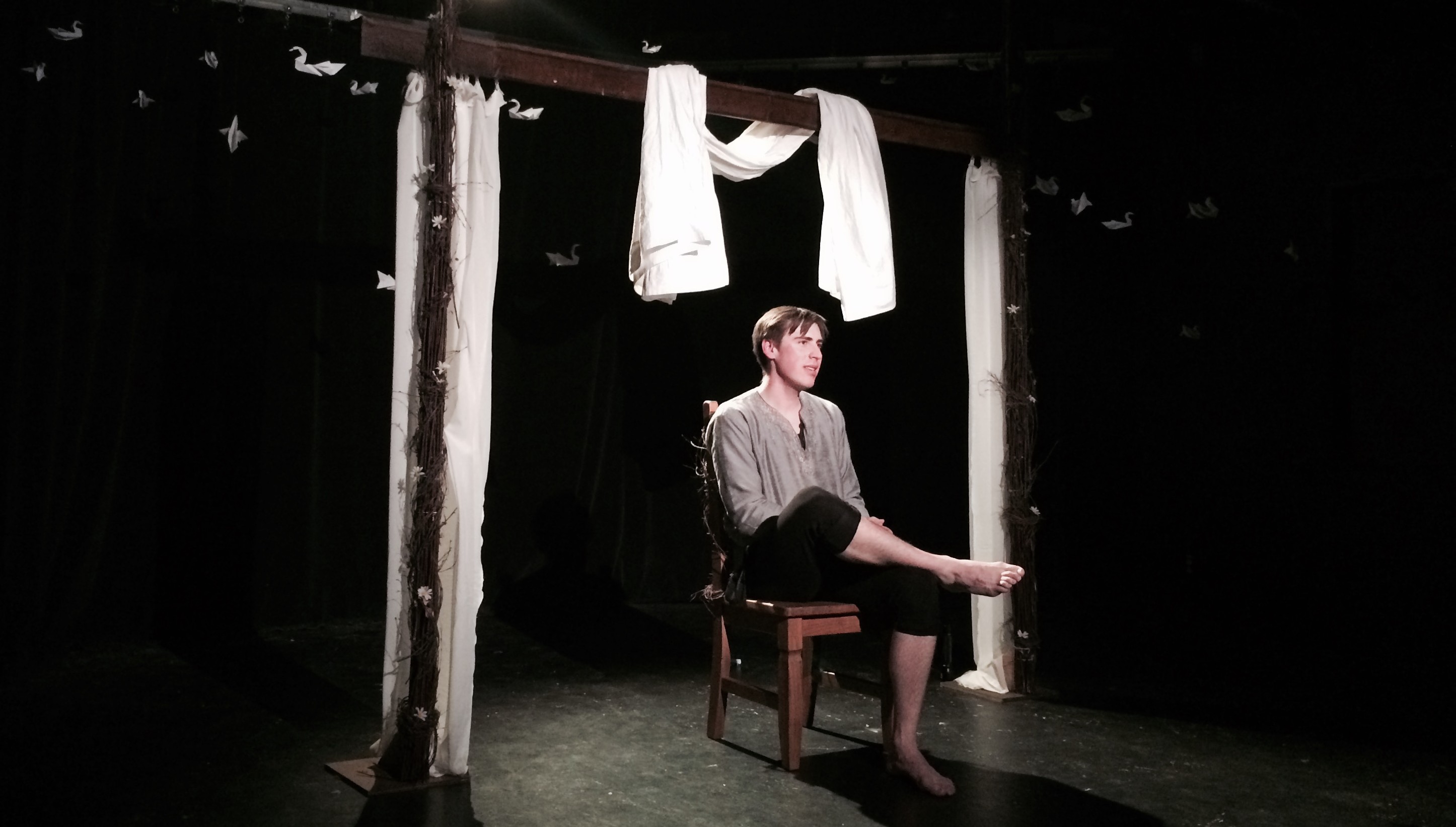
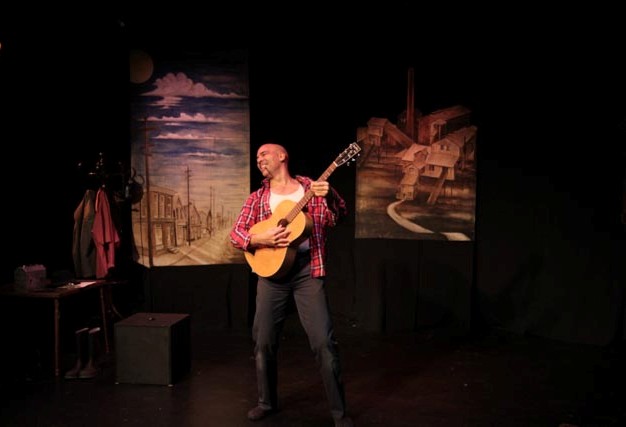
Promotional image for The Hudson Bay Epic. Pictured: Mudfoot Theatre Co-Founders and Artistic Directors Genevieve Pare and Ian McFarlane, with ensemble member Ryan Reese (right). Photo Credit: Chantal Wall.

Promotional image for The Hudson Bay Epic. Pictured: Mudfoot Theatre Co-Founders/Artistic Directors Geneviève Paré and Ian McFarlane with ensemble member Ryan Reese (right). Photo Credit: Chantal Wall.

Geneviève Paré and Ian McFarlane first met at the University of Lethbridge where they completed a BFA in Dramatic Arts (‘11) and BFA in Multidisciplinary (‘10), respectively. Paré and McFarlane met in their second year while working as designers on a show together. But Paré and McFarlane say one of their first real collaborations came later when a special room inside the university caught their attention.

“There was this miniature room that was built as sort of a ‘found space’ theatre space at the university,” Paré explained. “There was a microphone in the middle inviting people to sing songs and play music. The sound would be projected out into the atrium so everyone could hear what was going on in there. It was a way for people who were shy to share their music. Anyone had the opportunity to contribute.”

Sharing each other’s excitement for impulsive performance art, Paré and McFarlane decided to perform inside the space together. In the room, the pair washed their hands in a bowl of soap water, beat boxed, and performed improvised poetry.

Paré says the collaboration signaled to both her and McFarlane that not only were they “both weird” and into “super bizarre ideas,” but that they could also work together.

In 2012, Paré and McFarlane collaborated again for Junquatica, a performance installation that ran as part of We Should Know Each Other #100. McFarlane says Junquatica was inspired by the aquatic intertidal zone, an area of interest for Paré who was working as a kayak guide off the coast at the time.

“It was a fun project,” said McFarlane about Junquatica. “Gen had this great idea of [creating] this box where people looked in and there were performers. But when they looked in they were also looking at each other…They all became characters of this world.”

At the time, Paré and McFarlane performed under the name Deux Fous Frivoles. The name was later changed to English (Frivolous Fools) due to pronunciation difficulty.

It was also at this point that the pair became excited about using found materials, like garbage. Junquatica’s performance space was constructed out of reclaimed materials meant to reflect a concern for the health of the oceans. McFarlane says the idea of found materials carried over into The Hudson Bay Epic, a play that toured both the Winnipeg Fringe Festival and Calgary Fringe Festival in 2014.

A historical fiction, The Hudson Bay Epic stages the story of Henry Hudson’s last voyage into the Canadian arctic. On board the ill-fated Discovery, a forbidden romance develops between two crew members while the threat of violent mutiny grows larger with every passing day.

The production featured a ship-like structure made from reclaimed materials. The structure was unique for its ability to produce music and ambient sounds.

“The initial inspiration came out of a performance idea of creating a structure that we could play like an instrument,” McFarlane explained. “We were excited about having this machine that we turn a crank and runs some music.”

For The Hudson Bay Epic, Paré and McFarlane formally adopted the name Frivolous Fools Performance. But the two ran into a problem with the name when touring the show, McFarlane explains.

“It was when we started touring The Hudson Bay Epic, people started calling us ‘The Fools’. We can’t do that because in Calgary there’s already ‘The Fools’ [Green Fools Theatre]. [We thought] we can’t have – This is just not good for anybody! It’s going to confuse and disrupt.”

Unfortunately, this was not the only issue with the name. When it came time to apply for grants, McFarlane and Paré were advised to change their name to something more suitable, as McFarlane explains.

“Grant advisors would be like ‘you should consider changing your name because you are neither foolish or frivolous.’ And yes, it’s ironic because we are working with junk and we’re not frivolous at all. We’re being quite humble with our work, this humble magic we are working with. But when it comes to applying to Canada Council…”

Paré and McFarlane sought a name that better reflected their work and aesthetic. After much consideration, Paré and McFarlane finally agreed on the name Mudfoot Theatre.

“There’s a whole bunch of ways to look at a name and how it resonates with who we are as artists,” said Paré about the name change. “If you’ve got muddy feet, it’s because you’re doing something awesome…If you’ve got your feet wet in the mud, then you’re active and in some interesting process.”

As their history shows, McFarlane and Paré are no strangers to change. What began as a performance duo has now grown into an independent creation-based theatre company.

Mudfoot Theatre collaborates with interdisciplinary artists to create contemporary folk tales through simple, grassroots storytelling. The company primarily stages Canadian history, something some Canadian theatre artists avoid, says Paré.

“Theatre artists don’t want to be identified as Canadian theatre artists. There’s something….What’s the word? It’s patronised a little bit. Because we’re softcore Americans, we’re so nice…Canadian is like…It’s not cutting edge.”

“If you’re a Canadian artist, you’re not from like Berlin or New York where you’re cutting edge and taking chances. But we do, do that as Canadian artists.”

Paré and McFarlane believe there are other reasons that make Canadian history less enticing as both performance material and a subject of interest among Canadians. For McFarlane, one reason has to do with how Canadian history was documented.

“It’s written as a business account,” said McFarlane. “We traded furs for this much money. We set up a shop in this place. It’s all written by merchants who are writing back to the homeland.”

“One of the fascinating things about Canadian history,” McFarlane continued, “is that that there were so many details that weren’t written down. In Europe, quite clear that these are the stories and these are the people. Endless literature. But in Canada, someone in the bush had this crazy experience but didn’t know how to read or write.”

“One of the things Europeans have about their history,” Paré added, “is that because their history goes so far back and it’s not written about in such a clinical way, there is room for myth…There’s magic, actual magic in the soil where they live. I want to have magic in my soil too.”

For Paré and McFarlane, staging Canadian history is not just about finding our collective voice as a nation, but also infusing our identity with a sense of magic.

And it is this sense of magic that the company’s next project River will embrace.

Inspired by David Thompson’s expeditions, River will tell the story of the Bow River through live music and puppetry. McFarlane says River will be a very different production from The Hudson Bay Epic.

“In The Hudson Bay Epic, we were quite direct with our history,” said McFarlane. “We took a journal and pulled stuff straight out of the journal and created characters that were actually historical people. In River, we are being quite broad and quite loose. Making it more on the mythical side than the historical side.”

Paré says audiences can expect “a tragic love story between a glacier, a star and a trickster paralleled by some narrative from David Thompson’s personal journals.”

Joining Paré and McFarlane for River are pianist Jesse Plessis and guest collaborator Jesse McMann-Sparvier.

River will be presented this week as part of the Calgary Region One-Act Play Festival at Pumphouse Theatres. Paré notes that the presentation is a prototype, or launching point, for a larger show.

Looking to the future, Paré and McFarlane say they are not sure what the company will develop next, but that they are confident they will find themselves doing something inventive and unexpected.


Mudfoot Theatre’s River will be presented at The Calgary Region One-Act Play Festival, March 26th at 7:30pm.

For more information about the festival and how to purchase tickets, visit: http://www.pumphousetheatre.ca/sections/calendar_s/calendar_2.htm

For information on Mudfoot Theatre, visit their website:
http://www.mudfoottheatre.com/
The Old Trouts Spare No Puppet in Famous Puppet Death Scenes

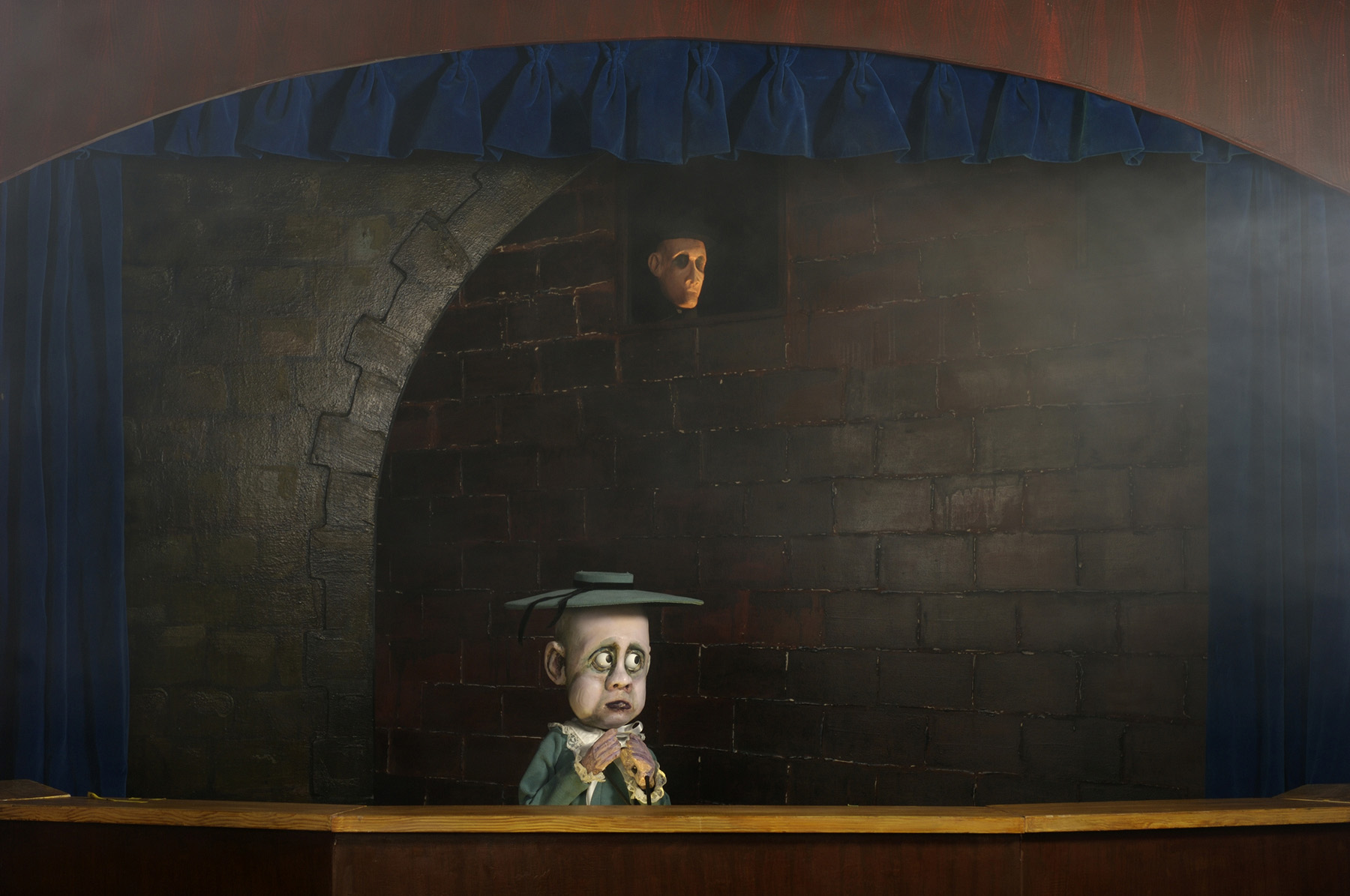
Pictured, The Beast of Muggditch Lane by August Stainbrook: Act 1, Scene 1. Image supplied by Theatre Junction GRAND.

The Beast of Muggditch Lane by August Stainbrook: Act 1, Scene 1. Image supplied by Theatre Junction GRAND.

Death.

A taboo subject in our society, and why not? ‘Not being here’ one day is an unpleasant idea that some would rather not think about, much less openly discuss. Others are more keen on the subject, like Nathanial Tweak, host and curator of Famous Puppet Death Scenes.

Created by The Old Trout Puppet Workshop, Famous Puppet Death Scenes recreates death scenes from history’s greatest (fictional) puppet shows. Tweak, a puppet himself, has amassed this grand collection in hopes that the scenes reveal something to us about the nature of life and death.

One of the first things we learn is that death is random. One minute, we may find ourselves enjoying some fresh air, then the next we are crushed under the weight of a giant fist (The Feverish Heart by Nordo Frot – Act 1, Scene 3). Or, powerful gusts of winds blow us apart, limb by limb (The Forgotten Dish by Sterling Lowry; “The Winds of Fate”). Sometimes though, it’s just a matter of picking the wrong door (Das Bipsy Und Mumu Puppensiel by Freuliecher Friedrich – Episode 43 “Bipsy’s Mistake”).

Other times too, our poor decisions invite death; poor decisions like dressing up as a deer in the middle of the forest (The Ballad of Edward Grue by Samuel Groanswallow: Act 4, Scene 6).

But perhaps the evening’s most resonant lesson is that death simply happens.

Taking a pause from the absurd, The Last Whale by Grover Bellick features a giant whale’s eye that opens, then closes very slowly. That’s it. Even the mightiest creature on Earth cannot outrun death’s grip.

Lucille Arabesque by Agathon Finley is no different. An old woman rests on her deathbed, taking what are perhaps her last breaths. There are no moving last words. Only an unsettling silence, a confrontation with our fragile mortality.

And yet, despite everything, Tweak insists there is such a thing as The Perfect Death Scene. In the play’s final moments, we wonder whether or not Tweak himself learned anything in the process.

The Old Trouts are at their finest in this spectacular display of grisly humour and puppetry. The depth of dramatic styles and periods explored is quite remarkable. Not to mention the inventive staging that takes us across such a variety of fictional works, which each feel distinct in both voice and aesthetic.

And the audience is right there for every moment of it. Joy, shock, pity, you can hear it all in the theatre. The reactions from the audience almost lend a ‘musical’ quality to the production. That is the strength of the work by
the puppeteers (Nick Di Gaetano, Pityu Kenderes, Viktor Lukawski) who really make us feel for the ill-fated puppets.

Dark and funny at one moment, then haunting the next, Famous Puppet Death Scenes is a brilliant show that will stay with audiences long after its finale. A standing ovation truly earned.


Co-presented by Theatre Junction GRAND and The International Festival of Animated Objects, The Old Trout Puppet Workshop’s Famous Puppet Death Scenes runs at Theatre Junction GRAND, March 13 – 28, 2015.

For more information on the show and how to buy tickets, visit: http://www.theatrejunction.com/1415season/fpds/

Storytelling At Its Finest: Kyall Rakoz’s Ludwig & Lohengrin Enchants

Kyall Rakoz's Ludwig & Logengrin runs at Motel Theatre, Feb 24 - 28, 2015.

Kyall Rakoz’s Ludwig & Logengrin runs at Motel Theatre (Arts Commons), Feb 24 – 28, 2015. Photo Credit: Jonathan Brower

Why do we escape to the theatre? To see shows like Kyall Rakoz’s Ludwig & Lohengrin.

Presented at Motel Theatre, Rakoz’s one-man show stages the story of King Ludwig II who reigned over Bavaria in the late 1800s, but was himself ruled by an obsession with the fantastical. Ludwig was particularly enthralled by the story of the Swan Knight, the subject of Wagner’s opera Lohengrin. The king would, in fact, go on to be Wagner’s patron, giving way to a relationship only best described as complicated.

And that is one reason why Rakoz does not allow the audience to meet Ludwig. For how is it one could portray a man who sought to remain an enigma? Instead, Rakoz reveals Ludwig to the audience via the perspective of others.

Playing these multiple characters, some of whom were real people in Ludwig’s life, the actor gives the audience an idea of what was being said about this eccentric king. Questions surrounding his sanity were among the whispers travelling around the castle. But these were not quiet rumbles. Ludwig’s fixation on building elaborate, ‘fairytale’ castles deeply disturbed his cabinet ministers as the castles were a financial burden on Bavaria. One way or another, the ministers figured, Ludwig’s ludicrous spending had to end.

What is important to note is that this story is not about Ludwig as a king. Rakoz goes beyond the royal veil to humanize Ludwig as a complicated man who had the misfortune of being king. Had he been an everyman, the actor suggests, Ludwig would have fared much better than he did. Ludwig, whose sexuality attracted speculation from many, would have been able to follow his heart’s desires without the public damning him for it.

Rakoz’s show fascinates with its inventive staging that is nothing short of magical. Rakoz’s shadow play is particularly dazzling. Watching it, one cannot help but feel totally absorbed in the drama of the Swan Knight. Then, the actor escapes into 17 different characters who each feel alive in their own right. Certainly, the brain does take awhile to catch up sometimes, but never to a point where one feels lost in the story.

Really, there is so much here that has to be seen. Nearly every moment Rakoz paints on stage is simply beautiful. And such beauty makes our hearts tremble when the play nears its end. The audience wastes no time to rise to their feet and applaud Rakoz.

Set designer Leon Schwesinger’s set is both very earthy and elegant in its presentation. The paper swans hung from the ceiling are a nice touch.

Third Street Theatre did well to bring Kyall Rakoz’s Ludwig & Lohengrin to Calgary audiences. Rakoz’s ability to capture both our hearts and imaginations makes for an incredibly moving evening at the theatre. Those fortunate enough to catch Ludwig & Lohengrin during its limited run are in for something truly special. This is storytelling at its finest.


Kyall Rakoz’s Ludwig & Lohengrin runs at Motel Theatre (Arts Commons), Feb 24 – 28, 2015. 

For more information on the show, visit: 
http://thirdstreet.ca/2014-2015-season/ludwiglohengrin/
http://ludwigandlohengrin.com/


World Premiere: Lunchbox Theatre Goes ‘Speed Dating for Sperm Donors’

A lesbian couple in search of a sperm donor. Well, not just any sperm donor. The perfect sperm donor. How hard could it be? Ask Natalie Meisner, she could tell you. You might say, in fact, that she’s an expert on the subject.

Enjoying its world premiere at Lunchbox Theatre, Meisner’s Speed Dating for Sperm Donors is a fun dramatized account of the playwright and her partner’s experience in trying to start family.

Helen (Julie Orton) and Paige (Janelle Cooper) are ready to have a baby. Unfortunately, Helen’s best friend has said no to being the sperm donor. This sets the couple off on a journey to find the perfect sperm donor; perfect as defined by a very strict set of criteria. Helen and Paige’s search turns up a lot of ‘duds’ like a Russian physicist (Mark Bellamy) keen on eugenics, and a recovering sex addict (Christian Goutis). Eventually, the couple’s relationship begins to suffer as their unfruitful search leads to doubt and frustration.

As much as the play sets out to be about the couple and their journey, the story is really about Helen. We do not hear much from Paige beyond her reactionary responses that support Helen’s character arc rather than help support one of her own. On the one hand, it makes sense considering that the play is based off Meisner’s non-fiction book Double Pregnant which is written from her point of view. On the other, however, this is a dramatization that – according to the Playwright’s Notes – seeks to play with and flesh out “the dramatic potential” of Meisner’s autobiography. That is why it is so strange that Meisner chooses to narrow the play’s perspective rather than expand it in a work of fiction.

Perhaps though it is a limitation inherent to adapting non-fiction for the stage. There could be nothing more exposing, after all, than having one’s life story played out in front of a live audience. And as a result, there may be a fear/worry on the playwright’s part of misrepresenting and/or overstepping the personal boundaries of those involved in real events.

Where Meisner does hit the mark is in her application of humour to approach (and widen) the conversation surrounding LGBT families. While she may achieve this by playing into certain stereotypes, Meisner does it in such a way that reflects a sharp self-awareness on her part. The playwright is able to venture out into the ‘two-dimensional’, then bring it back to something sincere. In doing so, she entertains (which may ease some into the conversation), and then uses humour as a means to illuminate and establish a common ground with the audience.

Meisner’s revolving door of quirky characters, though, does wear thin after awhile. The first few characters are fun, but then the later character scenarios – especially the one Meisner throws in as misdirection – stall the pace of the play.

Thankfully, Bellamy and Goutis are strong enough in these roles that the play does not completely drag in its last thirty minutes. (Bellamy has an infectious charm that lights up the stage).

While very funny and clever at times, Speed Dating for Sperm Donors does feel as though it could go further to explore its more serious, dramatic elements. Pacing issues also stifle Meisner’s comedic wit, but great character work by the actors help keep the play light-hearted and enjoyable.


Lunchbox Theatre’s Speed Dating for Sperm Donors runs Feb 2 – 21, 2015.

For information on the show and how to purchase tickets, visit: http://www.lunchboxtheatre.com/calendar/2015/2/2/speed-dating-for-sperm-donors-by-natalie-meisner?view=calendar

Beneath Springhill: The Maurice Ruddick Story Shines Light On Canadian Hero

Beau Dixon as Maurice Ruddick in Beneath Springhill: The Maurice Ruddick Story. Photo Credit: Nicole Zylstra

Beau Dixon as Maurice Ruddick in Beneath Springhill: The Maurice Ruddick Story. Photo Credit: Nicole Zylstra

October 23rd, 1958.

On this day, the town of Springhill, Nova Scotia experienced a terrible mining disaster. A collapsed mine, triggered by a ‘bump’, would claim the lives of 74 men.

The story of Maurice Ruddick and the five men who he saved, however, would live on.

In Beau Dixon’s one-man show Beneath Springhill: The Maurice Ruddick Story, Dixon celebrates Ruddick’s unyielding spirit in the face of disaster. A beautifully woven tale of heroism, Dixon skillfully pays tribute to a man whose music and faith gave him the strength to inspire others.

A husband and father of 12, Ruddick works as a coal miner to support his family. Though his dreams of being a musician have long been put to the wayside, Ruddick is not shy to share his passion for singing with his co-workers. Unfortunately, Ruddick, an African-Canadian, is not always welcomed by the men he works with.

When news of the mine collapse breaks out, Dixon imagines what Ruddick’s 10-year old daughter Valerie experienced when watching live television coverage of the event. The coverage is hosted by a CBC reporter who Dixon also plays.

Trapped at the bottom of the mine with six other men, Ruddick is compelled to keep their spirits high until the rescue teams reach them. He does so by singing and leading the men in various hymnals. Even though the men’s morale drops with each passing day, Ruddick is firm in his resolve.

Beneath Springhill is a moving piece of drama that succeeds in portraying Ruddick as a man who did not see himself as a hero, but someone simply doing the right thing. Someone guided by not only their faith, but their basic humanity. (The real-life Ruddick would go on to play down his hero status).

Ruddick’s admirable character as a family man and a hard worker is, in fact, what drives the emotional impact of the play.

Dixon never allows us to forget how easily Ruddick could have lost all hope. It is truly gut-wrenching to watch the trapped men resign themselves to death while Ruddick pulls what little energy he has left, setting aside his own fears in the meantime, to maintain their morale. And all the while, who is Ruddick? He is just a simple man who risks his life on a daily basis to put food on the table.

Nor does Dixon allow us to forget how Ruddick was later rewarded for his courage. Because of segregation at the time, Ruddick’s invitation by the Governor of Georgia to a luxurious resort is sent under the condition that he and his family stay in a trailer park, away from the other survivors.

Under the hot theatre lights, we can see that this production is not easy for Dixon who plays a wide range of characters. Yet, despite the furious pace at which these transitions happen, Dixon somehow manages to not lose control of the distinct voices and mannerisms he has crafted, especially those of the five coal miners trapped with Ruddick.

Also, Dixon does well to keep the play moving forward by framing the central action with scenes of Ruddick’s daughter and the CBC’s coverage. Despite Dixon’s mixed performance as a 10-year old, seeing the disaster through a young girl’s eyes is still heart-breaking. And the CBC’s (rather pessimistic) coverage of the event reminds us just how great the odds are/were against Ruddick and the other coal miners.

A story about hope, family, and humanity, Beneath Springhill: The Maurice Ruddick Story pays its respects to a Canadian hero who inspired strength in others. Audiences will find Dixon’s performance as incredible as the emotional story he brings to life.


Beau Dixon’s Beneath Springhill: The Maurice Ruddick Story runs at Lunchbox Theatre Jan 12 – 24, 2015. 

‘Beneath Springhill’ is co-presented with the 25th Annual High Performance Rodeo.

For more information about the show and how to buy tickets, visit:
http://www.lunchboxtheatre.com/calendar/2015/1/12/beneath-springhill-the-maurice-ruddick-story-by-beau-dixon?view=calendar

For information about this year’s High Performance Rodeo, visit: https://www.hprodeo.ca/

Maurice Ruddick was featured in a Heritage Minute which can be seen here: 
https://www.youtube.com/watch?v=d9jnQnUuDmE


Lunchbox Theatre’s With Bells On Brings That Holly Jolly

This holiday season, in association with Guys in Disguise, Darrin Hagen’s With Bells On returns to Lunchbox Theatre where it was first produced in 2010.

Directed by Hagen, With Bells On is a fabulous comedy that celebrates the holiday spirit by taking it to new heights.

Ted (Stafford Perry) is a young divorcé stuck with a lousy apartment and lackluster social life. One night, riding in the apartment’s elevator, Ted runs into Natasha (Paul Welch) – a statuesque drag queen dressed as a Christmas tree. Natasha’s dream of competing for the title of ‘Christmas Queen’ that night is in jeopardy when the elevator abruptly stops.

Life is full of ups and downs, and we move right with it in every direction. So, what happens when it just stops? In this pause, what is that we discover about ourselves and each other?

Hagen uses Ted and Natasha’s momentary pause from the business of everyday life to reflect on loneliness – a feeling exacerbated by this particular time of the year. This loneliness though is just not about being alone, but feeling lonely in a crowd. And so, when the opportunity presents itself to Ted and Natasha to make a real, human connection with a stranger – it is at once both exciting and terrifying. Continue reading

Fully Functional Starts a Conversation About Disability, Sexuality, and Society

A co-production between Inside Out Theatre and MoMo Dance Theatre, Fully Functional is a new play that gives a voice and real presence to its artists of mixed abilities. Drawing inspiration from their own personal experiences, the artists/creators tell stories of love, sex, and romance through dance and movement.

Being late to a first date, sex poems and orgasmic shouting: it is fearless storytelling injected with humour.

But past the laughter and heartbreak of these stories, the artists ignite a conversation about how our society views persons with disabilities.

In a talk-back session after the performance, an audience member asked “what impact do you hope to have for people afraid to let others in? [I mean it’s] easy to say I want love, but to say I deserve love is a good place to start as well.”

Mark Ikeda, artistic director of MoMo Dance theatre, responded.

“We got together in a room…and talked how taboo the topic is about the intersection between disability and sexuality, and how not only does no one know how to talk about it but people are afraid to talk about it. We hope to start a conversation, start people thinking about…how certain preconceived notions or thoughts might be quite harmful”

Thomas Poulsen, one of the performing artists, followed Ikeda’s response with his own, saying “I think you indicated that fear is very much out there in the community – in the disability community.”

Fully Functional opened at the Joyce Dolittle Theatre inside The Pumphouse Theatre on December 3rd. Pictured (left to right): Stephen Henry, Gaelyn Thomson, and Kathy Austin. Photo Credit: Chantal Wall

Fully Functional opened at the Joyce Dolittle Theatre inside The Pumphouse Theatre on December 3rd, 2014. Pictured (left to right): Stephen Henry, Gaelyn Thomson, and Kathy Austin. Photo Credit: Chantal Wall

The fear Poulsen refers to is a fear of rejection that goes deeper than what one might assume. On a whole, persons with disabilities are marginalized and rejected by mainstream society.

Consider how we speak about disability.

The disabled – a homogenizing term that attempts to refer to all persons with disabilities. It is a term that ignores the fact that disabilities are various in their form and appearance. Above all, it is a damaging term that erases the individual and reduces them to a diagnosis.

Newspaper articles sometime describe wheelchair users as either “bound” or “confined” to their chair. Persons with disabilities are framed as ‘victims who suffer from’, rather than ‘persons who live with’ a disability.

And then, it is the distance “the able-bodied” maintain between themselves and persons with disabilities. This distance comes out of fear, anxiety, and discomfort. But yet, we feel comfortable enough to stare out of curiosity and to make assumptions about their lives (but never to assume that they might have their own desires for human intimacy).

So, how can one think that they deserve to be loved when they are confronted over and over again with this idea that living with a disability somehow makes you a lesser human?

On its surface, Fully Functional addresses the assumption that disability interrupts sexuality. What it also addresses is the lack of belonging persons with disabilities experience in society.

Fittingly, the play ends with a slow dance, but this time – unlike the first time – the artists invite members of the audience to come dance with them. The slow dance serves as an invitation to close the distance and to start connecting with one another.

After all, at the end of the day, we are all human beings who want to love and be loved.


Inside Out Theatre and MoMo Dance Theatre’s Fully Functional ran at the Joyce Dolittle Theatre inside The Pump House Theatre from Dec 3 – 6, 2014.

Fully Functional was created and performed by:

Kathy Austin
Emily Collins-Tucker
Stephen Henry
Thomas Poulsen
Gaelyn Thomson

Co-directors: Col Cseke and Mark Ikeda, artistic directors of Inside Out Theatre and MoMo Dance Theatre respectively.
Assistant Director: Jordan Dalley

Inside Out Theatre: http://insideouttheatre.com/
MoMo Dance Theatre: http://www.momodancetheatre.org/

Closing Night, Open Doors: Western Canada High School Drama Students Say Goodbye to Our Town

It is closing night of Western Canada High School Drama’s production of Our Town, a play by Thornton Wilder. Family and friends have braved the freezing weather outside to come support the cast and crew.

Laughter. Tears. Curtain.

Inside the empty school theatre, Grade 12 student Julia Hermanson says goodbye to her second family.

“Everyone [comes to know] each other so well. You spend two or three hours with each other after school and then see each other on the weekends. You become like a family” says the graduating WCHS student who played Mrs. Webb in the production.

Hermanson not only learned more about how she works with others, but in the process she also learned more about her self. To be true to a character, she shares, is to be true to one’s own emotions and experiences.

And while the show may be over, fellow castmate Emilee Shackleton (Emily Webb) says she won’t soon forget the lessons she also learned along the way.

“Theatre has taught me to be honest. It has taught me to never stop discovering” says Shackleton, a senior student who made her debut in last year’s production of Macbeth.

For drama teacher Brittany Babott, it is this sense of discovery that drives WCHS’ Drama program.

“For me, it is the exploration of what it means to be human that is a big component of the program” Babott explains. Theatre offers students like Hermanson and Shackleton a great opportunity for personal growth and development.

Despite this, Babott says, theatre still has a hard time in education.

“You need measurable outcomes, [but] you can’t have quantifiable outcomes for empathy, expression, or the students who are shy and push that.”

Part of the program’s mandate, Babott continues, is also to replicate a professional experience for students – on both the performance and technical side. It does this by collaborating with theatre professionals from the community. (Our Town was directed by Calgary based director Kevin McKendrick, an eight time Betty Mitchell nominee for Outstanding Direction).

And for students who plan to pursue a career in theatre, Babott says, the exposure to successful industry professionals fosters theatre as not only a possible career option, but a viable one as well.

What’s next for Hermanson and Shackleton after graduation?

Hermanson has applied to York University, the University of Toronto, and will be auditioning at the National Theatre School of Canada.

“Big, small, this is what I want to do…I want to continue telling the truth” says Shackleton who has also applied to several theatre schools.

It is closing night. The stage is clear. The lights are off. And with a wave goodbye, the cast and crew of WCHS Drama’s Our Town are ready to go celebrate a successful run.

Hermanson and Shackleton are deep in reflection.

Exit.


Western Canada High School Drama’s production of Our Town ran at the WCHS Theatre from Nov 25 – 28, 2014.

Why We Remember: Jake’s Gift Is a Heartfelt Tribute to Veterans

One woman. Two characters. Thousands of soldiers who never made it home. But for playwright/performer Julia Mackey, the shores of Juno Beach were never meant to be their final resting place.

Presented at Lunchbox Theatre, Mackey’s one-woman show Jake’s Gift delivers a moving dramatic experience.

Directed by Dirk Van Stralen, Jake’s Gift tells the story of Jake, a Canadian WWII veteran who (reluctantly) returns to Normandy, France for the 60th anniversary of D-Day. The trip brings back painful memories for Jake who lost his older brother Chester during the war – a difficult loss he has been unable to deal with in the years since. Jake develops an unlikely friendship with a 10-year-old local named Isabelle. Isabelle’s innocent fascination with D-Day, though first met with resistance, pushes Jake to confront his past and, in doing so, come to terms with his brother’s death.

The weight of the war and its personal impact is marked all over Jake’s body – from his difficulty walking to his shaking arm and curled fingers. Continue reading

Chromatic Theatre’s Debut Production Shows Promise, but Just Misses The Mark

Presented at Motel inside the EPCOR Centre and directed by Jenna Rodgers, Chromatic Theatre – Calgary’s newest theatre company – makes its debut with Michael Golamco’s Cowboy Versus Samurai.

A modern re-telling of Edmond Rostand’s Cyrano de Bergerac, Cowboy Versus Samurai tells the story of Korean-American Travis Park (Mike Tan), a high school English teacher who lives in the fictional town of Breakneck, Wyoming. Besides Travis, there is only one other Asian in this predominantly white rural town: Chester (Richard Lee Hsi) – his friend and brother in Asian solidarity. When Asian-American Veronica Lee (Carmela Sison) moves into town, Travis immediately falls for the school’s new Biology teacher. There is, however, just one problem: Veronica only dates white men. Soon, Travis finds himself ghostwriting love letters to Veronica on behalf of his friend Del (Mat Glessing), a Caucasian P.E teacher, while struggling to reconcile his inner “Cowboy” and “Samurai.”

Golamco sets out to dismantle racialized stereotypes, and he does so very explicitly with Chester – an amalgamation of pop culture Asian stereotypes. Chester’s extreme, over-the-top expression of “Asianness” is a confrontation of how our culture operates with regards to race. Just as Chester embodies sweeping generalizations about Asians, so too does he paint his own broad strokes about white people. These assumptions effectively erase the individual out of the picture.

Chester breaks down in front of Travis. Front to Back: Richard Hsi, Mike Tan. (Photo Credit: Miquelon Rodriguez)

Chester (Richard Lee Hsi) breaks down in front of Travis (Mike Tan). Photo Credit: Miquelon Rodriguez

Chester eventually comes to realize that his preoccupation with being Asian has obscured his own individual identity.

What is interesting, though, is that Breakneck, Wyoming remains a homogeneous, bigoted “sea of white” throughout. It is, of course, the small rural town and its small-minded residents that are Golamco’s obvious culprits for prejudice. And Del – the play’s spokesperson for white people – is part of the problem. Yes, by the end of the play, Del makes significant progress in terms of how he thinks and talks about race, but the fact remains that Golamco’s attempt to subvert stereotypes falls short of rising above the very thing he sets out to criticize.

Despite this, Golamco’s does manage to bring forward some insightful observations surrounding identity and inter-racial dating – the latter being a topic rarely discussed as earnestly and with such vigor as it is here.

But the script lacks character depth. Awkward dialogue does nothing to help characters who struggle to say anything interesting when race is not involved. And it does little to help us truly care about Travis and Veronica’s relationship. There are some sharply written moments to be found, but character development, for the most part, takes a backseat to the play’s major ideas.

Hsi fully commits to the ridiculous nature of his character during both scenes and scene transitions. Tan is a great straight man to Hsi’s antics, while also being entertaining in his own right. The duo are a good pair.

Jennifer Lee Arsenault’s set design is aesthetically pleasing with its waterbrush look. The use of spinning cardboard boxes, hung on tubes in rows of three, is an ingenious way of changing scenery. (Though they are prone to getting stuck in mid-spin).

A questionable production choice is the company’s use of a live cap gun. The gun’s loud bang is deafening inside the small studio space – which only seats 50. A sound cue would suffice.

While the company could have chosen a tighter script, Chromatic Theatre’s production of Golamco’s Cowboy Versus Samurai fares well enough as a first impression. It will be interesting to see how the company develops from this point on.


Chromatic Theatre’s production of Michael Golamco’s Cowboy Versus Samurai runs at Motel (EPCOR Centre) from Nov 13 – 22, 2014.

For more information about the show and how to purchase tickets, visit: http://chromatictheatre.ca/cowboy-versus-samurai/