The Age of Love Turns The Taboo Into Something Sweet

Love, you never know where you’ll find it. Just ask 21-year-old Ash (Ryan Gray). Who have guessed that Ash would meet the love of his life at his grandfather’s funeral? Funerals aren’t exactly breeding grounds for romance, you know with the whole death thing. But when Ash laid his eyes upon his sobbing step-grandmother that day, something just clicked.

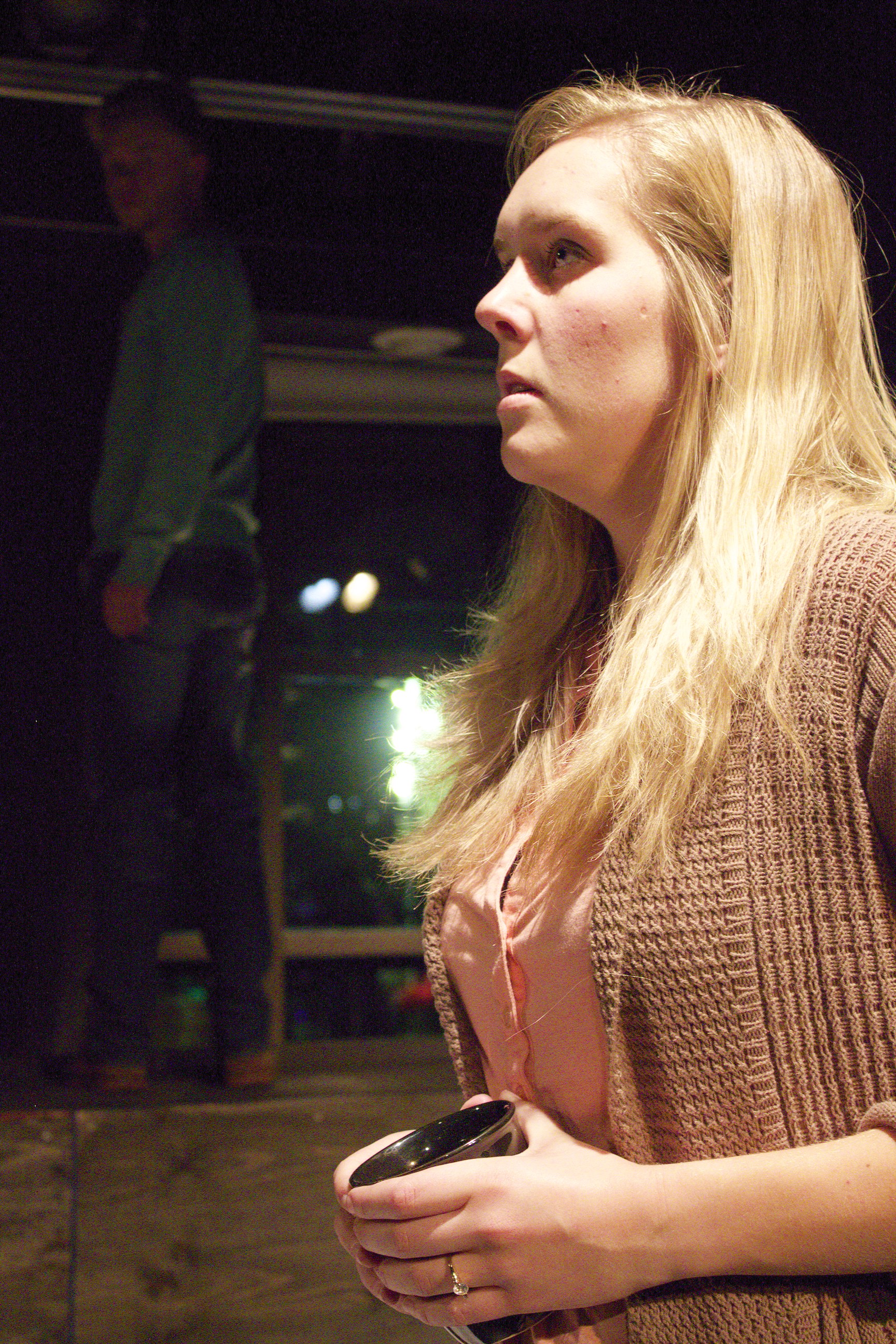
Presented by Urban Stories Theatre, Maria Crooks’ The Age of Love stages the ‘scandalous’ relationship between Ash and his 77-year-old step-grandmother Olivia (Diana-Marie Stolz). While the relationship is no problem for Olivia, a feisty mature woman, Ash has been slow about making their love known publicly. The thing is, Ash has a whole lot of money waiting to be inherited, but the inheritance is at the discretion of his mother Evelyn (Olga Primak). Ash can’t just marry anyone, you see, he needs to marry someone who has Evelyn’s approval, otherwise Ash receives nothing.

More libido than brains, Ash decides the best way to break the news to his mother is to have them all appear on a ratings thirsty tabloid TV show hosted by Lex Rodriguez (Ellen Sullivan).

Crooks goes beyond the taboo to find something sweet in Ash and Olivia’s relationship. Sure, the playwright goes for laughs, and maybe tries too hard in the process, but the playwright stays away from framing the two lovebirds as sexual deviants. Instead, Crooks is interested in exploring what exactly defines a normal relationship. So long as people are happy and not hurting anyone, then why should anyone worry about the status quo when their heart says otherwise?

Crooks takes a bite out of the status quo by positioning Ash and Olivia’s relationship against the outrageous spectacle produced by slimy, Jerry Springer-esque TV shows. Suddenly, there are far stranger things in life than a couple who just happen to be 50 years apart, like TV talk shows that exploit people for entertainment.

And in a fun twist, the eccentric psychologist and shoe fetishist Dr. Blezieau (Scottie Grinton) is perhaps the most rational person in the room.

With that being said, Crooks’ script could really benefit from a significant trim. 75 minutes feels just a little too long for this quirky play. While Britt Kennedy’s direction brings a lot of pep to the show, the material does start to run thin, especially towards the end.

On that note, there is not much on stage besides two chairs, a bed, and a desk. A good thing considering the front row has to be conscious of their feet so they don’t trip anyone during some of the more physical moments.

Stolz brings a lot of fire to the stage, and a lot of that fire comes out when she goes toe to toe against Primak. No easy battle given Primak plays Evelyn as less than a helicopter parent and more of a fighter jet. Gray is a lot of fun to watch as he tries to maintain the peace between the two fierce women.

Grinton is a real scene stealer with his faux, over the top German accent, and all the uncomfortable euphemisms that come out of his character’s well-meaning mouth. And the audience loves Sullivan as Lex, a TV host who cares more about camera angles than real human emotion. Sullivan has a great time with the character, and who wouldn’t when they get to poll the ‘studio audience’ on what they think about Ash and Olivia’s relationship?

Based on actual events, Crooks’ new play The Age of Love is a hilarious, oddly touching show that audiences will enjoy for its refreshing look at the taboo.


Urban Stories Theatre’s The Age of Love runs Nov 10 – 21 at Motel Theatre.

For more information about the show, including how to purchase tickets, visit: http://www.urbanstoriestheatre.org/
 

The Far, Far Edge of Theatre: Nadia Ross Talks What Happened to The Seeker


WH EXHIBIT PHOTO OF SECTION AS PROMO IMAGE 3.jpg

STO Union’s What Happened to The Seeker opens next Wednesday (Nov 25) at Theatre Junction GRAND.

Founded in 1992 by Artistic Director Nadia Ross, STO Union is a multidisciplinary art and performance company that explores new methods of theatre creation and production by bringing together artists from a variety of mediums. For their latest show What Happened to The Seeker, the company has brought together exhibition, video, and live performance to stage an experience unlike any other.

“We are the far, far edge of theatre,” Ross says, “even to the point where we’re not even sure theatre critics can review it…[but] that’s what STO Union does is explore, what else can you do in a venue? What are other ways to communicate? It’s bringing up questions we want it to bring up.”

What Happened to The Seeker tells the story of a middle-class, North American woman who embarks on a personal journey to reclaim the ideals of her youth. The journey is based on vivid experiences from childhood, intertwined with the history of the Seekers – youth of the 1960s who travelled the world to find spiritual enlightenment. The performance triptych, encapsulating the era from 1965 to 2010, takes the audience on a journey of their own as they piece together the story of the character’s fragmented life.

“There’s an underlying franticness in her because of her search, her desire to find some sort of place where she feels okay in the world,” says Ross about the character. “There’s also this huge underlying – it’s subtle, but it’s there – level of disappointment because there was so much anticipation, so much hope, so much belief. I mean, they were talking about climate change in the sixties. They were talking about plastics. They were talking about all of this stuff.

“[The character] realizes that change is very, very slow. She did not expect that by the time she was in her fifties that women would be still be paid so much less than men. She thought they would be equals, that’s what she assumed was going to happen.”

Ross adds that part of the danger when talking about the sixties is the nostalgia surrounding the period. “A lot of people say, that was the highlight, and we’ve gone downhill since then.”

The internationally acclaimed artist explains that the show’s structure is inspired by changes currently developing in the communication revolution. “I think with the internet, Facebook, and all that, it’s changed how we look at things. We’ve become far more visual. It’s all about the image. Language is sort of deteriorating.”

“What I did with this show is I’m trying to imitate what happens when you go online,” says Ross about bringing together three mediums to tell a story. “One minute you have this; the next you have that. You have totally different formats that you are exposed to very quickly. We don’t do it as fast as online, but that’s why we give you very different experiences. So, one moment you feel like you are in an art gallery, then the next moment you are watching a puppet movie, eating popcorn.

“So, it’s sort of an experiment into, can you do that? Can you pile things on top of each other that are different forms and still, in some way, have communication with the audience? [Can you] still keep that red thread going through the whole thing?”

Even with all our progress, Ross believes that what will always remain true about human beings is our desire not to change what is there in order to feel better. “Our search [for spiritual enlightenment] is like, buy your lotto ticket and get your million dollars.”

“[The character] goes through hundreds of boyfriends,” she says. “She goes through different things at work. She’s just kind of tearing through life in hopes that she’s going to find it, find that sweet spot… that’s what we want to look at, that eternal desire for something else, for something more, for something that’s going to hit the spot, and how we never find it.”

Although the show may be far from traditional, the experiments that are being staged may one day affect the mainstream. Ross hopes that people who are curious about what is on the horizon will come see the show when it opens next Wednesday at Theatre Junction GRAND.


STO Union’s What Happened to The Seeker runs Nov 25 -28 at Theatre Junction GRAND.

For more information about the show, including how to purchase tickets, visit: http://www.theatrejunction.com/portfolio/what-happened-to-the-seeker/

STO Union’s website: http://stounion.com/

I Say, You Say: Holt Takes The Stage For Shakespeare’s Will

Elinor Holt plays Anne Hathaway in Thiessen's one-woman drama Shakespeare's Will. Photo credit: McDonald Photography.

Elinor Holt plays Anne Hathaway in Thiessen’s one-woman drama Shakespeare’s Will. Photo credit: McDonald Photography.

Absence makes the heart grow fonder, maybe. Ask William Shakespeare’s wife Anne Hathaway (Elinor Holt) what she thinks about that.

One part history, several parts dramatic whimsy, Canadian playwright Vern Thiessen’s Shakespeare’s Will should not be taken as a pure biography of Anne Hathaway’s life. Think of the play – presented by Sage Theatre – more as an imagining inspired by historical fact. Thiessen’s imagining is primarily inspired by Shakespeare’s last will and testament, an actual document whose phrasing has produced much speculation on the nature of Anne and William’s relationship.

On the eve of William’s funeral, Anne is pressured by her husband’s sister, Joan, to hurry home and read his will. Anne is hesitant, however, to read her late husband’s final wishes. Instead, the widow journeys back to when she, at the age of 26, met the young Shakespeare. The 18-year-old writer is, surprisingly, a man of few words, content only to respond with ‘aye’ when speaking with Anne. Despite this, Anne falls for and eventually marries William – Anne’s pregnancy may or may not have fast tracked that decision.

Anne and her three children are just about abandoned by William when his theatrical aspirations call him to London. Yes, he sends money and (very brief) letters from the city, but what about the months spent away from his family? What about Anne’s unfulfilled sexual desires? Maybe Anne’s overbearing father was right about not trusting Catholics. After all, William is nowhere close for support when the plague breaks out.

Thiessen may not be interested in telling just any old love story, but the play certainly feels familiar. One reason for the play’s familiarity is that at its core, its premise is this: a woman marries an artist whose career takes him far away from home. No doubt, what makes this specific story standout is the mystique surrounding Shakespeare’s personal life. Given that Anne is very much on the periphery of that fascination, more of an answer on an high school English exam than a historical figure, Thiessen’s play feels as though any couple of the same dynamic could replace Anne and William.

Thiessen’s rich, flowing language has a rhythm to it that Holt carries wonderfully. Kelly Reay’s smooth direction matches Thiessen’s style impeccably. The director’s strong awareness of space and movement transforms the stage into an almost dream-like sea of memories where Holt is caught adrift. Ajay Badoni’s emotional lighting design plunges the stage further into this ethereal state, to the tune of Allison Lynch’s solid musical composition.

Memory is a powerful thing as Holt demonstrates in full force. How Holt so effortlessly sweeps back and forth between Anne’s memories is mesmerizing. Every word spoken feels honest, almost as if Holt were revealing a secret to a friend. Holt truly lives every detail of Anne’s personal history, from the birth of her children to her unhappy encounter with tragedy. Alone, Holt conjures an intimate, stirring performance that almost convinces us otherwise about Thiessen’s loose imagining of history.

Ultimately, Thiessen’s springboard for imagination, as he calls it, misses the mark by telling a story about a woman like Anne Hathaway, not a story about Anne Hathaway. Thiessen admits the play is not a proper historical representation of Anne Hathaway, and that apology is founded. Although there is not a vast wealth of knowledge about Anne Hathaway’s personal life, there is still something strange about trying to stage Anne’s perspective when it relies so heavily on her husband’s legacy. Thiessen’s script is written well as it offers plenty for Holt to sink her teeth into, but audiences may feel a lingering disconnect in the back of their minds.


Sage Theatre’s Shakespeare’s Will runs Nov 6 – 14 at the Joyce Doolittle Theatre.

For more information about the show, including ticket information: http://sagetheatre.com/

Let’s Do a Puppet Show!: Ronnie Burkett’s The Daisy Theatre Impresses

It’s often said that puppets can get away with just about anything. Think about Punch & Judy. Despite being very cruel and violent, the show is still a hit with audiences today. Think about the Tony-Award winning musical Avenue Q. Puppets sing about racism, pornography, then go off to have wild puppet sex – and that’s just the first act!

And then, there’s The Daisy Theatre by Canadian puppeteer Ronnie Burkett.

Because over forty marionette characters call The Daisy Theatre home, each night is a different show. Unscripted, Burkett’s razor sharp wit is free to play and surprise in every performance.

At the top of the show, Burkett introduces us to Franz and Schnitzel. Franz is a dirty sex fiend, and Schnitzel is a sweet little fairy child. When he’s not berating Schnitzel, Franz finds time to riff on the NDP, and the political left. Poor Schnitzel – everything good and innocent in the world – only wants to grow wings and fly with the birds. Cue the audience melting into a goopy puddle of emotions.

Or we would if Miss. Lillian Lunkhead, Canada’s oldest and worst actress, weren’t so picky about how the audience greets her entrance – clap this way, gasp that way. The stage veteran does make up for it by giving one lucky audience member the opportunity to be her scene partner for Romeo & Juliet. Sure, she might be a little…mature for the role of Juliet, but dang if she doesn’t know how to command the stage and audience.

The audience later meets Edna Rural, everyone’s sweet elderly neighbor. Edna is from the small community of Turnips Corner, Alberta. Lord love a duck if the audience doesn’t fall in love with Edna Rural. Edna, a widow, starts one place with her humourous (mis)adventures, and before we know it, she’s somewhere else entirely in her story. That’s life, though, isn’t it? But start to finish, the audience is taken by Edna’s genuine goodheart.

About puppets getting away with just about anything, Burkett pushes that theory to the limit. Over the course of two hours, Burkett’s puppets indulge in some of the filthiest, most bizzaro humour ever to grace a Calgary stage. (Salty old entertainer Rosemary Focaccia has quite the mouth on her!). Proving the theory right, the audience eats it up, almost falling out of their seats laughing. And it’s not just the puppets who have lots to say. Burkett has a thing or two to say during the evening, especially about Canadian Theatre (Showbiz, what’s that?).

What’s simply fascinating about Burkett are his masterful articulations of movement and voice that bring these puppet characters to life. Even though we can see the puppets hanging off to the side, there’s so much spirit that we can almost imagine each of these wacky, endearing characters nervously pacing backstage, all in their own personal ways.

Hands down, The Daisy Theatre should not be missed. The incredible wealth of humour and heart that Burkett brings to the stage makes for an unforgettable experience at the theatre. No wonder The Daisy Theatre is an audience favourite.


The Daisy Theatre by Ronnie Burkett Theatre of Marionettes runs Oct 27 – Nov 15 at the Big Secret Theatre.

For more information about the show and how to purchase tickets, visit: https://www.artscommons.ca/WhatsOn/ShowDetails.aspx?show_id=66984640-5CF2-4919-975D-FBE780E7BC3C

For more about The Daisy Theatre: http://www.thedaisytheatre.com/

The Truth, or Some Version of It: Theatre BSMT Stages Drader’s Liar at Motel Theatre

Theatre BSMT's season opener Liar, by Brian Drader, ran October 6 - 10 at Motel Theatre. Pictured: Carolyn Ruether (Sherri) with Simon Tottrup (Jeremy) in background. Image provided by Theatre BSMT.

Theatre BSMT’s season opener Liar, by Brian Drader, ran October 6 – 10 at Motel Theatre. Pictured: Carolyn Ruether (Sherri) with Simon Tottrup (Jeremy) in background. Image provided by Theatre BSMT.

The truth is invaluable, or at least we like to think it is. There are times when honesty is not the best policy because sometimes, the truth is unkind. When truth becomes displaced, white lies make lofty nests. And as Ben and Sherri Ingles (Grayson Ogle, Carolyn Ruether) discover in Brian Drader’s Liar, these nests are lined with patient thorns.

Presented by Theatre BSMT, Drader’s Liar tells a compelling story about family, loss, and the lonely journey towards closure. And it begins one night at a gay bar where Sherri’s estranged brother Jeremy (Simon Tottrup) meets a strange drifter named Mark (Corey Joyce). And maybe the reason why Jeremy joins Mark on the roof of a building for some beers is that he seems harmless enough, despite leading Jeremy on.

The next morning, Jeremy is found dead, and only Mark can answer the question of whether he fell or jumped.

Ben and Sherri’s marriage is in trouble, the love that was once there is just an act these days. Ever since their four-year old son disappeared, Ben and Sherri have never been the same. And so, Sherri becomes desperate to establish a relationship with the person who was there for her brother’s last hours in order to find closure. Unfortunately, the closure Mark provides is dishonest. Mark was neither Jeremy’s boyfriend, nor a co-worker at the hospital where he worked. Slowly, good intentions reveal themselves as something more sinister.

The Canadian playwright demonstrates the shattering effect of loss on the human psyche. Ben is quick to suspect Mark has ulterior motives, especially as he starts entering deeper and deeper into the couple’s personal lives, while Sherri takes anything this stranger has to say about Jeremy (and himself) as gospel. The audience may find Sherri gullible, if not totally irrational, but is she really? Consider how psychic mediums claim to have the gift of communicating with the deceased, and the fellowship they amass by those who so desperately want to believe. From the outside, the whole idea is nonsense, but to those affected by loss it is something, which is easier to accept than the complete absence of a person.

And it is this vulnerability that Mark preys upon. What makes Mark such a threat is that, as a drifter, he has nothing to lose, and everything to gain. Given this, Mark can be anything anyone wants him to be, as he shows with Ben who he wins over by becoming his new drinking buddy. In Mark, Drader reflects the malleability of truth, the versions of truth we seek out and, sometimes to our own peril, lose ourselves in.

Unfortunately, DJ Gellatly’s direction feels too relaxed for such a gripping narrative. If the production’s pace were tighter, then perhaps the pauses and silences would be more effective than they are. As it is, Gellatly traps himself and his actors within a fairly limited range where these breaks have little significance in the face of the menace and anger from which they are born from.

Where Gellatly has some success in the staging of this play is in keeping the actors actively involved at various periods within this web of broken truths on stage. Something so simple as having Ogle review his tapes downstage while a scene plays out upstage behind him benefits the dramatic tension by adding layers to the action.

Ruethers’ has some difficulty capturing the emotional nuance of her characters’ arc, effectively lacking punch when the script calls for it, but there are moments where the young actress really digs inside and shines. Ogle is very expressive as Ben whose emotions read clear across his voice, face and gestures. The actor moves with tremendous purpose, even when the character is unclear of the situation. And that makes it all the more unsettling how such a strong-willed character is won over by a mysterious stranger. Jeremy, who appears briefly throughout, is played well by Tottrup who delivers as a troubled youth in need of presence.

Joyce has the challenge of playing a manipulative character ready to change persona at the turn of a dime, and ultimately it does prove too challenging for the actor. A part of the problem is that Joyce rarely shows the same genuineness with Ben and Sherri that he does in scenes with Tottrup’s Jeremy. The audience is never given the chance to doubt Ben’s suspicions about Mark, to be surprised when Mark’s true colors are revealed. Joyce’s performance as the evening’s catalyst for emotional ruin leaves much to be desired.

The use of the Motel Theatre’s windows as both the city’s nightscape and Ben and Sherri’s house windows is smart given the theatre’s limited space. Lisa Floyd’s atmospheric lighting design makes the theatre space feel intimate, if not deeply personal.

Although it may fall short in some areas, Theatre BSMT’s production of Liar still manages to provoke its audience to consider the many ways we lie to each other and ourselves, and what that means in the long run. And no doubt audiences will think about this on their way home from the theatre.


Theatre BSMT’s production of Brian Drader’s Liar ran Oct 6 – 10 at Motel Theatre.

For more information about the show, visit: http://www.theatrebsmt.ca/Theatre_BSMT/Whats_On.html

A Waltz With History: Devon More on What She Learned From Berlin

Devon More's Berlin Waltz ran July 31 - August 8 as part of the 2015 Calgary Fringe Festival. Photo Credit: Petrocker Photography.

Devon More’s Berlin Waltz ran July 31 – August 8 as part of the 2015 Calgary Fringe Festival. Photo Credit: Petrocker Photography.

For singer-songwriter Devon More, live performance offers an invaluable opportunity to plant new ideas.

“I have a very active brain. I love to research, and I love to learn,” said the Vancouver-based artist. “I find that a lot of media and entertainment that we are exposed to is quite hollow, and I think what a shame…because entertainment value is the perfect way to educate or teach someone.”

And with endless information at our fingertips, live performance is more important than ever in this age of Web 2.0, says More.

“It’s amazing if people give you an hour of their time in a world where seven seconds into a Youtube video clip if it’s not entertaining, then you’re onto the next page, right? So, a full hour of time seems like a wasted opportunity to bring people into a room without trying to give them something… [that they] can marinate on later.”

Last month, More premiered her one-woman musical comedy Berlin Waltz at the Calgary Fringe Festival. Through original music and puppetry, More staged Berlin’s history during the Cold War, from the end of World War II to the fall of the Berlin Wall.

More felt inspired to develop Berlin Waltz after living in Germany’s capital city for four years.

“Everyone wants to know why I went to Berlin, but it was completely haphazard,” said More. “I had finished my first undergrad in Kamloops at Thompson Rivers University where I did a Bachelor of Arts in Theatre and Anthropology. So, naturally, I was still working a restaurant managerial job after I finished. And I thought, well I could do this somewhere cooler.”

“I had done a study exchange to the Netherlands years previous, so I already spoke Dutch. My slightly flawed logic was that German would be the next easiest language to pick up after that, and I could get a working holiday visa for Germany.”

With her best friend joining her, More set off for Germany. Upon arriving in Berlin, More and her friend attended an orientation session on how to navigate through German bureaucracy e.g. work permits, tax numbers.

“[We] figured we would probably end up getting seasonal work somewhere else in Germany, like at a ski resort. But when we got to Berlin, it was just…you could feel the energy of the city,” said More. “People are out and contributing to the city, taking part in the city. I just couldn’t think of a good enough reason to leave, even though unemployment at the time was at almost 20%. This was during the 2008/2009 Recession.”

Despite her limited German, More found work at a pub. Working and living in Berlin, More started to recognize something amazing about the city. Even after “witnessing all the extremes, all the worst possible outcomes” just decades before, Berlin still held the arts in high esteem.

“It’s the only place I’ve ever been where if someone asks you what you do, and you say I am an artist, their next question is not “What’s your real job?” It’s a very creative city,” said More. “And it’s a very beautiful thing as a creative person to be in a city that’s been basically slapped in the face by everything that happened in the 20th century and to see the priorities of the city be art and culture.”

More returned to Canada in 2012. Development on Berlin Waltz would begin after More’s 2014 fringe tour.

“The fringe is…I’ve never worked so hard for meager returns, but you know it’s amazing,” said More about the fringe experience. “Professional development pays for itself — so don’t make me seem like I’m money hungry! But you spend so much time on the fringe working, selling, trying to promote, trying to get people excited about your show…I just couldn’t…you really need to care about, at least I do, what you’re trying to sell to be able to maintain that level of involvement with it.”

With this in mind, More searched for a subject that she felt ready to invest all her time and energy into.

“In Berlin, I learned so much just by living there about what the sort of broad political, ideological ideas, terms, and decisions mean when they actually get down to the human level, to one person, to an individual. And it was a really important lesson for me to know that. And so, I thought, well that’s something i could spend a lot of time and energy on and feel good about.”

Although much of the show’s content comes from what she learned while in Berlin, More says research was necessary in order to accurately and properly contextualize the events that shaped Berlin and its people.

“Berlin is a very strange city. It’s contradictory, it’s not like most first-world capital cities,” said More. “If you don’t know why, if you don’t know what happened in history to create that, it’s kind of hard to understand, so I didn’t feel I could give people the broad strokes of Berlin without planting it in its history.”

More’s Berlin Waltz stands as a love letter to a city, an intimate encounter between biography and history, and also, a call for action. In her show, the artist encourages her audience to question actions taken by the Canadian government, specifically the introduction of invasive bills like the controversial Bill C-51.

“I learned a lot about the Cold War living in Berlin,” said More. “And then, I came back to Canada three years ago, and I was kind of astonished by what I felt like were some political mistakes we were making here. What happened in East Germany proved bad for the greater good. So, I was concerned. I thought, we already know this, we learned these lessons from history. We learned about intense surveillance of the population with the Stasi, and now that beast has morphed with online surveillance and all the beautiful implications of technology.”

More fears that the Cold War has become distant in the minds of Canadians, that the high-tension era which saw so much propaganda has “become history, rather than contemporary history.”

“At this vantage point of 25 years down the road after the victory of capitalism…of this quest for unlimited economic growth and what that entails for the environment and resources, it’s only really now that we know what that meant. I think rather than just blazing forward on the same path we’ve been on for 25 years since the wall fell, maybe it’s time to take inventory and say “could it be better?”…I think the answer is absolutely yes. We’re at a point where we don’t have enemies like the Soviets versus the US anymore.”

Looking ahead, More says she will perform Berlin Waltz again. She intends on using all the feedback she received to fine tune and polish the show. Ultimately, More says, she hopes to continue inspiring people to consider the parallels between what happened in East Germany and what is happening here at home.


Devon More’s Berlin Waltz ran July 31 – August 8 as part of the Calgary Fringe Festival.

Visit CBC Music’s profile on Devon More to learn more about the artist: http://music.cbc.ca/#!/artists/Devon-More

Devon More’s Bandcamp Page: http://devonmore.bandcamp.com/ 

Hoodlum Theatre’s Debut Production Impresses

Forsooth, My Lovely

David Belke’s Forsooth, My Lovely marks Hoodlum Theatre’s first company outing. From left to right: Andrew Burniston, Bianca Wu, Thomas Rayment, Griffin Cork, and John Tasker. Centre: Malik Elassal, Jane Wishart. Photo Credit: Benjamin Laird.

When Detective Birnam Wood (Griffin Cork) is on the case, everyone in the city of Padua is a suspect. Yes, everyone including Romeo Montague (Malik Elassal), Katherine Minola (Jane Wishart), and even the prudish Malvolio (Thomas Rayment).

A clever parody of film noir and the Bard’s best works, David Belke’s Forsooth, My Lovely imagines a seedy, corrupt world inhabited by Shakespeare’s most well-known characters. With dames, swords, and strong performances, Hoodlum Theatre’s inaugural production sets the bar high for the young company.

Directed by Karen Johnson-Diamond, Belke’s Forsooth, My Lovely follows Birnam Wood as he sets out to solve a case of blackmail that threatens to ruin a rich merchant’s family. In his search for answers, however, Birnam comes across a gallery of Shakespearean characters who make it obvious that something more sinister is afoot in Padua. Twists and turns in the case eventually see Birnham caught in a dangerous web of deception.

The manner in which Belke presents film noir’s defining elements – heavy disillusionment, moral decay at the heart of an urban centre, trench coats and trilbys – within a world where the characters speak in blank verse, but dress in 1940s fashion, is marvelous. The juxtaposition of styles makes for cheeky moments of self-awareness, which the ensemble is careful not to overdo. For that is the success of such a production, a clear understanding of the genre and what it is the playwright is parodying.

And none – which is a tough evaluation considering the talent present – demonstrate a better understanding of the genre than Wishart. Wishart plays the ‘shrewish’ Katherine with the edge of a femme fatale; independent, subversive. Wishart speaks as if engaged in a sparring match where she intends on coming out victorious.  At the same time, too, there is a vulnerability underlying Wishart’s performance which reveals itself in full form near the play’s end. Add in Wishart’s aptitude for accents, and you have an all-around stunning performance.

Belke’s script does require a certain degree of familiarity with Shakespeare’s collection of works in order to truly appreciate the playwright’s numerous winks and nods. (And the same could be said about film noir, but to a lesser degree). Those not so much in the know will still find the show very enjoyable, but may feel left out of the loop at times.

The production sees some issues in the way of actors tripping over dialogue. Fight sequences are loose and sluggish. And Cork’s toothpick is more a distraction than anything else. (A toothpick may work on film, but not on stage where every movement, no matter how small, is picked up by the audience).

Those issues aside, the tight-knit ensemble under Johnson Diamond’s sharp direction carry the two-hour long show well, which is made more impressive considering the multiple characters each actor (except for Cork) plays throughout the show.

What makes Belke’s Forsooth, My Lovely ideal as an inaugural production is that it offers plenty for actors to sink their teeth into. And the young talent here have done so boldly in the interest of proving themselves as emerging artists.

Hoodlum Theatre’s debut shows great promise for the company moving forward.


Hoodlum Theatre, in association with Calgary Young People’s Theatre, presented David Belke’s Forsooth, My Lovely at the West Village Theatre, Aug 19 – 23.

For more information about Hoodlum Theatre, visit: http://www.hoodlumtheatre.com/

Mercutio & Tybalt Impresses at Calgary Fringe Festival

MAndT_CalgaryFringe2015_byChrisTait_web-0148

From left to right: Tybalt (Celene Harder) and Mercutio (Val Duncan) bring their side of the story to life in Valour & Tea’s Mercutio & Tybalt. Photo Credit: Chris Tait.

William Shakespeare’s Romeo and Juliet has seen its fair share of adaptations and retellings, but none, Mercutio (Val Duncan) says, have come even close to the truth. For how many know that Mercutio and Tybalt (Celene Harder) were actually close friends? That is the premise of Valour & Tea’s newest work Mercutio & Tybalt, a hilarious reimagining of Shakespeare’s most popular play.

Written and directed by Duncan and Harder, Mercutio & Tybalt catches up with the titular characters in the afterlife. Still bitter about the fact that the story of two dumb, hormone-crazed teenagers has endured the last 400 years, Mercutio and Tybalt decide it’s time that they share their story with the world. What follows is an epic tale of bromance, full of puppetry and swordplay, that weaves in and out of familiar scenes from Romeo and Juliet.

Duncan and Harder stay true to the Bard’s style by performing the show entirely in iambic pentameter, with modern slang included in the mix. In doing so, Mercutio and Tybalt’s vaudeville-inspired antics are given a natural, if not musical, rhythm for the actors to follow.

Duncan and Harder have crafted a wildly fun show that works for both friends and acquaintances of the Bard. Harder’s bad-tempered Tybalt is the perfect foil to Duncan’s immature, yet sharp tongued Mercutio. The pair work brilliantly together, delivering a charming performance abundant in wit and attitude.

Mercutio & Tybalt captures the spirit of its source material, while delivering something fresh and vibrant at the same time. Audiences will find much to enjoy here, guaranteed.


Val Duncan and Celene Harder’s Mercutio Tybalt runs July 31st – August 8th as part of the 2015 Calgary Fringe Festival.

For more information about the show and how to purchase tickets, visit: http://see.calgaryfringe.ca/events/464-mercutio-tybalt

Helmut’s Big Day Charges Forward, Stumbles

Helmut_Calgary_Postcard_Side1

James Wade’s Helmut’s Big Day is one of 27 shows running at the 2015 Calgary Fringe Festival.

The Empire is good, God is great, and the uncivilized, Cat-Demon worshipping Barbarians call the Barren Plain home. Sabir (Alan Johnson) knows these three things for sure, except…well, the Barren Plain is the one with the small bush, right?

Presented by Red Phone Theatre, James Wade’s Helmut’s Big Day is a satirical comedy that pokes fun at notions of empire and conformity. The play blends hijinks and philosophy for a breezy, though sometimes sluggish, critique of political ideologies.

Atop the wall separating the Empire from the Barren Plain, Sabir keeps a vigilant eye over the Great Plain which he is sworn to protect. While marching back and forth may not be glamorous, Sabir is compelled to serve the Empire because, according to the army’s manuals, God is watching – always watching. Lonely at his post, Sabir finds a friend in Helmut, a soldier’s helmet he converses with.

Sabir’s troubles begins when Helmut “asks” him to identify what the difference is between the two Plains. (After all, they’re both plain!) The question, at first taken with confidence, makes Sabir uneasy as what he actually sees, which is no discernible difference at all, stands at odds with the narratives fed to him by the Empire. As the contradiction disturbs Sabir, he suddenly spots riders approaching from both sides. Which is the enemy, which is the ally, the problem of the Plains worsens with every passing second.

The nature of Sabir’s blind loyalty to the Empire reveals itself further when Katar (Emma Sinclair) comes to check on her comrade. Also confused by the Plains, Katar proposes the idea that morality is subjective, that maybe the Barbarians see themselves as good and the Empire as evil. Either that, Katar says, or life is random and all action, like guarding the wall, is meaningless. (God, Cat-Demon, makes no difference in the end). Sabir dismisses Katar’s foolish ideas, despite being confronted by the falseness of the Empire head on.

What emerges from the total confusion of these two lowly soldiers is sheer buffoonery. Sabir and Katar’s ‘best’ judgement leads to disastrous results.

While fun, Wade’s expression of these philosophical ideas is largely cumbersome. The script has difficulty weaving the play’s big ideas and physical humour together without resorting to mouthfuls. The ideas land heavy and, as a result, interrupt Johnson and Sinclair’s comedic antics.

Director/Designer Kathryn Smith’s clean, simple set helps the action flow neatly. Smith’s remedies the sometimes stagnant pace of the script by employing the two wall borders to create and thrust the audience into the panicked frenzy shared between Sabir and Katar. The use of the wall borders to show different dimensions of both the wall and the action is smart.

The snappy chemistry between Johnson and Sinclair is enjoyable, though not so much until later in the show when the script gives the actors more room to play. Sinclair’s performance as the oblivious ‘wise fool’ plays well against Johnson’s condescending, but utterly foolish character.

Ultimately, Helmut’s Big Day satirical bite is bogged down by clumsy dialogue. The play delivers fun, physical humour, but its commentary struggles to have a sharp presence in the mix.


Presented by Red Phone Theatre, James Wade’s Helmut’s Big Day runs July 31st – August 8th at the 2015 Calgary Fringe Festival. 

For more information about the show and how to purchase tickets, visit: http://see.calgaryfringe.ca/events/473-helmuts-big-day

Mir & Andrews’ ‘A Picture With A Bull’ A Mixed Effort

Ruben (Ahad Mir) loves his friends, that he knows for sure. Everything else, well, everything else he just doesn’t know about anymore. Ever since his best friend Nico (Chad Hamilton Andrews) started dating Lisa (Courtney Charnock), Ruben’s life has been a weird mess.

A comedy co-written by Mir and Andrews, A Picture With A Bull asks if adulthood and friendship can ever mix. What audiences will find here is certainly a mix: a lengthy mix of crude humour and cliché under the guise of something meaningful.

The play begins with Ruben taking us back to before all the trouble began, the trouble of girlfriends, responsibility, and nostalgia. Every year, Ruben, Nico, and Greg (Alex Peters) go on a trip together to bond and get away from life. For Ruben, what makes the trip special is that it’s always just him and his bros – no girls allowed. This year, though, Ruben’s friends have a different idea for the trip: what if Lisa and Ruben’s girlfriend Diana (Natasha Strickey) came along too? Ruben outright rejects the idea. He refuses to betray tradition, a tradition only he seems to really care about.

Ruben’s stubbornness eventually leads the guys to question their friendship, career paths, and ultimate end goals; the usual frustrations of twenty-somethings in a 9-5 world.

Mir and Andrews’ play is set up much like a sitcom. In fact, the audience can identify almost right away the usual personalities. Lisa is something like the Phoebe of the group, quirky and artsy. Greg is the Funny Guy/Slacker who is good for a laugh, but not much else (like character development). Ruben is the charismatic Cool Guy, the clever one who has a comeback for everything. And they all work in the professional fields of law, healthcare, and business – except for Lisa who is a dancer, naturally.

Like a sitcom, the writing is (over)stuffed with zingers and risqué jokes. At the same time, too, there are real concerns about adult friendships, about relationships being work rather than things that simply happen. The balance between the two is uneven, to say the least. What unfolds is a messy demonstration of the ensemble’s comedic chops. The play’s more serious commentary exists largely as an afterthought.

When the play exhausts its cheap laughs, the show settles on presenting in full its dramatic side. What follows is a forgettable conclusion – forgettable because the characters never earn anything beyond that – that abruptly ends on a less than hopeful note.

The ensemble’s strength is their charming chemistry which invites the audience into this group of friends, allowing them to laugh along plenty at Mir’s sharp tongued performance and Peters’ wacky antics. The ensemble, however, is allowed to be too much at ease with each other. Brett Tromburg’s relaxed direction takes the punch out of some of the play’s more witty exchanges.

There is no denying that Mir and Andrews have written a funny, if uneven, script. The problem is that not much stands out to make this play particularly memorable. The characters, along with the comedy, are flat, and the drama is undercooked.

Despite having its moments, Mir and Andrews’ A Picture With A Bull is ultimately a mixed effort that offers nothing new that hasn’t been done before.


Ahad Mir and Chad Hamilton Andrews’ A Picture With A Bull ran July 22 – July 25 at the Motel Theatre (Arts Commons) as part of the Common Ground Festival. The full festival runs until Aug 1st.

For more information about the festival, visit: http://www.commongroundyyc.com/