The Strangely Sweet Charm of MacIvor’s In On It is Hard to Deny

In On It 0091 NB1_1284.jpg

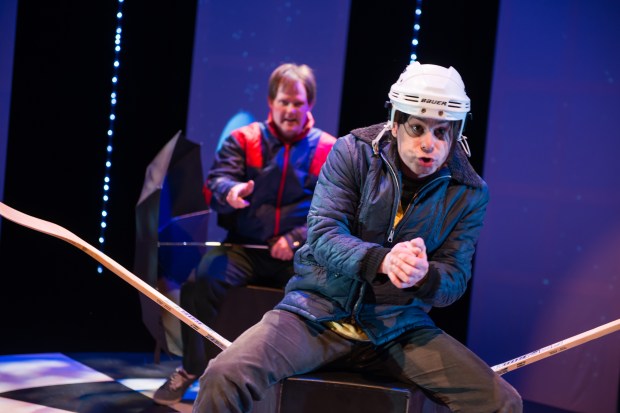
Left to Right: Mark Bellamy and Stafford Perry in Daniel MacIvor’s In On It, running now at Lunchbox Theatre. Photo Credit: Benjamin Laird Arts & Photo.

Audiences may not exactly get ‘in on it’ by the end, but there’s no denying the strangely sweet charm of Daniel MacIvor’s metatheatrical play.

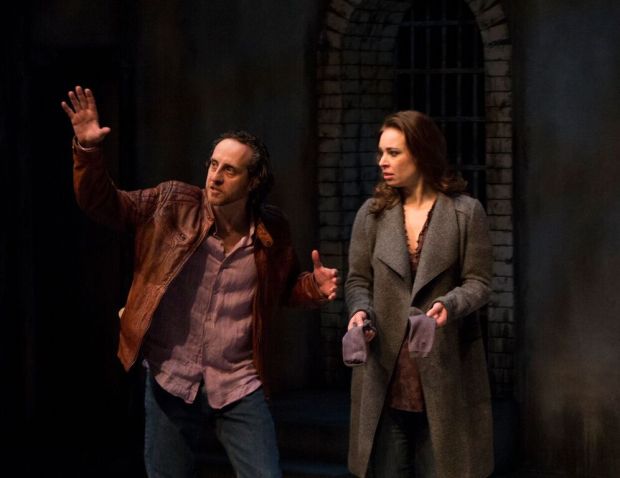
Running now at Lunchbox Theatre, MacIvor’s In On It stages two characters named This One (Mark Bellamy) and That One (Stafford Perry) trapped in liminal space – an in-between place where life has yet to disappoint. Really, it’s a rehearsal for a play underway in front of the Lunchbox audience. Going through various scenes, the actors take turns playing the play’s different characters, interpreting them as they see fit. The play-within-a-play deals primarily with an average somebody named Ray who has a terminal illness, at least until the tests say otherwise. Ray’s son is a self-centered adman, his wife is a boozy adulterer, and his father can’t recognize him due to memory loss. Lonely, Ray contemplates ending his life.

There’s also a young boy who’s abandoned by his step-dad, or more accurately his mom’s boyfriend. Ray and the boy have more common with each other than they know.

The scenes are frequently interrupted and criticized by the actors who just can’t see eye-to-eye creatively. The audience eventually learns that the actors are gay partners. Their differences are both creative and personal, shaping the scenes and their characters’ motivations accordingly. And so, the constant editing that occurs between them becomes more about what they want from each other in their relationship than the play itself. The stage acts as a place of reconciliation between the roles we play and the faces we hide.

(MacIvor would later use the same metatheatrical device in his 2006 play A Beautiful View, which Sage Theatre produced during its 2014-15 season.)

MacIvor playfully subverts audience expectations by opting for reality – which some audiences like to escape from by going to the theatre – than comforting fiction. The liminal space mentioned earlier is an imagined place from the future that comes full circle to a car accident. There are the stories we tell, and then the stories we would like to tell. The truth lies somewhere in-between.

In On It is a play about opposites, namely two opposite people trying to meet in the middle. What unfolds here is that struggle for human connection.

Director Samantha MacDonald finds and brings out the oddly inspiring essence of MacIvor’s play. MacDonald’s energetic, yet precise direction makes clear the connective tissues of this play, a challenge given that MacIvor doesn’t exactly spell out the whole thing. MacDonald demonstrates a clear and confident vision for this play that features multiple threads running at once.

What’s remarkable about this production is that Perry stepped into his role just one week before opening. Christian Goutsis was originally scheduled to play That One but had to withdraw from the production due to a family emergency. The cast and crew rehearsed the play in five days with Perry. For five days rehearsal, the result is truly incredible. Perry and Bellamy are absolutely wonderful together. The actors bring out so much from one another in this play of emotional highs and lows.

MacIvor has a knack for writing plays that stay with you on the drive home, and In On It is no different. Some audience members may feel lost trying to connect the dots, while some will appreciate MacIvor’s open-to-interpretation approach. Regardless, there’s no denying the strangely sweet charm of this play about life, relationships, and regret.


Daniel MacIvor’s In On It runs March 21 – April 9 at Lunchbox Theatre.

For more information about the show, including how to purchase tickets, visit: http://www.lunchboxtheatre.com/in-on-it/


A Knockout: Cseke’s The Fight or Flight Response Enters The Ring

20160308 Fight or Flight RG 08.jpg

Verb Theatre presents The Fight or Flight Response by Col Cseke, March 10-19 at the Joyce Dolittle Theatre. Pictured, L to R: Justin Michael Carriere and Nathan Pronyshyn. Photo Credit: Rob Galbraith.

On its surface, Col Cseke’s The Fight or Flight Response is about two guys trying to escape their unfulfilling lives.

By day, Kevin (Justin Michael Carriere) is an Assistant Manager at Subway; by night he is a mixed martial arts fighter training for his first professional MMA fight. On the verge of turning thirty, Kevin sees the fight as his last first experience ever, a thought that motivates him even more to win and climb the professional ladder.

On the flip side, Kevin’s long-time friend Doug (Nathan Pronyshyn) is struggling to get away from the MMA scene altogether. Doug’s problem is that he has very little experience with anything outside of fighting. Before working full-time at Mohammed’s MMA Gym, the thirty-two year old slung coffee at Tim Hortons. Doug knows he wants to do something else with his life, but he just doesn’t know what that something else looks like. Paralyzed by fear and indecision, Doug hopes for some external force to move him in one direction or another.

This Verb Theatre production is staged inside the Joyce Dolittle Theatre, a small but malleable space. Costume and Set Designer Victoria Krawchuk has transformed the space into a MMA gym, equipment and all. The theatre’s brick walls add to the grittiness of the space, and the drama that unfolds during very real and brutal fight sequences (Fight choreography by Karl Sine with Pronyshyn and Carriere).

As mentioned, Cseke’s play is in some parts about these two friends trying to turn their lives around, but really the play is about the many problems with traditional masculinity, namely the emotional disconnect that young men experience. Traditional masculinity dictates that young men ought to keep their emotions bottled inside, that showing emotion is a sign of weakness. About the nature of fighting, Kevin muses that guys like fighting because it’s the only time when human contact between men is acceptable. Guys can’t touch other guys otherwise, he says, unlike girls who can make contact with other girls whenever. And so, following these lines, young men remove themselves emotionally in two ways, from the self and from others.

So, it’s no surprise that the men in Cseke’s play have such a hard time not only describing what they’re feeling, but then sharing that with someone else. For them, the only thing that makes sense is fighting, knowing that someone wins and someone loses at the end of a match. Support, not competition, it’s a novel idea.

Director Kelly Reay pursues this awkwardness between Kevin and Doug by having both actors never quite engaging each other directly, not until the heated finale anyway. Maybe the best way to describe Reay’s direction is by comparing it to when people walk aimlessly around their homes while on the telephone. The actors play or distract themselves with the various equipment laying around the gym while digging deep into their character’s emotional well. It’s a funny thing at first, but then we realize that these distraught characters would need to distract themselves in order to be so open about their emotions. And the actors are most usually talking to each other from afar, growing that emotional distance even further. Excellent direction by Reay who succeeds in pulling the actors and action together at the end.

Pronyshyn and Carriere display tremendous vulnerability in this raw, engaging production. The actors speak volumes through their movement alone. It’s fascinating just how much non-verbal communication is expressed during the training periods, and other blows exchanged between the two. What’s exciting, too, is the sense of immediacy that the actors draw from their characters’ seemingly hopeless lives. The big life changes, they have to happen now or never. Time is not something people can fight, but only accept.

A riveting piece of work by Cseke, and a knockout production from Verb Theatre.


Verb Theatre’s The Fight or Flight Response by Col Cseke runs March 10 – 19 at the Joyce Dolittle Theatre (Pumphouse Theatres).

For more information about the show, including how to purchase tickets, visit: http://www.verbtheatre.com/season/


Cockroach Crawls Under Canada’s Skin

unspecified-1

Haysam Kadri and Daniela Vlaskalic in Jonathan Garfinkel’s Cockroach, based on the novel by Rawi Hage, running now at Alberta Theatre Projects (March 1 – 19). Photo Credit: Kara Sturk.

Based on the 2008 novel of the same by Canadian author Rawi Hage, Jonathan Garfinkel’s Cockroach is a story about failure, namely the failure of multiculturalism in Canada. Uncomfortable truths come to surface in this play that rips the seams of our nation’s beloved cultural mosaic during a time of heightened awareness around newcomers and refugees.

Enjoying its world premiere at Alberta Theatre Projects, Cockroach stages the journey of an unnamed Middle Eastern immigrant (Haysam Kadri) in 1990s Montreal. The play opens with The Narrator waiting patiently for Shohreh (Daniela Vlaskalic), a troubled young woman from Tehran, in the dingy basement of the restaurant where he works, as a busboy. Through flashbacks, the audience learns more about the Narrator’s past  in his home country, and his experience living in Canada as an immigrant. More about the Narrator’s life is revealed during his state-mandated therapy sessions with Genevieve (Carmen Grant), a psychiatrist whose privilege as a white Canadian stands as an obstacle between the two.

Gun in hand, the Narrator continues waiting for Shohreh in the present, preparing himself for a decision that will change his life forever.

Addressing the Syrian Refugee Crisis, Garfinkel writes (in his Playwright’s Notes) that Cockroach is not about the debate surrounding whether or not to let refugees into Canada, but about life after arrival for immigrants. The play goes beyond the feel-good propaganda of multiculturalism, choosing to present instead a less-than-glamorous portrayal of a predominantly white society where racial prejudice and discrimination exist, whether the Canadian public wants to believe it or not.

From the bottom looking upwards, the Narrator sees Canada as a nation of hypocrites. Lying underneath Canada’s “perfect white skin” is a history of cultural genocide, systemic racism and fear of the Other – which presented itself in full force during the 2003 SARS Outbreak. Genevieve buys into the myth of Canadian multiculturalism, while the Narrator lives its failed promises everyday, making their relationship tense as a result. Although he may be uneducated and afflicted by mental health issues, the Narrator’s difficulty adjusting to life in Canada is not made any easier by living in the slums of a country steeped in inequality.

Interestingly, the very thing that ties the Narrator home is what help him survive on a daily basis – storytelling. Sometimes, stories are all immigrants really have when they arrive, and it’s through metaphor that the Narrator can make sense of the world he lives in.

The problem with Garfinkel’s Cockroach is that the play falters in the middle, loses steam from an otherwise strong beginning. Kadri’s devilish charm adds plenty of punch to his character’s zippy one-liners about Canada, but even his charm can’t help the problems that come from relying on a narrator and flashbacks to tell a story. The show has a little more in common with an audiobook than a fully staged production. Events in the narrative are relayed primarily through the Narrator, with occasional glimpses to the events themselves. The narrative suffers from this abundance of talk that acts as a wall between itself and the audience, resulting in an experience that is somewhat difficult to invest into emotionally.

Director Vanessa Porteous, artistic director of ATP, brings a keen sense of space to the production, a premiere of a new Canadian play. Kadri’s character identifies, intimately, with cockroaches, insects that are known as survivors of even the worse conditions (like nuclear wastelands, a popular myth). Most importantly, the cockroach is mobile. Porteous’s direction sees a strong sense of displaced movement onstage, the type of movement expected from an outsider in a hostile environment. Porteous gives the actors breathing room to react big and almost candidly (well, as candid as can be for a scripted show). Even still, the play’s lengthy narrations remain spatially uninteresting, and that’s likely due to the limited cast available to give the story more dimension, both dramaturgically and spatially.

Narda McCaroll’s appropriately ‘grimey’ set is cast in layers of shadows by Anton de Groot’s lighting design. Groot’s lighting work is important to distinguishing the social tiers Kadri’s character visits, by legal means and otherwise, over the course of the play. The higher he travels, the more light there is on stage, and vice versa. Cockroaches flood the stage thanks to clever projection design by Amelia Scott and Joel Adria.

Again, Kadri’s charm gives energy to the play. The Narrator is deeply flawed, engaging in misogyny and theft at every corner, but Kadri makes us root for the underdog, hope that the character’s inner-goodness – the kind that betrays good-natured people – pulls through. Meanwhile, Vlaskalic plays her character with a defensive edge, an edge with many sides. She and Kadri share great chemistry as they encounter each other from such different, but not distant emotional levels. Vlaskalic shines in the play’s final moments, delivering an intense performance. The well-intentioned Genevieve is not such a straight-forward role as it may seem. It’s not just a psychiatrist assessing the mental state of a Middle Eastern immigrant, but a person of privilege reassessing the state of their country’s imagined national identity. Grant successfully brings out these dimensions as she plays Genevieve with just a hint of ignorance, and a feigned sense of relation to the Narrator.

Issues aside, Garfinkel’s Cockroach is a play that deserves our attention as it offers insight into Canada’s cultural landscape from an often ignored perspective. Or, if not ignored, a perspective taken over by well-meaning (white) Canadians. ATP’s production of Cockroach is relevant, bold, and likely to ruffle a few feathers.


Jonathan Garfinkel’s Cockroach, based on the novel by Rawi Hage, runs March 1 – 19 at Alberta Theatre Projects.

For more information about the show, including how to purchase tickets, visit: http://atplive.com/whats-on/cockroach/

An earlier version of the review incorrectly credited Anton de Groot for the cockroach projection work. The review has been updated to credit co-projection designers Amelia Scott and Joel Adria appropriately.


Ground Zero Theatre Summons The Force For ‘Boy’s Own Jedi Handbook’

Boys Own Jedi Handbook 0487 NB1_7067.jpg

Karl Sine and Christian Goutsis in Stephen Massicotte’s The Boy’s Own Jedi Handbook, presented by Ground Zero Theatre. Photo Credit: Benjamin Laird Arts & Photo.

Forty years after the original movie’s release, and Star Wars continues to dominate our galaxy. Star Wars: The Force Awakens, the seventh and latest entry in the sci-fi series, has smashed box-office records, earning $2 billion worldwide, and proved that the cultural phenomenon is not going away anytime soon.

Given the recent awakening of The Force, Ground Zero Theatre could not have picked a better time to stage Stephen Massicotte’s The Boy’s Own Jedi Handbook, running now at Vertigo Theatre’s Studio.

The year is 1977, and The Kid (Christian Goutsis) has just had his mind blown away by Star Wars: A New Hope. Star Wars is all the 10-year-old can talk about, much to the annoyance of his mother. Lucky for him, his obsession with Star Wars makes him a new friend in detention. James (Karl Sine) and The Kid bond over their love of Star Wars, recreating the movie the best they can with burlap sack jedi robes, cardboard tube lightsabers, and other junk laying around.

For anyone familiar with The Complete Works of William Shakespeare (Abridged), imagine almost exactly that but with Star Wars. Goutsis and Sine win howling laughter from the audience as they blow through just about every iconic scene from the original movie, voices and all. The madcap action is brilliantly directed by Ryan Luhning, artistic director of Ground Zero Theatre.

Massicotte’s play is not just about Star Wars, of course. The play is largely a coming of age story about a lonely boy who survives moving to a new city and going to a new school with help from The Force. Massicotte goes beyond Star Wars as a cultural juggernaut and explores why so many have fallen in love with the franchise. For The Kid, Star Wars is not just a movie, but a world he can escape into where the good guys win. A needed escape from the trials and tribulations of grade 4.

The second half sees James and The Kid now in junior high. Junior high is a different beast altogether, as boys and girls are going around town. Star Wars: The Empire Strikes Back is just around the corner, but this time James and The Kid have company. Kerry (Amber Bissonnette) and Mandy (Sarah Wheeldon) ‘bump’ into the boys at the movie theatre, later inviting them to go roller-skating for a (disastrous) double date.

The young romance is all kinds of sweet and awkward, as the characters dance around the obvious. (Jedi training doesn’t say anything about first kisses!).

The genius of Massicotte’s play is its universality, despite being grounded in Star Wars fandom.  Audiences will likely be thrown back to their own wonder years, for better or for worse, by this fun, compelling story about friendship and growing up in an era far, far away. Children, too, will enjoy this wildly imaginative production that bridges generations of Star Wars fans together.

Sine’s fight choreography is made even more epic by JP Thibodeau’s striking lighting design. (Yes, that scene between Darth Vader and Luke happens, and it is glorious). The choreographed fights are a sight to see, along with the creative use of different materials to re-construct big set pieces from the movies.

With something for everyone, including young padawans, The Boy’s Own Jedi Handbook is a must-see.


Ground Zero Theatre’s The Boy’s Own Jedi Handbook runs Feb 11 – 21 at Vertigo Theatre’s Studio.

For more information about the show, including how to buy tickets, visit: http://www.groundzerotheatre.ca/


Like A Bucket of Spilled Paint: One Yellow Rabbit’s ‘Calgary, I Love You’ is Colorful, but a Total Mess

Members of the Ensemble in One Yellow Rabbit’s Calgary, I Love You, But You Are Killing Me. Part of the 30th High Performance .jpg

Members of the Ensemble in One Yellow Rabbit’s Calgary, I Love You, but You’re Killing Me. Part of the 30th High Performance Rodeo. Photo Credit: Trudie Lee.

If the city of Calgary has a soul, it’s a strange one. If nothing else, that’s what audiences can expect to take away from One Yellow Rabbit’s Calgary, I Love You, but You’re Killing Me.

Written and directed by Blake Brooker, ‘Calgary, I Love You’ is a musical journey through the soul of a city largely defined by oil and the frontier. The show sets out to paint a broader, more detailed picture of Calgary, from both the inside and outside. And while fun and insightful at times, the production is ultimately like a bucket of spilled paint, colorful but a total mess.

One Yellow Rabbit was founded in 1982, and the performing ensemble has called the Big Secret Theatre home since the late 80’s. In other words, the company has been around a long time, so if any group knows a thing or two about Calgary, it’s the Rabbits. Here, Denise Clarke and Andy Curtis are joined onstage by guest artists Karen Hines and Jamie Tognazzini. The artists are accompanied by musicians Kris Demeanor, Jonathan Lewis, and David Rhymer.

The show opens with various stories surrounding Calgary’s origins, starting with a creation myth told by Clarke. Curtis dismisses the fanciful story for something a little more ‘textbook’. He tells a story about early settlers – led by Joseph Tomato, a Mormon-inspired figure – who took were given the land by the native people. Hines’ account claims that aliens first populated Calgary – which would explain the politics.

No matter how the city was founded, there is no denying that Calgary has become a “city of ideas,” a magnet for many in search of opportunity. Sometimes, though, life throws us curveballs.

Tognazzini plays Kyla, a young woman who lives in a condo, but can’t afford her most recent purchase, a MacBook. She tries returning the computer to the store, then later selling it online, but with no luck. The credit card bill is fast approaching, and Kyla is in serious need of funds. The ensemble tell Kyla, through catchy song and dance, to “get a job” and that she shouldn’t ashamed of moving back in with her parents. There’s a strong sense that Kyla’s Calgary dream has burst as a result of the recent economic turmoil, and that her damaged ego is specific to someone who migrated out west from, let’s say, the maritimes. (Migrating out west has almost become a rite of passage for young people out east).

The ensemble stage a hilarious scene where different residents share their favourite places in Calgary to have a panic attack. The scene is fitting given that Calgarians are reported to work the longest hours in Canada, and also binge drink more than other Canadians. (The show’s title is perhaps more literal than anyone expected).

Hines offers a different and humorous perspective of Calgary as a Torontonian. As Hines sees it, the frontier spirit has escalated to beautiful wealthy hipsters living in lavish condos where they enjoy all sorts of ridiculous luxuries. Are they happier than the rest of us? Probably, she says.

Somewhere in this show that runs 120 minutes (with a 15 minute intermission), there lies a great concept, waiting to be executed with much more precision. The few scenes highlighted above feel as though they serve a purpose, that they say something about the character of Calgary and the complicated relationship its citizens have with their city. And then, there are scenes that outright miss the mark. For example, why do we need to hear about some guy, played by Demeanor, who avoids being robbed at the liquor store he works at because he was busy masturbating in the bathroom? Sure, the scene’s crassness is funny, especially with the way Demeanor tells it, but how does it serve the greater narrative?

Calgary’s nuisance animals later take the stage in a rather unusual scene. Clarke and Curtis play a magpie (misunderstood birds, by the way) and squirrel, respectively, and Hines plays a gopher. And that’s about it, really. The scene wins howling laughter from the audience, and then just keeps on going, not satisfied until its milked every bit of Clarke’s screeching magpie – “I’m a positive magpie!”

The audience is later subjected to a scene where Curtis plays a horse whisperer, and a horse, played by Lewis, sings his inner monologue to the audience. Also, Hines plays a landscape, and Clarke is the horse’s bottom half. The scene feels better suited for a David Ives play, than this show that tests the audience’s patience.

At least the ensemble present these scenes with a lot of zest and commitment to the silliness. Even so, the gallery of scenes feel inconsequential, fit for the cutting room floor.

One Yellow Rabbit had the chance to say something meaningful about Calgary, a city that they have called home for over thirty years, but instead they have chosen to squander it on cheap laughs. The disappointment is made greater by the fact that there are glimpses of brilliant wit and humour that run through the show. Unfortunately, the production suffers from a significant lack of polish, resulting in a lengthy, disjointed mess of ideas, each clamoring for attention.

Theatre goers at the 30th Annual High Performance Rodeo can skip One Yellow Rabbit’s Calgary, I Love You, but You’re Killing Me.


One Yellow Rabbit’s Calgary, I Love You, but You’re Killing Me runs Jan 12 – 23 at the Big Secret Theatre (Arts Commons), as part of the 2016 High Performance Rodeo.

For more information about the show, including how to purchase tickets, visit: https://www.hprodeo.ca/2016/calgary-i-love-you-but-youre-killing-me

Paddle Song Stages Life of E. Pauline Johnson

Paddle Song 0324 NB2_5302 (1).jpg

Cheri Maracle stars as E. Pauline Johnson in Paddle Song, written by Dinah Christie with Tom Hill. Photo Credit: Benjamin Laird Arts & Photo.

If any famous Canadian deserves a Heritage Minute, it’s poet E. Pauline Johnson.

The daughter of a Six Nations Mohawk Chief and an English mother, Johnson toured across North America and England in the late 19th century, earning recognition everywhere she went. Audiences and literary critics, both contemporary and modern, praised Johnson’s poetry for its evocative imagery and urgent voice. Through her poetry, Johnson brought attention to the struggles of women and First Nations people.

Johnson’s life is chronicled in Paddle Song, written by Dinah Christie with Tom Hill. From her childhood days spent on the Grand River to the early days of her prosperous career, and beyond, the one-woman show stages an elegant presentation of the poet’s life. Canadian actress, singer-songwriter Cheri Maracle stars as Johnson, delivering a performance best summed as genuinely captivating.

The set-up is fairly straightforward, as most biographical plays are. Paddle Song takes the audience through the poet’s upbringing, her inspirations, and most importantly, her insecurities. Johnson’s insecurities stem from her entering into a field historically dominated by (white) men. The praise written about her in the papers is uplifting, but also the cause of much anxiety as she feels burdened with expectations (magnified by her status as a woman of mixed heritage).

Johnson also deals with the difficulties of touring, specifically the physical strain on her body. Perhaps fueled by a desire to prove herself, Johnson continues touring despite her body telling her otherwise.

Maracle’s wonderfully nuanced performance makes clear the magnitude of Johnson’s accomplishments. In Maracle, we see a young woman who is both excited, but also terrified at the revolutionary path she has set herself on. From Maracle’s performance, the audience gains a sense that Johnson truly appreciated every moment of her fame, as maybe she thought it might disappear at any moment – fearing she might be a fad in the literary world.

Maracle’s performance also sees lots of sharp quips and asides that radiate confidence. Her stage presence is marvelously magnetic. Her performance is a true delight.

Over the course of the play, Maracle recites a selection of Johnson’s poetry, including one of her most well-known works The Song My Paddle Sings. Maracle performs Johnson’s poetry with tremendous grace and power. The emotion in her words during A Cry From An Indian Wife is volcanic. Her talent brings Johnson’s poetry to life, and will undoubtedly lead many in the audience to seek out more of the poet’s work.

Christie’s energetic direction sees this humorous, touching play move effortlessly. The director goes for simplicity here, following the adage of ‘less is more’. Johnson’s canoe is nothing more than a bench, and that’s all Maracle needs (besides her paddle) to transport us to the river.

Often the literary contributions by women are overlooked or obscured by those made by (white) men. And so, staging plays like Paddle Song is critically important to the task of exploring and establishing a well-represented canon of Canadian literature. (Which is why the Heritage Minutes were mentioned, as they shape and influence the public’s cultural knowledge bank).

Co-presented by One Yellow Rabbit and Lunch Box Theatre, Paddle Song is a beautiful production that audiences should make every effort to see at the 30th Annual High Performance Rodeo.


Paddle Song runs Jan 11 – 23 at Lunchbox Theatre , as part of the 2016 High Performance Rodeo. Paddle Song is a co-presentation by One Yellow Rabbit and Lunchbox Theatre.

For more information about the show, including ticket information, visit: https://www.hprodeo.ca/2016/paddle-song

For more information about Cheri Maracle, visit her website: http://www.cherimaracle.com/


Evalyn Parry’s SPIN Opens The 30th Annual High Performance Rodeo

evalyn parry SPIN - Photo by Jeremy Mimnagh

evalyn parry’s SPIN was first presented by Buddies in Bad Times Theatre, in association with OutSpokeProductions, March 2011. Photo Credit: Jeremy Mimnagh.

There’s a strong fascination with the bicycle in North American culture, due in part to its role in popular culture. Think about Steven Spielberg’s hit 1982 film E.T: The Extra-Terrestrial. The bicycle, thanks to E.T’s powers, offers Elliott and his alien friend an escape from the authorities, and grants them wondrous freedom. The popularity of Gameboys and Nintendos years later would see parents pushing their children to go outside and ride their bikes – experience in full the freedom of childhood.

Toronto theatre artist and songwriter evalyn parry’s fascination with the bicycle is about freedom, too, but a different kind of freedom, one that was fought for by women no longer satisfied with the status quo.

Written and performed by parry, SPIN is some parts history, some parts personal reflection on the bicycle and its ties with first-wave feminism. Bicycle percussionist Brad Hart joins parry in telling the story of Annie Londonderry, the first woman to ride around the world on a bicycle in 1895.

On a wager, 23-year old Annie Londonderry sets off across the world on her bicycle for a 15-month journey that will win her $10,000. No stranger to the world of advertising, Annie gains plenty of corporate sponsors for her trip, including the Londonderry Lithia Spring Water Company whose name she took on as part of their deal. (Her real name was Annie Cohen Kopchovsky).

Just so the audience realizes the significance of Annie’s trip, parry sets the scene for what’s happening in the ‘gay nineties’. The ‘mobile woman’ is on the rise, much to the chagrin of men who rather they stay in the home. Women have organized themselves to fight for the vote. Reformers are encouraging women to learn how to ride bicycles, while male doctors warn women that the bicycle may be harmful to their reproductive organs. Women’s fashion changes to suit the needs of mobile women everywhere, lending them even more freedom in movement.

The bicycle becomes important not only for transportation, but also social mobility.

While parry’s theatrical ingenuity is certainly praise-worthy, there remain moments where the material struggles to hold our attention, specifically the audience’s crash course on the bicycle as social phenomenon. Yes, the history of the bicycle is interesting (for some, maybe) and important for context, but it’s a bit difficult to form a connection with facts and dates, no matter how dressed up they might be. The presentation picks up once the group dives into the compelling story of Annie’s around-the-world voyage, or at least it’s made compelling by parry’s demonstrated passion for the subject. Until then, the show engages in a total ‘info dump’.

parry’s hypnotic spoken word is accompanied by Hart’s percussions on a suspended vintage bicycle, and a string trio (Cello: Kevin Fox; Viola: Angela Rudden; Violin: Kathleen Kajioka). Hart delivers a rich, satisfying musical experience by mixing and looping his bicycle beats. Who knew someone could play a bicycle as an instrument, and play it so well? The bicycle percussion lends the production a real grassroots, folk feel, appropriate considering parry’s own personal relationship with the bicycle.

From the first-wave to the third-wave, the artist’s personal relationship with the bicycle completes the ride, as parry tells us how she used to travel the streets of Montreal on her bicycle, defacing sexist billboards in the night. In a city where bicycles spark outrage from motorists (see: the cycle tracks downtown), it’s refreshing to hear and see such eloquent love for the bicycle.

Co-presented by One Yellow Rabbit and Theatre Calgary, as part of the 2016 High Performance Rodeo, parry’s SPIN is an original musical experience that breathes the spirit of adventure.


evalyn parry’s SPIN runs Jan 7 – 10 at the Martha Cohen Theatre, as part of the 30th Annual High Performance Rodeo.

For more information about the show and how to purchase to tickets, visit: https://www.hprodeo.ca/2016/evalyn-parrys-spin

For more about evalyn parry, visit her website: http://evalynparry.com/


Dave Kelly Shines Bright in Epiphany


NB1_7902

Dave Kelly’s Epiphany runs at Lunchbox Theatre, Nov 30 – Dec 23. Photo Credit: Benjamin Laird Arts & Photo.

Webster’s Dictionary defines epiphany as “a moment in which you suddenly see or understand something in a new or very clear way.” What Webster’s leaves out is that the road to epiphany is not always easy, in fact it can be really, really challenging. And what could be more challenging than trying to survive the holidays?

Enjoying its world premiere at Lunchbox Theatre, Dave Kelly’s new comedy Epiphany tells the story of Steve, played by Kelly, a middle-aged father whose world is turned upside down when he learns that his only daughter Amelia is pregnant. See, Steve isn’t ready to be a grandfather, not yet anyway. For one, he and Amelia don’t really get along, and then there’s the fact that Steve’s just too young to be a grandfather. In Steve’s mind, he’s still the young, promising musician who rocked the Ugly Buffalo so many moons ago with his buddy Danny (Tim Williams).

To add more stress to the holidays, Steve volunteers to play Jingle Bells at his wife Ruth’s Christmas pageant. The thing about that, Steve can’t actually play the whole song from start to finish. He’s lucky if he can play the first few notes!

There’s something very Canadian about this story that Kelly tells about a family who could very well be our own neighbors. A major reason for that feeling is the honesty of Kelly’s storytelling. In any other hands, Steve might fall under the tired ‘bumbling father’ trope, but here Steve’s shortcomings are presented with heart. Although he may not have everything all figured out, Steve tries anyway to do the right thing, even if it doesn’t always pan out. There’s something to admire about that sort of devotion in a person, and in a father especially.

It’s easy, isn’t it, to think of our parents as having all the answers when really, they’re only human. And that’s really what Kelly animates in this holiday comedy. Some audience members may go back and understand differently moments where they were at odds with their parents, or children. While no one is perfect, the best thing we can do is try, and always keep each other close. The life lesson is punctuated by delicious musical interludes from Williams, an accomplished blues musician, on guitar.

Director Christopher Hunt eases Kelly’s character transitions well enough considering the number of characters that make an appearance. Costume designer Rebecca Toon treats the audience to a real doozy of a pageant costume that makes the show’s finale all the more hilarious. (Seriously, the finale is a real hoot).

All in all, Epiphany feels like sitting beside a crackling fireplace on a cold winter’s night. There’s a lot to enjoy about a show that uncovers gems of truth through genuine, heartfelt humour. It’s no surprise that the show is almost sold-out, because audiences know Kelly is a charming and formidable storyteller. Audiences will not be disappointed by Kelly’s latest offering.


Dave Kelly’s Epiphany, with music by Tim Williams, runs at Lunchbox Theatre, Nov 30 – Dec 30.

For more information about the show, visit: http://www.lunchboxtheatre.com/epiphany/ 

Of Magic & Mumplings: Legend Has It Returns to Alberta Theatre Projects

IMG_3050.jpg

The cast of Legend Has It, which opened November 24 at Alberta Theatre Projects. Image provided by ATP.

Two years have passed since Alberta Theatre Projects premiered Rebecca Northan’s Legend Has It as part of the 2014 Enbridge PlayRites Festival of New Canadian Plays. Audiences who missed Northan’s award-winning comedy the first time now have the opportunity to catch it this holiday season at ATP.

Every night, one lucky audience member is chosen to star in an epic fantasy adventure to save the land of Jaro from the evil Haldor (Jamie Northan). Tonight’s hero is Phil, an electrician from Calgary, who the prophecy foretold would return peace to Jaro.

When Phil arrives in Jaro, he is greeted by a Mumpling named Maggie (Northan) who informs him that her people have been taken from their homes by Haldor and his minions. Maggie’s plan to save the Mumplings is made more urgent when her Gran (Christy Bruce) is captured. Phil and Maggie encounter the strange citizens of Jaro along their way to save Gran and the rest of the Mumplings.

Here’s the thing, the journey to Haldor’s castle will not be the same every night.

The magic of Legend Has It is that the entire show is improvised by Northan and the show’s ensemble. As well, the hero gets to customize their experience by choosing who will play their companion and who will play the villain. Think of the show as a real-life game of Dungeons & Dragons. The major difference from D & D is that, instead of dice or a pencil, the hero gets to wield a sword and fight in glorious slow-motion in front of 400 people.

Our hero Phil is a fast learner. He not only learns the ropes of stage combat  – it’s all about the squat – but he also gets a handle on trading witty banter with the ensemble.  The audience gets in the action, too, with their own comments. The theatre feels like a very communal space, full of good vibes.

Given the show’s improvised nature, surprise is literally around every corner. Some may feel uncomfortable with this, but rest assured the ensemble’s talent for improv is magnificent. There are certainly moments where the show goes off the rails, but these moments are far from disastrous thanks to the ensemble’s lightning fast wit. The actors roll confidently with the punches, finding opportunity in nearly every random element thrown their way.

While the ensemble may not be too concerned with presenting a serious epic like, say, Lord of the Rings, there is a genuine concern here by Northan to explore what heroism means. Northan brings notions of bravery from the realm of the epic to the everyday by asking Phil if he has ever lost anyone in his life, and how he overcame that loss. In doing so, Northan reminds us that life is itself an epic adventure, full of obstacles that we overcome everyday, making us each heroic in our own unique ways.

The show’s fantasy elements come alive thanks to Scott Reid’s marvelous castle set, and his lighting design. Reid’s dramatic lighting gives the slow-motion fight scenes a comical edge. Deitra Kalyn’s fantasy costumes feel as though they were plucked straight out of a Terry Pratchett novel. Jonathan Lewis’ original composition and sound design succeeds at underscoring the whimsy of Phil’s journey. Major praise for Ellis LaLonde’s ability to improvise sound cues on the fly.

Top to bottom, Legend Has It is this season’s ultimate feel good show. Northan’s comedy invites us to laugh, reflect, and maybe discover something new about ourselves. With all the recent bad news for Alberta’s economy, there could be no greater gift this holiday season than the gift of laughter. A win for Alberta Theatre Projects.


Alberta Theatre Projects’ Legend Has It runs November 24 – December 31, 2015.

Legend Has It was originally created by Rebecca Northan with Renee Amber, Bruce Horak, Mark Meer, and Jamie Northan.

For more information about the show, including how to purchase tickets, visit: http://atplive.com/whats-on/legend-has-it/

The Ensemble:
Josh Bertwistle
Christy Bruce
Bruce Horak
Ellis Lalonde
Jamie Northan
Rebecca Northan


Join The Club: MacIvor’s Inside Examines Modern Life

Inside 0003 NB1_6928.jpg

The University of Calgary’s School of Creative and Performing Arts presents Inside by Daniel MacIvor. Photo Credit: Benjamin Laird Arts & Photo.

Canadian playwright Daniel MacIvor’s Inside is far from optimistic about modern life.

Directed by MacIvor, Inside stages nine characters whose lives are set to collide minutes before midnight at a high-end nightclub. The urban dwellers are hopelessly lost in a world disrupted by social media – a network of mirages. The authentic is bled dry for fame and followers; presence in the 21st century. The search for belonging in the age of Web 2.0 has led the characters to form difficult, and sometimes harmful, relationships.

MacIvor has adapted the play’s narrative and characters to suit the student actors cast in this production by the University of Calgary’s School of Creative and Performing Arts,. The collaboration makes for an interesting blend of cynicism towards modern life. At some points, the cynicism seems to come from a Millennial’s viewpoint while at other times from the viewpoint of Generation X.

Take for example, the young, self-loathing activist Todd (Brandon Huszti). Todd sees a lot of problems with his generation, particularly the rise of selfies and artifice. Todd wants his generation, and everyone else, to look up from their phones, and he plans on achieving that with his devices (that won’t hurt anyone, he claims). The thing about Todd’s objective is, the objective seems concerned with returning to some sort of idealised past that Todd has never known, but only studied – like a freshman enlightened after taking one Philosophy course.

Then, there is Sana (Keshia Cheesman) and her sister Kara (Onika Henry). Kara, a lawyer, believes the only way to create meaningful change is to go through the proper channels. Kara believes that working from the inside is the most effective way to make change happen, while Sana stands firmly beside her method of making noise from the edges. Sana’s stance is not surprising given her obsession with social media, particularly its capacity to affect the offline e.g. produce celebrities like Kim Kardashian.

Sana and Kara’s argument boils down to this, what is the effectiveness of social media campaigns like #BlackLivesMatter? The skepticism of Generation X towards the influence of digital campaigns, versus traditional ‘analog’ methods, is well represented in Kara. Kara sees her younger sister as being naive for thinking that action without presence could have any impact.

Another interesting thread running through MacIvor’s play is the friendship between Jeanie (Paige Thomas) and Violet (Bianca Miranda). The emotionally abusive Jeannie exploits Violet’s kindness in order to satisfy her own interests. While Violet recognizes that Jeannie is not very nice towards her, she also recognizes that Jeanie is her only friend. Jeanie and Violet’s friendship is very much an exchange, as opposed to something founded upon mutual respect. It is a very cynical view of friendship that MacIvor presents us.

It is unclear what exactly MacIvor wants the audience to take away from Inside. MacIvor points out a lot of flaws about modern life, specifically emotional disengagement, but does little in the way of providing possible solutions. MacIvor’s concern for this road we are traveling down together is essentially a series of observations and thin arguments that land heavy without much subtlety. The play’s unrelenting cynicism makes it difficult for the audience to identify a common ground with the characters. The finale ultimately proves unsatisfying as it ends on a cheap moment of optimism that begs to be taken seriously.

MacIvor tries bleeding the scenes into each other with club music and dance, but the transitions feel hard nonetheless. The narrative’s episodic nature interrupts the steady momentum he tries to sustain in this ensemble piece. Fortunately, there is not much to move during transitions (set design by Skylar Desjardins) as the actors only have to move tables and chairs.

Anton de Groot’s edgy lighting design with Alex Allan’s pulse pounding sound work transform the Reeve Theatre into a nightclub, the evening’s hub for misery.

Thomas is absolutely vicious as Jeanie, a young woman abusing her disability leave. The audience is nearly on the verge of hissing at Thomas as she cuts into Miranda’s heartbreaking Violet without remorse.

Cheesman plays Sana confidently, as does Henry with Kara. The pair demonstrate that the sisters are, more or less, two sides of the same coin, even if they think otherwise.

Nick Wensrich delivers an eerie performance that burns slowly as Mason, a former soldier disturbed what he saw on deployment. He brings out the character’s manipulative personality that lays deep underneath his guise as a total schmuck. Vanessa Jetté emotes well Audrey’s vulnerability as a reluctant prostitute, hired by Mason.

Dylan Forkheim plays the nightclub’s manager Brian with the sleaziness most, if not all, nightclubs attract, though Brian’s sleaziness is punctuated by sadistic tendencies.

Kris Vanessa Teo’s free-spirited performance as Todd’s girlfriend Mary is a strong and much needed contrast to her boyfriend’s pseudo-intellectualism, played well by Huszti. Miranda’s Violet, pregnant, and Huszti’s Todd, on the way to enact his plan, play a rather touching scene together in the second act where the merits of modern life are debated.

While the ensemble manages well enough with MacIvor’s script, issues and all, there is a strong sense that the ensemble could go further with their performances. The ensemble might benefit from a more intimate space, because here the Reeve Theatre feels somewhat vacant, lacking in presence.

Overall, MacIvor’s Inside leaves much to be desired in terms of a narrative worth investing in. Audiences will feel disengaged by this play steeped in cynicism towards modern life. An underwhelming production that strays far from the SCPA’s usual fare.


The University of Calgary’s School of Creative and Performing Arts’ production of Daniel MacIvor’s Inside runs Nov 24 – Dec 5 at the Reeve Theatre.

For more information about the show, visit: https://scpa.ucalgary.ca/events/inside