Before The Night Takes Us Lurks, Bumps

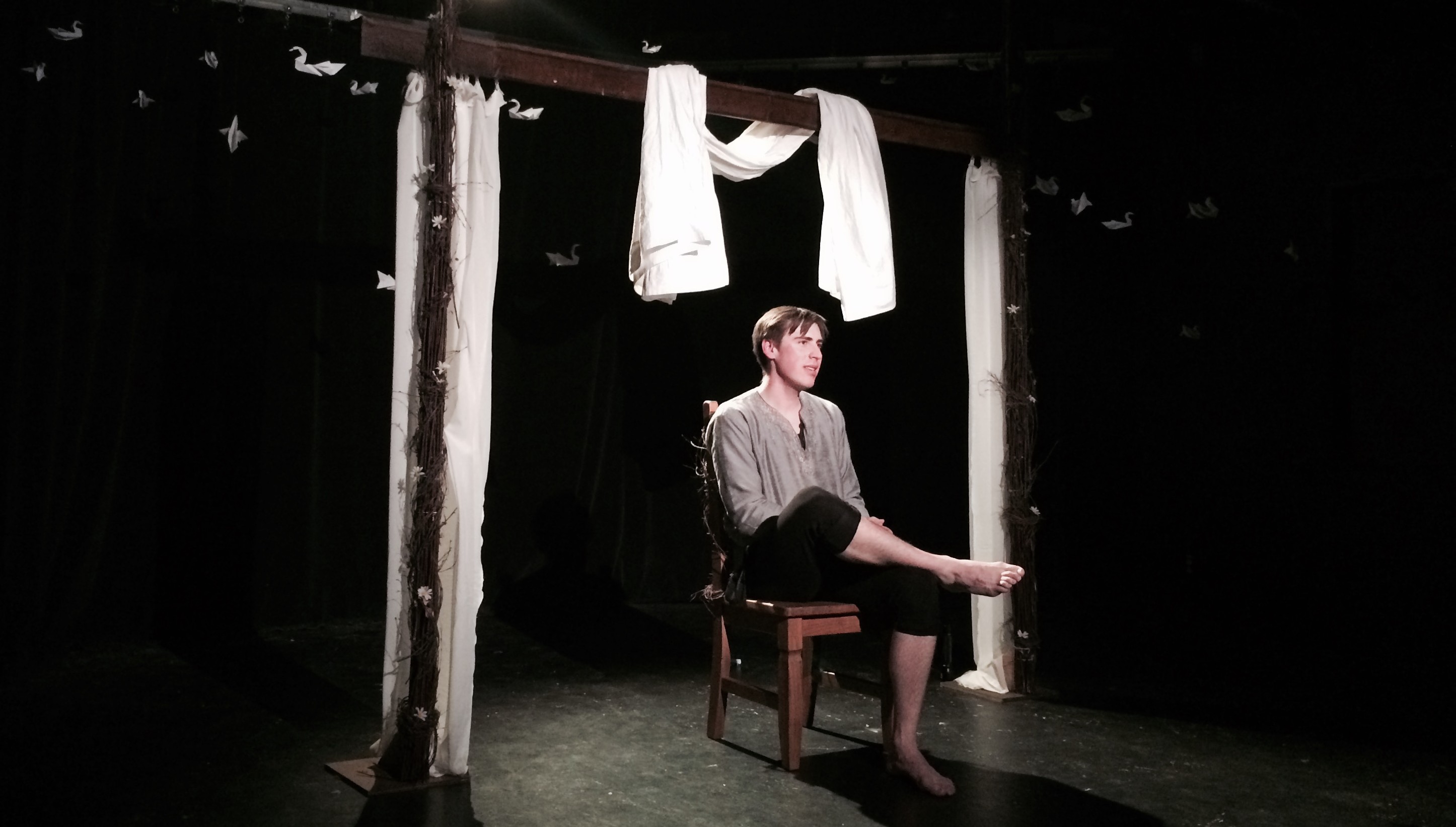
Kas Nixon as Alison in Ryan Reese's Before The Night Takes Us. Photo Credit: Colton Holmes.

Kas Nixon as Alison in Ryan Reese’s Before The Night Takes Us. Photo Credit: Colton Holmes.

Alison (Kas Nixon) hasn’t been sleeping well lately. Nightmares of grisly murders torment the frustrated clarinetist who has all but lost her ability to play. When Ray (Joel David Taylor), a telepathic pianist, walks into Alison’s life, she is soon thrown into something more sinister than she could ever expect.  For Alison, things are only going to get worse (and weirder) before they get better.

Presented by Theatre BSMT, Ryan Reese’s Before The Night Takes Us is a suspense-filled drama that trips over its paranormal premise.

For a character whose abilities are even a mystery to him, Ray sure seems to have a lot of answers, or a lot of good guesses. Part of that is due to Reese being quick to change/expand the rules of Ray and Alison’s telepathy when convenient. Of course, Reese is faced with the challenge of both establishing ground rules to adhere by and fleshing out a whole story within 120min, so wild assumptions by the characters are to be expected. Still, one cannot help but feel that the drama is undermined by fluctuations in the play’s logic.

Thankfully, Amy (Samantha Duff), a no-nonsense detective, gives the play immediacy, a sense of danger. While Amy trusts Ray’s abilities, Amy also needs answers now. She can’t wait on Ray to unlock the secrets of Alison’s dreams, especially not when there is a serial killer loose in the city. For Amy, the clock is ticking, and every minute that goes by is another minute where someone’s life is in danger.

But again, there are some problems with the play’s logic that are hard to ignore. The truth about Alison’s dreams raise questions about what kind of office Amy is working in that none of her colleagues or superiors would notice something off about one of their top detectives. And despite having access to her case files, in addition to her mind, Ray fails to recognize any inconsistencies with the investigation.

These issues aside, Reese intrigues with the general greyness of the characters – greyness in terms of his characters’ true motives, their murky pasts, and their relationships with one another. As we become more acquainted with Alison, Ray, and Amy, the loneliness of these characters become more apparent; the search for a connection more potent. And that is mainly what carries our interest through to the end: the fate of these characters thrown together against strange circumstances.

Unfortunately, the play proceeds at a choppy pace, mainly due to its scenes of varying lengths and their hard transitions. When the lights come down, so too does the energy. The dip in pace is partly due to the odd configuration of just one entrance/exit. Director Kyle Schulte might have opted for a set-up that allows better flow between scenes, rather than one where there is a good amount of unused physical space (which would feel emptier if it were not for some instruments laying around).

Taylor rises to the task of playing the piano live on stage. He and Nixon share good energy together on stage. Though Duff is who most catches our eye with her menacing presence. Fortunately, Nixon holds her own in her clashes with Duff. The two are a sharp pair that respond to each other effectively.

A murdery mystery with a paranormal twist, Reese’s Before The Night Takes Us catches our attention with its grey characters, but then loses us with its thin logic.


Theatre BSMT’s Before The Night Takes Us runs May 6 – 9 at Motel Theatre (Arts Commons).

For more information about the show, visit: http://www.theatrebsmt.ca/Theatre_BSMT/Whats_On.html

U of C Grad Student Working to Bring The Arts & Social Sciences Together

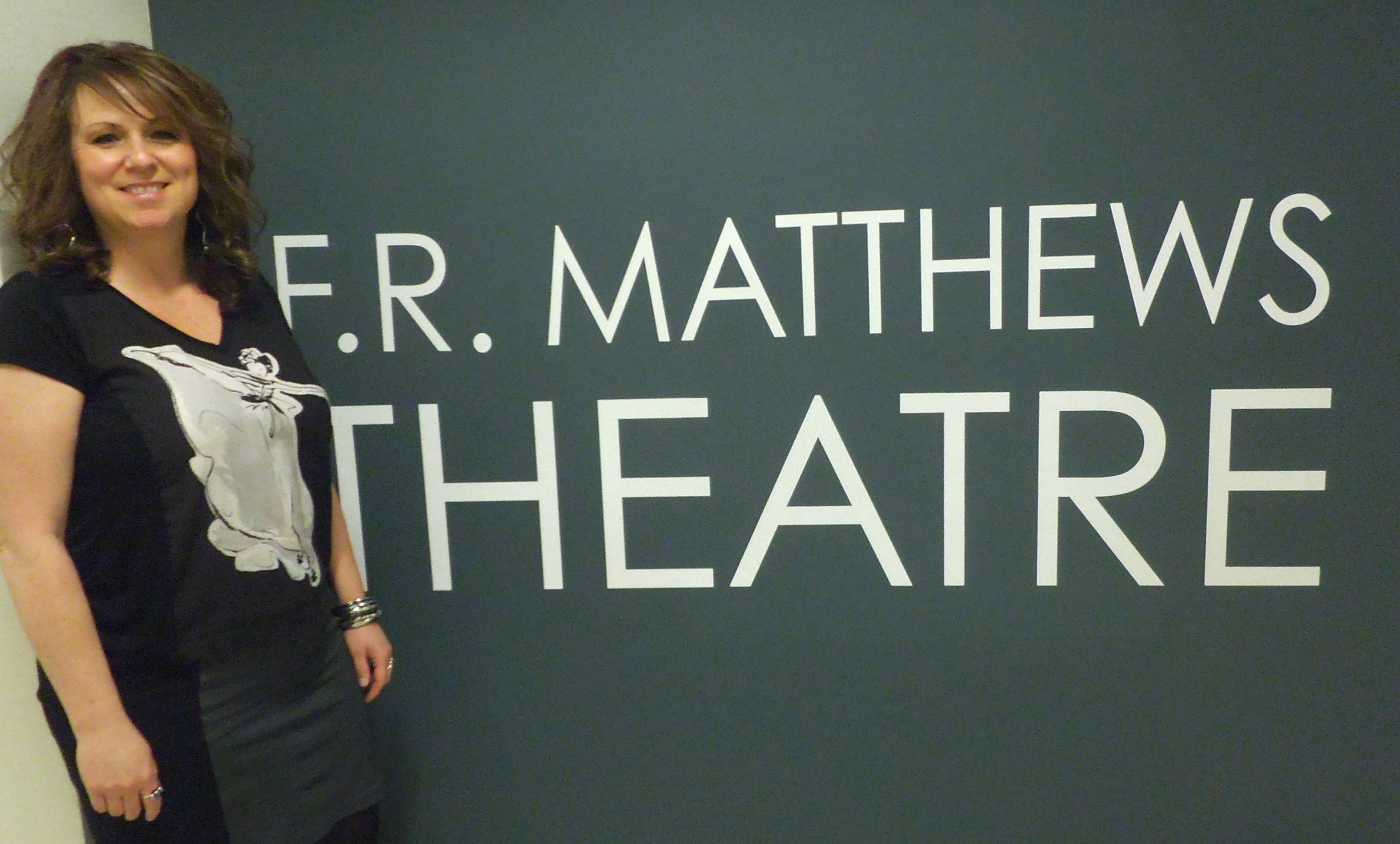
Playwright Sherryl Melnyk after the staged reading of her new play Can't Cross a Bridge.

Playwright Sherryl Melnyk after the staged reading of her new play Can’t Cross a Bridge.

Sherryl Melnyk’s new play Can’t Cross a Bridge was read aloud publicly for the first time this Monday night at the University of Calgary’s F.R Matthews Theatre. The staged reading was presented by the School of Creative and Performing Arts’ Taking Flight: Festival of Student Work.

But whereas much of the work in the annual student festival has been largely fictional, Melnyk’s play differs in that it is rooted in real women’s stories of abuse.

Can’t Cross a Bridge tells the story of Velma and Lizzy, a mother and daughter estranged for 16 years. One day, a surprise call from the RCMP informs Velma that her daughter has returned. But hanging over their reunion are secrets from the past, painful secrets that Lizzy can no longer keep inside.

Melnyk is completing her PhD in the Interdisciplinary Studies program, combining studies in English, Drama, and Women’s Studies/Sociology. Can’t Cross a Bridge is one component of her PhD dissertation.

The first component, the social science component, saw Melnyk interviewing 21 women about their sexual histories. From that research, Melnyk chose three of the stories that she thought fit together the best, then synthesized them for the play. The last component comprised of theory, discussions around the creation of the work.

Melnyk says her work is focused on bringing the arts and social sciences together, disseminating research through the arts as a means of creating meaningful dialogue surrounding social issues.

“I think what happens to a lot of research is that it’s wonderful research, but it’s lost in journals,” said Melnyk. “No one really reads it but other academics. I think a better combination of the arts and social sciences working together is going to make it more accessible to the public at large.”

And of course, her research could not have been possible without participants willing to share their lives openly with Melnyk.

“I started out my research trying to understand if women are kind of moving beyond the traditional view of women in sexuality; Woman as part of the male gaze, woman in pornography, woman as victim…How have women’s stories changed, that’s how I started my interview with all the people that participated.”

“I think what was really interesting about all of the women I interviewed was the fact that they wanted to tell their story. They want people to hear it. They want women to be empowered through their stories. All different ages sat down with me and spoke. Some of them were an hour, and some were two and half hours about their life history.”

For Melnyk, the intimacy theatre grants between audiences and ideas is necessary for not only bridging the arts and social sciences, but also bringing these women’s stories to the community.

“I think you could see it tonight in the gasps and the reactions of the audience. The sadness, the laughter, the drama that is created through theatre. I think it speaks more to our heart and soul than reading an article.”

Melnyk hands in her dissertation on April 24th, then defends it later next month.


The staged reading of Sherryl Melnyk’s Can’t Cross a Bridge was presented by the School of Creative and Performing Arts’ Taking Flight: Festival of Student Work. The festival runs Mar 31 – Apr 11th, 2015.

For more information about the festival, visit: http://scpa.ucalgary.ca/events/taking-flight-festival-student-work

Cast

Lizzy – Jacqueline Dyment
Velma – Val Campbell
Lester – Brian Smith
Andrea – Courtney Charnock

Company

Director – Dawn Mari McCaugherty
Stage Directions – Siobhan Cooney

Mudfoot Theatre Ready to Set Sail Again, Infuse Canadian History With Magic

Promotional image for The Hudson Bay Epic. Pictured: Mudfoot Theatre Co-Founders and Artistic Directors Genevieve Pare and Ian McFarlane, with ensemble member Ryan Reese (right). Photo Credit: Chantal Wall.

Promotional image for The Hudson Bay Epic. Pictured: Mudfoot Theatre Co-Founders/Artistic Directors Geneviève Paré and Ian McFarlane with ensemble member Ryan Reese (right). Photo Credit: Chantal Wall.

Geneviève Paré and Ian McFarlane first met at the University of Lethbridge where they completed a BFA in Dramatic Arts (‘11) and BFA in Multidisciplinary (‘10), respectively. Paré and McFarlane met in their second year while working as designers on a show together. But Paré and McFarlane say one of their first real collaborations came later when a special room inside the university caught their attention.

“There was this miniature room that was built as sort of a ‘found space’ theatre space at the university,” Paré explained. “There was a microphone in the middle inviting people to sing songs and play music. The sound would be projected out into the atrium so everyone could hear what was going on in there. It was a way for people who were shy to share their music. Anyone had the opportunity to contribute.”

Sharing each other’s excitement for impulsive performance art, Paré and McFarlane decided to perform inside the space together. In the room, the pair washed their hands in a bowl of soap water, beat boxed, and performed improvised poetry.

Paré says the collaboration signaled to both her and McFarlane that not only were they “both weird” and into “super bizarre ideas,” but that they could also work together.

In 2012, Paré and McFarlane collaborated again for Junquatica, a performance installation that ran as part of We Should Know Each Other #100. McFarlane says Junquatica was inspired by the aquatic intertidal zone, an area of interest for Paré who was working as a kayak guide off the coast at the time.

“It was a fun project,” said McFarlane about Junquatica. “Gen had this great idea of [creating] this box where people looked in and there were performers. But when they looked in they were also looking at each other…They all became characters of this world.”

At the time, Paré and McFarlane performed under the name Deux Fous Frivoles. The name was later changed to English (Frivolous Fools) due to pronunciation difficulty.

It was also at this point that the pair became excited about using found materials, like garbage. Junquatica’s performance space was constructed out of reclaimed materials meant to reflect a concern for the health of the oceans. McFarlane says the idea of found materials carried over into The Hudson Bay Epic, a play that toured both the Winnipeg Fringe Festival and Calgary Fringe Festival in 2014.

A historical fiction, The Hudson Bay Epic stages the story of Henry Hudson’s last voyage into the Canadian arctic. On board the ill-fated Discovery, a forbidden romance develops between two crew members while the threat of violent mutiny grows larger with every passing day.

The production featured a ship-like structure made from reclaimed materials. The structure was unique for its ability to produce music and ambient sounds.

“The initial inspiration came out of a performance idea of creating a structure that we could play like an instrument,” McFarlane explained. “We were excited about having this machine that we turn a crank and runs some music.”

For The Hudson Bay Epic, Paré and McFarlane formally adopted the name Frivolous Fools Performance. But the two ran into a problem with the name when touring the show, McFarlane explains.

“It was when we started touring The Hudson Bay Epic, people started calling us ‘The Fools’. We can’t do that because in Calgary there’s already ‘The Fools’ [Green Fools Theatre]. [We thought] we can’t have – This is just not good for anybody! It’s going to confuse and disrupt.”

Unfortunately, this was not the only issue with the name. When it came time to apply for grants, McFarlane and Paré were advised to change their name to something more suitable, as McFarlane explains.

“Grant advisors would be like ‘you should consider changing your name because you are neither foolish or frivolous.’ And yes, it’s ironic because we are working with junk and we’re not frivolous at all. We’re being quite humble with our work, this humble magic we are working with. But when it comes to applying to Canada Council…”

Paré and McFarlane sought a name that better reflected their work and aesthetic. After much consideration, Paré and McFarlane finally agreed on the name Mudfoot Theatre.

“There’s a whole bunch of ways to look at a name and how it resonates with who we are as artists,” said Paré about the name change. “If you’ve got muddy feet, it’s because you’re doing something awesome…If you’ve got your feet wet in the mud, then you’re active and in some interesting process.”

As their history shows, McFarlane and Paré are no strangers to change. What began as a performance duo has now grown into an independent creation-based theatre company.

Mudfoot Theatre collaborates with interdisciplinary artists to create contemporary folk tales through simple, grassroots storytelling. The company primarily stages Canadian history, something some Canadian theatre artists avoid, says Paré.

“Theatre artists don’t want to be identified as Canadian theatre artists. There’s something….What’s the word? It’s patronised a little bit. Because we’re softcore Americans, we’re so nice…Canadian is like…It’s not cutting edge.”

“If you’re a Canadian artist, you’re not from like Berlin or New York where you’re cutting edge and taking chances. But we do, do that as Canadian artists.”

Paré and McFarlane believe there are other reasons that make Canadian history less enticing as both performance material and a subject of interest among Canadians. For McFarlane, one reason has to do with how Canadian history was documented.

“It’s written as a business account,” said McFarlane. “We traded furs for this much money. We set up a shop in this place. It’s all written by merchants who are writing back to the homeland.”

“One of the fascinating things about Canadian history,” McFarlane continued, “is that that there were so many details that weren’t written down. In Europe, quite clear that these are the stories and these are the people. Endless literature. But in Canada, someone in the bush had this crazy experience but didn’t know how to read or write.”

“One of the things Europeans have about their history,” Paré added, “is that because their history goes so far back and it’s not written about in such a clinical way, there is room for myth…There’s magic, actual magic in the soil where they live. I want to have magic in my soil too.”

For Paré and McFarlane, staging Canadian history is not just about finding our collective voice as a nation, but also infusing our identity with a sense of magic.

And it is this sense of magic that the company’s next project River will embrace.

Inspired by David Thompson’s expeditions, River will tell the story of the Bow River through live music and puppetry. McFarlane says River will be a very different production from The Hudson Bay Epic.

“In The Hudson Bay Epic, we were quite direct with our history,” said McFarlane. “We took a journal and pulled stuff straight out of the journal and created characters that were actually historical people. In River, we are being quite broad and quite loose. Making it more on the mythical side than the historical side.”

Paré says audiences can expect “a tragic love story between a glacier, a star and a trickster paralleled by some narrative from David Thompson’s personal journals.”

Joining Paré and McFarlane for River are pianist Jesse Plessis and guest collaborator Jesse McMann-Sparvier.

River will be presented this week as part of the Calgary Region One-Act Play Festival at Pumphouse Theatres. Paré notes that the presentation is a prototype, or launching point, for a larger show.

Looking to the future, Paré and McFarlane say they are not sure what the company will develop next, but that they are confident they will find themselves doing something inventive and unexpected.


Mudfoot Theatre’s River will be presented at The Calgary Region One-Act Play Festival, March 26th at 7:30pm.

For more information about the festival and how to purchase tickets, visit: http://www.pumphousetheatre.ca/sections/calendar_s/calendar_2.htm

For information on Mudfoot Theatre, visit their website:
http://www.mudfoottheatre.com/

Storytelling At Its Finest: Kyall Rakoz’s Ludwig & Lohengrin Enchants

Kyall Rakoz's Ludwig & Logengrin runs at Motel Theatre, Feb 24 - 28, 2015.

Kyall Rakoz’s Ludwig & Logengrin runs at Motel Theatre (Arts Commons), Feb 24 – 28, 2015. Photo Credit: Jonathan Brower

Why do we escape to the theatre? To see shows like Kyall Rakoz’s Ludwig & Lohengrin.

Presented at Motel Theatre, Rakoz’s one-man show stages the story of King Ludwig II who reigned over Bavaria in the late 1800s, but was himself ruled by an obsession with the fantastical. Ludwig was particularly enthralled by the story of the Swan Knight, the subject of Wagner’s opera Lohengrin. The king would, in fact, go on to be Wagner’s patron, giving way to a relationship only best described as complicated.

And that is one reason why Rakoz does not allow the audience to meet Ludwig. For how is it one could portray a man who sought to remain an enigma? Instead, Rakoz reveals Ludwig to the audience via the perspective of others.

Playing these multiple characters, some of whom were real people in Ludwig’s life, the actor gives the audience an idea of what was being said about this eccentric king. Questions surrounding his sanity were among the whispers travelling around the castle. But these were not quiet rumbles. Ludwig’s fixation on building elaborate, ‘fairytale’ castles deeply disturbed his cabinet ministers as the castles were a financial burden on Bavaria. One way or another, the ministers figured, Ludwig’s ludicrous spending had to end.

What is important to note is that this story is not about Ludwig as a king. Rakoz goes beyond the royal veil to humanize Ludwig as a complicated man who had the misfortune of being king. Had he been an everyman, the actor suggests, Ludwig would have fared much better than he did. Ludwig, whose sexuality attracted speculation from many, would have been able to follow his heart’s desires without the public damning him for it.

Rakoz’s show fascinates with its inventive staging that is nothing short of magical. Rakoz’s shadow play is particularly dazzling. Watching it, one cannot help but feel totally absorbed in the drama of the Swan Knight. Then, the actor escapes into 17 different characters who each feel alive in their own right. Certainly, the brain does take awhile to catch up sometimes, but never to a point where one feels lost in the story.

Really, there is so much here that has to be seen. Nearly every moment Rakoz paints on stage is simply beautiful. And such beauty makes our hearts tremble when the play nears its end. The audience wastes no time to rise to their feet and applaud Rakoz.

Set designer Leon Schwesinger’s set is both very earthy and elegant in its presentation. The paper swans hung from the ceiling are a nice touch.

Third Street Theatre did well to bring Kyall Rakoz’s Ludwig & Lohengrin to Calgary audiences. Rakoz’s ability to capture both our hearts and imaginations makes for an incredibly moving evening at the theatre. Those fortunate enough to catch Ludwig & Lohengrin during its limited run are in for something truly special. This is storytelling at its finest.


Kyall Rakoz’s Ludwig & Lohengrin runs at Motel Theatre (Arts Commons), Feb 24 – 28, 2015. 

For more information on the show, visit: 
http://thirdstreet.ca/2014-2015-season/ludwiglohengrin/
http://ludwigandlohengrin.com/


World Premiere: Lunchbox Theatre Goes ‘Speed Dating for Sperm Donors’

A lesbian couple in search of a sperm donor. Well, not just any sperm donor. The perfect sperm donor. How hard could it be? Ask Natalie Meisner, she could tell you. You might say, in fact, that she’s an expert on the subject.

Enjoying its world premiere at Lunchbox Theatre, Meisner’s Speed Dating for Sperm Donors is a fun dramatized account of the playwright and her partner’s experience in trying to start family.

Helen (Julie Orton) and Paige (Janelle Cooper) are ready to have a baby. Unfortunately, Helen’s best friend has said no to being the sperm donor. This sets the couple off on a journey to find the perfect sperm donor; perfect as defined by a very strict set of criteria. Helen and Paige’s search turns up a lot of ‘duds’ like a Russian physicist (Mark Bellamy) keen on eugenics, and a recovering sex addict (Christian Goutis). Eventually, the couple’s relationship begins to suffer as their unfruitful search leads to doubt and frustration.

As much as the play sets out to be about the couple and their journey, the story is really about Helen. We do not hear much from Paige beyond her reactionary responses that support Helen’s character arc rather than help support one of her own. On the one hand, it makes sense considering that the play is based off Meisner’s non-fiction book Double Pregnant which is written from her point of view. On the other, however, this is a dramatization that – according to the Playwright’s Notes – seeks to play with and flesh out “the dramatic potential” of Meisner’s autobiography. That is why it is so strange that Meisner chooses to narrow the play’s perspective rather than expand it in a work of fiction.

Perhaps though it is a limitation inherent to adapting non-fiction for the stage. There could be nothing more exposing, after all, than having one’s life story played out in front of a live audience. And as a result, there may be a fear/worry on the playwright’s part of misrepresenting and/or overstepping the personal boundaries of those involved in real events.

Where Meisner does hit the mark is in her application of humour to approach (and widen) the conversation surrounding LGBT families. While she may achieve this by playing into certain stereotypes, Meisner does it in such a way that reflects a sharp self-awareness on her part. The playwright is able to venture out into the ‘two-dimensional’, then bring it back to something sincere. In doing so, she entertains (which may ease some into the conversation), and then uses humour as a means to illuminate and establish a common ground with the audience.

Meisner’s revolving door of quirky characters, though, does wear thin after awhile. The first few characters are fun, but then the later character scenarios – especially the one Meisner throws in as misdirection – stall the pace of the play.

Thankfully, Bellamy and Goutis are strong enough in these roles that the play does not completely drag in its last thirty minutes. (Bellamy has an infectious charm that lights up the stage).

While very funny and clever at times, Speed Dating for Sperm Donors does feel as though it could go further to explore its more serious, dramatic elements. Pacing issues also stifle Meisner’s comedic wit, but great character work by the actors help keep the play light-hearted and enjoyable.


Lunchbox Theatre’s Speed Dating for Sperm Donors runs Feb 2 – 21, 2015.

For information on the show and how to purchase tickets, visit: http://www.lunchboxtheatre.com/calendar/2015/2/2/speed-dating-for-sperm-donors-by-natalie-meisner?view=calendar

Why We Remember: Jake’s Gift Is a Heartfelt Tribute to Veterans

One woman. Two characters. Thousands of soldiers who never made it home. But for playwright/performer Julia Mackey, the shores of Juno Beach were never meant to be their final resting place.

Presented at Lunchbox Theatre, Mackey’s one-woman show Jake’s Gift delivers a moving dramatic experience.

Directed by Dirk Van Stralen, Jake’s Gift tells the story of Jake, a Canadian WWII veteran who (reluctantly) returns to Normandy, France for the 60th anniversary of D-Day. The trip brings back painful memories for Jake who lost his older brother Chester during the war – a difficult loss he has been unable to deal with in the years since. Jake develops an unlikely friendship with a 10-year-old local named Isabelle. Isabelle’s innocent fascination with D-Day, though first met with resistance, pushes Jake to confront his past and, in doing so, come to terms with his brother’s death.

The weight of the war and its personal impact is marked all over Jake’s body – from his difficulty walking to his shaking arm and curled fingers. Continue reading

WORLD PREMIERE: Theatre Calgary’s Liberation Days Is a Sentimental Look at the Past

The war is over. Celebrations erupt across Europe. This victory, though, has come at a great cost. And for the Netherlands, the fight is far from over.

David van Belle’s new play Liberation Days is more than a lesson in history, it is a meditation on perseverance in the face of extraordinary struggle. Although, despite its strong performances and stunning set design, Theatre Calgary’s latest production fails to leave a lasting impact.

The bulk of the play centers around the romantic relationship that develops between Canadian soldier Alex King (Byron Allen) and Emma de Bruijn (Lindsey Angell), a young Dutch woman. The language barrier is not the only thing that stands between them. Emma’s mother Aaltje (Valerie Planche) strongly disapproves of her daughter’s relationship with the Canadian. And if that were not enough, there is also the problem of Emma’s fiancee Jan van Egmond (Jonathan Seinen) – a Dutch soldier presumed to be dead by his community.

Meanwhile, the Canadian forces struggle to gain the trust of the locals they have been assigned to help with rebuilding. The clash between the two cultures plays out between Cpt. Miles Cavendish (Garett Ross) and the village’s religious leader Dominee Herman van Egmond (Duval Lang).

The play is narrated by Marijke Bos (Kelsey Gilker) – the village outcast who dared fall in love with a German soldier during occupation. Continue reading

“If Only We Could Let It Be What It Is”: MacIvor’s A Beautiful View Asks What’s In A Name

Would a rose be as sweet if it had no name at all? Presented at The Studio (Vertigo Theatre), Daniel MacIvor’s A Beautiful View criticizes our need to label relationships. Thanks to the chemistry of its two leads, Sage Theatre’s production of A Beautiful View, directed by Jason Mehmel, captures MacIvor’s signature wit.

The play begins with L (Stacie Harrison) and M (Monice Peter) who, rather cryptically, decide to revisit their past together, all the while being aware of the audience. Their story begins when they meet each other in a store while shopping for camping gear. From this meeting, an attraction develops between the two. The attraction, though, is neither totally friendly or romantic; it just simply is. But, as the years go on, the question of defining what they are soon makes its way to the forefront of their relationship and, as a result, breeds tension between the two.

MacIvor confronts his audience with a deceptively simple question: what is in a name? For the playwright, the act of naming something, especially something so personal as a relationship, is political. Continue reading

Heavy, Challenging: Nicolas Billon’s Butcher Commands Our Attention

A police station. Christmas Eve. An inspector, a lawyer, and a “John Doe” dressed in military uniform and a santa hat with a butcher’s hook hung around his neck. This is Nicolas Billon’s new play Butcher, presented by Alberta Theatre Projects at the Martha Cohen Theatre. Directed by Weyni Mengesha, Billon’s Butcher deals with heavy themes surrounding the nature of justice in an (un)civilized world.

Billon’s play begins simple enough: Inspector Lamb (Eric Nyland) has called in Hamilton Barnes (Andrew Musselman) in order to solve the identity of Josef Dzhbrilovo (John Koensgen), a old man mysteriously dropped off at the police station in the middle of the night. Lamb is unable to make any progress in the case because Josef speaks only in Lavinian (a fictional language co-created for the play by Dr. Christina Kramer and Dragana Obradovic). Meanwhile, Barnes has no idea who the man could be, despite the fact his business card was attached to the butcher’s hook found on Josef’s person. Elena (Michelle Monteith), a Lavinian translator, is called in by Lamb to help with the case, but her arrival does anything but. On this night, the Butcher will finally answer to his crimes. Continue reading

“Never Tell Maritimers The Odds”: Fire Exit Theatre’s Halo Sparks Discussion About Faith and Family

Fire Exit Theatre opens its 2014-15 season with Halo, a comedy by Josh MacDonald. Directed by Mark Lewandowski, Halo asks questions about faith, family, and miracles. While the script is weak in some areas, Fire Exit Theatre’s production of Halo proves to be an emotional piece that just misses the mark slightly.

Set in the fictional small town of Nately, Nova Scotia, Halo tells the story of Casey (Jamie Matchullis), a sarcastic, newcomer from the “big city” of Halifax. Casey works at the local Tim Hortons where she is visited regularly by her boyfriend Jansen (Jacob Lesiuk) who helps ease the pains of dealing with the town’s interesting residents. One day, the image of Jesus appears on the side of the building. The town comes to see the divine picture as a miracle. Meanwhile, Donald (Randall Wiebe) prays for his own miracle at the bedside of his youngest daughter who has been in a coma for the past three years. When his eldest daughter Lizzy (Kendra Hitchinson) comes to visit from Toronto, Donald’s faith and hope for his daughter’s recovery are put to the test. Continue reading