Dave Kelly Shines Bright in Epiphany


NB1_7902

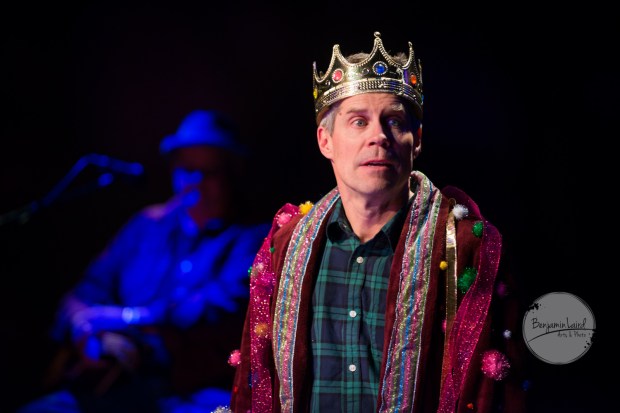
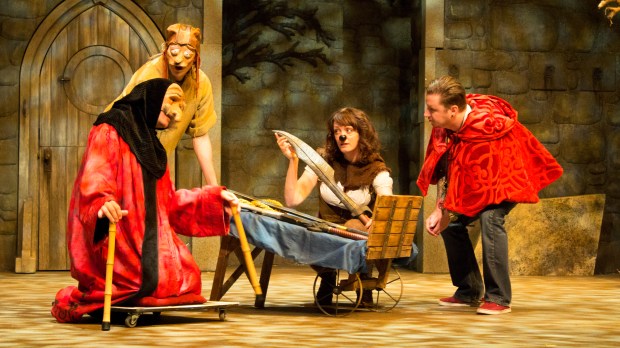
Dave Kelly’s Epiphany runs at Lunchbox Theatre, Nov 30 – Dec 23. Photo Credit: Benjamin Laird Arts & Photo.

Webster’s Dictionary defines epiphany as “a moment in which you suddenly see or understand something in a new or very clear way.” What Webster’s leaves out is that the road to epiphany is not always easy, in fact it can be really, really challenging. And what could be more challenging than trying to survive the holidays?

Enjoying its world premiere at Lunchbox Theatre, Dave Kelly’s new comedy Epiphany tells the story of Steve, played by Kelly, a middle-aged father whose world is turned upside down when he learns that his only daughter Amelia is pregnant. See, Steve isn’t ready to be a grandfather, not yet anyway. For one, he and Amelia don’t really get along, and then there’s the fact that Steve’s just too young to be a grandfather. In Steve’s mind, he’s still the young, promising musician who rocked the Ugly Buffalo so many moons ago with his buddy Danny (Tim Williams).

To add more stress to the holidays, Steve volunteers to play Jingle Bells at his wife Ruth’s Christmas pageant. The thing about that, Steve can’t actually play the whole song from start to finish. He’s lucky if he can play the first few notes!

There’s something very Canadian about this story that Kelly tells about a family who could very well be our own neighbors. A major reason for that feeling is the honesty of Kelly’s storytelling. In any other hands, Steve might fall under the tired ‘bumbling father’ trope, but here Steve’s shortcomings are presented with heart. Although he may not have everything all figured out, Steve tries anyway to do the right thing, even if it doesn’t always pan out. There’s something to admire about that sort of devotion in a person, and in a father especially.

It’s easy, isn’t it, to think of our parents as having all the answers when really, they’re only human. And that’s really what Kelly animates in this holiday comedy. Some audience members may go back and understand differently moments where they were at odds with their parents, or children. While no one is perfect, the best thing we can do is try, and always keep each other close. The life lesson is punctuated by delicious musical interludes from Williams, an accomplished blues musician, on guitar.

Director Christopher Hunt eases Kelly’s character transitions well enough considering the number of characters that make an appearance. Costume designer Rebecca Toon treats the audience to a real doozy of a pageant costume that makes the show’s finale all the more hilarious. (Seriously, the finale is a real hoot).

All in all, Epiphany feels like sitting beside a crackling fireplace on a cold winter’s night. There’s a lot to enjoy about a show that uncovers gems of truth through genuine, heartfelt humour. It’s no surprise that the show is almost sold-out, because audiences know Kelly is a charming and formidable storyteller. Audiences will not be disappointed by Kelly’s latest offering.


Dave Kelly’s Epiphany, with music by Tim Williams, runs at Lunchbox Theatre, Nov 30 – Dec 30.

For more information about the show, visit: http://www.lunchboxtheatre.com/epiphany/ 
Of Magic & Mumplings: Legend Has It Returns to Alberta Theatre Projects

IMG_3050.jpg

The cast of Legend Has It, which opened November 24 at Alberta Theatre Projects. Image provided by ATP.

Two years have passed since Alberta Theatre Projects premiered Rebecca Northan’s Legend Has It as part of the 2014 Enbridge PlayRites Festival of New Canadian Plays. Audiences who missed Northan’s award-winning comedy the first time now have the opportunity to catch it this holiday season at ATP.

Every night, one lucky audience member is chosen to star in an epic fantasy adventure to save the land of Jaro from the evil Haldor (Jamie Northan). Tonight’s hero is Phil, an electrician from Calgary, who the prophecy foretold would return peace to Jaro.

When Phil arrives in Jaro, he is greeted by a Mumpling named Maggie (Northan) who informs him that her people have been taken from their homes by Haldor and his minions. Maggie’s plan to save the Mumplings is made more urgent when her Gran (Christy Bruce) is captured. Phil and Maggie encounter the strange citizens of Jaro along their way to save Gran and the rest of the Mumplings.

Here’s the thing, the journey to Haldor’s castle will not be the same every night.

The magic of Legend Has It is that the entire show is improvised by Northan and the show’s ensemble. As well, the hero gets to customize their experience by choosing who will play their companion and who will play the villain. Think of the show as a real-life game of Dungeons & Dragons. The major difference from D & D is that, instead of dice or a pencil, the hero gets to wield a sword and fight in glorious slow-motion in front of 400 people.

Our hero Phil is a fast learner. He not only learns the ropes of stage combat  – it’s all about the squat – but he also gets a handle on trading witty banter with the ensemble.  The audience gets in the action, too, with their own comments. The theatre feels like a very communal space, full of good vibes.

Given the show’s improvised nature, surprise is literally around every corner. Some may feel uncomfortable with this, but rest assured the ensemble’s talent for improv is magnificent. There are certainly moments where the show goes off the rails, but these moments are far from disastrous thanks to the ensemble’s lightning fast wit. The actors roll confidently with the punches, finding opportunity in nearly every random element thrown their way.

While the ensemble may not be too concerned with presenting a serious epic like, say, Lord of the Rings, there is a genuine concern here by Northan to explore what heroism means. Northan brings notions of bravery from the realm of the epic to the everyday by asking Phil if he has ever lost anyone in his life, and how he overcame that loss. In doing so, Northan reminds us that life is itself an epic adventure, full of obstacles that we overcome everyday, making us each heroic in our own unique ways.

The show’s fantasy elements come alive thanks to Scott Reid’s marvelous castle set, and his lighting design. Reid’s dramatic lighting gives the slow-motion fight scenes a comical edge. Deitra Kalyn’s fantasy costumes feel as though they were plucked straight out of a Terry Pratchett novel. Jonathan Lewis’ original composition and sound design succeeds at underscoring the whimsy of Phil’s journey. Major praise for Ellis LaLonde’s ability to improvise sound cues on the fly.

Top to bottom, Legend Has It is this season’s ultimate feel good show. Northan’s comedy invites us to laugh, reflect, and maybe discover something new about ourselves. With all the recent bad news for Alberta’s economy, there could be no greater gift this holiday season than the gift of laughter. A win for Alberta Theatre Projects.


Alberta Theatre Projects’ Legend Has It runs November 24 – December 31, 2015.

Legend Has It was originally created by Rebecca Northan with Renee Amber, Bruce Horak, Mark Meer, and Jamie Northan.

For more information about the show, including how to purchase tickets, visit: http://atplive.com/whats-on/legend-has-it/

The Ensemble:
Josh Bertwistle
Christy Bruce
Bruce Horak
Ellis Lalonde
Jamie Northan
Rebecca Northan


Join The Club: MacIvor’s Inside Examines Modern Life

Inside 0003 NB1_6928.jpg

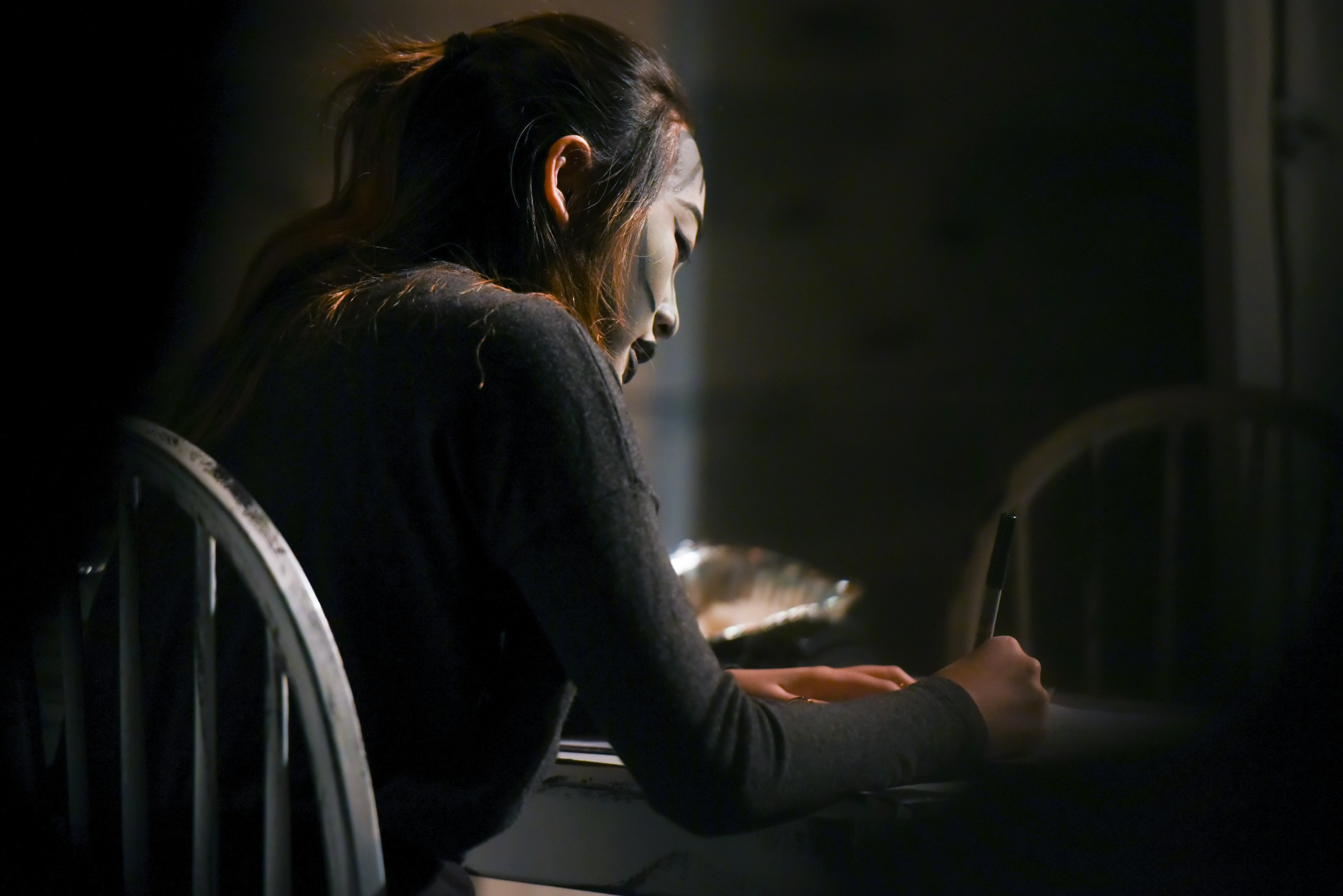
The University of Calgary’s School of Creative and Performing Arts presents Inside by Daniel MacIvor. Photo Credit: Benjamin Laird Arts & Photo.

Canadian playwright Daniel MacIvor’s Inside is far from optimistic about modern life.

Directed by MacIvor, Inside stages nine characters whose lives are set to collide minutes before midnight at a high-end nightclub. The urban dwellers are hopelessly lost in a world disrupted by social media – a network of mirages. The authentic is bled dry for fame and followers; presence in the 21st century. The search for belonging in the age of Web 2.0 has led the characters to form difficult, and sometimes harmful, relationships.

MacIvor has adapted the play’s narrative and characters to suit the student actors cast in this production by the University of Calgary’s School of Creative and Performing Arts,. The collaboration makes for an interesting blend of cynicism towards modern life. At some points, the cynicism seems to come from a Millennial’s viewpoint while at other times from the viewpoint of Generation X.

Take for example, the young, self-loathing activist Todd (Brandon Huszti). Todd sees a lot of problems with his generation, particularly the rise of selfies and artifice. Todd wants his generation, and everyone else, to look up from their phones, and he plans on achieving that with his devices (that won’t hurt anyone, he claims). The thing about Todd’s objective is, the objective seems concerned with returning to some sort of idealised past that Todd has never known, but only studied – like a freshman enlightened after taking one Philosophy course.

Then, there is Sana (Keshia Cheesman) and her sister Kara (Onika Henry). Kara, a lawyer, believes the only way to create meaningful change is to go through the proper channels. Kara believes that working from the inside is the most effective way to make change happen, while Sana stands firmly beside her method of making noise from the edges. Sana’s stance is not surprising given her obsession with social media, particularly its capacity to affect the offline e.g. produce celebrities like Kim Kardashian.

Sana and Kara’s argument boils down to this, what is the effectiveness of social media campaigns like #BlackLivesMatter? The skepticism of Generation X towards the influence of digital campaigns, versus traditional ‘analog’ methods, is well represented in Kara. Kara sees her younger sister as being naive for thinking that action without presence could have any impact.

Another interesting thread running through MacIvor’s play is the friendship between Jeanie (Paige Thomas) and Violet (Bianca Miranda). The emotionally abusive Jeannie exploits Violet’s kindness in order to satisfy her own interests. While Violet recognizes that Jeannie is not very nice towards her, she also recognizes that Jeanie is her only friend. Jeanie and Violet’s friendship is very much an exchange, as opposed to something founded upon mutual respect. It is a very cynical view of friendship that MacIvor presents us.

It is unclear what exactly MacIvor wants the audience to take away from Inside. MacIvor points out a lot of flaws about modern life, specifically emotional disengagement, but does little in the way of providing possible solutions. MacIvor’s concern for this road we are traveling down together is essentially a series of observations and thin arguments that land heavy without much subtlety. The play’s unrelenting cynicism makes it difficult for the audience to identify a common ground with the characters. The finale ultimately proves unsatisfying as it ends on a cheap moment of optimism that begs to be taken seriously.

MacIvor tries bleeding the scenes into each other with club music and dance, but the transitions feel hard nonetheless. The narrative’s episodic nature interrupts the steady momentum he tries to sustain in this ensemble piece. Fortunately, there is not much to move during transitions (set design by Skylar Desjardins) as the actors only have to move tables and chairs.

Anton de Groot’s edgy lighting design with Alex Allan’s pulse pounding sound work transform the Reeve Theatre into a nightclub, the evening’s hub for misery.

Thomas is absolutely vicious as Jeanie, a young woman abusing her disability leave. The audience is nearly on the verge of hissing at Thomas as she cuts into Miranda’s heartbreaking Violet without remorse.

Cheesman plays Sana confidently, as does Henry with Kara. The pair demonstrate that the sisters are, more or less, two sides of the same coin, even if they think otherwise.

Nick Wensrich delivers an eerie performance that burns slowly as Mason, a former soldier disturbed what he saw on deployment. He brings out the character’s manipulative personality that lays deep underneath his guise as a total schmuck. Vanessa Jetté emotes well Audrey’s vulnerability as a reluctant prostitute, hired by Mason.

Dylan Forkheim plays the nightclub’s manager Brian with the sleaziness most, if not all, nightclubs attract, though Brian’s sleaziness is punctuated by sadistic tendencies.

Kris Vanessa Teo’s free-spirited performance as Todd’s girlfriend Mary is a strong and much needed contrast to her boyfriend’s pseudo-intellectualism, played well by Huszti. Miranda’s Violet, pregnant, and Huszti’s Todd, on the way to enact his plan, play a rather touching scene together in the second act where the merits of modern life are debated.

While the ensemble manages well enough with MacIvor’s script, issues and all, there is a strong sense that the ensemble could go further with their performances. The ensemble might benefit from a more intimate space, because here the Reeve Theatre feels somewhat vacant, lacking in presence.

Overall, MacIvor’s Inside leaves much to be desired in terms of a narrative worth investing in. Audiences will feel disengaged by this play steeped in cynicism towards modern life. An underwhelming production that strays far from the SCPA’s usual fare.


The University of Calgary’s School of Creative and Performing Arts’ production of Daniel MacIvor’s Inside runs Nov 24 – Dec 5 at the Reeve Theatre.

For more information about the show, visit: https://scpa.ucalgary.ca/events/inside


Stage West Throws it Way Back With ‘80s Solid Gold 2

Don't Worry, Be Happy.JPG

The cast of Stage West’s ’80s Solid Gold 2: A Musical Revue, performing Bobby McFerrin’s Don’t Worry, Be Happy. Imaged provided by Stage West.

The ‘80s are back! Think about it, Donald Trump is in the headlines again, and a Trudeau is Prime Minister. Add in Alberta’s slumping economy, as a result of low oil prices, and it’s almost like the 1980s never went away.

And what would the ‘80s be without all that great music from the ‘big hair, don’t care’ decade?

Written by Howard Pechet & Timothy French, ‘80s Solid Gold 2: A Musical Revue is a compilation of decade defining music. From the hard rock to pop ballads, and those guilty pleasures, the show is a mixtape for just about every ear.

On this musical journey presented by Stage West, the ensemble highlights important events from every year until 1989. Canadian sports trivia wins plenty hoots and hollers, while some trivia about Canadian politics – like Pierre Trudeau’s National Energy Program – elicits boos and jeers from the audience. The trip down memory lane is punctuated by humour that keeps the evening fun and light hearted.

In this show, colour is absolutely everywhere. In the background, large screens run eye-popping visuals that are reminiscent of early music videos. Bright, outrageous ‘80s fashion makes an appearance, geometric shapes and all.

The challenge for shows like this is, how do you keep a two-hour performance from going stale? French, the show’s director and choreographer, goes big and thinks outside the box. For the show’s Michael Jackson category, the ensemble takes turns playing the King of Pop, going from hit to hit, iconic dance move to iconic dance move, then settling into a unique arrangement of Michael Jackson’s songs. Then later, the men play out every ‘80s teenager’s dream of being a rockstar with songs like Van Halen’s Jump and Here I Go Again by Whitesnake. French’s choreography is a serious throwback to the ridiculous spectacle of ‘80s rock shows.

The cast engages enthusiastically with the songs and audience. The different impersonations of famous singers, like Paula Abdul and Janet Jackson, are almost nearly spot-on. Most importantly, though, the ensemble nails the diverse range of vocal styles showcased. The vocals are, unfortunately, hindered by the audio levels, which sound just a bit too sharp at times.

Overall, ‘80s Solid Gold 2 is a wildly entertaining night of everything 1980s. The audience has a blast singing and dancing, as much they can after a full meal, to the greatest hits of the ‘80s as compiled by co-creators Pechet & French. Audiences looking to recapture the spirit of the ‘80s will want to go see Stage West’s ‘80s Solid Gold 2: A Musical Revue.


Stage West’s ’80s Solid Gold 2: A Musical Revue runs Nov 13 – Feb 7, 2016.

Ensemble:
Tzeitel Abrego
Jahlen Barnes
Amber Bisonnette
Jeremy Carver-James
Christian Goutsis
Sarah Horsman
Erik Kopacsi
Andrew McGillivray
Katrina Reynolds
Antonette Rudder
Chris Sans

For more information about the show, including how to purchase tickets, visit: http://stagewestcalgary.com/80s-solid-gold-2-a-musical-revue/


A Worthwhile Tradition: The Mousetrap is Set At Vertigo Theatre


The Mousetrap 0243 NB1_5099.jpg

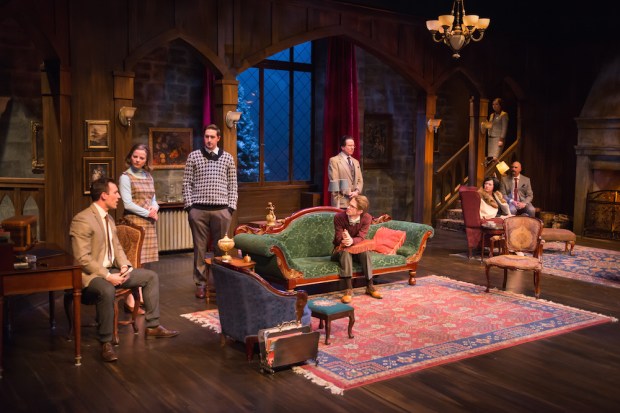
The cast of Agatha Christie’s The Mousetrap, playing now at Vertigo Theatre. Photo Credit: Benjamin Laird Arts and Photos, 2015.

Vertigo Theatre has a long history with Agatha Christie’s The Mousetrap. Since 1980, the company has returned time and time again to Christie’s classic murder-mystery. This season, The Mousetrap returns for its 14th production at Vertigo Theatre, where the play was last staged in 2008.

Directed by Kate Newby, The Mousetrap finds Mollie and Giles Ralston (Anna Cummer, Devon Dubnyk) waiting for their guests to arrive at Monkswell Manor, a newly opened guest house in the country. Just before any of the guests arrive, the radio reports that the police are still searching for the killer who recently claimed the life of a local woman.

One by one, the guests arrive, beginning with a young, free spirited man named Christopher Wren (Geoffrey Simon Brown). Mrs. Boyle (Laura Perken) is instantly displeased with Monkswell Manor, and argues she was misled by Mollie and Giles’ advertisement. Major Metcalf (Duval Lang) arrives just behind the unpleasant woman, and fortunately he is far more jovial than her. The last scheduled guest is Miss. Casewell (Genevieve Paré), a well-travelled, yet reserved, woman. Mr. Paravicini (Cam Ashcroft), a strange man whose appearance seems disingenuous, joins the party after his car overturns in a snowdrift.

The guests are trapped indoors by a violent snowstorm, leaving no one able to get in or out. The only person able to reach the manor is Sergeant Trotter (Stafford Perry) who arrives by skis. The policeman is there to protect the guests, he reveals, as police have reason to believe the killer is on his or her way to the manor – if the killer is not already in their midst. When one of the guests is murdered, Sgt. Trotter must find out who among them is the killer and stop them before they strike again. And with no contact with the outside world, there is no time for anyone to withhold any secrets from the investigation.

By now, the whodunnit genre has been well-played, but there is something to appreciate about the classics. And here, we are not involved with just any mystery writer, but the Queen of Crime herself. Christie’s ability to build intrigue is second to none, and her attention to detail is impeccable – the radio report on the mechanics of fear comes to mind. The fun of a good mystery endures in this thrilling play where isolation pulls tension to the surface.

Newby’s lively, but measured, direction makes this production feel like an exciting game of Clue. There is almost a hint of camp, and that is not a stretch by any means. Via Mr. Paravicini, played by a very funny Ashcroft, the play already pokes fun at itself and the logic common in murder-mysteries. Christie had a good sense of humour about her work, and Newby emphasizes that for an audience well-familiar with the tropes Christie helped establish during her career.

If grizzly murder were not afoot, set & lighting designer Narda McCarroll’s gorgeous Monkswell Manor would be the envy of any traveller. The snow falling outside the spacious manor’s large window adds very nicely to the atmosphere. Add in April Viczko’s colorful costume design, and the audience is fully absorbed into the period.

The evening’s tension is heightened by Perry’s furious commitment to apprehending the killer. Perry’s Sgt. Trotter is intent on leaving no stone unturned during the investigation. Unfortunately, the guests are less like stones and more like boulders. Brown’s enigmatic, oddball Wren delights as he makes a joke of the whole thing, making everyone in the manor feel uncomfortable while doing so. Brown gives Dubnyk’s stuffy Giles more than enough reason to dislike him. Cummer’s Mollie tries desperately to keep the house running smoothly, while also trying to keep the peace between the guests. Cummer knows how to make small physical moments sing. Perken’s aristocratic Mrs. Boyle stirs the house like a witch at her cauldron. Paré plays Miss. Casewell with a firmness that stands well against Perken, and that cuts through much of the swirling around by the other guests.

There are some projection issues, as in the audience strains to hear bits of dialogue, but the cast is largely on point delivering the material. The accents could use some differentiation, however, as they all sound just a touch too similar to each other, an odd thing considering the guests come from all over.

The production has a vibrant energy surging through it, from start to finish. And the same energy carries during intermission and after the show where the audience buzzes about all the various clues. There is a seriousness to it all, which Newby is interested in exploring, but the show is mainly a lot of fun thanks to the strengths of its cast.

Ultimately, Vertigo Theatre’s The Mousetrap reminds us why Christie is the master of mystery, and why the company keeps returning to this classic play.


Vertigo Theatre’s The Mousetrap runs Nov 14 – Dec 13.

For more information about the show, including how to purchase tickets, visit: http://www.vertigotheatre.com/the-mousetrap/


The Age of Love Turns The Taboo Into Something Sweet

Love, you never know where you’ll find it. Just ask 21-year-old Ash (Ryan Gray). Who have guessed that Ash would meet the love of his life at his grandfather’s funeral? Funerals aren’t exactly breeding grounds for romance, you know with the whole death thing. But when Ash laid his eyes upon his sobbing step-grandmother that day, something just clicked.

Presented by Urban Stories Theatre, Maria Crooks’ The Age of Love stages the ‘scandalous’ relationship between Ash and his 77-year-old step-grandmother Olivia (Diana-Marie Stolz). While the relationship is no problem for Olivia, a feisty mature woman, Ash has been slow about making their love known publicly. The thing is, Ash has a whole lot of money waiting to be inherited, but the inheritance is at the discretion of his mother Evelyn (Olga Primak). Ash can’t just marry anyone, you see, he needs to marry someone who has Evelyn’s approval, otherwise Ash receives nothing.

More libido than brains, Ash decides the best way to break the news to his mother is to have them all appear on a ratings thirsty tabloid TV show hosted by Lex Rodriguez (Ellen Sullivan).

Crooks goes beyond the taboo to find something sweet in Ash and Olivia’s relationship. Sure, the playwright goes for laughs, and maybe tries too hard in the process, but the playwright stays away from framing the two lovebirds as sexual deviants. Instead, Crooks is interested in exploring what exactly defines a normal relationship. So long as people are happy and not hurting anyone, then why should anyone worry about the status quo when their heart says otherwise?

Crooks takes a bite out of the status quo by positioning Ash and Olivia’s relationship against the outrageous spectacle produced by slimy, Jerry Springer-esque TV shows. Suddenly, there are far stranger things in life than a couple who just happen to be 50 years apart, like TV talk shows that exploit people for entertainment.

And in a fun twist, the eccentric psychologist and shoe fetishist Dr. Blezieau (Scottie Grinton) is perhaps the most rational person in the room.

With that being said, Crooks’ script could really benefit from a significant trim. 75 minutes feels just a little too long for this quirky play. While Britt Kennedy’s direction brings a lot of pep to the show, the material does start to run thin, especially towards the end.

On that note, there is not much on stage besides two chairs, a bed, and a desk. A good thing considering the front row has to be conscious of their feet so they don’t trip anyone during some of the more physical moments.

Stolz brings a lot of fire to the stage, and a lot of that fire comes out when she goes toe to toe against Primak. No easy battle given Primak plays Evelyn as less than a helicopter parent and more of a fighter jet. Gray is a lot of fun to watch as he tries to maintain the peace between the two fierce women.

Grinton is a real scene stealer with his faux, over the top German accent, and all the uncomfortable euphemisms that come out of his character’s well-meaning mouth. And the audience loves Sullivan as Lex, a TV host who cares more about camera angles than real human emotion. Sullivan has a great time with the character, and who wouldn’t when they get to poll the ‘studio audience’ on what they think about Ash and Olivia’s relationship?

Based on actual events, Crooks’ new play The Age of Love is a hilarious, oddly touching show that audiences will enjoy for its refreshing look at the taboo.


Urban Stories Theatre’s The Age of Love runs Nov 10 – 21 at Motel Theatre.

For more information about the show, including how to purchase tickets, visit: http://www.urbanstoriestheatre.org/


The Far, Far Edge of Theatre: Nadia Ross Talks What Happened to The Seeker


WH EXHIBIT PHOTO OF SECTION AS PROMO IMAGE 3.jpg

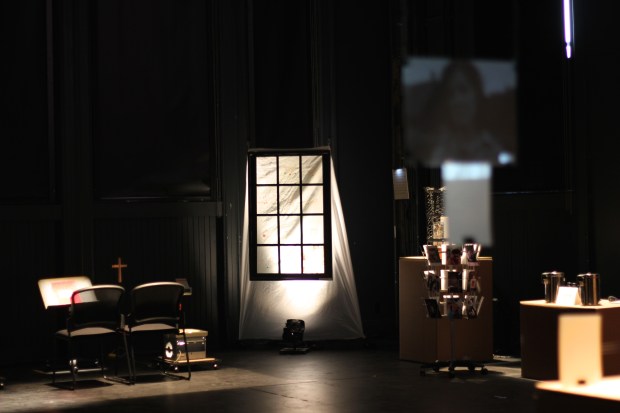
STO Union’s What Happened to The Seeker opens next Wednesday (Nov 25) at Theatre Junction GRAND.

Founded in 1992 by Artistic Director Nadia Ross, STO Union is a multidisciplinary art and performance company that explores new methods of theatre creation and production by bringing together artists from a variety of mediums. For their latest show What Happened to The Seeker, the company has brought together exhibition, video, and live performance to stage an experience unlike any other.

“We are the far, far edge of theatre,” Ross says, “even to the point where we’re not even sure theatre critics can review it…[but] that’s what STO Union does is explore, what else can you do in a venue? What are other ways to communicate? It’s bringing up questions we want it to bring up.”

What Happened to The Seeker tells the story of a middle-class, North American woman who embarks on a personal journey to reclaim the ideals of her youth. The journey is based on vivid experiences from childhood, intertwined with the history of the Seekers – youth of the 1960s who travelled the world to find spiritual enlightenment. The performance triptych, encapsulating the era from 1965 to 2010, takes the audience on a journey of their own as they piece together the story of the character’s fragmented life.

“There’s an underlying franticness in her because of her search, her desire to find some sort of place where she feels okay in the world,” says Ross about the character. “There’s also this huge underlying – it’s subtle, but it’s there – level of disappointment because there was so much anticipation, so much hope, so much belief. I mean, they were talking about climate change in the sixties. They were talking about plastics. They were talking about all of this stuff.

“[The character] realizes that change is very, very slow. She did not expect that by the time she was in her fifties that women would be still be paid so much less than men. She thought they would be equals, that’s what she assumed was going to happen.”

Ross adds that part of the danger when talking about the sixties is the nostalgia surrounding the period. “A lot of people say, that was the highlight, and we’ve gone downhill since then.”

The internationally acclaimed artist explains that the show’s structure is inspired by changes currently developing in the communication revolution. “I think with the internet, Facebook, and all that, it’s changed how we look at things. We’ve become far more visual. It’s all about the image. Language is sort of deteriorating.”

“What I did with this show is I’m trying to imitate what happens when you go online,” says Ross about bringing together three mediums to tell a story. “One minute you have this; the next you have that. You have totally different formats that you are exposed to very quickly. We don’t do it as fast as online, but that’s why we give you very different experiences. So, one moment you feel like you are in an art gallery, then the next moment you are watching a puppet movie, eating popcorn.

“So, it’s sort of an experiment into, can you do that? Can you pile things on top of each other that are different forms and still, in some way, have communication with the audience? [Can you] still keep that red thread going through the whole thing?”

Even with all our progress, Ross believes that what will always remain true about human beings is our desire not to change what is there in order to feel better. “Our search [for spiritual enlightenment] is like, buy your lotto ticket and get your million dollars.”

“[The character] goes through hundreds of boyfriends,” she says. “She goes through different things at work. She’s just kind of tearing through life in hopes that she’s going to find it, find that sweet spot… that’s what we want to look at, that eternal desire for something else, for something more, for something that’s going to hit the spot, and how we never find it.”

Although the show may be far from traditional, the experiments that are being staged may one day affect the mainstream. Ross hopes that people who are curious about what is on the horizon will come see the show when it opens next Wednesday at Theatre Junction GRAND.


STO Union’s What Happened to The Seeker runs Nov 25 -28 at Theatre Junction GRAND.

For more information about the show, including how to purchase tickets, visit: http://www.theatrejunction.com/portfolio/what-happened-to-the-seeker/

STO Union’s website: http://stounion.com/

I Say, You Say: Holt Takes The Stage For Shakespeare’s Will

Elinor Holt plays Anne Hathaway in Thiessen's one-woman drama Shakespeare's Will. Photo credit: McDonald Photography.

Elinor Holt plays Anne Hathaway in Thiessen’s one-woman drama Shakespeare’s Will. Photo credit: McDonald Photography.

Absence makes the heart grow fonder, maybe. Ask William Shakespeare’s wife Anne Hathaway (Elinor Holt) what she thinks about that.

One part history, several parts dramatic whimsy, Canadian playwright Vern Thiessen’s Shakespeare’s Will should not be taken as a pure biography of Anne Hathaway’s life. Think of the play – presented by Sage Theatre – more as an imagining inspired by historical fact. Thiessen’s imagining is primarily inspired by Shakespeare’s last will and testament, an actual document whose phrasing has produced much speculation on the nature of Anne and William’s relationship.

On the eve of William’s funeral, Anne is pressured by her husband’s sister, Joan, to hurry home and read his will. Anne is hesitant, however, to read her late husband’s final wishes. Instead, the widow journeys back to when she, at the age of 26, met the young Shakespeare. The 18-year-old writer is, surprisingly, a man of few words, content only to respond with ‘aye’ when speaking with Anne. Despite this, Anne falls for and eventually marries William – Anne’s pregnancy may or may not have fast tracked that decision.

Anne and her three children are just about abandoned by William when his theatrical aspirations call him to London. Yes, he sends money and (very brief) letters from the city, but what about the months spent away from his family? What about Anne’s unfulfilled sexual desires? Maybe Anne’s overbearing father was right about not trusting Catholics. After all, William is nowhere close for support when the plague breaks out.

Thiessen may not be interested in telling just any old love story, but the play certainly feels familiar. One reason for the play’s familiarity is that at its core, its premise is this: a woman marries an artist whose career takes him far away from home. No doubt, what makes this specific story standout is the mystique surrounding Shakespeare’s personal life. Given that Anne is very much on the periphery of that fascination, more of an answer on an high school English exam than a historical figure, Thiessen’s play feels as though any couple of the same dynamic could replace Anne and William.

Thiessen’s rich, flowing language has a rhythm to it that Holt carries wonderfully. Kelly Reay’s smooth direction matches Thiessen’s style impeccably. The director’s strong awareness of space and movement transforms the stage into an almost dream-like sea of memories where Holt is caught adrift. Ajay Badoni’s emotional lighting design plunges the stage further into this ethereal state, to the tune of Allison Lynch’s solid musical composition.

Memory is a powerful thing as Holt demonstrates in full force. How Holt so effortlessly sweeps back and forth between Anne’s memories is mesmerizing. Every word spoken feels honest, almost as if Holt were revealing a secret to a friend. Holt truly lives every detail of Anne’s personal history, from the birth of her children to her unhappy encounter with tragedy. Alone, Holt conjures an intimate, stirring performance that almost convinces us otherwise about Thiessen’s loose imagining of history.

Ultimately, Thiessen’s springboard for imagination, as he calls it, misses the mark by telling a story about a woman like Anne Hathaway, not a story about Anne Hathaway. Thiessen admits the play is not a proper historical representation of Anne Hathaway, and that apology is founded. Although there is not a vast wealth of knowledge about Anne Hathaway’s personal life, there is still something strange about trying to stage Anne’s perspective when it relies so heavily on her husband’s legacy. Thiessen’s script is written well as it offers plenty for Holt to sink her teeth into, but audiences may feel a lingering disconnect in the back of their minds.


Sage Theatre’s Shakespeare’s Will runs Nov 6 – 14 at the Joyce Doolittle Theatre.

For more information about the show, including ticket information: http://sagetheatre.com/

Artists’ Collective Theatre Brings Arden of Faversham to Canada

Artists' Collective Theatre's Arden of Faversham by Unknown ran Oct 22 - 30 at Festival Hall. Imaged provided by Artists' Collective Theatre.

Artists’ Collective Theatre’s Arden of Faversham by Unknown ran Oct 22 – 30 at Festival Hall. Image provided by Artists’ Collective Theatre.

Enjoying its Canadian premiere at Artists’ Collective Theatre, Arden of Faversham (1590) is a play whose authorship has long been disputed. Scholars have attributed the domestic tragedy to the likes of Christopher Marlowe, Thomas Kyd, and William Shakespeare. While the authorship is still debated today, what is known for certain is that Arden of Faversham is based on a true crime from 1551.

Directed by Christopher Weddell, Arden of Faversham stages the grizzly murder of Thomas Arden (Peter Cameron) by his wife Alice (Jennifer Merio) and her lover, Mosbie (Felix Leblanc). Alice and Mosbie hire hitmen Black Will (Ben Francis) and Shakebag (Josh Bertwistle) to murder Thomas. Other conspirators include servants Michael (Jonathan Molinski) and Susan (Megan Baldrey), property rival Greene (Amanda Liz Cutting), and a painter named Clarke (Conrad Belau). The plot against Thomas repeatedly fails, despite many (humorous) attempts on his life.

Weddell has staged Arden of Faversham in the style of a film noir drama. An appropriate choice given that England’s seedy underbelly is thrust to the spotlight in this true crime dramatization. Weddell captures the style well by emphasizing the social decay surrounding the characters. Michelle McAulay’s lighting design sees the hall darkly lit , populating the performance area with shadows – shadows that hide malicious intent.

Weddell has turned an otherwise musty narrative that runs too long into something of a farce. The emphasis on character antics works fairly well with the film noir elements. Blackwill and Shakebag’s assasination attempts are played like a series of Boris and Natasha plots. Bertwistle returns each time filthier and more beaten up, barely able to talk, but just alive enough to try one more time. Really, the dark humour is not a gigantic leap considering the strangeness already present e.g. a painting that kills any who look it at.

Even still, the play runs far too long, especially since the audience knows Thomas will eventually get sacked. The big (and bloody) moment is quite rewarding, thankfully.

What slows the production are the number of set pieces that have to be wheeled around between scenes. Stairs are a prominent image here. The set, designed by Nigel Francis, is visually appealing, but the actual build is concerning. The Arden residence wobbles whenever actors go up and down the stairs.

Merio’s Alice is truly befitting of the title femme fatale. The actress delivers a striking performance as the seductress who bends men to her deadly will. Leblanc’s Mosbie may be a lover, but he is also a worthy opponent for Alice. Cameron carries himself well as Thomas, a wealthy and reviled businessman. Eric Pettifor joins Cameron as Thomas’ trusted companion. Francis and Bertwistle really throw themselves into the comedic roles of Blackwill and Shakebag, respectively. The audience laughs plenty watching these two fail again and again, receiving a beating each time by Cutting.

Even actors in smaller roles pull their weight in this production. Molinski gets big laughs from the audience in fun character moments peppered throughout. Linda Kee brings a delightful energy to the stage as Bradshaw, an unknowing accomplice who was acquitted posthumously. And Charlotte Loeppky, who plays various roles, is solid, making us wish she were given more stage time.

Certainly, Arden of Faversham is not for everyone. The Elizabethean tragedy is difficult to access, mainly due to its unruly length. Where this production succeeds is in its efforts to make the play accessible by adapting the narrative to a familiar context. Issues aside, ACT’s Arden of Faversham is an alluring production that delivers both intrigue and fun.


Artists’ Collective Theatre’s Arden of Faversham ran Oct 22 – 30 at Festival Hall.

Artists’ Collective Theatre: http://acttheatre.ca/

Yee’s Ching Chong Chinaman Delivers Satire, Wacky Family Antics

Desdemona (Conni Mah) has her eyes on Princeton in Lauren Yee's Ching Chong Chinaman. Photo Credit: Lillie Cameron

Desdemona (Conni Mah) has her eyes on Princeton University in Lauren Yee’s Ching Chong Chinaman. Photo Credit: Lillie Cameron.

American society is often referred to as a cultural melting pot, a concept which vastly differs from Canada’s cultural mosaic. For any unfamiliar with the term, the melting pot refers to a society where its members have ‘melted’ into a homogeneous culture, adopting a singular identity (“American”).

While some may dislike the idea of the melting pot, there are others who fully embrace assimilation like the Wong family who are as American as apple pie. Maybe too American, in fact, if you ask daughter Desdemona (Conni Mah).

American playwright Lauren Yee’s Ching Chong Chinaman tells the story of Ed (Ben Wong) and Grace Wong (Grace Lu) and their two children, Upton (Devin Kotani) and Desdemona. The Wongs are a suburban Chinese-American family with all the usual troubles. Upton spends too much time playing World of Warcraft, Desdemona is stressed out about her grades and being accepted into Princeton, and Ed and Grace have communication problems. Everything drastically changes, however, when Chinese immigrant J (Kida Nakamura), hired by Upton to do his homework and chores, starts living at the Wong residence. J’s presence brings to surface questions about cultural identity that the Wong family has never seriously asked themselves before.

Much of the play is driven by Desdemona’s struggle writing a compelling admissions essay for Princeton. Desdemona cannot think of any obstacles she has had to overcome as a well-to-do American girl living in a nuclear family. In search of inspiration, and after watching the Joy Luck Club, Desdemona decides to explore her Chinese ancestry for help writing her essay.

That is a big part of what Yee goes after in this satirical comedy, that ethnicity, even the lack of, only matters when necessary. Never at any point of the play does the Wong family experience any sort of ethnicized discrimination. A lot of that is owed to the fact that the family plays the White Man’s game, which is not just golf in this case. Striking white makeup on the actors’ faces – with the exception of Nakamura – emphasizes the fact. Yee’s point is that sure, people enjoy Chinese things, like fortune cookies, but that is as far as it goes. There is a lot to be gained socially when immigrants totally assimilate into American culture, and plenty to lose out on otherwise. Cultural identity effectively becomes more about politics and less about meaningful self-perception, something Desdemona eventually struggles with in her investigations.

Given the eye catching title of the play, audiences should not be surprised that Yee’s satire burns hot. Yee’s oddball humour, too, makes for an enjoyable visit with the Wong family, until the second act anyway. The second act shifts gears in terms of tone, leaving us with something of a messy ending. Still, there are a lot of laughs to be had, particularly from the Wong family’s unease trying to connect with J – who they call Ching Chong, among other stereotypical names.

Limited space inside the Motel Theatre stifles the actors’ performances. Added chairs in the front means the front row has to tuck in their legs so not to hit or trip any of the actors. Nakamura and Lu have little room for their tap dance routine, which sees big leg movement from Nakamura. The lack of space creates hesitation, hindering the sort of pace needed to deliver Yee’s comedic material. Director John Iglesias might have done well by not adding any more chairs to an already tight space.

Maybe JP Thibodeau’s ‘white washed’ design for the Wong residence could have been scaled back, too.

Mah displays great comedic chops as Desdemona. Mah’s hilarious teen angst plays well against Wong’s Ed, a corporate type who rather be on the green than at home dealing with his family. Lu’s Grace is a lonely housewife who everyone ignores, everyone except for J. Lu’s blossoming personality is a lot of fun to watch, especially as the tables turn on everyone else. Kotani plays pro-gamer Upton with delight. The mostly silent Nakamura really steals the show. Nakamura’s expressions of confusion at the totally strange Wong family are hilarious.

Otherwise strong performances are troubled by several fumbled lines of dialogue, unfortunately.

Overall, Yee’s Ching Chong Chinaman is a very funny play that has a lot to say, and says it brilliantly, about America’s melting pot. While Yee’s strong writing may trip in the second act, the Wong family is still worth visiting, thanks to the ensemble’s dynamic performances.


Iglesia Productions’ Ching Chong Chinaman runs Oct 27 – Nov 7 at the Motel Theatre (Arts Commons).