WORLD PREMIERE: Theatre Calgary’s Liberation Days Is a Sentimental Look at the Past

The war is over. Celebrations erupt across Europe. This victory, though, has come at a great cost. And for the Netherlands, the fight is far from over.

David van Belle’s new play Liberation Days is more than a lesson in history, it is a meditation on perseverance in the face of extraordinary struggle. Although, despite its strong performances and stunning set design, Theatre Calgary’s latest production fails to leave a lasting impact.

The bulk of the play centers around the romantic relationship that develops between Canadian soldier Alex King (Byron Allen) and Emma de Bruijn (Lindsey Angell), a young Dutch woman. The language barrier is not the only thing that stands between them. Emma’s mother Aaltje (Valerie Planche) strongly disapproves of her daughter’s relationship with the Canadian. And if that were not enough, there is also the problem of Emma’s fiancee Jan van Egmond (Jonathan Seinen) – a Dutch soldier presumed to be dead by his community.

Meanwhile, the Canadian forces struggle to gain the trust of the locals they have been assigned to help with rebuilding. The clash between the two cultures plays out between Cpt. Miles Cavendish (Garett Ross) and the village’s religious leader Dominee Herman van Egmond (Duval Lang).

The play is narrated by Marijke Bos (Kelsey Gilker) – the village outcast who dared fall in love with a German soldier during occupation. Continue reading

“If Only We Could Let It Be What It Is”: MacIvor’s A Beautiful View Asks What’s In A Name

Would a rose be as sweet if it had no name at all? Presented at The Studio (Vertigo Theatre), Daniel MacIvor’s A Beautiful View criticizes our need to label relationships. Thanks to the chemistry of its two leads, Sage Theatre’s production of A Beautiful View, directed by Jason Mehmel, captures MacIvor’s signature wit.

The play begins with L (Stacie Harrison) and M (Monice Peter) who, rather cryptically, decide to revisit their past together, all the while being aware of the audience. Their story begins when they meet each other in a store while shopping for camping gear. From this meeting, an attraction develops between the two. The attraction, though, is neither totally friendly or romantic; it just simply is. But, as the years go on, the question of defining what they are soon makes its way to the forefront of their relationship and, as a result, breeds tension between the two.

MacIvor confronts his audience with a deceptively simple question: what is in a name? For the playwright, the act of naming something, especially something so personal as a relationship, is political. Continue reading

Heavy, Challenging: Nicolas Billon’s Butcher Commands Our Attention

A police station. Christmas Eve. An inspector, a lawyer, and a “John Doe” dressed in military uniform and a santa hat with a butcher’s hook hung around his neck. This is Nicolas Billon’s new play Butcher, presented by Alberta Theatre Projects at the Martha Cohen Theatre. Directed by Weyni Mengesha, Billon’s Butcher deals with heavy themes surrounding the nature of justice in an (un)civilized world.

Billon’s play begins simple enough: Inspector Lamb (Eric Nyland) has called in Hamilton Barnes (Andrew Musselman) in order to solve the identity of Josef Dzhbrilovo (John Koensgen), a old man mysteriously dropped off at the police station in the middle of the night. Lamb is unable to make any progress in the case because Josef speaks only in Lavinian (a fictional language co-created for the play by Dr. Christina Kramer and Dragana Obradovic). Meanwhile, Barnes has no idea who the man could be, despite the fact his business card was attached to the butcher’s hook found on Josef’s person. Elena (Michelle Monteith), a Lavinian translator, is called in by Lamb to help with the case, but her arrival does anything but. On this night, the Butcher will finally answer to his crimes. Continue reading

“Never Tell Maritimers The Odds”: Fire Exit Theatre’s Halo Sparks Discussion About Faith and Family

Fire Exit Theatre opens its 2014-15 season with Halo, a comedy by Josh MacDonald. Directed by Mark Lewandowski, Halo asks questions about faith, family, and miracles. While the script is weak in some areas, Fire Exit Theatre’s production of Halo proves to be an emotional piece that just misses the mark slightly.

Set in the fictional small town of Nately, Nova Scotia, Halo tells the story of Casey (Jamie Matchullis), a sarcastic, newcomer from the “big city” of Halifax. Casey works at the local Tim Hortons where she is visited regularly by her boyfriend Jansen (Jacob Lesiuk) who helps ease the pains of dealing with the town’s interesting residents. One day, the image of Jesus appears on the side of the building. The town comes to see the divine picture as a miracle. Meanwhile, Donald (Randall Wiebe) prays for his own miracle at the bedside of his youngest daughter who has been in a coma for the past three years. When his eldest daughter Lizzy (Kendra Hitchinson) comes to visit from Toronto, Donald’s faith and hope for his daughter’s recovery are put to the test. Continue reading

“It’s A Scary Old World”: Lunchbox Theatre’s The Life History of The African Elephant Delights

First performed in 1989, then again in 2001, Clem Martini’s The Life History of The African Elephant returns to Lunchbox Theatre to open the company’s 2014-15 season. Directed by Bartley Bard, the production sees the original cast returning for this third outing of Martini’s comedy.

The Life History of The African Elephant stages the unlikely friendship that develops between accident-prone, ceramic artist Florence Bond (Barbara Gates-Wilson) and Glen Beddoes (David LeReaney), a reserved elephant trainer. After crashing her car through Glen’s backyard and into his shed, Florence goes to the zoo enclosure where he works to apologize. Inside the enclosure, Florence discovers that Glen is trying to help an elephant overcome its depression. Florence tells Glen that she will return again, but next time with her older brother Phillip (Brian Jensen) who will be visiting on his day pass from prison. Over a late-night picnic at the zoo, Florence, Glen, and Philip try and sort out their childhoods and anxieties about the future.

Martini’s play has a great deal of heart. Continue reading

“It’s basically S&M, right?”: Alberta Theatre Projects Takes the Stage with Venus In Fur

Directed by Tracey Flye, Alberta Theatre Projects’ production of David Ives’ Venus in Fur at the Martha Cohen Theatre is a vulgar, oddly compelling experience.

The play opens with playwright/director Thomas Novachek (Tim Campbell) in a worn-down studio after a round of failed auditions for his latest project, an adaptation of Leopold von Sacher-Masoch’s Venus in Fur. Frustrated at the lack of female talent in the city, Thomas sets out to go home to his fiancee. Abruptly, actress Vanda Jordan (Amanda Lisman) bursts into the room and pleads for an audition. At first, the very crude and immature Vanda turns Thomas off. It is when the actress delivers an impressive cold read for the role of Wanda von Dunayev that the director takes great interest in her. Continue reading

Dancers’ Studio West’s 33rd Annual Alberta Dance Festival Showcases Exciting Talent

Presented at the Pumphouse Theatre, Dancers’ Studio West’s 33rd Annual Alberta Dance Festival is a showcase of both emerging and established Canadian dance talent. This year, the dance festival is titled “Dance & The Image.” Nine choreographers workshopped their respective dance pieces over the course of a seven-day Creative Intensive with direction provided by the company’s artistic director, Davida Monk, and the Dance Action Group.

In this second week of the festival, six choreographers and their dancers take to the stage to present choreography influenced by various works of art.

First in the showcase is Choreographer Serenella Sol’s “Hollyhocks and Cacti,” an abstract piece that plays with the notion of female archetypes. Underscoring Sol’s piece are recited lines of Maya Angelou’s poem “Still I Rise” which play over the speakers. Valentia Dimitriou and Kimberly Powley, Sol’s two dancers in this piece, go on to embody various archetypes, like the Seductress.
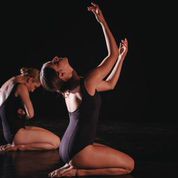
Choreographer Serenella Sol's Hollyhocks and Cacti. Dancers: Valentia Dimitriou (front), Kimberly Powley (back). Phototographer: Tim Nguyen

Choreographer Serenella Sol’s Hollyhocks and Cacti. Dancers: Valentia Dimitriou (front), Kimberly Powley (back). Phototographer: Tim Nguyen

As the piece goes on, however, there is a moment of rejection where the two dancers remove their dresses and show disgust towards them. We are left to wonder: what are they rejecting? If we accept dresses to be signifiers of femininity, then perhaps that is what the two dancers are rejecting: socially normalized ways of performing femininity. In only their body suits, the two dancers appear to find freedom and individuality; they no longer belong to any particular archetype.The act of rejection, then, can be taken as an act of defiance. This idea of defiance is supported by these lines of Angelou’s poem “You may write me down in history With your bitter, twisted lies, You may trod me in the very dirt But still, like dust, I’ll rise” which Sol’s piece closes on.

In the following piece, choreographer Oriana Pagnotta continues on the topic of femininity, specifically the everyday experience of women, with her piece “We Aren’t Always in Pieces.”

From the beginning, Pagnotta, performing in her own piece, Eva Biro, and Lindsay Oehlerking generate a strong sense of uneasiness. They move about the stage frantically with exaggerated, physical movements where they sometimes hit themselves with their arms. The dancers repeat phrases like “don’t cry” and “don’t breathe,” which they then answer back with “I won’t.” We gather that there is more to the anxious quality of the piece.

What Pagnotta’s piece culminates to is a commentary on the way society at large frames violence against women. The instructions repeated over and over again speak to negative attitudes toward female victims that hold them exclusively responsible for their own safety, that if only they had done “the right thing” they could have avoided being battered and/or sexually assault. The frantic, uneasy movement of Pagnotta’s dancers, in effect, come to be understood as discomfort of being in one’s own skin, of being forced to believe that they are the problem, and they do not belong to the space which they occupy.

Pagnotta’s piece hits hard as she successfully conveys through movement and a choice selection of words a powerful and relevant message to her audience.

Choreographed by Chelci Blais, Quinn Kliewer, and Sisa Madrid, “Seiten” – the third piece of the showcase – stages a critique of media and consumerism. In this piece, newspapers fill the stage. Dancers Kelsey Clement, Valentia Dimitriou, Emily Henley, Raine Kearns, and Tessa Mark each sit with their fair share of newspapers. However, a frenzied competition and control of the newspapers overtakes the dancers. They fight each other, tearing newspapers in the process, until they achieve satisfaction. But what is enough? At what point does one have enough? The question is lost to the dancers, but brought to our attention by the choreographers.

“Seiten” is a smart, fun piece. The dancers bring plenty of expression and vigor to their movement. Even in the chaos of newspaper being torn and thrown around, the dancers manage to keep the choreography tight. Blais, Kliewer, and Madrid also do well to make clear their narrative and views on the effects of consumerism. The piece ends with a surprise where the dancers reach a resolution – by way of an act of kindness through sharing – only to have a bundle of newspapers drop downstage. (The cycle begins anew).

The showcase’s final piece is Pamela Tzeng’s “to be or not to be: A Very Important Verb (Part 1).” Here, Tzeng struggles to make peace between her Canadian and Chinese identities.

The piece begins playfully with Tzeng listening to a “How to Speak Mandarin (Chinese)” learning tape. Tzeng attempts the various common phrases the instructor guides her through, but fails. Then, moving beyond sound, Tzeng tries to look Chinese. She manipulates her face, sculpting it to read as Chinese. The most striking change Tzeng makes is removing the round appearance of her eyes. But as she goes on, we can see that Tzeng realizes the futility of her efforts.

The futility of Tzeng’s efforts to embody (signifers of) foreigness leads to a heavy frustration. Tzeng’s frustration nears higher levels when she cannot fit her head through a traditional Chinese dress. But then, Tzeng, now undressed, lays the dress over her body and pretends that she, perhaps for once, is finally Chinese. The joy Tzeng expresses is great. Tzeng proceeds to lose herself in a delightful dance with a red umbrella. The act of appearing Chinese suffices for Tzeng. But then the conflict between her two identities resurfaces, leading to a frightening madness where Tzeng’s frustration is finally too much for her.

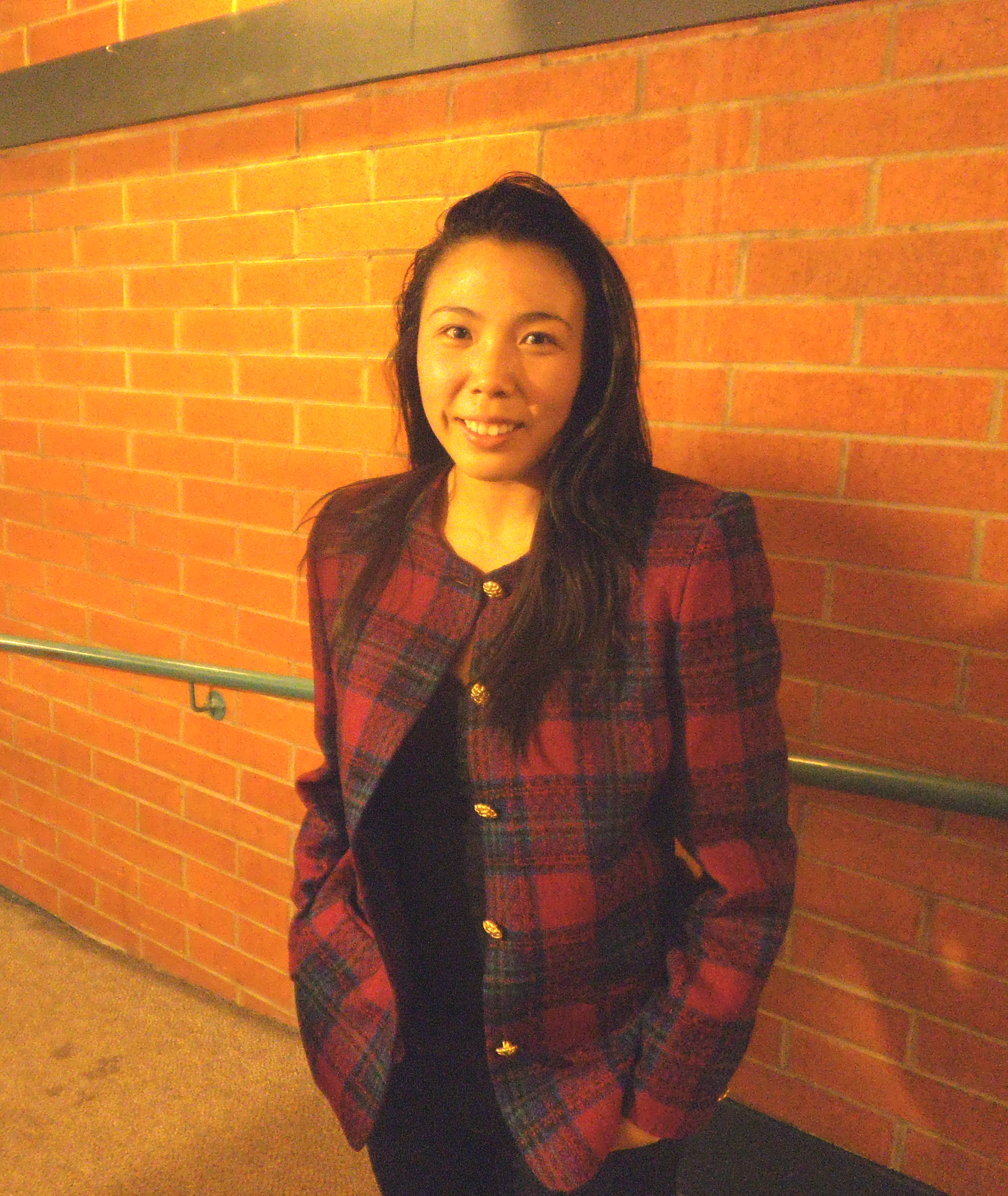
Choreographer/Dancer Pamela Tzeng, after the show.

Choreographer/Dancer Pamela Tzeng, after the show.

Tzeng does a good job of exploring questions of cultural identity. Is belonging to a culture simply speaking the language and looking the part, or is there more? And for those with two cultures, how does one reconcile the differences between that of their origins and their host? Is it truly a matter of one over the other? As this is only a 10-minute excerpt of the final product, it will be interesting to see what conclusions, if any, Tzeng comes to at the Fluid Movements Arts Festival where the piece is set to premiere.

But the experience of the festival is marred by the noise travelling from the neighboring room into the performance space. Loud conversations and laughter remove us from the intimacy of certain moments throughout the showcase. Hopefully, the company will resolve this issue for future performances.

Ultimately, however, the DSW’s 33rd Annual Alberta Dance Festival succeeds. The talent of the dancers is impressive. But it is the clarity of the choreographers who demand us to listen to what they have to say that truly capture our attention. It will be interesting to see what the choreographers do next in their artistic journeys.


Dancers’ Studio West’s 33rd Annual Alberta Dance Festival – Dance & The Image ran from September 11-13, 18-20, 2014.

For more information about DSW’s upcoming season, visit: http://www.dswlive.ca

All Ears For Ghost River Theatre’s Production of Tomorrow’s Child

The audience has put on their Sensory Deprivation Masks. Blindfolded, they are led one by one to a room booming with the sound of children at play. Overheard above the noise are murmurs of confusion and excitement from the audience.

Ghost River Theatre’s production of Ray Bradbury’s short story Tomorrow’s Child is the first installment in the company’s Six Senses Performance Series. As advertised by the company, the production is an “audio experience created for a blindfolded audience.” Continue reading

“There are no black cowboys”: Ellipsis Tree Collective Impresses With World Premiere of John Ware Reimagined

For playwright Cheryl Foggo, history is not just about dates and facts. Presented at Lunchbox Theatre, Ellipsis Tree Collective’s John Ware Reimagined is an intelligent drama that offers audiences more than a lesson in Canadian history.

Written by Foggo and directed by Kevin McKendrick, John Ware Reimagined tells the story of Joni (Kirsten Alter), a young African-Canadian girl growing up in 1960s Calgary. Continue reading