
Undressing The Dance: Dancers’ Studio West’s Latest Initiative Promotes Open, Critical Dialogue

Kimberley Cooper has been invited to partake in a public discussion hosted by Dancers’ Studio West surrounding her biography and latest show Year of The Horse. Leading the discussion is Davida Monk, the artistic director of DSW, who asks Cooper insightful questions about the dancer’s influences and where she is headed as a choreographer. Encouraged to participate, guests in attendance ask questions of their own along the course of the discussion.

This was DSW’s 3rd Undressing The Dance Dialogue.

Beginning in September of last year, the Undressing The Dance Dialogues are the latest initiative by DSW and its Dance Action Group to promote open, critical dialogue about dance with the involvement of audience members.

“We’re really passionately interested and committed in critical dialogue as a way to improve our own creativity and works, to raise awareness amongst interested members of the public and to build community in an effective way,” Monk said about the Dance Dialogues.

The first Dance Dialogue focused on the Alberta Dance Festival where audience members, choreographers, along with production crew, discussed the works in the program. The second Dance Dialogue, which took place in October, focused on Lev’s House which ran at the Fluid Festival.

In regards to post-performance discussions, Monk says the Dance Dialogues offer audience members a different sort of critical dialogue, one that she feels is not possible without some distance.

“After some time, some reflection on the work and a longer period of time not in the theatre setting – a different kind of dialogue can be done,” Monk explained. “You have to ask yourself what stayed with you after the week. When you go home that night something will stay with you, but after a week what stayed with you?”

DSW’s next Dance Dialogue will host Ame Anderson of Public Recordings. One of the topics that will be discussed is Anderson’s what we are saying which opens January 21st as part of the High Performance Rodeo.

The free event will be held at Ironwood Stage & Grill, Nov 23 from 12-2pm. Space is limited. RSVP to communications@dswlive.ca


Decidedly Jazz Dancework’s Year of The Horse: The Completely Fictional Adventures of Josephine Baker ran Nov 7 – 15, 2014, at Theatre Junction Grand. Cooper, DJD’s artistic director, choreographed the piece which featured eight mechanical horses.

Public Recording’s what we are saying runs Jan 21 – 24 at the Royal Canadian Legion #1 as part of the High Performance Rodeo. For more information about the show and how to buy tickets, visit: https://www.hprodeo.ca/2015/what-we-are-saying

For more information about Dancers’ Studio West, visit: http://www.dswlive.ca/

*This interview with Davida Monk took place Nov 23, 2014 at the 3rd Undressing The Dance Dialogue.
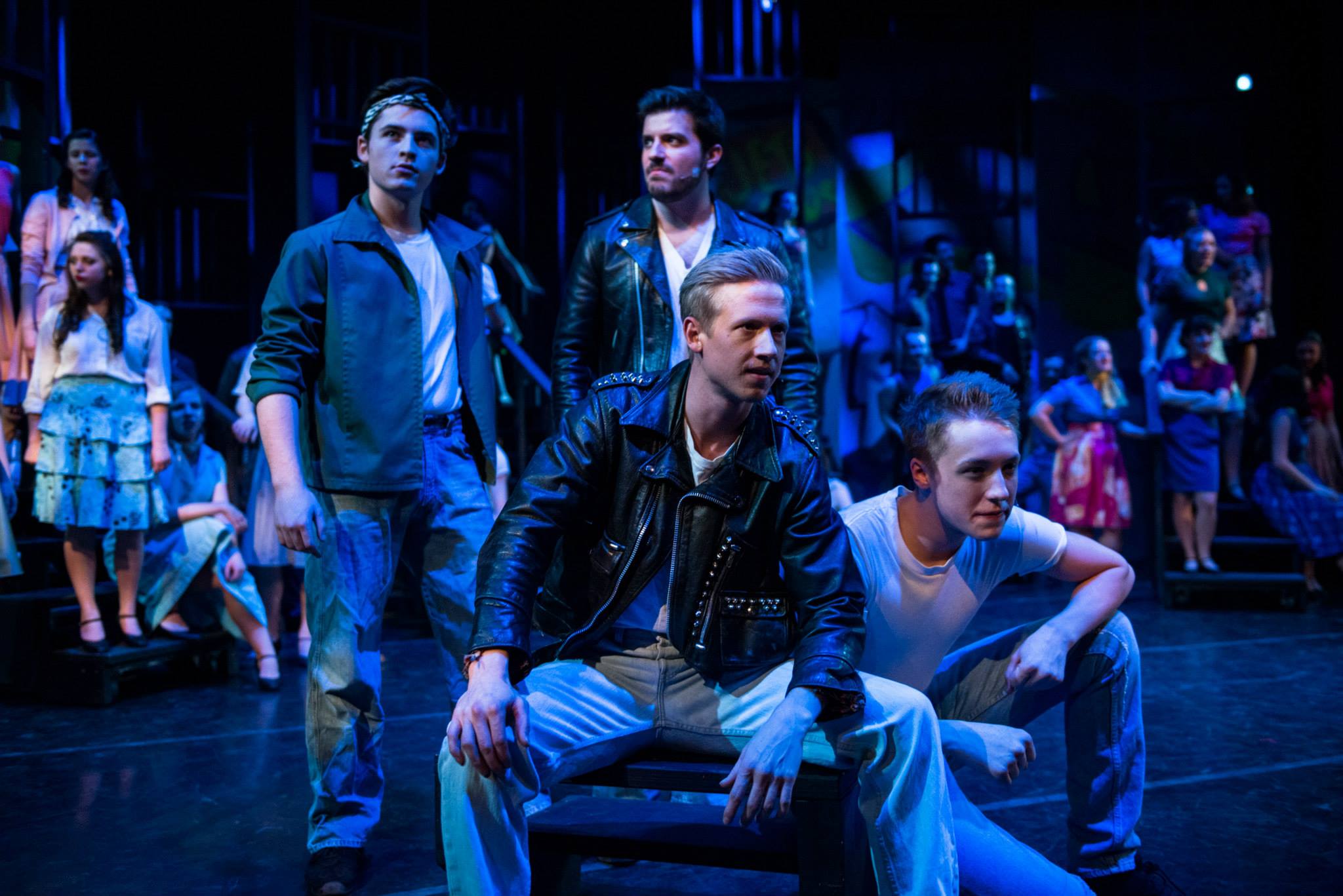
Coming Out Swinging: The SCPA Takes on West Side Story

The American Jets, led by Riff (Matthew Hall), are ready to rumble in West Side Story. Photo Credit: Citrus Photography.

The American Jets, led by Riff (Matthew Hall, front), are ready to rumble in West Side Story. Photo Credit: Citrus Photography.

The latest production by the University of Calgary’s School of Creative and Performing Arts, West Side Story impresses with its musical score and social themes that are as relevant today as they were when the musical was first produced in 1957. Even with its great choreography and sound, however, this production of the classic Broadway musical leaves much to be desired when the music stops.

Based on William Shakespeare’s Romeo and Juliet, West Side Story trades the Capulets and Montagues of fair Verona with warring street gangs fighting over territory in New York’s Upper West Side.

Set in the 1950s, the American Jets, led by Riff (Matthew Hall), and the Puerto Rican Sharks, led by Bernando (Rufi O. Rodriguez), plan to hold one last, decisive fight between the two teenage gangs. Riff calls on a reluctant Tony (Ahad Mir) to come support the guys one last time. Tony agrees to help. Although, the situation becomes complicated when Tony meets and falls in love with Maria (Jocelyn Francescut), Bernando’s sister, at the school dance. When he sets out to stop the rumble at Maria’s request, Tony soon becomes more involved than he ever wanted to be.

Dispersed across the theatre audience are five actors who open the show with the Prologue from Romeo and Juliet. The ‘Greek Chorus’ returns again, this time in black clothing, to close the first act, then the second with the Epilogue. It is a largely unnecessary addition to the musical considering this is not Romeo and Juliet. It may have been inspired by the Bard’s play, yes, but it is its own story that speaks to a whole different set of issues like immigration, racism, and at-risk street youth. Not to mention that the actors speak their lines out of sync with the others.

While visually appealing, the colorful graffiti designs painted across the set are not period-appropriate. The graffiti is reminiscent of what came out of the hip-hop culture explosion of the 1980s. As such, it sits oddly against the very 50s feel and setting of the musical.

Melissa Monteros and Wojciech Mochniej’s choreography is brilliant. The “Dance at the Gym” and “America” numbers see a lot of flair and excitement. The movement during the rumble and other fight scenes is sharp. There is certainly an edge to Monteros and Mochniej’s choreography. And thankfully, the students, alumni members, and community members involved in the production are up to task and dance wonderfully. (Although, not without some near collisions along the way).

Leonard Bernstein’s memorable musical score is beautifully interpreted by Maestro Wendy J. Freeman and her orchestra. The orchestra plays superbly, giving us a very full, expressive sound.

Unfortunately, in between musical numbers, the show runs a bit flat due to some uninspiring performances. Besides stand outs like Hall and Kayla Mackenzie who plays the fiery Anita, the remaining cast, for the most part, is lackluster. It is not until the second act that the ensemble seems to truly connect with the piece.

Francescut gives an astounding vocal performance. Her voice is powerful, easily capable of filling the theatre, and simply beautiful in its clarity. It is too bad then that Mir’s own vocal performance never quite rises to the same level as his scene partner.

Overall, the SCPA’s production of West Side Story is a strong effort. Audiences will find much to enjoy here, despite some areas that are lacking.


 The University of Calgary’s School of Creative and Performing Arts’ production of West Side Story runs from Jan 8 – 15, 2014, at the University Theatre.

For more information about the show, visit: http://scpa.ucalgary.ca/events/west-side-story

West Side Story
Based on a Conception of Jerome Robbins
Book by Arthur Laurents
Music by Leonard Bernstein
Lyrics by Stephen Sondheim.

Staging a Classic: U of C’s SCPA Brings West Side Story to Calgary

Something’s coming.

This week, the University of Calgary’s School of Creative and Performing Arts will be presenting the hit Broadway musical West Side Story.

For Colleen Whidden, the artistic director of U of C’s Music Theatre company, the decision that West Side Story should be the SCPA’s first show was an easy one to make.

“It’s West Side Story! Classic story…amazing music, every song…and from a dance point of view, it’s so dance intensive,” said Whidden. “There’s just so much area in the music for amazing creativity in the dance.”

“When we were bringing together the dance, drama, and music departments we said what would be a great first show for us to do together. It was sort of a no-brainer that [West Side Story should be it] because every department could really flourish, could really shine through this particular musical.”

Based on William Shakespeare’s Romeo and Juliet, West Side Story stages the heated gang rivalry between the American Jets and the Puerto Rican Sharks in New York’s Upper West Side during the 1950s. Caught between the conflict are two young lovers whose relationship is threatened by the hatred and violence that surrounds them.

And despite the almost 60 year gap between this production and when the musical was first produced in 1957, Whidden believes that the story and its themes have not lost any of their relevance over the years.

“Even in 2015 now, we still can relate to it,” said Whidden. “Is it a story we don’t see anymore? No. We see it everyday. We probably just read about it in the paper…we see it in our own community, across our country and abroad. Maybe even more now we need to hear that story of resolution of coming together and bringing…divisive parties together.”

Tony (Ahad Mir) and Maria (Jocelyn Francescut) in West Side Story. Photo Credit: Citrus Photography.

Tony (Ahad Mir) and Maria (Jocelyn Francescut). Photo Credit: Citrus Photography.

This spirit of coming together is also reflected in the collaborative nature of the production which Whidden says has benefited the students, alumni, and community members involved.

“We’re coming together as the School of Creative and Performing Arts…with four of us from the drama, music, and dance departments each of us [can] bring our strengths.”

This has made West Side Story a great learning experience for both Ahad Mir and Jocelyn Francescut who play the lead characters Tony and Maria, respectively.

Mir, a fourth year U of C drama student, praises the collaboration, saying that he feels it has fostered plenty of opportunities to learn from his peers in the dance and music departments, and vice versa.

Likewise, Francescut, a music graduate from the University of Alberta’s Augustana Campus, says she has learned a lot through working with other disciplines in what she calls her first acting role ever.

“This has been a huge challenge for me since I haven’t done a lot of acting [but] I feel like I’ve learned a lot in the process,” said Francescut. “Sometimes it’s been hard, but it’s been so rewarding.”

Delivering such a well-rounded experience means that the level of what is expected of students in the future will only go up, Whidden says. She is confident, however, that students will meet, if not exceed, those expectations.


The University of Calgary’s School of Creative and Performing Arts’ production of West Side Story opens Thursday, January 8th at the University Theatre.

Performance Schedule:

Jan. 8 – 10, 13 – 15 at 7:30 p.m.
Jan. 11 at 2 p.m.
Jan. 14 at 12 p.m.

Tickets are $20 for Adults and $15 for Students/Seniors. Tickets can be purchased on-line (http://www.ucalgary.ca/tickets/) or at the door.

For more information about the show, visit: http://scpa.ucalgary.ca/events/west-side-story

Lunchbox Theatre’s With Bells On Brings That Holly Jolly

This holiday season, in association with Guys in Disguise, Darrin Hagen’s With Bells On returns to Lunchbox Theatre where it was first produced in 2010.

Directed by Hagen, With Bells On is a fabulous comedy that celebrates the holiday spirit by taking it to new heights.

Ted (Stafford Perry) is a young divorcé stuck with a lousy apartment and lackluster social life. One night, riding in the apartment’s elevator, Ted runs into Natasha (Paul Welch) – a statuesque drag queen dressed as a Christmas tree. Natasha’s dream of competing for the title of ‘Christmas Queen’ that night is in jeopardy when the elevator abruptly stops.

Life is full of ups and downs, and we move right with it in every direction. So, what happens when it just stops? In this pause, what is that we discover about ourselves and each other?

Hagen uses Ted and Natasha’s momentary pause from the business of everyday life to reflect on loneliness – a feeling exacerbated by this particular time of the year. This loneliness though is just not about being alone, but feeling lonely in a crowd. And so, when the opportunity presents itself to Ted and Natasha to make a real, human connection with a stranger – it is at once both exciting and terrifying. Continue reading

Award-Winning Playwright Trina Davies Talks The Bone Bridge

For Canadian playwright Trina Davies, staging a public reading of a new work is an invaluable part of a play’s development.

“This is the first time I have had the chance to have a wide audience present [which] is a totally new experience for the play,” said Davies. “I’ve learned so much in a very short period of time from the audience’s reactions tonight.”

This November, Davies was announced the winner of the 2014 Uprising National Playwriting Competition for her play The Bone Bridge. A joint initiative between Downstage and the Consortium for Peace Studies at the University of Calgary, the annual competition recognizes plays that “dynamically [engage] with social and political issues and/or [promote] peace, social justice and human rights.”

Set in the aftermath of the Bosnian War, The Bone Bridge follows several characters who struggle to move on with their lives and reconcile with both family and neighbors. When the charismatic ‘Leader’ is captured and charged with war crimes by an international tribunal, the characters are called to confront the past and testify at the trial. Relevant and insightful, The Bone Bridge is a poignant reminder of the invisible damages of war.

Davies shares what the research process looked like in developing the play which is based off real people and events.

Playwright Trina Davies

Playwright Trina Davies

“[I read] books on…the Bosnian conflict and the post-conflict. And then, I pulled trial transcripts from The Hague. I actually went through them and watched pieces of the trial. Then, I went broader. I looked into the social psychology of war and peace, reading on people who have worked in conflict resolution and have published [on] what they’re finding around the world.”

For first place, Davies’ play received a two-day workshop, followed by a public reading which was held at U of C’s F.R Matthews Theatre on Dec. 12th.

“I always sit in the back [because] I feel like I get the best read on how the audience is reacting,” said Davies. “It’s an energy you feel from the audience. If there’s fidgeting, something’s gone on too long. So, you get a good read on what’s hitting, what’s working, and what’s not working.”

After the reading, the audience was invited to ask Davies questions and to share their responses to the piece. Audience members were later invited to a reception where they could speak with Davies one-on-one.

The actors who participated in the workshop and reading, Davies says, were also very important in terms of feedback.

“The first day [of the workshop] was very discussion based,” said Davies. “We did a read of the play, and then we had a really engaging discussion about what their personal response was to it, and then their character response. And then we went from that and moved into a second read of the play [where] we talked about technical specifics like structure and image.”

The input from both the actors and the audience have helped give Davies an idea of how she wants to move forward with the script, but still, she says, the play’s future remains uncertain.

“Right now, I don’t know where this play is going to go next. It’s a bit of a tough play. It’s a large number of characters and well, it’s not Mary Poppins. So, it is something that will have to be a labor of love and a passion for the theatre who agrees to take it on.”

But Davies says the audience’s response from the reading has left her feeling encouraged.


The staged reading of Trina Davies’ The Bone Bridge was held at the University of Calgary’s F.R Matthews Theatre, December 12th, 2014.

Actors:
Paul Cowling – The Leader
Valerie Planche – Mevla
Ellen Close – Ankica
Dawn McCaugherty – Blanka
Kevin Rothery – Dragan
Shawna Burnett – Danika
Brian Jensen – Judge/Male Voice/Husan

Director: Simon Mallett
Assistant Director: Azri Ali

Competition Director: Dawn Mari McCaugherty

For more information:
Trina Davies – http://trinadavies.com

Downstage – http://downstage.ca/
The Consortium for Peace Studies – http://www.ucalgary.ca/peacestudies/

Theatre BSMT’s !Duranged! Is a Fun, Bizarre Evening at the Theatre

“Safe” is not a word that appears in Playwright Christopher Durang’s vocabulary. If one needs proof of this, then one only needs to look to Durang’s ‘dentity Crisis and Wanda’s Visit. And conveniently for us, Theatre BSMT has packaged the two for its latest production.

Presented at Motel Theatre inside the EPCOR Centre, Theatre BSMT’s double header !Duranged! is an evening of absurdist humour injected with high-energy antics.

First up is ‘dentity Crisis, the evening’s more bizarre play. Coming off a recent suicide attempt, Jane (Elisa Benzer) is trapped at home with her overbearing mother, Edith Fromage (Hayley Feigs), who claims to have invented cheese. Jane’s brother Robert (Alan Johnson) offers no solace as he is not only passionately in love with their mother, but he is constantly turning into Jane’s father, her grandfather, and a French count. Jane’s only ally seems to be her psychiatrist Mr. Summers (DJ Gellatly) who helps her cope with her psychosis.

Benzer does well not to play her lines for laughs, instead going for the dark, disturbed nature of her character (as she best demonstrates in her “Peter Pan” monologue). In doing so, the ensuing absurdity has somewhere to go as opposed to hitting us at 100% from the beginning , which would exhaust the audience.

The escalating nature of the piece is laugh-out loud funny. The actors fully commit to the outrageous hijinks that hit one after another from beginning to end. (It gets to a point where even the sight of Gellatly’s ridiculous facial expressions draw big laughs from the audience).

Unfortunately, some of that eagerness leads to some stumbling on lines.

As well, the momentum of the play is interrupted by the poor build of the two doors on stage. Every entrance and exit makes the door frames wobble, giving the actors a hard time when they try to shut the door behind them. It is enough to cause a dip in the energy.

Jane loses grasp of reality and her own identity in Christopher Durang's 'dentity Crisis. Pictured (left to right): Alan Johnson, Hayley Feigs (Back), Elisa Benzer (Front), DJ Gellatly. Photo Credit: Chelsey Fawcett

Jane loses grasp of reality and her own identity in Christopher Durang’s ‘dentity Crisis. Pictured (left to right): Alan Johnson, Hayley Feigs (Back), Elisa Benzer (Front), DJ Gellatly. Photo Credit: Chelsey Fawcett

Foregoing an intermission, a fun musical interlude plays while the cast disassembles and arranges the set for the evening’s second play.

Wanda’s Visit tells the story of Jim (Gellatly) and Marsha (Tara Marlena Laberge), a married couple celebrating 13 years together. But when Jim’s old highschool girlfriend Wanda (Feigs) comes to visit, jealousy and temptation threaten to ruin Jim and Marsha’s marriage.

Compared to ‘dentity Crisis, Wanda’s Visit is much more grounded in reality which shows in Durang’s very funny, but also genuine marital dialogue between Jim and Marsha.

And the couple really stands out thanks to Laberge and Gellatly who are a great pairing.

Laberge is fantastic in delivering Marsha’s sharp remarks and pent up frustration which occasionally slips out over the course of the play. Gellatly is entertaining as the bumbling husband who tries to satisfy both his wife and this mad woman who wedges herself between them. And together, they share this relaxed chemistry that is simply a joy to watch.

Wanda, on the other hand, is an atrocious character whose despicable behavior as a guest grates on our nerves. And Durang leaves it that way until the very end where finally, something interesting happens. Until that point, the audience is stuck with a joke that stops being funny within the first 10 minutes.

Feigs does her best with the given material, but even her performance runs a bit stale.

How does !Duranged! stand as a whole package? Durang’s strange sense of humour may not be for everyone, but there is something about this selection of plays that is just fun. The whole evening is a lively theatrical experience fueled by slapstick and chaos. And yes, there are issues with both the plays and the production itself, but the evening has an indescribable charm to it.

Ultimately, Theatre’s BSMT !Duranged! is a curious evening of two plays that will certainly leave an impression on audiences.


*This review is based off a preview performance.

Theatre BSMT’s !Duranged! runs at the Motel Theatre inside the EPCOR Centre from Dec 10 – 20, 2014.

For more information about the show and how to purchase tickets, visit: http://www.theatrebsmt.ca/Theatre_BSMT/Whats_On.html


Fully Functional Starts a Conversation About Disability, Sexuality, and Society

A co-production between Inside Out Theatre and MoMo Dance Theatre, Fully Functional is a new play that gives a voice and real presence to its artists of mixed abilities. Drawing inspiration from their own personal experiences, the artists/creators tell stories of love, sex, and romance through dance and movement.

Being late to a first date, sex poems and orgasmic shouting: it is fearless storytelling injected with humour.

But past the laughter and heartbreak of these stories, the artists ignite a conversation about how our society views persons with disabilities.

In a talk-back session after the performance, an audience member asked “what impact do you hope to have for people afraid to let others in? [I mean it’s] easy to say I want love, but to say I deserve love is a good place to start as well.”

Mark Ikeda, artistic director of MoMo Dance theatre, responded.

“We got together in a room…and talked how taboo the topic is about the intersection between disability and sexuality, and how not only does no one know how to talk about it but people are afraid to talk about it. We hope to start a conversation, start people thinking about…how certain preconceived notions or thoughts might be quite harmful”

Thomas Poulsen, one of the performing artists, followed Ikeda’s response with his own, saying “I think you indicated that fear is very much out there in the community – in the disability community.”

Fully Functional opened at the Joyce Dolittle Theatre inside The Pumphouse Theatre on December 3rd. Pictured (left to right): Stephen Henry, Gaelyn Thomson, and Kathy Austin. Photo Credit: Chantal Wall

Fully Functional opened at the Joyce Dolittle Theatre inside The Pumphouse Theatre on December 3rd, 2014. Pictured (left to right): Stephen Henry, Gaelyn Thomson, and Kathy Austin. Photo Credit: Chantal Wall

The fear Poulsen refers to is a fear of rejection that goes deeper than what one might assume. On a whole, persons with disabilities are marginalized and rejected by mainstream society.

Consider how we speak about disability.

The disabled – a homogenizing term that attempts to refer to all persons with disabilities. It is a term that ignores the fact that disabilities are various in their form and appearance. Above all, it is a damaging term that erases the individual and reduces them to a diagnosis.

Newspaper articles sometime describe wheelchair users as either “bound” or “confined” to their chair. Persons with disabilities are framed as ‘victims who suffer from’, rather than ‘persons who live with’ a disability.

And then, it is the distance “the able-bodied” maintain between themselves and persons with disabilities. This distance comes out of fear, anxiety, and discomfort. But yet, we feel comfortable enough to stare out of curiosity and to make assumptions about their lives (but never to assume that they might have their own desires for human intimacy).

So, how can one think that they deserve to be loved when they are confronted over and over again with this idea that living with a disability somehow makes you a lesser human?

On its surface, Fully Functional addresses the assumption that disability interrupts sexuality. What it also addresses is the lack of belonging persons with disabilities experience in society.

Fittingly, the play ends with a slow dance, but this time – unlike the first time – the artists invite members of the audience to come dance with them. The slow dance serves as an invitation to close the distance and to start connecting with one another.

After all, at the end of the day, we are all human beings who want to love and be loved.


Inside Out Theatre and MoMo Dance Theatre’s Fully Functional ran at the Joyce Dolittle Theatre inside The Pump House Theatre from Dec 3 – 6, 2014.

Fully Functional was created and performed by:

Kathy Austin
Emily Collins-Tucker
Stephen Henry
Thomas Poulsen
Gaelyn Thomson

Co-directors: Col Cseke and Mark Ikeda, artistic directors of Inside Out Theatre and MoMo Dance Theatre respectively.
Assistant Director: Jordan Dalley

Inside Out Theatre: http://insideouttheatre.com/
MoMo Dance Theatre: http://www.momodancetheatre.org/

Closing Night, Open Doors: Western Canada High School Drama Students Say Goodbye to Our Town

It is closing night of Western Canada High School Drama’s production of Our Town, a play by Thornton Wilder. Family and friends have braved the freezing weather outside to come support the cast and crew.

Laughter. Tears. Curtain.

Inside the empty school theatre, Grade 12 student Julia Hermanson says goodbye to her second family.

“Everyone [comes to know] each other so well. You spend two or three hours with each other after school and then see each other on the weekends. You become like a family” says the graduating WCHS student who played Mrs. Webb in the production.

Hermanson not only learned more about how she works with others, but in the process she also learned more about her self. To be true to a character, she shares, is to be true to one’s own emotions and experiences.

And while the show may be over, fellow castmate Emilee Shackleton (Emily Webb) says she won’t soon forget the lessons she also learned along the way.

“Theatre has taught me to be honest. It has taught me to never stop discovering” says Shackleton, a senior student who made her debut in last year’s production of Macbeth.

For drama teacher Brittany Babott, it is this sense of discovery that drives WCHS’ Drama program.

“For me, it is the exploration of what it means to be human that is a big component of the program” Babott explains. Theatre offers students like Hermanson and Shackleton a great opportunity for personal growth and development.

Despite this, Babott says, theatre still has a hard time in education.

“You need measurable outcomes, [but] you can’t have quantifiable outcomes for empathy, expression, or the students who are shy and push that.”

Part of the program’s mandate, Babott continues, is also to replicate a professional experience for students – on both the performance and technical side. It does this by collaborating with theatre professionals from the community. (Our Town was directed by Calgary based director Kevin McKendrick, an eight time Betty Mitchell nominee for Outstanding Direction).

And for students who plan to pursue a career in theatre, Babott says, the exposure to successful industry professionals fosters theatre as not only a possible career option, but a viable one as well.

What’s next for Hermanson and Shackleton after graduation?

Hermanson has applied to York University, the University of Toronto, and will be auditioning at the National Theatre School of Canada.

“Big, small, this is what I want to do…I want to continue telling the truth” says Shackleton who has also applied to several theatre schools.

It is closing night. The stage is clear. The lights are off. And with a wave goodbye, the cast and crew of WCHS Drama’s Our Town are ready to go celebrate a successful run.

Hermanson and Shackleton are deep in reflection.

Exit.


Western Canada High School Drama’s production of Our Town ran at the WCHS Theatre from Nov 25 – 28, 2014.

WCHS Drama Hits All The Right Notes in Our Town

For playwright Thornton Wilder, the ordinary is extraordinary. It is, however, a simple truth we fail to see in the course of our daily lives.

Directed by Kevin McKendrick, Western Canada High School Drama delivers a charming, well-executed production of Wilder’s Our Town.

Set in the small fictional town of Grover’s Corners, New Hampshire, Our Town stages the life and history of its residents between the years 1901 and 1913. The Stage Manager (Act I – Bonnie Wearmouth, Act II – Montsy Videla, Act III – Haley Petrowhich) acts as our guide to the town by providing narration as well as inviting various townspeople to speak to different aspects of the town. At the heart of the play is the budding romance between George Gibbs (Leif Wester) and Emily Webb (Emily Shackleton) which develops over the play’s three acts: Daily Life, Love and Marriage, and Death and Dying.

Our Town is notable for two things: its minimal set and the use of mime in place of physical props. It is no easy task to create a town out of imaginary space, nor to peel beans, milk a cow, or even drink a cup of coffee at the breakfast table. The actor’s job is to deliver consistent, believable movement which takes into account the weight and dimensions of an object and/or activity; it is an exercise in the critical observation of simple, taken for granted actions. Continue reading

Theatre Encounter’s Production of The Dumb Waiter Disappoints

Directed by Ben Charland and Val Duncan, Theatre Encounter’s production of Harold Pinter’s The Dumb Waiter is a frustrating experience marked by questionable direction and lackluster performances.

The Dumb Waiter opens with Ben and Gus (Rachel Gilliatt and Meredith Pritchard respectively),  two assassins waiting for their target in an old, abandoned basement. The two fill the time discussing current affairs, idioms, and the details of this particular job. But when a dumb waiter starts to mysteriously send down food orders, Gus begins to question just who exactly they answer to while Ben tries to stay focused on the job.

Charland and Duncan’s first misstep is the preshow which leads into the main action. Gilliatt begins by walking on stage, exploring the space and performing some movement. Pritchard follows suite and does her own routine alongside Gilliatt. All the while, the audience sits unsure of whether to go quiet or continue talking – after all, the house lights at this point are still on and new audience members are still entering the theatre and finding their seats. It becomes hard then to focus on the action on stage with the theatre door wide open and chatter outside the theatre entering in. Continue reading