Fire Exit Theatre & Corps Bara Dance Theatre Search For God in Absence

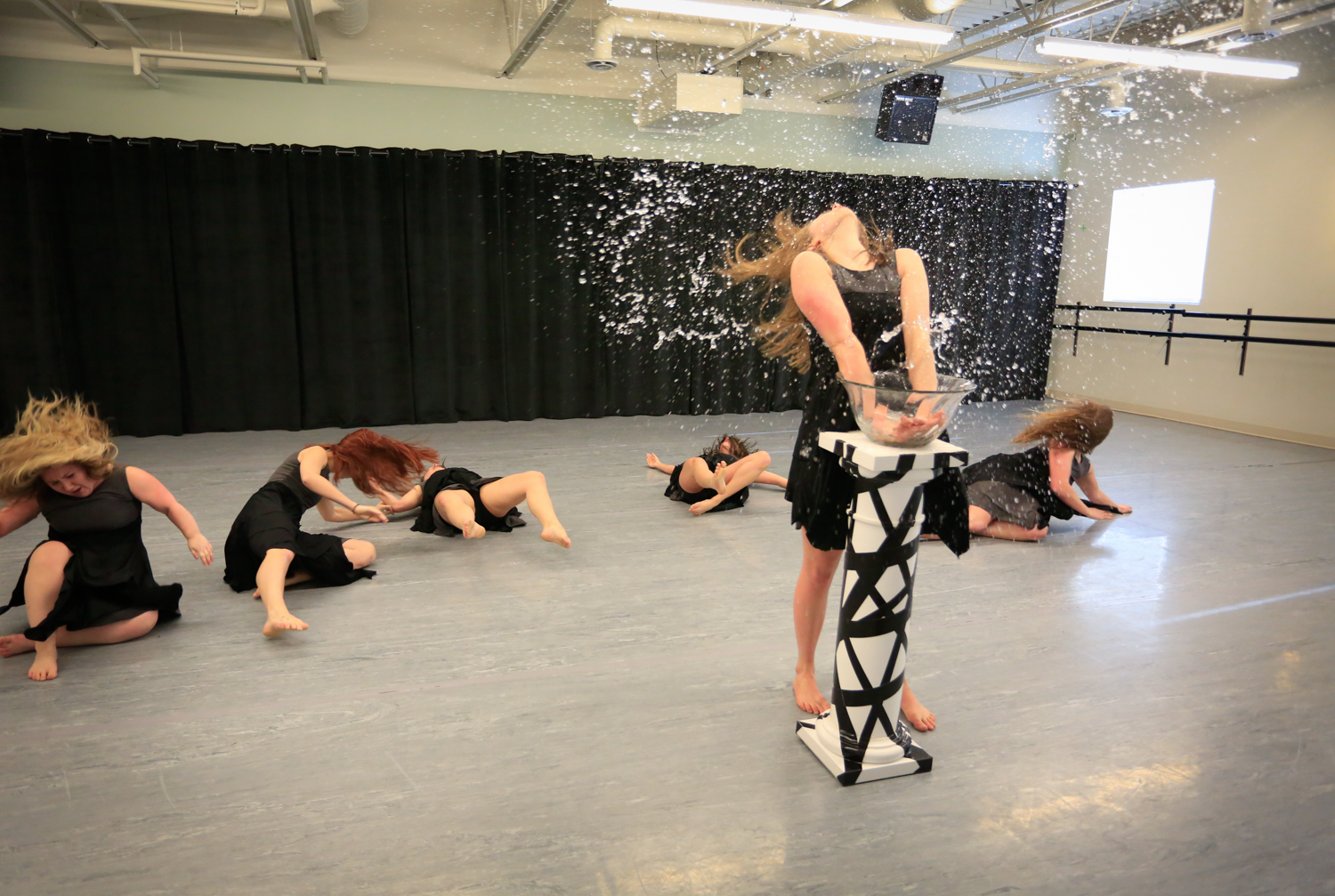
Corps Bara Dance Theatre rehearsing "Cleansing," one of six dance pieces in Absence. Photo Credit: Char G. Photography

Corps Bara Dance Theatre rehearsing “Cleansing,” one of six dance pieces in Absence. Photo Credit: Char G. Photography

What is the value of faith in a world full of injustices? This is one of many tough questions Fire Exit Theatre and Corps Bara Dance Theatre fearlessly tackle in Absence. Blending theatre and dance, Absence explores the doubt, fear, and perhaps even anger that some experience in their personal relationship with God.

Written and directed by Val Lieske, Absence stages three characters (played by Brendan Andrews, Jennifer Beacom, and Sarah Irwin) who feel utterly overwhelmed by the world. So overwhelmed by the world, in fact, that they are spiritually exhausted. For if God is everywhere, as he claims to be, then why do bad things continue to happen in our world today?

For these socially conscious youth, it is the poor and the downtrodden who suffer the most from God’s absence. And what frustrates the youth is that the marginalized are asked to remain firm in their faith. But how can one, the youth ask, trust in God when he has failed them, and so many others at home and abroad?

And their shared frustration reflects a larger phenomenon regarding youth and traditional teachings. For youth, of what relevance does the Bible have today in our chaotic world? How can we apply its teachings to unprecedented levels of disaster and conflict? And this scrutiny extends to the church where youth retention is a very present issue. What can the church do to help alleviate the dissatisfaction youth feel towards the Bible and its inadequacy to make sense of their everyday experiences? Lieske suggests that the church needs to modernize and acknowledge current affairs. Singing gospels can only get one so far in their spiritual journey, especially when there are so many questions to be asked. And so, the church needs to welcome and foster critical discussions where youth feel they can raise questions that challenge the foundations of faith.

Unfortunately, Absence lacks a central narrative to tie its main arguments together. The characters simply debate amongst themselves various positions regarding God’s inexplicable absence in the world. And they do so by making vague, heavy handed observations on politics, crime, and the media. So when there is a truly potent question raised, it has no support to carry it where it needs to go in order to have a real stimulating effect. Instead, the question becomes engulfed in an exasperating amount of talk.

Where the production does manage to hold our interest is in its six dance pieces led by Corps Bara’s dance ensemble (Laura Barcelo, Jessalyn Britton, Sarah Curtis, Valentia Dimitriou, Jason Galeos, Natalka Lewis, Sylvie Maquin, Caitlin Unrau). The reason being is that each piece is focused on one or two central ideas.

One particular piece that stands out is Cleansing, choreographed by Amy Meyers. Downstage centre, there is a bowl of holy water atop a pedestal. And the dancers each try to bring themselves to it, but they cannot for they feel unworthy. Externalized here is the spiritual agony that doubt creates. And it reads across the dancers’ faces and bodies as they frantically circle the holy water. The piece ends when finally, a dancer gives herself over and smashes the water with her hands. It is a striking image that brings the first act to a close.

And then, there is Cinch, choreographed by Krysten Blair. Setting up this piece is talk surrounding the debate between faith and reason; religion and science. And this piece explores this conversation with a recurring phrase of movement where the dancers pull apart threads or, depending on your perspective, split atoms. For once we apply scientific rationality to religious beliefs, we fall into an almost infinite series of questions that only lead to more questions.

These physical meditations of the soul are executed gracefully by the dancers.

But regardless, the sort of dramatic interest needed to fill an approx. two-hour run time is not here. The elements of the show operate in segments that result in a bland pattern of “acting/dancing/acting” and so on. There is no cohesion between the acting and dance segments until the end, but then it is too late. The audience is ready to exit the theatre.

Absence suffers from pacing issues and clumsy dialogue. While its dance pieces are exciting, the overall production lacks the necessary momentum to truly leave an impact on its audiences.


Fire Exit Theatre in partnership with Corps Bara Dance Theatre presented Absence at the Lantern Community Church, Feb. 25 – Mar 1, 2015.

For more information on
Fire Exit Theatre, visit: https://www.fireexit.ca/
Corps Bara Dance Theatre, visit: http://www.corpsbara.com/
Storytelling At Its Finest: Kyall Rakoz’s Ludwig & Lohengrin Enchants

Kyall Rakoz's Ludwig & Logengrin runs at Motel Theatre, Feb 24 - 28, 2015.

Kyall Rakoz’s Ludwig & Logengrin runs at Motel Theatre (Arts Commons), Feb 24 – 28, 2015. Photo Credit: Jonathan Brower

Why do we escape to the theatre? To see shows like Kyall Rakoz’s Ludwig & Lohengrin.

Presented at Motel Theatre, Rakoz’s one-man show stages the story of King Ludwig II who reigned over Bavaria in the late 1800s, but was himself ruled by an obsession with the fantastical. Ludwig was particularly enthralled by the story of the Swan Knight, the subject of Wagner’s opera Lohengrin. The king would, in fact, go on to be Wagner’s patron, giving way to a relationship only best described as complicated.

And that is one reason why Rakoz does not allow the audience to meet Ludwig. For how is it one could portray a man who sought to remain an enigma? Instead, Rakoz reveals Ludwig to the audience via the perspective of others.

Playing these multiple characters, some of whom were real people in Ludwig’s life, the actor gives the audience an idea of what was being said about this eccentric king. Questions surrounding his sanity were among the whispers travelling around the castle. But these were not quiet rumbles. Ludwig’s fixation on building elaborate, ‘fairytale’ castles deeply disturbed his cabinet ministers as the castles were a financial burden on Bavaria. One way or another, the ministers figured, Ludwig’s ludicrous spending had to end.

What is important to note is that this story is not about Ludwig as a king. Rakoz goes beyond the royal veil to humanize Ludwig as a complicated man who had the misfortune of being king. Had he been an everyman, the actor suggests, Ludwig would have fared much better than he did. Ludwig, whose sexuality attracted speculation from many, would have been able to follow his heart’s desires without the public damning him for it.

Rakoz’s show fascinates with its inventive staging that is nothing short of magical. Rakoz’s shadow play is particularly dazzling. Watching it, one cannot help but feel totally absorbed in the drama of the Swan Knight. Then, the actor escapes into 17 different characters who each feel alive in their own right. Certainly, the brain does take awhile to catch up sometimes, but never to a point where one feels lost in the story.

Really, there is so much here that has to be seen. Nearly every moment Rakoz paints on stage is simply beautiful. And such beauty makes our hearts tremble when the play nears its end. The audience wastes no time to rise to their feet and applaud Rakoz.

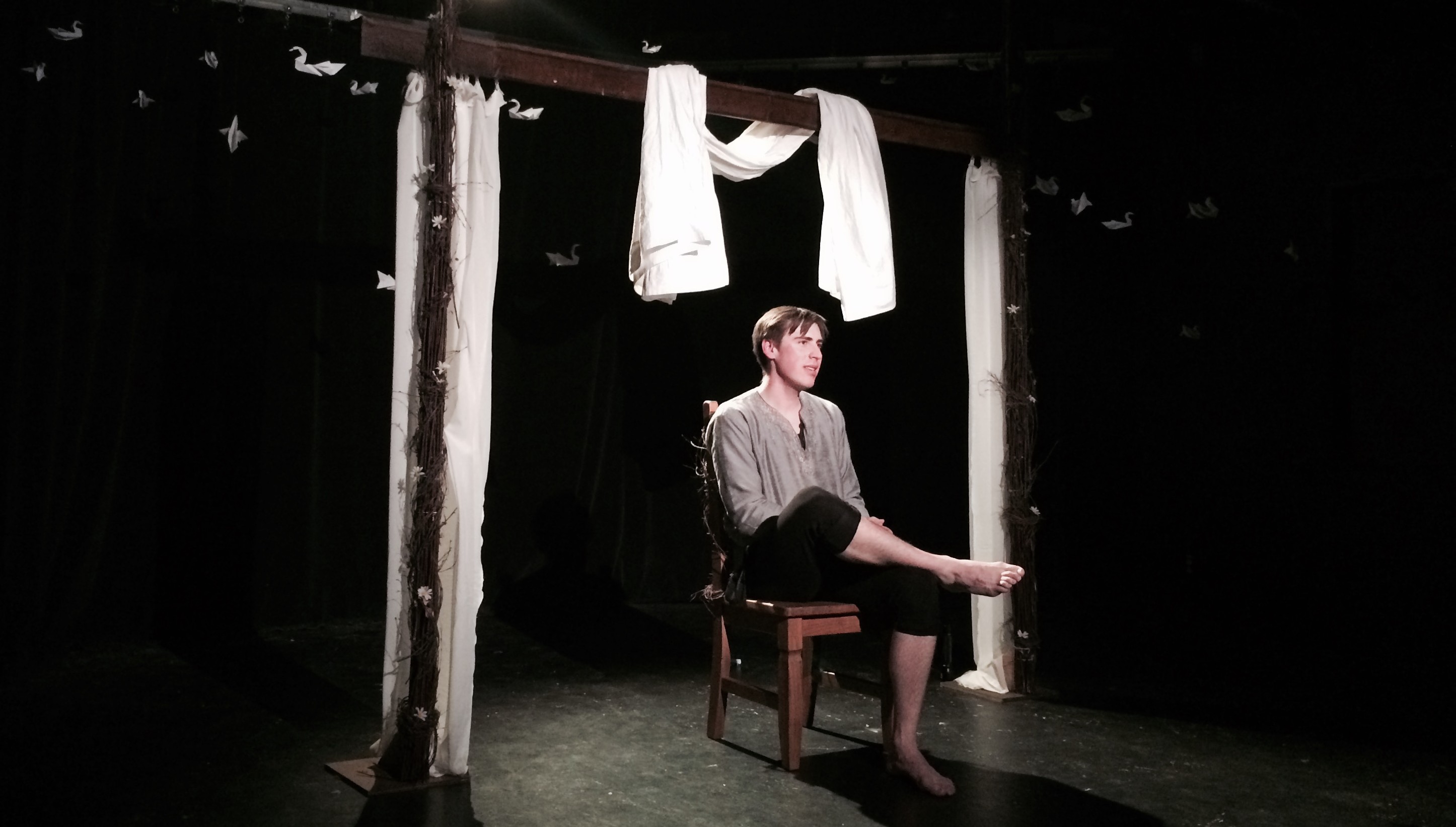
Set designer Leon Schwesinger’s set is both very earthy and elegant in its presentation. The paper swans hung from the ceiling are a nice touch.

Third Street Theatre did well to bring Kyall Rakoz’s Ludwig & Lohengrin to Calgary audiences. Rakoz’s ability to capture both our hearts and imaginations makes for an incredibly moving evening at the theatre. Those fortunate enough to catch Ludwig & Lohengrin during its limited run are in for something truly special. This is storytelling at its finest.


Kyall Rakoz’s Ludwig & Lohengrin runs at Motel Theatre (Arts Commons), Feb 24 – 28, 2015. 

For more information on the show, visit: 
http://thirdstreet.ca/2014-2015-season/ludwiglohengrin/
http://ludwigandlohengrin.com/


Soulocentric’s Dance Cabaret Features Diverse Original Works by Local, National Dancers

Shelby Jansen and Allison Zwozdesky duke it out in Cooking Truths, one of eleven works presented in Soulocentric's Dance Cabaret. Photo Credit: Ben Laird Arts and Photo

Allison Zwozdesky (left) and Shelby Jansen (right) duke it out in Cooking Truths, one of eleven works presented in Soulocentric’s Dance Cabaret. Photo Credit: Ben Laird Arts and Photo

Presented at West Village Theatre, Soulocentric’s Dance Cabaret is a showcase of original works by both emerging and professional dancers. The Dance Cabaret runs as part of the company’s 2015 Contemporary Performance Showcase, formerly known as the Soulocentric Dance Festival.

Ranging in style and tone, the Dance Cabaret comprises of eleven works choreographed and performed by local and national dancers.

The showcase opens with Tangy Lime Dance Projects’ baBBLe ON, a contemporary stilt dance piece. Stilt dancer Allara Gooliaf impresses with the control and ease of effort she displays moving to the sounds of a bustling city. The urban soundscape mixed with Julie Funk’s active movement is reminiscent of the 1998 film Run Lola Run. The piece runs smoothly until Tara Blue, who is also on stilts, starts singing. The loud music overpowers the dancer who simply cannot compete, thus making the audience lost on the lyrics. As a result, the piece ends on a weak note.

Next, Kelsey Hanna and Megan Fraser take the stage for their contemporary piece From Silence. Hanna and Fraser, both professional graduate students from the School of Alberta Ballet, are a tight pairing in this piece that explores the difficulty of loving that which cause one pain.

Dario Charles’ solo piece Without Face follows. Charles confidently exposes and plays with the the impact social conventions have on our capacity for real, unmediated human interactions. One way Charles does this is by creating uneasiness through inactivity. Sitting down, adjusting himself for maximum comfort, Charles takes a stand against the expectations of the audience – performer relationship. Then, through repeated motions, the dancer emphasizes the scripted nature of our relationships with the other. Overall, Charles presents an interesting piece. (Although, at one point, Charles’ own script refers to non-existent armrests which does remove us from the narrative).

Natalka Lewis and her company Trip The Light Dance present Dandelion Children. A collaborative effort between Lewis and her seven dancers (Misha Behnia, Madison Dixon, Odessa Johnston, Christina Robertson, Janelle Shiffner, Jordan Wallan & Katherine Mandolidis), Dandelion Children stages the abusive relationship between a mother and her daughter. The ensemble reflects the complexity of these relationships in a recurring phrase of movement where one dancer supports the other, only to drop her suddenly onto the floor. And then, they switch positions; the abuser becomes the abused. The choreography is well-thought out, and clearly presents the narrative it sets out to tell. Although, the choreography does lack an exact moment where the daughter, played by Lewis, comes into her own, leaving something to be desired in terms of a cohesive resolution.

Halifax-based dance company Votive Dance tells its own narrative of control in Proven Lands (choreography by Catherine Hayward). Kathleen Doherty plays a sinister character/force that sets out to corrupt and manipulate Stephanie Mitro’s character who attempts to resist her influence. Doherty embodies very well the weight of conformity on the individual, and Mitro displays a great vulnerability in the piece. The piece does lose some steam near its end, which is drawn out quite slowly, but overall it is a solid piece from start to finish.

Der schuh-shoe-La chaussure, choreographed by Jason Owin Galeos, is the last piece before intermission. Interested in the shoes we wear and where they take us in life, the piece begins with four dancers – Galeos, Cenzia Nina Aviles, Meghann Michalsky, and Chandler Smith – who walk on stage holding in their arms various footwear. The piece fails to make its intentions clear, thus making it feel like a missed opportunity. Galeos’s choreography attempts to grasp onto a central idea, but leaves the audience with little going into intermission.

Taking us into the second act is Metamorphsis, choreographed and performed by Krizia Canvas Carlos and Aris Nsungani. Carlos and Nsungani light up the stage in this exciting urban dance fusion piece.

Choreographed by Naomi Lawson Baird, Jass Parlour’s Daughters of The Deep is a short jazz piece that features Baird, Kimberley Ilott, and Hannah McCathy. Well-executed, though not particularly memorable.

Performed by Terra Plum, Jessalyn Britton, and Janelle Schiffer, Tri Some blends jazz with West African dance forms. Plum’s upbeat choreography is delivered effortlessly by the dancers. The mix between the two dance styles makes for a very cool piece.

Carisa Hendrix brings a strong stage presence in Just For Me, a solo hula hoop act created by Hendrix. What makes this short, playful piece particularly entertaining is both the speed at which Hendrix maneuvers her hula hoop and the element of risk (e.g. the hoop hitting the floor, bringing the piece to a sudden stop) in the maneuvers she performs.

Shelby Jansen and Allison Zwozdesky bring the night to a close with Cooking Truths. In Cooking Truths, Jansen and Zwozdesky play two celebrity chefs competing against each other in the kitchen. There is an array of fun, bizarre moments, like Jansen plucking her rival’s heart out, that receive big laughs from the audience. And inventive staging keeps the piece moving forward as the dancers flip and fold tables to create big, epic moments of warfare (performed in slow motion, of course). The piece does take time to hit its stride, however, as its first couple minutes are rather clunky and awkward. Moreover, the piece might benefit from a shorter run time as it feels a little too loose in its current state.

Featuring a diverse range of original works, Soulocentric’s Dance Cabaret succeeds at entertaining, and giving audience members the opportunity to witness and support Canada’s independent artists.


Soulocentric’s Contemporary Performance Showcase ran at West Village Theatre, Feb 19-21 2015.

For more information on the company, visit: http://www.soulocentric.org/


U of C’s SCPA Clowns Around, Impresses With Creative Take On Brecht’s Man Equals Man

Galy Gay becomes the perfect soldier in Bertolt Brecht's Man Equals Man. Pictured (left to right): Natasha Strickey, Kristi Max, and Vince Mok.

Galy Gay becomes the perfect soldier in Bertolt Brecht’s Man Equals Man. Pictured (left to right): Natasha Strickey, Kristi Max, and Vince Mok. Photo Credit: Citrus Photography

Inside the University Theatre, a troupe of clowns dressed in military uniform await their audience. The clowns juggle, sing, and crack jokes to warm the audience up for the night’s main event: the transformation of an ordinary citizen into the perfect soldier.

Directed by Tim Sutherland, U of C’s School of Creative and Performing Arts’ production of Bertolt Brecht’s Man Equals Man is an uproarious spectacle of slapstick and danger.

Set in British Colonial India, Man Equals Man stages the story of Galy Gay (Natasha Strickey), a lowly porter, who is thrust into the ranks of the British Army by three incompetent privates. Needing someone to pass off as their fourth man during roll call, Uriah Shelly (Andy Weir), Jesse Mahoney (Ahad Raza Mir), and Polly Baker (Onika Henry) enlist Galy to be their stand in for the night, whereafter he will no longer be needed. But when their comrade Jeriah Jip (Connor WIlliams) goes missing indefinitely, the privates set out to turn Galy into the soldier they need him to be.

Despite the presence of firearms, there is little violence that actually takes place on stage. And that is the point. For Brecht, it is not firearms, but rather political ideologies that pose a grave threat to all persons of the world. After all, a gun cannot fire without someone to pull the trigger.

Here, what Brecht specifically fears is the influence of state propaganda on citizens. Though he resists at first, Galy is eventually won over by a narrative that glorifies the soldier as an inherently noble figure worthy of many rewards. Over time, the narrative digs deeper under Galy’s skin where it re-positions his values to align closer with those of the state and its armed forces. Galy’s identity effectively becomes estranged from his biography. And it is from this metamorphosis that violence emerges as Galy becomes a soldier on the front; a weapon of the state.

Accordingly, Sutherland’s circus positions war as an elaborate production. Translated within this context, a soldier’s uniform becomes nothing but a costume that anyone can wear, even a clown. By highlighting how persons and groups assign meaning to the mundane, as opposed to the mundane possessing an inherent value, Sutherland undermines the symbolic authority of the uniform.

And despite changing into costumes (e.g. ninja attire) that suggests otherwise, the clowns remain British soldiers throughout the entirety of the play. This contradiction in appearance emphasizes Brecht’s concern over the sort of false realities that ideologies construct and attempt to present as truth in the face of actuality.

This is a furiously high-spirited circus that engages on all fronts through physical humour, music and dance. And everyone in the cast is on board here, even the actors in the background who are giving as much as those leading the scenes. There is a lot of great character work on display, a varied mix of personalities and antics. The ensemble’s total commitment to the piece truly elevates this production to something quite fantastic.

Strickey displays a great amount of quirk and charm which makes her an absolute joy to watch on stage. Her facial expressions and mannerisms read very clearly from the stage. Along with her comedic timing, Strickey is also adept at capturing the dramatic tones of the play.

Weir, Mir, and Henry share a delightful chemistry together. Although, the actors would benefit from better enunciation and projection as sometimes we lose their dialogue, particularly with some of the accents at work.

Set and lighting designer Anton de Groot’s work is visually exciting and very much in tune with the eccentric quality of the production.

Funny, thought provoking, and certainly unique, U of C’s School of Creative and Performing Arts’ production of Brecht’s Man Equals Man is a lively experience that both entertains and challenges its audience.


The University of Calgary’s School of Creative and Performing Arts’ production of Bertolt Brecht’s Man Equals Man runs at the University Theatre, Feb 17 – 28, 2015.

For more information on the show and how to purchase tickets,
visit: http://scpa.ucalgary.ca/events/man-equals-man

The Weight of The World Suffocates in Duncan MacMillan’s Lungs

Presented by Verb Theatre, Duncan MacMillan’s gripping play Lungs stages the story of F (Anna Cummer) and M (Kyle Jespersen), a well-educated couple in their thirties. One day, while in line at Ikea, M puts forward the idea of having a child. From this moment, a turbulent, uninterrupted conversation surrounding the ramifications of bringing a baby into the world – a world already strained for resources – begins and follows into the next several days, months, and years.

Per MacMillan’s explicit stage instructions, there is no set nor are there any props. What there is plenty of though is a lot of talk, and a lot of talk about talking.

Over and over again, F justifies to herself (and M) why the couple should not bring a child into the world. Think of the environment, F says, citing the impact one whole person’s carbon footprint has on the Earth. Then, switching her position, F reasons why the couple are allowed to have a child, citing primarily the fact they are not only are they good people, but they are also very aware.

The whole play reads as a sharp criticism of slacktivism. F and M self-identify as well-informed citizens based off how much they (claim to) read. And that is enough for them to separate themselves from the masses. In other words, because the couple knows better, then they cannot be part of the problem. F and M equate not only knowledge with responsibility, but also as a form of action in itself. Unfortunately, for all their awareness, they fail to participate in any meaningful action to help the world. They only talk about what they have done or plan to do – the latter being subject to whether or not they have a child.

And it is this shallow satisfaction with themselves that sets the couple up for heartbreak when they are hit hard, very hard, with the realization that the world is indifferent to them, no matter how many trees they intend to plant.

In this way, MacMillan reflects back to us our growing complacency in the digital age. For MacMillan, awareness is not enough. Using a hashtag or sharing a video is only a small step in creating change. In this world, which goes on with or without us, what truly matters is action; knowledge put in practice.

With regards to the script, MacMillan offers no escape from what is born out of a simple conversation. He holds nothing back in this emotional roller coaster that punches forward on a track bent in every direction, leaving its audience speechless by the end.

And thankfully, Cummer and Jespersen match the velocity of MacMillan’s fearless script. Cummer is fantastic in drawing out so many emotions from the audience. And there is this one powerful moment, which demands to be seen, where Cummer simply nails it. Never has a theatre gone so quiet. And Jespersen is there with Cummer every step of the way. Rarely do a pair respond to and match so well what the other brings to the table.

Running at Motel Theatre, Verb Theatre’s arresting production of Duncan MacMillan’s Lungs is one not to miss.


Verb Theatre’s production of Duncan MacMillan’s Lungs runs at Motel Theatre (Arts Commons), Feb 5-14, 2015.

For more information on the show and how to purchase tickets,
visit: http://www.verbtheatre.com/season/


World Premiere: Lunchbox Theatre Goes ‘Speed Dating for Sperm Donors’

A lesbian couple in search of a sperm donor. Well, not just any sperm donor. The perfect sperm donor. How hard could it be? Ask Natalie Meisner, she could tell you. You might say, in fact, that she’s an expert on the subject.

Enjoying its world premiere at Lunchbox Theatre, Meisner’s Speed Dating for Sperm Donors is a fun dramatized account of the playwright and her partner’s experience in trying to start family.

Helen (Julie Orton) and Paige (Janelle Cooper) are ready to have a baby. Unfortunately, Helen’s best friend has said no to being the sperm donor. This sets the couple off on a journey to find the perfect sperm donor; perfect as defined by a very strict set of criteria. Helen and Paige’s search turns up a lot of ‘duds’ like a Russian physicist (Mark Bellamy) keen on eugenics, and a recovering sex addict (Christian Goutis). Eventually, the couple’s relationship begins to suffer as their unfruitful search leads to doubt and frustration.

As much as the play sets out to be about the couple and their journey, the story is really about Helen. We do not hear much from Paige beyond her reactionary responses that support Helen’s character arc rather than help support one of her own. On the one hand, it makes sense considering that the play is based off Meisner’s non-fiction book Double Pregnant which is written from her point of view. On the other, however, this is a dramatization that – according to the Playwright’s Notes – seeks to play with and flesh out “the dramatic potential” of Meisner’s autobiography. That is why it is so strange that Meisner chooses to narrow the play’s perspective rather than expand it in a work of fiction.

Perhaps though it is a limitation inherent to adapting non-fiction for the stage. There could be nothing more exposing, after all, than having one’s life story played out in front of a live audience. And as a result, there may be a fear/worry on the playwright’s part of misrepresenting and/or overstepping the personal boundaries of those involved in real events.

Where Meisner does hit the mark is in her application of humour to approach (and widen) the conversation surrounding LGBT families. While she may achieve this by playing into certain stereotypes, Meisner does it in such a way that reflects a sharp self-awareness on her part. The playwright is able to venture out into the ‘two-dimensional’, then bring it back to something sincere. In doing so, she entertains (which may ease some into the conversation), and then uses humour as a means to illuminate and establish a common ground with the audience.

Meisner’s revolving door of quirky characters, though, does wear thin after awhile. The first few characters are fun, but then the later character scenarios – especially the one Meisner throws in as misdirection – stall the pace of the play.

Thankfully, Bellamy and Goutis are strong enough in these roles that the play does not completely drag in its last thirty minutes. (Bellamy has an infectious charm that lights up the stage).

While very funny and clever at times, Speed Dating for Sperm Donors does feel as though it could go further to explore its more serious, dramatic elements. Pacing issues also stifle Meisner’s comedic wit, but great character work by the actors help keep the play light-hearted and enjoyable.


Lunchbox Theatre’s Speed Dating for Sperm Donors runs Feb 2 – 21, 2015.

For information on the show and how to purchase tickets, visit: http://www.lunchboxtheatre.com/calendar/2015/2/2/speed-dating-for-sperm-donors-by-natalie-meisner?view=calendar

W & M Physical Theatre’s Waiting Rooms in Heaven Reflects On The Life (Not) Lived

W & M Physical Theatre's Waiting Rooms in Heaven. Pictured: Laura Henley and Wojciech Mochniej. Photo Credit:

W & M Physical Theatre’s Waiting Rooms in Heaven. Pictured (left to right): Valerie Campbell, Laura Henley and Wojciech Mochniej. Photo Credit: Aldona B Photography

Presented at the University Theatre, W & M Physical Theatre’s preview of its latest work in development Waiting Rooms in Heaven summons poignant reflections on life and the life (not) lived.

The piece takes place inside a room decorated with pristine white chairs. The only exit is a door atop some stairs, but out this door are a flock of birds that obscure the sky. This place is nowhere exact or well-defined. It is a metaphysical space whereupon eight unfortunate individuals enter into without any answers nor any clarity. Regrets from the past soon reemerge and make heavy the souls of those trapped in this mysterious unknown.

There is woven into this piece this desire that life choices were not so permanent. It is an idea that repeats itself as a wish that life were written in pencil than in pen, that one could go back and do things differently. It is an idea, however, that removes the opportunity to not only learn, but to also experience life in the moment. After all, what is a life stripped of its spontaneity? What is a life interrupted by fear and anxiety?

Driving this idea of doing one’s life over again are the “what ifs” the adult characters of this piece find themselves trapped within. Repeated again and again are what the characters wish they could have done differently if only ‘this’ or ‘that’. It is fitting then that the there is an almost violent sense of control in the movement. As if trying to change the outcomes of some past scenarios, the dancers attempt to manipulate and bend to their will the other. Their efforts are in vain just as wondering “what if?” is a futile attempt at changing the past. Where they manage to exert any sort of “real” control is in throwing the rows of chairs into one large pile. Of course, what meaningful impact does such a destructive action have in the grand scheme of things?

The company has incorporated in this piece four actors who range from 10 to 60 years old. It makes sense that the two adult characters would carry some baggage as they certainly have had the years to accumulate such burdens, but what about the little girl and teenager trapped in this room with the others? How do they, who appear to be brother and sister, fit in this place? Perhaps their baggage is of the second-hand kind, the kind handed down through the generations. If this is the case, then perhaps their wish is not to have lived life differently, but to have been born into a whole different life altogether.

The piece ends on a hopeful tone when the door is opened once again and, this time, soaring birds greet the characters. It is an invitation to let go and move on, to fly away and live a life unrestrained.

Here, the company’s latest work explores the idea that the gravity of our burdens are only as great as we allow them to be. While the current circumstances of our lives may be cemented as a result of choices made, the life not yet lived remains to be written. And this life that waits for us relies upon on the right state of mind which, in the end, makes all the difference.

With this only being stage one of development, it will be interesting to see how the piece evolves and what it will ultimately resemble when W & M Physical Theatre brings Waiting Rooms in Heaven to Calgary again in 2016.


W & M Physical Theatre’s Waiting Rooms in Heaven ran at the University of Calgary’s University Theatre Jan 22 – 24, 2014. The piece was presented as part of U of C’s School of Creative and Performing Arts’ Dance Pro Series.

Choreographed by: Wojciech Mochniej with Melissa Monteros
Performers: Wojciech Mochniej, Laura Henley, Rufi O. Rodriguez, and Serenella Sol
Guest Performers: Valerie Campbell, Valerie Pearson, Griffin Cork, Ruby June Bishop, and Kent Brockman (bass)

For more information about the show, visit: 
http://wmdance.com/
http://scpa.ucalgary.ca/events/pro-series


Keeping Dance Local: En Corps Dance Collective Provides Opportunities for Calgary Dancers

This is Melanie Nightingale’s last year with En Corps Dance Collective, a company she helped found twenty years ago. One of the last founding members remaining, Nightingale says it has been interesting to see how the company has grown since its inception in 1995.

Initially, En Corps was influenced by the style of dance Nightingale and its other founding members were introduced to in Los Angeles during the 1990s.

“A lot of us used to go to Los Angeles to dance in the summertime,” Nightingale explained.”En Corps really started back in fall of ‘95, maybe spring ‘96, because a lot of us dancers – I think there were five or six of us – we wanted to bring a style of dance to Calgary that we didn’t think existed. We wanted to bring kind of that LA style and feel up to Calgary and give that opportunity to dancers.”

Nightingale adds that while there was a studio in Vancouver they could have gone to, it was important to the dancers that they stay in Calgary.

With how Calgary’s dance community has grown in the past twenty years, Nightingale says the company’s original mission is no longer as relevant as it once was. Now, En Corps is more concerned with retaining local talent.

“We first started because we thought we were bringing to Calgary something that didn’t exist…now, we don’t really see ourselves in that way anymore,” said Nightingale. “We just want to provide a dance experience to dancers in the city, so they don’t have to leave.”

It is not uncommon that dancers move to cities like Toronto or New York in order to pursue dance professionally. The reason for leaving is usually attributed to the lack of local opportunities for professional growth. To remedy this, En Corps offers dancers over the age of 18 classes and performance opportunities aimed at helping them grow and evolve as professional dancers.

For Nightingale, however, it is not enough that dancers gain solid technical training, but that they also feel a sense of belonging within the company, especially since founding members like herself are not always going to be around.

“I think I’m the last remaining founding member of En Corps, and this will be my last year because I’m going on to do different things,” said Nightingale. “We want to make people feel welcome in our group, so that they know that we want them on committees. We want them to get involved in what we’re doing and have a vested interest in En Corps to keep it going.”

And as the company prepares for its upcoming show The Escape, it is not hard to see what a significant impact the company and its commitment to fostering a friendly, professional environment has had on both new and veteran members.

En Corps Dance Collective presents The Escape, Jan 30-31st at the Wright Theatre, 8:00pm. Photo Credit: Red Dot Photography

En Corps Dance Collective presents The Escape, Jan 30-31st at the Wright Theatre, 8:00pm. Photo Credit: Red Dot Photography

The Escape tells the story of a distraught young girl who uses the power of her magic red ball to escape into a magical world of fantastic creatures. Unable to cope with reality, the young girl becomes dependent on this fantasy world to deal with her problems. Will she find the strength to return to the real world or will she become trapped in this unknown dimension?

Brittany Robertson and Jenna Powell started with the company’s drop-in classes five and nine years ago, respectively. Now, Robertson and Powell are not only dancing in The Escape, but they have also helped choreograph pieces for the show.

Powell, the artistic director of En Corps, says Nightingale’s departure signals a ‘passing on’ to the next generation who are becoming more active within the company.

“It’s slowly trickling down into my generation. We’re starting to direct more and to choreograph, ” Powell explained. “There’s also younger dancers who are part of our cast and part of [the University of Calgary’s] dance program, and they’ll eventually probably start to choreograph and become more involved.”

Odessa Johnston, a second year U of C dance student, says her first year with the company has been a valuable learning experience thanks to the diversity of dance experience she has been exposed to.

“This is quite a large range of age which is so great and so wonderful to experience because you get dancers that have been dancing for so long and have these great experiences, then dancers like me who have only been in university dancing for a few years now,” said Johnston.

Johnston, who hopes to pursue an MA in Dance, says she would like to continue dancing with the company, maybe even choreograph for them as well.

Even though there is always the challenge of fundraising and increasing costs associated with performance spaces and costumes, Nightingale believes that En Corps will be around so long as the company is willing to nurture the love of dance that its members share.

“[Twenty years] it’s a long time, especially since we’re a non-profit and we do everything ourselves,” Nightingale said. “I think it’s just because we have such a good base of dancers and we are really creating kind of, like I said, a family of dancers. We’re welcoming to people. We don’t – once people have children or they have families, we don’t say “oh, you can’t dance with us anymore.” …We’ve had pregnant ladies who’ve danced on stage…and they’re dancing because they have a passion for it. We’re open to involving people in different ways and we think there’s a lot of talent in the city that we want to bring to the company.”

Ultimately, Nightingale hopes that the company continues to thrive so that it can continue to keep dance and those who are passionate about it in Calgary.


En Corps Dance Collective’s The Escape runs Jan 30 – 31st at the Wright Theatre (Mount Royal University), 8:00pm.

Tickets can be purchased online here: https://tickets.mtroyal.ca/TheatreManager/1/tmindex.html

For more information about the company and The Escape, visit: http://www.encorpsdance.ca

This story has been edited to make the following correction: Melanie Nightingale (Malarchuk).


20 Years Later, W & M Physical Theatre Shows No Signs of Slowing Down

W & M Physical Theatre's newest work, Waiting Rooms in Heaven. Photo Credit: Aldona B Photography

W & M Physical Theatre’s newest work Waiting Rooms in Heaven. Photo Credit: Aldona B Photography

This week, W & M Physical Theatre previews Waiting Rooms in Heaven, their newest dance work, at the University of Calgary. The presentation coincides with the company’s 20th anniversary celebrations.

Founded in 1994, W & M Physical Theatre’s story begins in Poland where Melissa Monteros and Wojciech Mochniej, the company’s founders, met at Silesian Dance Theatre.

“They were just starting the very first professional contemporary dance company [Silesian Dance Theatre] in Poland. The wall had just come down. This was 1991,” Monteros recalls. “[Wojciech and I] made our first work together in 1993. We launched our company at the end of ‘94.”

The company left Poland in 2000 after financial struggles made it clear that a move was necessary, Monteros shares.

“We started the company in Gdansk. We were there for a long time, six or seven years before we felt that funding was never going to happen. I had a house. I sold my house. I put half of my salary into the bank so I could pay the Polish dancers. It was a big struggle…Wojciech and I finally decided that it was too big a struggle. We also wanted to be working in one place because we would be going back and forth between Poland and Canada. It was expensive and difficult.”

20 years later, Monteros and Mochniej’s commitment to the company has not wavered.

Balancing responsibilities at U of C, where Monteros and Mochniej both teach, with a professional commitment to making art with the company is a matter of making time, says Monteros.

“I think we are relentless. Some people criticize us for it, some people shake their heads. Other people maybe admire us for it…there is a big part of the university job that is committed to research, so that’s a huge support, but it’s true that there isn’t the time. You have to make it happen.”

And with that time, W & M Physical Theatre has been busy developing Waiting Rooms in Heaven which Monteros says has been a great opportunity to revisit themes and questions from old works.

Waiting Rooms in Heaven sets out to explore how we experience life, that is if we are truly living rather than waiting for life to happen.

“Really, the piece overall is not about leaving life. It’s about, are we really experiencing life? Maybe, is this heaven? If it is, why are we sitting in the waiting room and not doing anything about it?”

And though she likes to ask big questions in her work, Monteros says that she “would never try to find the answers for somebody,” preferring instead that the audience discover the answers for themselves.

After its preview in Calgary, the company will tour their new work across Poland for a month in the spring. There, as they have done here with this production, the company will integrate local actors into the performance in what Monteros says will be a “very short, intense rehearsal process.”

The piece will then return to Calgary in 2016 as a fully-developed work.

With a rich history behind it, W & M Physical Theatre has plenty to celebrate on its 20th anniversary as it moves forward into the future with new, exciting works.


U of C’s School of Creative and Performing Arts’ Dance Pro Series presents W & M Physical Theatre’s preview of Waiting Rooms in Heaven Jan 22 – Jan 24, 2015 at the University Theatre.

For more information about the show and how to purchase tickets, visit: http://scpa.ucalgary.ca/events/pro-series

For more information on W & M Physical Theatre, visit: http://wmdance.com

Beneath Springhill: The Maurice Ruddick Story Shines Light On Canadian Hero

Beau Dixon as Maurice Ruddick in Beneath Springhill: The Maurice Ruddick Story. Photo Credit: Nicole Zylstra

Beau Dixon as Maurice Ruddick in Beneath Springhill: The Maurice Ruddick Story. Photo Credit: Nicole Zylstra

October 23rd, 1958.

On this day, the town of Springhill, Nova Scotia experienced a terrible mining disaster. A collapsed mine, triggered by a ‘bump’, would claim the lives of 74 men.

The story of Maurice Ruddick and the five men who he saved, however, would live on.

In Beau Dixon’s one-man show Beneath Springhill: The Maurice Ruddick Story, Dixon celebrates Ruddick’s unyielding spirit in the face of disaster. A beautifully woven tale of heroism, Dixon skillfully pays tribute to a man whose music and faith gave him the strength to inspire others.

A husband and father of 12, Ruddick works as a coal miner to support his family. Though his dreams of being a musician have long been put to the wayside, Ruddick is not shy to share his passion for singing with his co-workers. Unfortunately, Ruddick, an African-Canadian, is not always welcomed by the men he works with.

When news of the mine collapse breaks out, Dixon imagines what Ruddick’s 10-year old daughter Valerie experienced when watching live television coverage of the event. The coverage is hosted by a CBC reporter who Dixon also plays.

Trapped at the bottom of the mine with six other men, Ruddick is compelled to keep their spirits high until the rescue teams reach them. He does so by singing and leading the men in various hymnals. Even though the men’s morale drops with each passing day, Ruddick is firm in his resolve.

Beneath Springhill is a moving piece of drama that succeeds in portraying Ruddick as a man who did not see himself as a hero, but someone simply doing the right thing. Someone guided by not only their faith, but their basic humanity. (The real-life Ruddick would go on to play down his hero status).

Ruddick’s admirable character as a family man and a hard worker is, in fact, what drives the emotional impact of the play.

Dixon never allows us to forget how easily Ruddick could have lost all hope. It is truly gut-wrenching to watch the trapped men resign themselves to death while Ruddick pulls what little energy he has left, setting aside his own fears in the meantime, to maintain their morale. And all the while, who is Ruddick? He is just a simple man who risks his life on a daily basis to put food on the table.

Nor does Dixon allow us to forget how Ruddick was later rewarded for his courage. Because of segregation at the time, Ruddick’s invitation by the Governor of Georgia to a luxurious resort is sent under the condition that he and his family stay in a trailer park, away from the other survivors.

Under the hot theatre lights, we can see that this production is not easy for Dixon who plays a wide range of characters. Yet, despite the furious pace at which these transitions happen, Dixon somehow manages to not lose control of the distinct voices and mannerisms he has crafted, especially those of the five coal miners trapped with Ruddick.

Also, Dixon does well to keep the play moving forward by framing the central action with scenes of Ruddick’s daughter and the CBC’s coverage. Despite Dixon’s mixed performance as a 10-year old, seeing the disaster through a young girl’s eyes is still heart-breaking. And the CBC’s (rather pessimistic) coverage of the event reminds us just how great the odds are/were against Ruddick and the other coal miners.

A story about hope, family, and humanity, Beneath Springhill: The Maurice Ruddick Story pays its respects to a Canadian hero who inspired strength in others. Audiences will find Dixon’s performance as incredible as the emotional story he brings to life.


Beau Dixon’s Beneath Springhill: The Maurice Ruddick Story runs at Lunchbox Theatre Jan 12 – 24, 2015. 

‘Beneath Springhill’ is co-presented with the 25th Annual High Performance Rodeo.

For more information about the show and how to buy tickets, visit:
http://www.lunchboxtheatre.com/calendar/2015/1/12/beneath-springhill-the-maurice-ruddick-story-by-beau-dixon?view=calendar

For information about this year’s High Performance Rodeo, visit: https://www.hprodeo.ca/

Maurice Ruddick was featured in a Heritage Minute which can be seen here: 
https://www.youtube.com/watch?v=d9jnQnUuDmE