U of C’s SCPA Clowns Around, Impresses With Creative Take On Brecht’s Man Equals Man

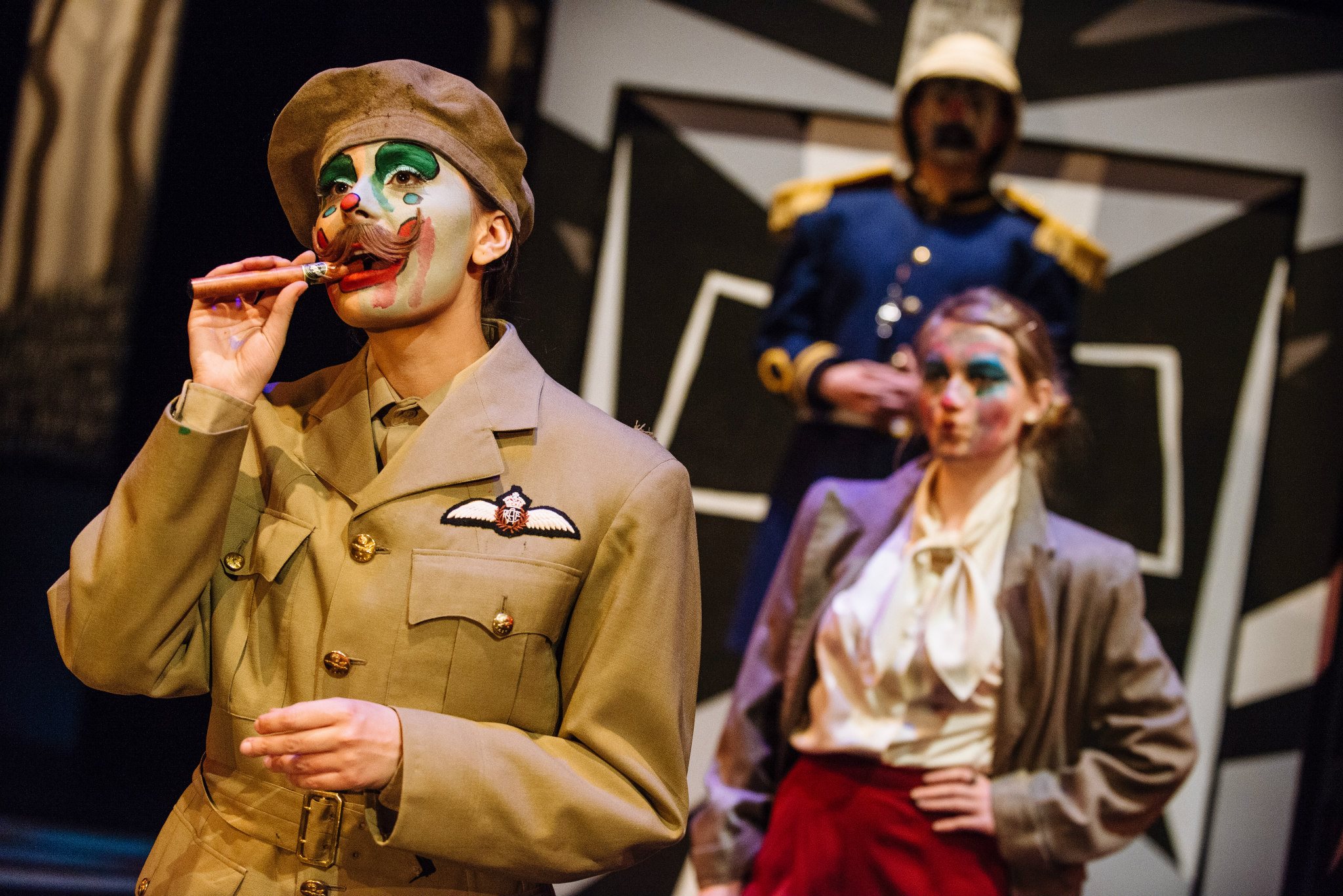
Galy Gay becomes the perfect soldier in Bertolt Brecht's Man Equals Man. Pictured (left to right): Natasha Strickey, Kristi Max, and Vince Mok.

Galy Gay becomes the perfect soldier in Bertolt Brecht’s Man Equals Man. Pictured (left to right): Natasha Strickey, Kristi Max, and Vince Mok. Photo Credit: Citrus Photography

Inside the University Theatre, a troupe of clowns dressed in military uniform await their audience. The clowns juggle, sing, and crack jokes to warm the audience up for the night’s main event: the transformation of an ordinary citizen into the perfect soldier.

Directed by Tim Sutherland, U of C’s School of Creative and Performing Arts’ production of Bertolt Brecht’s Man Equals Man is an uproarious spectacle of slapstick and danger.

Set in British Colonial India, Man Equals Man stages the story of Galy Gay (Natasha Strickey), a lowly porter, who is thrust into the ranks of the British Army by three incompetent privates. Needing someone to pass off as their fourth man during roll call, Uriah Shelly (Andy Weir), Jesse Mahoney (Ahad Raza Mir), and Polly Baker (Onika Henry) enlist Galy to be their stand in for the night, whereafter he will no longer be needed. But when their comrade Jeriah Jip (Connor WIlliams) goes missing indefinitely, the privates set out to turn Galy into the soldier they need him to be.

Despite the presence of firearms, there is little violence that actually takes place on stage. And that is the point. For Brecht, it is not firearms, but rather political ideologies that pose a grave threat to all persons of the world. After all, a gun cannot fire without someone to pull the trigger.

Here, what Brecht specifically fears is the influence of state propaganda on citizens. Though he resists at first, Galy is eventually won over by a narrative that glorifies the soldier as an inherently noble figure worthy of many rewards. Over time, the narrative digs deeper under Galy’s skin where it re-positions his values to align closer with those of the state and its armed forces. Galy’s identity effectively becomes estranged from his biography. And it is from this metamorphosis that violence emerges as Galy becomes a soldier on the front; a weapon of the state.

Accordingly, Sutherland’s circus positions war as an elaborate production. Translated within this context, a soldier’s uniform becomes nothing but a costume that anyone can wear, even a clown. By highlighting how persons and groups assign meaning to the mundane, as opposed to the mundane possessing an inherent value, Sutherland undermines the symbolic authority of the uniform.

And despite changing into costumes (e.g. ninja attire) that suggests otherwise, the clowns remain British soldiers throughout the entirety of the play. This contradiction in appearance emphasizes Brecht’s concern over the sort of false realities that ideologies construct and attempt to present as truth in the face of actuality.

This is a furiously high-spirited circus that engages on all fronts through physical humour, music and dance. And everyone in the cast is on board here, even the actors in the background who are giving as much as those leading the scenes. There is a lot of great character work on display, a varied mix of personalities and antics. The ensemble’s total commitment to the piece truly elevates this production to something quite fantastic.

Strickey displays a great amount of quirk and charm which makes her an absolute joy to watch on stage. Her facial expressions and mannerisms read very clearly from the stage. Along with her comedic timing, Strickey is also adept at capturing the dramatic tones of the play.

Weir, Mir, and Henry share a delightful chemistry together. Although, the actors would benefit from better enunciation and projection as sometimes we lose their dialogue, particularly with some of the accents at work.

Set and lighting designer Anton de Groot’s work is visually exciting and very much in tune with the eccentric quality of the production.

Funny, thought provoking, and certainly unique, U of C’s School of Creative and Performing Arts’ production of Brecht’s Man Equals Man is a lively experience that both entertains and challenges its audience.


The University of Calgary’s School of Creative and Performing Arts’ production of Bertolt Brecht’s Man Equals Man runs at the University Theatre, Feb 17 – 28, 2015.

For more information on the show and how to purchase tickets,
visit: http://scpa.ucalgary.ca/events/man-equals-man
The Weight of The World Suffocates in Duncan MacMillan’s Lungs

Presented by Verb Theatre, Duncan MacMillan’s gripping play Lungs stages the story of F (Anna Cummer) and M (Kyle Jespersen), a well-educated couple in their thirties. One day, while in line at Ikea, M puts forward the idea of having a child. From this moment, a turbulent, uninterrupted conversation surrounding the ramifications of bringing a baby into the world – a world already strained for resources – begins and follows into the next several days, months, and years.

Per MacMillan’s explicit stage instructions, there is no set nor are there any props. What there is plenty of though is a lot of talk, and a lot of talk about talking.

Over and over again, F justifies to herself (and M) why the couple should not bring a child into the world. Think of the environment, F says, citing the impact one whole person’s carbon footprint has on the Earth. Then, switching her position, F reasons why the couple are allowed to have a child, citing primarily the fact they are not only are they good people, but they are also very aware.

The whole play reads as a sharp criticism of slacktivism. F and M self-identify as well-informed citizens based off how much they (claim to) read. And that is enough for them to separate themselves from the masses. In other words, because the couple knows better, then they cannot be part of the problem. F and M equate not only knowledge with responsibility, but also as a form of action in itself. Unfortunately, for all their awareness, they fail to participate in any meaningful action to help the world. They only talk about what they have done or plan to do – the latter being subject to whether or not they have a child.

And it is this shallow satisfaction with themselves that sets the couple up for heartbreak when they are hit hard, very hard, with the realization that the world is indifferent to them, no matter how many trees they intend to plant.

In this way, MacMillan reflects back to us our growing complacency in the digital age. For MacMillan, awareness is not enough. Using a hashtag or sharing a video is only a small step in creating change. In this world, which goes on with or without us, what truly matters is action; knowledge put in practice.

With regards to the script, MacMillan offers no escape from what is born out of a simple conversation. He holds nothing back in this emotional roller coaster that punches forward on a track bent in every direction, leaving its audience speechless by the end.

And thankfully, Cummer and Jespersen match the velocity of MacMillan’s fearless script. Cummer is fantastic in drawing out so many emotions from the audience. And there is this one powerful moment, which demands to be seen, where Cummer simply nails it. Never has a theatre gone so quiet. And Jespersen is there with Cummer every step of the way. Rarely do a pair respond to and match so well what the other brings to the table.

Running at Motel Theatre, Verb Theatre’s arresting production of Duncan MacMillan’s Lungs is one not to miss.


Verb Theatre’s production of Duncan MacMillan’s Lungs runs at Motel Theatre (Arts Commons), Feb 5-14, 2015.

For more information on the show and how to purchase tickets,
visit: http://www.verbtheatre.com/season/


World Premiere: Lunchbox Theatre Goes ‘Speed Dating for Sperm Donors’

A lesbian couple in search of a sperm donor. Well, not just any sperm donor. The perfect sperm donor. How hard could it be? Ask Natalie Meisner, she could tell you. You might say, in fact, that she’s an expert on the subject.

Enjoying its world premiere at Lunchbox Theatre, Meisner’s Speed Dating for Sperm Donors is a fun dramatized account of the playwright and her partner’s experience in trying to start family.

Helen (Julie Orton) and Paige (Janelle Cooper) are ready to have a baby. Unfortunately, Helen’s best friend has said no to being the sperm donor. This sets the couple off on a journey to find the perfect sperm donor; perfect as defined by a very strict set of criteria. Helen and Paige’s search turns up a lot of ‘duds’ like a Russian physicist (Mark Bellamy) keen on eugenics, and a recovering sex addict (Christian Goutis). Eventually, the couple’s relationship begins to suffer as their unfruitful search leads to doubt and frustration.

As much as the play sets out to be about the couple and their journey, the story is really about Helen. We do not hear much from Paige beyond her reactionary responses that support Helen’s character arc rather than help support one of her own. On the one hand, it makes sense considering that the play is based off Meisner’s non-fiction book Double Pregnant which is written from her point of view. On the other, however, this is a dramatization that – according to the Playwright’s Notes – seeks to play with and flesh out “the dramatic potential” of Meisner’s autobiography. That is why it is so strange that Meisner chooses to narrow the play’s perspective rather than expand it in a work of fiction.

Perhaps though it is a limitation inherent to adapting non-fiction for the stage. There could be nothing more exposing, after all, than having one’s life story played out in front of a live audience. And as a result, there may be a fear/worry on the playwright’s part of misrepresenting and/or overstepping the personal boundaries of those involved in real events.

Where Meisner does hit the mark is in her application of humour to approach (and widen) the conversation surrounding LGBT families. While she may achieve this by playing into certain stereotypes, Meisner does it in such a way that reflects a sharp self-awareness on her part. The playwright is able to venture out into the ‘two-dimensional’, then bring it back to something sincere. In doing so, she entertains (which may ease some into the conversation), and then uses humour as a means to illuminate and establish a common ground with the audience.

Meisner’s revolving door of quirky characters, though, does wear thin after awhile. The first few characters are fun, but then the later character scenarios – especially the one Meisner throws in as misdirection – stall the pace of the play.

Thankfully, Bellamy and Goutis are strong enough in these roles that the play does not completely drag in its last thirty minutes. (Bellamy has an infectious charm that lights up the stage).

While very funny and clever at times, Speed Dating for Sperm Donors does feel as though it could go further to explore its more serious, dramatic elements. Pacing issues also stifle Meisner’s comedic wit, but great character work by the actors help keep the play light-hearted and enjoyable.


Lunchbox Theatre’s Speed Dating for Sperm Donors runs Feb 2 – 21, 2015.

For information on the show and how to purchase tickets, visit: http://www.lunchboxtheatre.com/calendar/2015/2/2/speed-dating-for-sperm-donors-by-natalie-meisner?view=calendar

Beneath Springhill: The Maurice Ruddick Story Shines Light On Canadian Hero

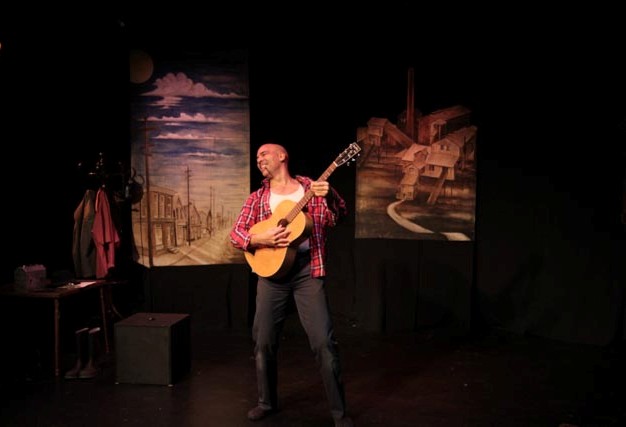
Beau Dixon as Maurice Ruddick in Beneath Springhill: The Maurice Ruddick Story. Photo Credit: Nicole Zylstra

Beau Dixon as Maurice Ruddick in Beneath Springhill: The Maurice Ruddick Story. Photo Credit: Nicole Zylstra

October 23rd, 1958.

On this day, the town of Springhill, Nova Scotia experienced a terrible mining disaster. A collapsed mine, triggered by a ‘bump’, would claim the lives of 74 men.

The story of Maurice Ruddick and the five men who he saved, however, would live on.

In Beau Dixon’s one-man show Beneath Springhill: The Maurice Ruddick Story, Dixon celebrates Ruddick’s unyielding spirit in the face of disaster. A beautifully woven tale of heroism, Dixon skillfully pays tribute to a man whose music and faith gave him the strength to inspire others.

A husband and father of 12, Ruddick works as a coal miner to support his family. Though his dreams of being a musician have long been put to the wayside, Ruddick is not shy to share his passion for singing with his co-workers. Unfortunately, Ruddick, an African-Canadian, is not always welcomed by the men he works with.

When news of the mine collapse breaks out, Dixon imagines what Ruddick’s 10-year old daughter Valerie experienced when watching live television coverage of the event. The coverage is hosted by a CBC reporter who Dixon also plays.

Trapped at the bottom of the mine with six other men, Ruddick is compelled to keep their spirits high until the rescue teams reach them. He does so by singing and leading the men in various hymnals. Even though the men’s morale drops with each passing day, Ruddick is firm in his resolve.

Beneath Springhill is a moving piece of drama that succeeds in portraying Ruddick as a man who did not see himself as a hero, but someone simply doing the right thing. Someone guided by not only their faith, but their basic humanity. (The real-life Ruddick would go on to play down his hero status).

Ruddick’s admirable character as a family man and a hard worker is, in fact, what drives the emotional impact of the play.

Dixon never allows us to forget how easily Ruddick could have lost all hope. It is truly gut-wrenching to watch the trapped men resign themselves to death while Ruddick pulls what little energy he has left, setting aside his own fears in the meantime, to maintain their morale. And all the while, who is Ruddick? He is just a simple man who risks his life on a daily basis to put food on the table.

Nor does Dixon allow us to forget how Ruddick was later rewarded for his courage. Because of segregation at the time, Ruddick’s invitation by the Governor of Georgia to a luxurious resort is sent under the condition that he and his family stay in a trailer park, away from the other survivors.

Under the hot theatre lights, we can see that this production is not easy for Dixon who plays a wide range of characters. Yet, despite the furious pace at which these transitions happen, Dixon somehow manages to not lose control of the distinct voices and mannerisms he has crafted, especially those of the five coal miners trapped with Ruddick.

Also, Dixon does well to keep the play moving forward by framing the central action with scenes of Ruddick’s daughter and the CBC’s coverage. Despite Dixon’s mixed performance as a 10-year old, seeing the disaster through a young girl’s eyes is still heart-breaking. And the CBC’s (rather pessimistic) coverage of the event reminds us just how great the odds are/were against Ruddick and the other coal miners.

A story about hope, family, and humanity, Beneath Springhill: The Maurice Ruddick Story pays its respects to a Canadian hero who inspired strength in others. Audiences will find Dixon’s performance as incredible as the emotional story he brings to life.


Beau Dixon’s Beneath Springhill: The Maurice Ruddick Story runs at Lunchbox Theatre Jan 12 – 24, 2015. 

‘Beneath Springhill’ is co-presented with the 25th Annual High Performance Rodeo.

For more information about the show and how to buy tickets, visit:
http://www.lunchboxtheatre.com/calendar/2015/1/12/beneath-springhill-the-maurice-ruddick-story-by-beau-dixon?view=calendar

For information about this year’s High Performance Rodeo, visit: https://www.hprodeo.ca/

Maurice Ruddick was featured in a Heritage Minute which can be seen here: 
https://www.youtube.com/watch?v=d9jnQnUuDmE


Coming Out Swinging: The SCPA Takes on West Side Story

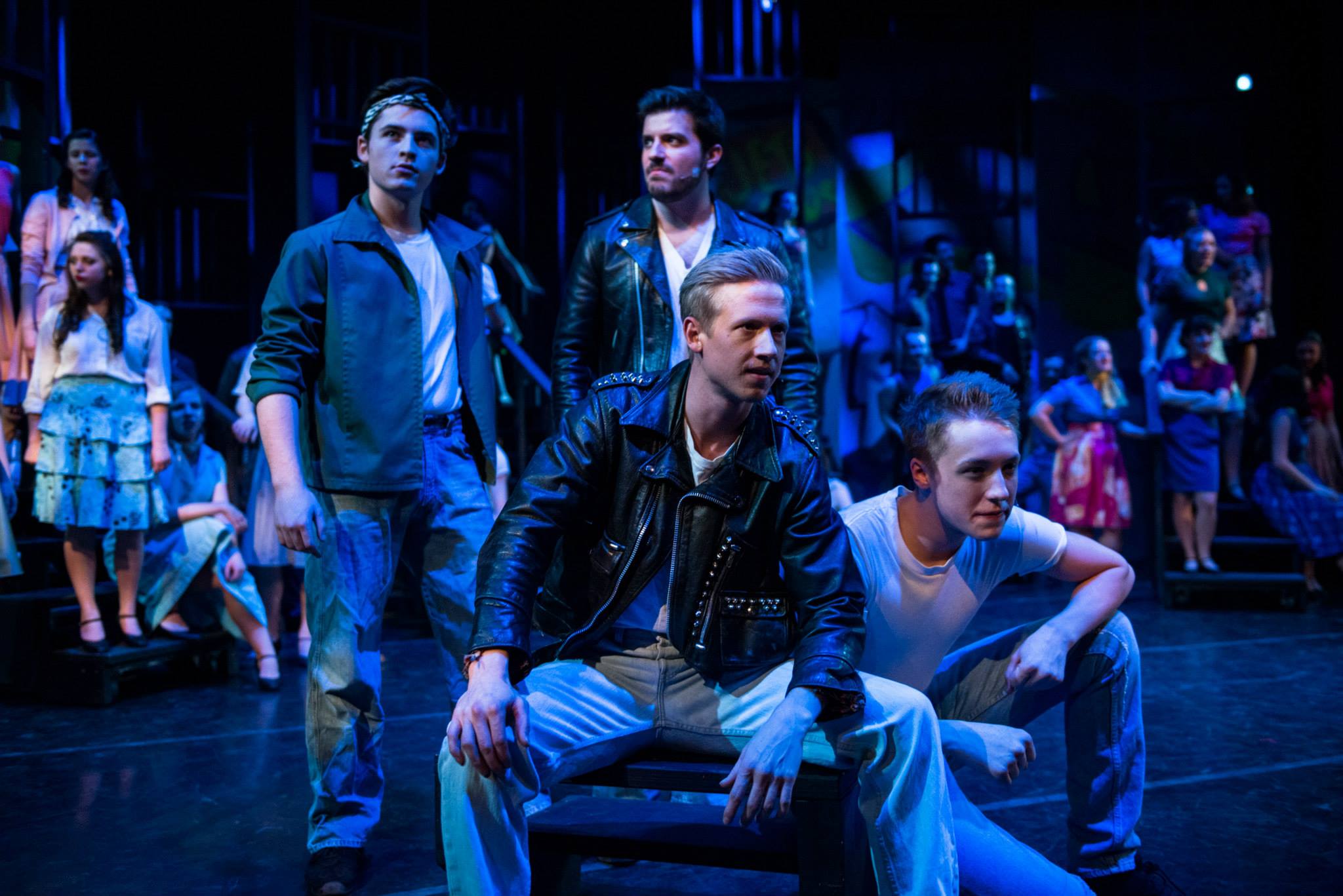
The American Jets, led by Riff (Matthew Hall), are ready to rumble in West Side Story. Photo Credit: Citrus Photography.

The American Jets, led by Riff (Matthew Hall, front), are ready to rumble in West Side Story. Photo Credit: Citrus Photography.

The latest production by the University of Calgary’s School of Creative and Performing Arts, West Side Story impresses with its musical score and social themes that are as relevant today as they were when the musical was first produced in 1957. Even with its great choreography and sound, however, this production of the classic Broadway musical leaves much to be desired when the music stops.

Based on William Shakespeare’s Romeo and Juliet, West Side Story trades the Capulets and Montagues of fair Verona with warring street gangs fighting over territory in New York’s Upper West Side.

Set in the 1950s, the American Jets, led by Riff (Matthew Hall), and the Puerto Rican Sharks, led by Bernando (Rufi O. Rodriguez), plan to hold one last, decisive fight between the two teenage gangs. Riff calls on a reluctant Tony (Ahad Mir) to come support the guys one last time. Tony agrees to help. Although, the situation becomes complicated when Tony meets and falls in love with Maria (Jocelyn Francescut), Bernando’s sister, at the school dance. When he sets out to stop the rumble at Maria’s request, Tony soon becomes more involved than he ever wanted to be.

Dispersed across the theatre audience are five actors who open the show with the Prologue from Romeo and Juliet. The ‘Greek Chorus’ returns again, this time in black clothing, to close the first act, then the second with the Epilogue. It is a largely unnecessary addition to the musical considering this is not Romeo and Juliet. It may have been inspired by the Bard’s play, yes, but it is its own story that speaks to a whole different set of issues like immigration, racism, and at-risk street youth. Not to mention that the actors speak their lines out of sync with the others.

While visually appealing, the colorful graffiti designs painted across the set are not period-appropriate. The graffiti is reminiscent of what came out of the hip-hop culture explosion of the 1980s. As such, it sits oddly against the very 50s feel and setting of the musical.

Melissa Monteros and Wojciech Mochniej’s choreography is brilliant. The “Dance at the Gym” and “America” numbers see a lot of flair and excitement. The movement during the rumble and other fight scenes is sharp. There is certainly an edge to Monteros and Mochniej’s choreography. And thankfully, the students, alumni members, and community members involved in the production are up to task and dance wonderfully. (Although, not without some near collisions along the way).

Leonard Bernstein’s memorable musical score is beautifully interpreted by Maestro Wendy J. Freeman and her orchestra. The orchestra plays superbly, giving us a very full, expressive sound.

Unfortunately, in between musical numbers, the show runs a bit flat due to some uninspiring performances. Besides stand outs like Hall and Kayla Mackenzie who plays the fiery Anita, the remaining cast, for the most part, is lackluster. It is not until the second act that the ensemble seems to truly connect with the piece.

Francescut gives an astounding vocal performance. Her voice is powerful, easily capable of filling the theatre, and simply beautiful in its clarity. It is too bad then that Mir’s own vocal performance never quite rises to the same level as his scene partner.

Overall, the SCPA’s production of West Side Story is a strong effort. Audiences will find much to enjoy here, despite some areas that are lacking.


 The University of Calgary’s School of Creative and Performing Arts’ production of West Side Story runs from Jan 8 – 15, 2014, at the University Theatre.

For more information about the show, visit: http://scpa.ucalgary.ca/events/west-side-story

West Side Story
Based on a Conception of Jerome Robbins
Book by Arthur Laurents
Music by Leonard Bernstein
Lyrics by Stephen Sondheim.

Lunchbox Theatre’s With Bells On Brings That Holly Jolly

This holiday season, in association with Guys in Disguise, Darrin Hagen’s With Bells On returns to Lunchbox Theatre where it was first produced in 2010.

Directed by Hagen, With Bells On is a fabulous comedy that celebrates the holiday spirit by taking it to new heights.

Ted (Stafford Perry) is a young divorcé stuck with a lousy apartment and lackluster social life. One night, riding in the apartment’s elevator, Ted runs into Natasha (Paul Welch) – a statuesque drag queen dressed as a Christmas tree. Natasha’s dream of competing for the title of ‘Christmas Queen’ that night is in jeopardy when the elevator abruptly stops.

Life is full of ups and downs, and we move right with it in every direction. So, what happens when it just stops? In this pause, what is that we discover about ourselves and each other?

Hagen uses Ted and Natasha’s momentary pause from the business of everyday life to reflect on loneliness – a feeling exacerbated by this particular time of the year. This loneliness though is just not about being alone, but feeling lonely in a crowd. And so, when the opportunity presents itself to Ted and Natasha to make a real, human connection with a stranger – it is at once both exciting and terrifying. Continue reading

Theatre BSMT’s !Duranged! Is a Fun, Bizarre Evening at the Theatre

“Safe” is not a word that appears in Playwright Christopher Durang’s vocabulary. If one needs proof of this, then one only needs to look to Durang’s ‘dentity Crisis and Wanda’s Visit. And conveniently for us, Theatre BSMT has packaged the two for its latest production.

Presented at Motel Theatre inside the EPCOR Centre, Theatre BSMT’s double header !Duranged! is an evening of absurdist humour injected with high-energy antics.

First up is ‘dentity Crisis, the evening’s more bizarre play. Coming off a recent suicide attempt, Jane (Elisa Benzer) is trapped at home with her overbearing mother, Edith Fromage (Hayley Feigs), who claims to have invented cheese. Jane’s brother Robert (Alan Johnson) offers no solace as he is not only passionately in love with their mother, but he is constantly turning into Jane’s father, her grandfather, and a French count. Jane’s only ally seems to be her psychiatrist Mr. Summers (DJ Gellatly) who helps her cope with her psychosis.

Benzer does well not to play her lines for laughs, instead going for the dark, disturbed nature of her character (as she best demonstrates in her “Peter Pan” monologue). In doing so, the ensuing absurdity has somewhere to go as opposed to hitting us at 100% from the beginning , which would exhaust the audience.

The escalating nature of the piece is laugh-out loud funny. The actors fully commit to the outrageous hijinks that hit one after another from beginning to end. (It gets to a point where even the sight of Gellatly’s ridiculous facial expressions draw big laughs from the audience).

Unfortunately, some of that eagerness leads to some stumbling on lines.

As well, the momentum of the play is interrupted by the poor build of the two doors on stage. Every entrance and exit makes the door frames wobble, giving the actors a hard time when they try to shut the door behind them. It is enough to cause a dip in the energy.

Jane loses grasp of reality and her own identity in Christopher Durang's 'dentity Crisis. Pictured (left to right): Alan Johnson, Hayley Feigs (Back), Elisa Benzer (Front), DJ Gellatly. Photo Credit: Chelsey Fawcett

Jane loses grasp of reality and her own identity in Christopher Durang’s ‘dentity Crisis. Pictured (left to right): Alan Johnson, Hayley Feigs (Back), Elisa Benzer (Front), DJ Gellatly. Photo Credit: Chelsey Fawcett

Foregoing an intermission, a fun musical interlude plays while the cast disassembles and arranges the set for the evening’s second play.

Wanda’s Visit tells the story of Jim (Gellatly) and Marsha (Tara Marlena Laberge), a married couple celebrating 13 years together. But when Jim’s old highschool girlfriend Wanda (Feigs) comes to visit, jealousy and temptation threaten to ruin Jim and Marsha’s marriage.

Compared to ‘dentity Crisis, Wanda’s Visit is much more grounded in reality which shows in Durang’s very funny, but also genuine marital dialogue between Jim and Marsha.

And the couple really stands out thanks to Laberge and Gellatly who are a great pairing.

Laberge is fantastic in delivering Marsha’s sharp remarks and pent up frustration which occasionally slips out over the course of the play. Gellatly is entertaining as the bumbling husband who tries to satisfy both his wife and this mad woman who wedges herself between them. And together, they share this relaxed chemistry that is simply a joy to watch.

Wanda, on the other hand, is an atrocious character whose despicable behavior as a guest grates on our nerves. And Durang leaves it that way until the very end where finally, something interesting happens. Until that point, the audience is stuck with a joke that stops being funny within the first 10 minutes.

Feigs does her best with the given material, but even her performance runs a bit stale.

How does !Duranged! stand as a whole package? Durang’s strange sense of humour may not be for everyone, but there is something about this selection of plays that is just fun. The whole evening is a lively theatrical experience fueled by slapstick and chaos. And yes, there are issues with both the plays and the production itself, but the evening has an indescribable charm to it.

Ultimately, Theatre’s BSMT !Duranged! is a curious evening of two plays that will certainly leave an impression on audiences.


*This review is based off a preview performance.

Theatre BSMT’s !Duranged! runs at the Motel Theatre inside the EPCOR Centre from Dec 10 – 20, 2014.

For more information about the show and how to purchase tickets, visit: http://www.theatrebsmt.ca/Theatre_BSMT/Whats_On.html


WCHS Drama Hits All The Right Notes in Our Town

For playwright Thornton Wilder, the ordinary is extraordinary. It is, however, a simple truth we fail to see in the course of our daily lives.

Directed by Kevin McKendrick, Western Canada High School Drama delivers a charming, well-executed production of Wilder’s Our Town.

Set in the small fictional town of Grover’s Corners, New Hampshire, Our Town stages the life and history of its residents between the years 1901 and 1913. The Stage Manager (Act I – Bonnie Wearmouth, Act II – Montsy Videla, Act III – Haley Petrowhich) acts as our guide to the town by providing narration as well as inviting various townspeople to speak to different aspects of the town. At the heart of the play is the budding romance between George Gibbs (Leif Wester) and Emily Webb (Emily Shackleton) which develops over the play’s three acts: Daily Life, Love and Marriage, and Death and Dying.

Our Town is notable for two things: its minimal set and the use of mime in place of physical props. It is no easy task to create a town out of imaginary space, nor to peel beans, milk a cow, or even drink a cup of coffee at the breakfast table. The actor’s job is to deliver consistent, believable movement which takes into account the weight and dimensions of an object and/or activity; it is an exercise in the critical observation of simple, taken for granted actions. Continue reading

Theatre Encounter’s Production of The Dumb Waiter Disappoints

Directed by Ben Charland and Val Duncan, Theatre Encounter’s production of Harold Pinter’s The Dumb Waiter is a frustrating experience marked by questionable direction and lackluster performances.

The Dumb Waiter opens with Ben and Gus (Rachel Gilliatt and Meredith Pritchard respectively),  two assassins waiting for their target in an old, abandoned basement. The two fill the time discussing current affairs, idioms, and the details of this particular job. But when a dumb waiter starts to mysteriously send down food orders, Gus begins to question just who exactly they answer to while Ben tries to stay focused on the job.

Charland and Duncan’s first misstep is the preshow which leads into the main action. Gilliatt begins by walking on stage, exploring the space and performing some movement. Pritchard follows suite and does her own routine alongside Gilliatt. All the while, the audience sits unsure of whether to go quiet or continue talking – after all, the house lights at this point are still on and new audience members are still entering the theatre and finding their seats. It becomes hard then to focus on the action on stage with the theatre door wide open and chatter outside the theatre entering in. Continue reading

SCPA’s Bloody Poetry Is A Tense, Fascinating Affair

The poet – an elusive figure whose voice demands to be heard; a visionary with ideas that challenge the status quo. But the poet and his or her new realities labor against the weight of the world – and their own humanity.

Directed by Brian Smith, The School of Creative and Performing Arts’ production of Howard Brenton’s Blood Poetry is an engaging spectacle supported by strong performances.

Brenton’s Bloody Poetry follows the strange company of Percy Bysshe Shelley (Brett Tromburg), Mary Shelley (Fatima Zaroual), Claire Clairmont (Onika Henry) and Lord Byron (Connor WIlliams). The scandalous nature of their private lives – Percy abandoning his wife Harriet Westbrook (Bianca Miranda) for Mary – has made them social outcasts of 19th c. English society. Starting their lives anew in Switzerland, the crusaders for revolution chase their vision of utopia. What ensues in the following years, however, is failure and disappointment – crushed spirits and broken hearts.

Brenton is mindful of historical accuracy, but, at the same time, he is not afraid to push those limits to explore serious questions about the relationship between poet and society.

Percy concerns himself with writing about social injustices, supporting the people’s struggle through verse; he thinks himself to be the voice of the people. But of what value is the poet in a world so cruel, where massacres continue and the people bleed for revolution? Ideas, talk, (words, words, words) – what the world needs is action.

Interestingly, Brenton shows us the early blueprints of what will eventually become one of Mary’s most famous works – Frankenstein. A thematic reminder of the poet as reject, struggling to find his or her place in the world.

Percy Bysshe Shelley (Brett Tromburg) Spirals Into Madness. Photo Credit: Citrus Photography

Percy Bysshe Shelley (Brett Tromburg) spirals down into madness. Photo Credit: Citrus Photography

Lighting designer Kerem Cetinel’s work is phenomenal. The set – designed by Patrick DuWors – is clean and effective for the theatricality of the piece.

The company uses a long white sheet to simulate ocean waves. The sound of crashing waves though overpowers the actors who are shouting to be heard. In the process, we lose some of the actors’ dialogue – an unfortunate shortcoming of an otherwise great scene.

Where the technique is particularly effective though – as Miranda and Tromburg demonstrate – is when the sheet serves as an extension of the body – a visual representation of the character’s inner turmoil.

Williams captures our attention with his entertaining rock star flair – no doubt inspired by Keith Richards. Given that, Williams’ dark eye makeup feels unnecessary given the already dominant presence of the character. Tromburg is commanding in the play’s second act, although his anger rings hollow at times. Zaroual and Henry are hesitant with their lines when we first meet them. Fortunately, the pair come to hold their own as the play goes on. Zaroual stands out with her quiet intensity – which makes one of her character’s final moments hit especially hard.

On a whole, the actors work very well off each other. They commit themselves to the demands of the script and, together, bring an edge to Brenton’s already sharp script.

SCPA’s production of Brenton’s Bloody Poetry is sure to entertain with its brilliant script, visuals, and strong ensemble.


The School of Creative and Performing Arts production of Howard Brenton’s Blood Poetry runs Nov. 25-Dec. 6, 2014 in the Reeve Theatre (University of Calgary Campus).

For more information about the show and how to purchase tickets, visit: http://scpa.ucalgary.ca/events/bloody-poetry