Tuplin Gets Personal With Dis/Connected

Melissa Tuplin's Dis/Connected was presented by Sage Theatre's Ignite! Festival. Image provided by Sage Theatre.

Melissa Tuplin’s Dis/Connected was presented by Sage Theatre’s Ignite! Festival. Image provided by Sage Theatre.

In our daily lives, do we exhibit the true self, that which is grounded in our personal convictions, or a false self, an image built upon expectation? For Melissa Tuplin, the former is a desire, while the latter is reality.  And so, she asks, if our identities exist outside ourselves, then what does that leave us with?

Presented by Sage Theatre’s Ignite! Festival, Tuplin’s latest solo piece Dis/Connected explores the complex relationship between who we are and how we want to be seen.

The lyrics “what is wrong with me?” repeat. It is a persistent echo of the mind. Nothing, Tuplin responds by baring herself to us. Yet, despite her confidence, there are small glimpses of hesitation that reveal themselves. But the desire to be happy, to be sincere and at peace with oneself is overwhelming. The dancer’s movements slice the air with vigor as she strives to resuscitate a connection lost too long ago.

In an act of defiance, Tuplin crosses the threshold and walks out into the audience. A determined look meets our curious gaze, until finally she takes a seat. No more is she an image.

Tuplin’s Dis/Connected is at once introspective and bold. Tuplin’s intimate examination of self-expression versus self-censorship excites with its vulnerability.


Melissa Tuplin’s solo piece Dis/Connected was presented by Sage Theatre’s 2015 Ignite! Festival. The festival ran June 18 – 20 inside The Studio at Vertigo Theatre.

A full recording of Tuplin’s Dis/Connected is available here: http://dancingmonkeylab.com/2015/06/14/disconnected-a-new-solo-work-by-melissa-tuplin/

For more information about Melissa Tuplin, visit: http://www.melissatuplin.com/


Dancers’ Studio West Invites Emerging Artists to LEAP

Sylvie Moquin and Dario Charles with Davida Monk, after rehearsal.

Dancers’ Studio West Artistic Director Davida Monk with emerging artists Sylvie Moquin and Dario Charles, after rehearsal in the studio.

Two years ago, Dancers’ Studio West made the decision to leave its theatre space, located in Sunalta. The company would instead operate remotely, renting both rehearsal and performance spaces, for its 2014-15 season. The decision was a difficult, but necessary one, says Artistic Director Davida Monk.

“The question of the DSW theatre space was a very difficult one for the board to resolve because the company had been there for 15 years,” said Monk. “Before that, it had been in a brewery over in the Inglewood area. In both cases, there was a theatre associated with the company. Productions and regular season events for the company were there, but not enough to really fill the theatre all the time.”

With the costs associated with the theatre unsustainable, DSW moved out of the space. (Presently, the space is shared between Calgary Young People’s Theatre, Ghost River Theatre, and Green Fools Theatre Society).

But ultimately, it’s not the space Monk is concerned about, it’s the artists.

“[We wanted] to channel what resources we did have into something that is effective for the development of the art form. If you ask me, it’s a lot more effective to put that into people than it is to put into a space.”

Founded in 1980, DSW nurtures contemporary dance artists through artist-focused programming. Two of the company’s major production programs are the Annual Alberta Dance Festival and the Dance Action Lab, a 10 week creative intensive that culminates in a full production.

This season, as part of the Dance Action Lab, DSW has invited Sylvie Moquin and Dario Charles to participate in the company’s Lab Emerging Artists Program (LEAP). Funded by The Royal Bank of Canada’s Emerging Artists Project, LEAP offers pre-professional dance artists exposure to professional practices, and the rigours of professional rehearsal and contemporary dance performance.

Originally from Ottawa, Ontario, Moquin is a graduate of Ryerson University where she received her BFA in Performance Dance.

“I’ve been here almost two years now,” said Moquin who left for Calgary shortly after graduation. “The first year I came, I did [Decidely Jazz Danceworks’] Professional Training Program. And I immediately found something that I really liked about Calgary, and specifically the dance community. I don’t know if I can pinpoint – I think it’s the idea of how welcoming this community is and how much people are excited about new artists and young emerging artists such as myself.”

“I was looking for an opportunity of where I was going, to find my voice and where I fit, and [LEAP] fell at the exact right time.”

Charles, an Edmonton-based dance artist, studied at The School of Toronto Dance Theatre. He then later completed a five month international dance program in Israel with Vertigo Dance Company. Since returning to Edmonton, Charles has worked with emerging companies and artists like himself.

“This application came up and I just thought…it would be great to be a part of [DSW], because most things I’ve done have been with starting out companies or people starting out,” said Charles. “[LEAP] appealed to me for the sake of an emerging artist being able to work with professionals. I think there’s tons to learn with emerging artists, but also with this other group as well.”

DSW’s Dance Action Group form the artistic core of the Dance Action Lab. A diverse ensemble of choreographers/performers, the DAG includes DJD company members Catherine Hayward and Shayne Johnson, MoMo Dance Theatre’s Artistic Director Mark Ikeda, and independent dance artists Deanne Walsh, Kate Stashko, and Helen Husak. The group is led under Monk’s direction.

Since April, Moquin and Charles have not only rehearsed, but also trained daily in technique classes with the professional ensemble. The dancers’ day starts at 9:30am with open classes that are run by Monk.

“The ensemble creating together have a technical beginning to the day,” said Monk. “Their bodies warm up and refresh the basic principles that will support the body through various rehearsals and repetitions. We’re trying to bring a balance and a strength and a fluidity to the body so that when we’re in rehearsal, we don’t get injured. We can sustain and repeat and be strong. Class is intended for that purpose.”

When class ends at 11:30am, the dancers take a short break, then rehearse until 3:00pm in their respective sections.

“We got to be involved in the creation process right away from week one, even pieces we weren’t cast in.” said Moquin. “We’re part of it. We’re part of what is this about, what can we try, where can we go with this, what is the potential of every single idea.”

“We go into some unknown places,” added Charles. “We’re working with choreographers who are treading deep waters. It’s all questions.”

And though there may be a lot to take in, Moquin says she is committed to taking away as much as she can from the experience.

“I’m…taking in every bit of information I can from these amazing artists,” said Moquin. “I take a lot of notes, and sometimes I just feel like I need to run to my notebook and write something down, because [something they said] really just struck and you need to hold onto that.”

Retaining these concepts and exercises is important, says Charles, because dancers must be multi-skilled (e.g. teaching, choreographing, performing).

Moquin and Charles are also gaining valuable insights outside their studio rehearsals.

On May 11th, DSW invited the public to an informal showing of the Dance Action Lab’s works-in-progress.

“It was informal, so we were willing to try things,” said Charles about the showing. “There were times where we would stop and do it again…I think it’s really important to able to talk about the work with the audience and get them involved in it.”

“I think it was great to have that dialogue with a new viewer,” said Moquin. “We’ve all been working and seeing these ideas together. As soon as you have someone new looking at it, it shifts the way you or the choreographer sees it.”

“Often times, I think you create work, then you mount it…and get all this feedback and dialogue afterwards,” Moquin continued. “And it’s like, I want to keep going with that! We’ve added that stage midway, so that the choreographers have that chance to take it in.”

Later this month, DSW will formally present Mythbehavin’, four new works produced by the Dance Action Lab.

“They’re all based in myth in some way or another,” said Monk about the works. “The choreographers determined that we would find a theme that we can all spring something from. The aspects are all very different, the ways the choreographers are responding are different. In some cases, it’s the interpretation of the myth, Jungian archetypes for example. In other cases, it’s more looking at the gods.”

“I think there’s excitement within the community,” said Moquin about the show. “I know other dancers are excited to see what’s going to happen, because this is such a diverse, dynamic group.”

Then, upon completing what were a rigorous 10 weeks, Moquin and Charles’ time with DSW will be over.

“Wouldn’t it be nice if it were 12 weeks, three months?” asked Monk. “This kind of experience is so valuable that the way you improve it is to lengthen it.”

Unfortunately, Monk says, a lack of political representation for the arts and, as a result, insufficient funding makes such an extension difficult.

“There is no person in political authority to speak and represent the arts publicly [in Alberta], to even lead the public towards a well understood policy of support for the arts,” said Monk. “We’re a long way away from that.”

That means dancers feel they need to look elsewhere for work, says Charles.

“There are no artists that stay here,” said Charles. “There’s a few professional training programs in Calgary, but there’s none in Edmonton, so everyone leaves because they think they’re going to get more work elsewhere. So, it’s a hard time growing a community here in Alberta.”

How DSW and other organizations can make a difference, says Monk, is by supporting those who choose to stay here. But, she adds, these organizations have just enough resources to operate as it is.

“I hate to sound like a broken record, but more money would be nice,” said Monk. “These two young people are getting experience here and they’re getting paid, but it’s a tip. They’re not really getting paid. That’s good in some ways, but not in other ways because it’s really limiting. It would be nice to have a larger pot to draw funds from. We’ve been very successful – I think this is our 4th year being able to access those funds, but they don’t go very far.”

“In the meantime, you do what you can. You pour everything into the opportunities.”


Dancers’ Studio West’s Mythbehavin’ runs June 25 – 27 at the Victor Mitchell Theatre (Pumphouse Theatres).

For tickets, visit: http://www.brownpapertickets.com/event/1626771

For more information about Dancers’ Studio West, visit: http://www.dswlive.ca/

A Pioneer in Classical Ballet: JCBS Founder Umran Sumen Shares Her Story

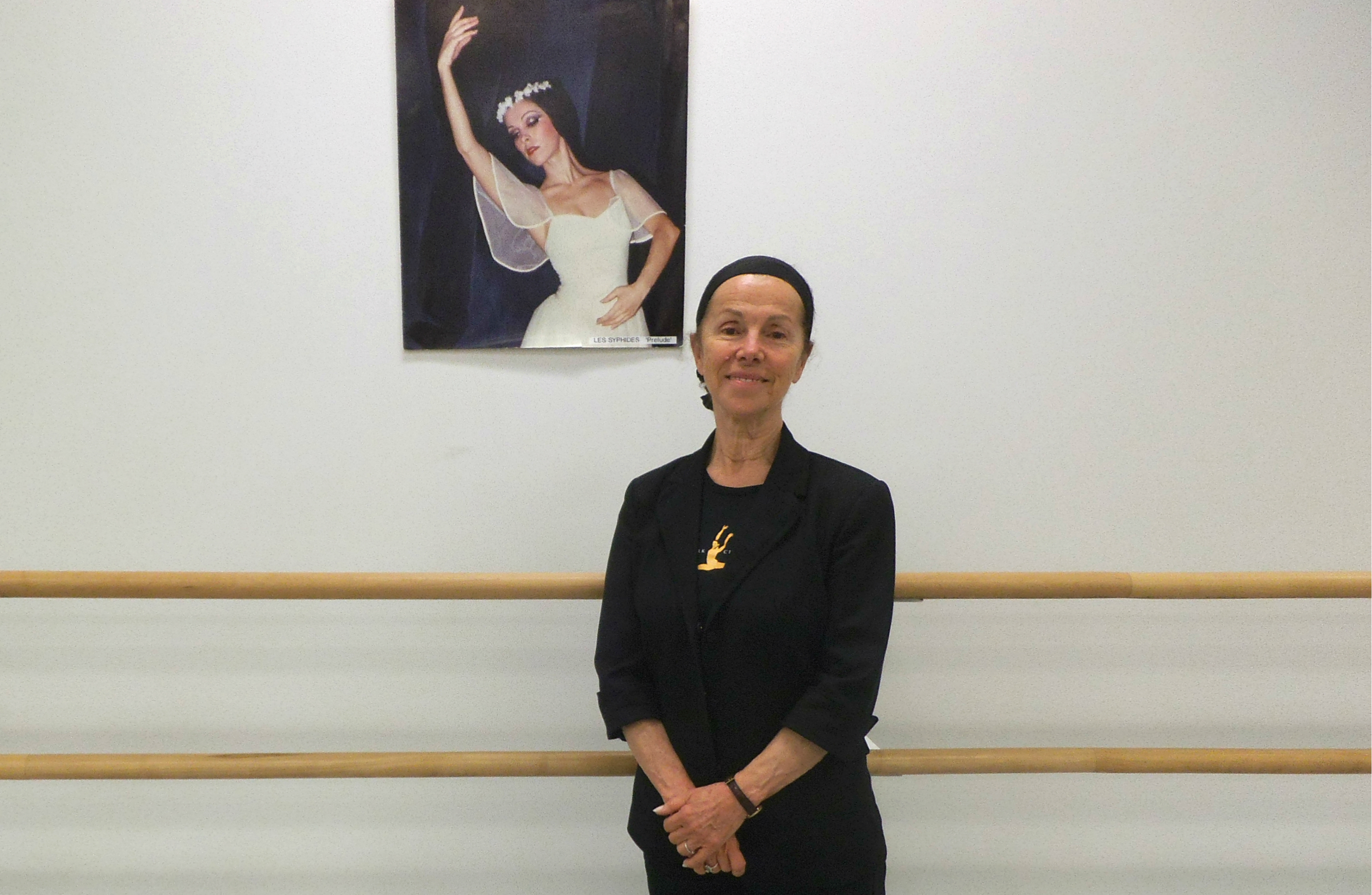
Jeunesse Classique Ballet Society's Founder & Artistic Director Umran Sumen, standing beside a portrait of herself from when she was a leading soloist with The National Ballet Company of Turkey.

Jeunesse Classique Ballet Society’s Founder & Artistic Director Umran Sumen, standing beside a portrait of herself from when she was a leading soloist with The National Ballet Company of Turkey.

When Umran Sumen arrived in Calgary 33 years ago, the former leading soloist with The National Ballet Company of Turkey thought her days of dancing were over.

“When I came here, I was thinking that I am not going to dance. I danced 16 years [with the NBCT]…I have a family, so now I am going to be a mother and wife to my husband…But then, the three boys in my life, my husband and two [sons], saw that I cannot. I am bitten by that virus for arts.”

At the time, however, ballet in Calgary did not have quite the same presence as it does today. Alberta Ballet, Canada’s second largest ballet company, was still in Edmonton and would be until 1990 when it merged with the Calgary City Ballet. (Sumen was appointed Artistic Director of the CCB in 1986). There was yet to be a place that offered young dancers intensive training in classical ballet. For Sumen, there needed to be not just a school, but also a company where dancers could apply what they learned to the stage, enhancing their dance education through live performance.

In 1988, Sumen founded the International School of Ballet and Jeunesse Classique Ballet Society. Sumen’s mission: “to put Calgary on the international dance map.”

Today, JCBS is one of the only pre-professional youth ballet companies in western Canada that does full-length productions of classical ballets. In addition to supplementing ballet dancers’ education, the company also aims to preserve and promote the cultural aesthetic of classical ballet in southern Alberta.

“In that time, it was a dream, but I believed so much that if you are not dreaming then you cannot achieve. You have to dream. [And now] we are celebrating 28 years.”

And in those 28 years, JCBS has produced numerous professional dancers who are not only prominent here in Canada, but internationally as well. JCBS & IBS alumnus Alexandra MacDonald is a second soloist with the National Ballet of Canada. Heather Myers has danced with the Boston Ballet (as a soloist) and Nederlands Dans Theatre where her choreography has also been produced. Other notable alumni: Michael Binzer (Royal Winnipeg Ballet), Gillian Abbot (Cirque de Soleil, Juilliard N.Y), Natalie Chui (Alberta Ballet).

For those who have continued on professionally in other fields, Sumen says she is just as proud of them as she is of those who have continued with ballet.

“If they want to do other professions, then they will still…make me proud. They carry that love of discipline, teamwork and [I know] they will shine in their own profession.

“Do you know how much classical ballet and that kind of high intensive training helps [students] develop as humans? That strength, that involvement in teamwork…makes me so happy when I see that. Do not give up. Raise the bar, always.”

Taylor Yanke, 12, and Montana Chong, 16, are two long-time JCBS members who are driven to succeed, and who will be performing in the company’s upcoming production of Coppelia.

Coppelia is a comic ballet about a life-like mechanical doll invented by Dr. Coppelius and the trouble it causes between Franz and Swanhilde, an engaged couple. From below her balcony, Franz admires and falls in love with the doll, Coppelia, who he believes to be real. Jealous, Swanhilde decides to dress as the doll in order to win back Franz.

“You can tell the instructors have a big background in ballet,” said Yanke who has been with the company since the age of three. “You want to work hard. Everyone is nice to each other and help the younger ones out. The older ones are very supportive of everyone.”

And with Coppelia, as with other classic ballets in JCBS’ repertoire, Yanke is excited to perform roles that have been played by distinguished dancers.

“I love JCBS, it’s really a great place to dance at. You get multiple opportunities to do all of these different roles you see principal dancers in Russia, in France do. When you have the opportunity to do those same variations, it’s really exciting.”

Having just finished her Advanced 2 last year and now progressing to her Solo Seal (the Royal Academy of Dance’s highest level), Chong says the support from her peers is also important to her and her success as a dancer.

“Overall, it’s a really great community here. I feel like I can always come here and be supported both onstage and off,” said Chong who will be playing Swanhilde.

“Their age is so young but what they are producing is amazing,” said Sumen about the 40 dancers involved in Coppelia. “Whoever we are inviting [as] guest dancers, they [are] surprised of the quality of the dancers.”

This year, JCBS is joined by Cuban dancer Elier Bourzac. Bourzac trained at the National Ballet School in Havana for eight years and graduated with honours in 2003. In 2007, he became a principal dancer with the Ballet National Cuba.

Yanke is thrilled to be “dancing among such a high dancer.”

“Just to see how [Bourzac] dances and what he does. He helps us out, too. He gives us corrections after we dance. It’s really great to have him here,” said Yanke.

Sumen is excited to stage Coppelia as she believes there is something for everyone to enjoy in this fun, lighthearted ballet. But she reminds us that such a production would not be possible without the generous help from her volunteers.

“I owe everything to the volunteers. Everyone is so dedicated, supportive. I cannot find anywhere else that has what we have in Calgary. If they will understand that you love what you are doing, you have a respect for what you are doing, you have a strong education in what you are doing, they are behind you. That is why I owe a lot to volunteers in Calgary.”

A pioneer in classical ballet, Sumen looks back on her successes with great joy. She tells her story and speaks about her students with immense pride. And Sumen looks forward to many years to come, because this is not her job, she says, this is her life.

“The arts feed your soul and bring you different perspectives to look at life…to see what is the purpose of who you are and what you are going to bring after you leave this life. If you are going to bring one drop of change in people’s life, then you are successful.”


Jeunesse Classique Ballet Society’s production of Coppelia runs May 29-30 at University Theatre. 

For tickets and more information about the company, visit: http://jcbs.ca/

International School of Ballet: http://www.iballet.com/

Spotlight: Katherine Kumpula

Katherine Kumpula.

Katherine Kumpula, on a recent visit to Calgary.

For Katherine Kumpula, dance is a “never-ending art.”

“Dance is a multi-dimensional experience [that] encompasses so many of the senses,” said the Toronto-based dancer. “The music, the timing, the visual aspect of everything from the audience’s perspective. Then, there’s the whole story behind it. Exploring all of those is such a multi-faceted experience.”

Kumpula started dancing at the age of three, beginning with classical ballet. As the years went on, the dancer, intrigued by the abstract, pushed towards contemporary dance. Kumpula attributes the shift in styles to her growing into her own as a dancer.

“Behind dance there is always the technique, and that’s what everyone starts with because you need the foundation in order to progress,” explained Kumpula. “The early years are often…technique-based. You spend a long time building your technique.”

“As you get older, you get to experiment with things…the creativity came out a lot more as I got older. Thinking about a piece of dance as a full thing onto itself beyond its technique.”

Today, Kumpula applies what she has learned over the years with Silhouettes Dance Company.

Founded in 2002 by Caryl Mostacho and Alesia Kachur, Silhouettes Dance Company is a performance-based dance troupe at the University of Toronto that performs several times over the year, ending its season with an annual showcase. The company adheres to values that promote a positive learning environment where both new and seasoned dancers can learn from one another.

“It’s choreography that’s made by the company members,” said Kumpula about Silhouettes Dance Company. “It is a space where there isn’t really a ton of restriction on the kind of choreography you can make. It’s a free space for people to experiment with different ideas.”

Katherine Kumpula,

Katherine Kumpula, “The Nights,” Silhouettes Dance (2015). Photo Credit: John Yelinek.

Last year, she choreographed a piece for the company that explored the dancer’s quest for perfection. It is an experience dancers know all too well, says Kumpula.

“The quest for perfection and how you’ve got this ideal you are working towards, but you’ll never quite get there. That’s a very angst-filled experience, and it’s a very emotional experience for a lot of dancers…because you’re always trying to fit this ideal which is essentially impossible to fit. By the very nature of it, it will never be perfect, but there is a big pressure with how demanding dance is to be perfect.”

But these days, dance is more an escape for Kumpula than something that causes her stress.

“[Dance] is very therapeutic. It’s therapeutic for me to have that [creative] outlet and to do something totally different than what I am doing the rest of the time,” said Kumpula who works at the hospital as a nurse.

Kumpula says dance is important too for the social connection, connecting with those who have a wide-variety of interests and, at the same time, want to keep their passion for dance alive. And though her journey through dance has seen many changes over the years, Kumpula’s passion for dance has been constant.

After all, dance is never-ending.


For more information about Silhouettes Dance Company, visit: http://silhouettes.sa.utoronto.ca/

Post-Show Discussion: Gravel, Vigneault on Usually Beauty Fails

Frédérick Gravel & Groupe d’Art Gravel Art Group’s Usually Beauty Fails opened April 15th at Theatre Junction. Audience members were invited to a reception following the performance. Gravel and Lucie Vigneault were present and shared some of their thoughts on both the group and the show.

In 2001, Vigneault graduated from the Université du Québec à Montréal with a degree in Contemporary Dance Performance. Since then, Vigneault has danced with numerous companies and choreographers in Montreal. In 2006, Vigneault joined Groupe d’Art Gravel Art Group, or GAG.

Directed by Gravel, another UQUAM graduate, GAG is a “moving team of artists” that includes both musicians and dancers. That is to say, Usually Beauty Fails started with a different set of artists than the one’s who appeared on stage for its most recent run. Introducing new artists to the group is important because it brings new energy to the piece, Gravel explains.

“The piece is not about I created the piece, I wrote the piece and there is truth about it. It’s more like…I led a team of artists to create something. Then, when a new artist comes…the group evolves with whoever is in,” said Gravel. “It’s not just about a new artist to get what is going on and fit in. I choose people who will fit well in this energy with [our artists]. When I find these people, these kind of artists, I know they will fit in, and we will all be inspired by them. They will be inspired by what we are doing.”

With regards to the type of work GAG produces, Vigneault says it is the company’s focus on presence that appeals to her as a dancer.

Dancer Lucie Vigneault, opening night reception for Usually Beauty Fails.

Dancer Lucie Vigneault, Usually Beauty Fails’ opening night reception.

“There is something about the way to be present on stage that is really interesting for me, because we don’t want to be too much ‘representative’ in the performance for the public, but something more directly in the action,” said Vigneault.

Vigneault describes Usually Beauty Fails as a show about relationships and how complicated they can be sometimes. “It’s not easy, these relationships…like you want to do something, but there is always something that is not working.”

For Gravel, the relationship between audience and performer is one that takes considerable navigation.

“I think we are trying to be as live as we can be,” said Gravel. “We are still here, you’re still there with us, living in the moment…I know you are thinking about what is going on. Is it worth the time I am putting in? What does that mean?”

“I’m trying to just not get the audience to be numb. To get involved. Be engaged. To see my strategies, our strategies to be seductive, but still appreciate it and be into it…maybe see what is at stake and not just …“that was the greatest show!” and then forget about it. It has to be engaging. It has to be engaging and still seductive, because it is live performance.”


Frédérick Gravel & Groupe d’art Gravel Art Gravel Group’s Usually Beauty Fails ran at Theatre Junction, April 15 – 18.

For more information about the show, visit: http://www.theatrejunction.com/1415season/ubf/

Music and dance performers on stage
David Albert-Toth

Frédérick Gravel
Charles Lavoie
Vincent Legault
Brianna Lombardo
Peter Trosztmer
Lucie Vigneault
Jamie Wright

Dancers at Creation
Kimberley De Jong

Francis Ducharme
Frédérick Gravel
Brianna Lombardo
Frédéric Tavernini
Jamie Wright

Usually Beauty Fails Lands With Mixed Results

Frederick Gravel & GAG's Usually Beauty Fails opened April 18th at Theatre Junction GRAND.

Frédérick Gravel & Groupe d’art Gravel Art Gravel Group’s Usually Beauty Fails opened April 15th at Theatre Junction GRAND. Photo Credit: Denis Farley.

Loud and assertive, this is the way Frédérick Gravel & Groupe d’art Gravel Art Gravel Group’s Usually Beauty Fails opens. The music holds us down in our seats. The dancers, whose eyes were locked with ours just moments ago, escape into fervid movement.

Blending dance and live music, Usually Beauty Fails is a raw display of human emotion. Parts of it, anyway.

Gravel, the show’s creator, director, and choreographer, is the evening’s leading man. Taking the microphone between dance pieces, he shares his thoughts, which are largely self-deprecating, with the audience about the performance. Gravel’s charm is well received by the audience, albeit for a short while. Eventually, the audience’s laughter shifts from warm to tired and nervous as Gravel’s drawn out, wayward thoughts overstay their welcome.

Gravel’s band (Charles Lavoie, vocals/guitar; Vincent Legault, guitar; Gravel, vocals/guitar) perform a varied arrangement of music that sometimes rocks out loud, then other times goes for a soft, melodic sound. The rock pieces are not particularly interesting. The acoustic pieces, on the other hand, draw us in close with simple, tender lyrics that travel smoothly thanks to Lavoie’s clean vocals.

Likewise, the choreography resonates best in its quieter moments.

There is a moment where two of the dancers stand closely together, undress, and explore each other’s naked bodies. Soft pauses. Gentle touches. Nothing is said, and it does not feel like anything has to be said. In this moment that breathes and takes its time, we are witness to human affection in its purest form.

But then, in the show’s final piece, we are reminded of life as we share it together socially. The dancers change into fancy dress – cocktail dresses and suits. They open bottles of champagne and pour each other plenty (and then some). Besides quick whispers between the dancers, not too much is said. And not too much happens. It is as almost as if the dancers have slipped into disguises, masks; pretenses. The dancers look at each other from afar as though wanting to say something, but choosing not to. What keeps them from doing so? Whatever it is, the champagne eventually causes the dancers to throw caution to the wind.

These impactful moments are scarce, stuffed away in favor of presenting something big and loud. Something so big, in fact, that at one point the stage lights flash so hard that the audience has trouble keeping their eyes on the stage. It is then that point that one ask themselves whether this is a dance show, a rock show, or an uneven effort in trying to accomplish both at the same time.

The show’s main problem, though, is that Gravel seems more interested in speaking about the work than allowing the work to speak for itself. It is too bad considering that the work does at times succeed in stirring something intimately profound within us. Not to mention also that Gravel’s dancers, who move with vigor, feel terribly underused.

Presented by Theatre Junction, Usually Beauty Fails’ integration of live music and dance is mixed at best, resulting in a show that sometimes grabs our attention, but mainly pushes us away.


Frédérick Gravel & Groupe d’art Gravel Art Gravel Group’s Usually Beauty Fails ran at Theatre Junction, April 15 – 18.

For more information about the show, visit: http://www.theatrejunction.com/1415season/ubf/

Music and dance performers on stage
David Albert-Toth

Frédérick Gravel
Charles Lavoie
Vincent Legault
Brianna Lombardo
Peter Trosztmer
Lucie Vigneault
Jamie Wright

U of C Grad Student Working to Bring The Arts & Social Sciences Together

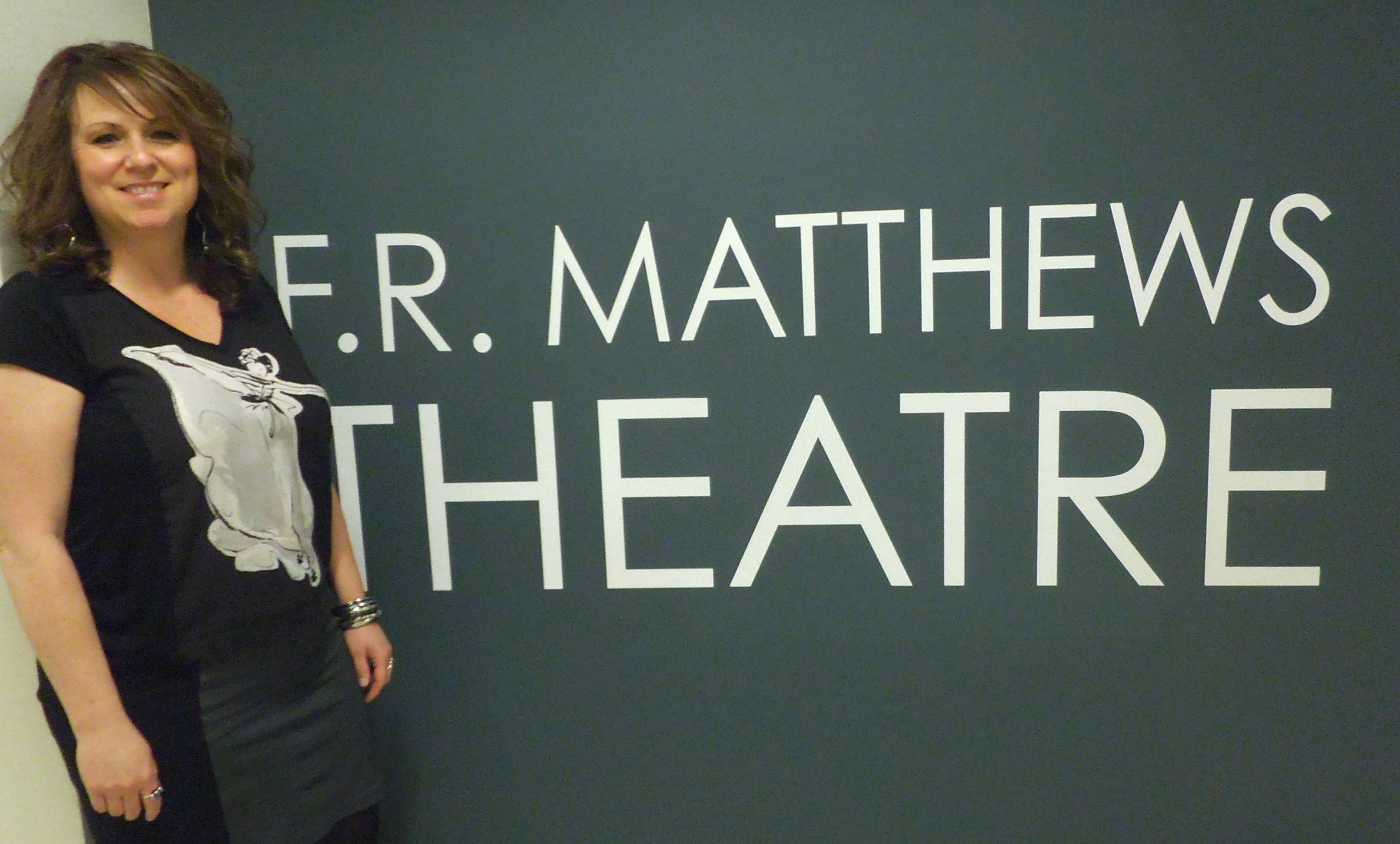
Playwright Sherryl Melnyk after the staged reading of her new play Can't Cross a Bridge.

Playwright Sherryl Melnyk after the staged reading of her new play Can’t Cross a Bridge.

Sherryl Melnyk’s new play Can’t Cross a Bridge was read aloud publicly for the first time this Monday night at the University of Calgary’s F.R Matthews Theatre. The staged reading was presented by the School of Creative and Performing Arts’ Taking Flight: Festival of Student Work.

But whereas much of the work in the annual student festival has been largely fictional, Melnyk’s play differs in that it is rooted in real women’s stories of abuse.

Can’t Cross a Bridge tells the story of Velma and Lizzy, a mother and daughter estranged for 16 years. One day, a surprise call from the RCMP informs Velma that her daughter has returned. But hanging over their reunion are secrets from the past, painful secrets that Lizzy can no longer keep inside.

Melnyk is completing her PhD in the Interdisciplinary Studies program, combining studies in English, Drama, and Women’s Studies/Sociology. Can’t Cross a Bridge is one component of her PhD dissertation.

The first component, the social science component, saw Melnyk interviewing 21 women about their sexual histories. From that research, Melnyk chose three of the stories that she thought fit together the best, then synthesized them for the play. The last component comprised of theory, discussions around the creation of the work.

Melnyk says her work is focused on bringing the arts and social sciences together, disseminating research through the arts as a means of creating meaningful dialogue surrounding social issues.

“I think what happens to a lot of research is that it’s wonderful research, but it’s lost in journals,” said Melnyk. “No one really reads it but other academics. I think a better combination of the arts and social sciences working together is going to make it more accessible to the public at large.”

And of course, her research could not have been possible without participants willing to share their lives openly with Melnyk.

“I started out my research trying to understand if women are kind of moving beyond the traditional view of women in sexuality; Woman as part of the male gaze, woman in pornography, woman as victim…How have women’s stories changed, that’s how I started my interview with all the people that participated.”

“I think what was really interesting about all of the women I interviewed was the fact that they wanted to tell their story. They want people to hear it. They want women to be empowered through their stories. All different ages sat down with me and spoke. Some of them were an hour, and some were two and half hours about their life history.”

For Melnyk, the intimacy theatre grants between audiences and ideas is necessary for not only bridging the arts and social sciences, but also bringing these women’s stories to the community.

“I think you could see it tonight in the gasps and the reactions of the audience. The sadness, the laughter, the drama that is created through theatre. I think it speaks more to our heart and soul than reading an article.”

Melnyk hands in her dissertation on April 24th, then defends it later next month.


The staged reading of Sherryl Melnyk’s Can’t Cross a Bridge was presented by the School of Creative and Performing Arts’ Taking Flight: Festival of Student Work. The festival runs Mar 31 – Apr 11th, 2015.

For more information about the festival, visit: http://scpa.ucalgary.ca/events/taking-flight-festival-student-work

Cast

Lizzy – Jacqueline Dyment
Velma – Val Campbell
Lester – Brian Smith
Andrea – Courtney Charnock

Company

Director – Dawn Mari McCaugherty
Stage Directions – Siobhan Cooney

Mudfoot Theatre Ready to Set Sail Again, Infuse Canadian History With Magic

Promotional image for The Hudson Bay Epic. Pictured: Mudfoot Theatre Co-Founders and Artistic Directors Genevieve Pare and Ian McFarlane, with ensemble member Ryan Reese (right). Photo Credit: Chantal Wall.

Promotional image for The Hudson Bay Epic. Pictured: Mudfoot Theatre Co-Founders/Artistic Directors Geneviève Paré and Ian McFarlane with ensemble member Ryan Reese (right). Photo Credit: Chantal Wall.

Geneviève Paré and Ian McFarlane first met at the University of Lethbridge where they completed a BFA in Dramatic Arts (‘11) and BFA in Multidisciplinary (‘10), respectively. Paré and McFarlane met in their second year while working as designers on a show together. But Paré and McFarlane say one of their first real collaborations came later when a special room inside the university caught their attention.

“There was this miniature room that was built as sort of a ‘found space’ theatre space at the university,” Paré explained. “There was a microphone in the middle inviting people to sing songs and play music. The sound would be projected out into the atrium so everyone could hear what was going on in there. It was a way for people who were shy to share their music. Anyone had the opportunity to contribute.”

Sharing each other’s excitement for impulsive performance art, Paré and McFarlane decided to perform inside the space together. In the room, the pair washed their hands in a bowl of soap water, beat boxed, and performed improvised poetry.

Paré says the collaboration signaled to both her and McFarlane that not only were they “both weird” and into “super bizarre ideas,” but that they could also work together.

In 2012, Paré and McFarlane collaborated again for Junquatica, a performance installation that ran as part of We Should Know Each Other #100. McFarlane says Junquatica was inspired by the aquatic intertidal zone, an area of interest for Paré who was working as a kayak guide off the coast at the time.

“It was a fun project,” said McFarlane about Junquatica. “Gen had this great idea of [creating] this box where people looked in and there were performers. But when they looked in they were also looking at each other…They all became characters of this world.”

At the time, Paré and McFarlane performed under the name Deux Fous Frivoles. The name was later changed to English (Frivolous Fools) due to pronunciation difficulty.

It was also at this point that the pair became excited about using found materials, like garbage. Junquatica’s performance space was constructed out of reclaimed materials meant to reflect a concern for the health of the oceans. McFarlane says the idea of found materials carried over into The Hudson Bay Epic, a play that toured both the Winnipeg Fringe Festival and Calgary Fringe Festival in 2014.

A historical fiction, The Hudson Bay Epic stages the story of Henry Hudson’s last voyage into the Canadian arctic. On board the ill-fated Discovery, a forbidden romance develops between two crew members while the threat of violent mutiny grows larger with every passing day.

The production featured a ship-like structure made from reclaimed materials. The structure was unique for its ability to produce music and ambient sounds.

“The initial inspiration came out of a performance idea of creating a structure that we could play like an instrument,” McFarlane explained. “We were excited about having this machine that we turn a crank and runs some music.”

For The Hudson Bay Epic, Paré and McFarlane formally adopted the name Frivolous Fools Performance. But the two ran into a problem with the name when touring the show, McFarlane explains.

“It was when we started touring The Hudson Bay Epic, people started calling us ‘The Fools’. We can’t do that because in Calgary there’s already ‘The Fools’ [Green Fools Theatre]. [We thought] we can’t have – This is just not good for anybody! It’s going to confuse and disrupt.”

Unfortunately, this was not the only issue with the name. When it came time to apply for grants, McFarlane and Paré were advised to change their name to something more suitable, as McFarlane explains.

“Grant advisors would be like ‘you should consider changing your name because you are neither foolish or frivolous.’ And yes, it’s ironic because we are working with junk and we’re not frivolous at all. We’re being quite humble with our work, this humble magic we are working with. But when it comes to applying to Canada Council…”

Paré and McFarlane sought a name that better reflected their work and aesthetic. After much consideration, Paré and McFarlane finally agreed on the name Mudfoot Theatre.

“There’s a whole bunch of ways to look at a name and how it resonates with who we are as artists,” said Paré about the name change. “If you’ve got muddy feet, it’s because you’re doing something awesome…If you’ve got your feet wet in the mud, then you’re active and in some interesting process.”

As their history shows, McFarlane and Paré are no strangers to change. What began as a performance duo has now grown into an independent creation-based theatre company.

Mudfoot Theatre collaborates with interdisciplinary artists to create contemporary folk tales through simple, grassroots storytelling. The company primarily stages Canadian history, something some Canadian theatre artists avoid, says Paré.

“Theatre artists don’t want to be identified as Canadian theatre artists. There’s something….What’s the word? It’s patronised a little bit. Because we’re softcore Americans, we’re so nice…Canadian is like…It’s not cutting edge.”

“If you’re a Canadian artist, you’re not from like Berlin or New York where you’re cutting edge and taking chances. But we do, do that as Canadian artists.”

Paré and McFarlane believe there are other reasons that make Canadian history less enticing as both performance material and a subject of interest among Canadians. For McFarlane, one reason has to do with how Canadian history was documented.

“It’s written as a business account,” said McFarlane. “We traded furs for this much money. We set up a shop in this place. It’s all written by merchants who are writing back to the homeland.”

“One of the fascinating things about Canadian history,” McFarlane continued, “is that that there were so many details that weren’t written down. In Europe, quite clear that these are the stories and these are the people. Endless literature. But in Canada, someone in the bush had this crazy experience but didn’t know how to read or write.”

“One of the things Europeans have about their history,” Paré added, “is that because their history goes so far back and it’s not written about in such a clinical way, there is room for myth…There’s magic, actual magic in the soil where they live. I want to have magic in my soil too.”

For Paré and McFarlane, staging Canadian history is not just about finding our collective voice as a nation, but also infusing our identity with a sense of magic.

And it is this sense of magic that the company’s next project River will embrace.

Inspired by David Thompson’s expeditions, River will tell the story of the Bow River through live music and puppetry. McFarlane says River will be a very different production from The Hudson Bay Epic.

“In The Hudson Bay Epic, we were quite direct with our history,” said McFarlane. “We took a journal and pulled stuff straight out of the journal and created characters that were actually historical people. In River, we are being quite broad and quite loose. Making it more on the mythical side than the historical side.”

Paré says audiences can expect “a tragic love story between a glacier, a star and a trickster paralleled by some narrative from David Thompson’s personal journals.”

Joining Paré and McFarlane for River are pianist Jesse Plessis and guest collaborator Jesse McMann-Sparvier.

River will be presented this week as part of the Calgary Region One-Act Play Festival at Pumphouse Theatres. Paré notes that the presentation is a prototype, or launching point, for a larger show.

Looking to the future, Paré and McFarlane say they are not sure what the company will develop next, but that they are confident they will find themselves doing something inventive and unexpected.


Mudfoot Theatre’s River will be presented at The Calgary Region One-Act Play Festival, March 26th at 7:30pm.

For more information about the festival and how to purchase tickets, visit: http://www.pumphousetheatre.ca/sections/calendar_s/calendar_2.htm

For information on Mudfoot Theatre, visit their website:
http://www.mudfoottheatre.com/

MoMo Dance Theatre Springs Forward With I Didn’t Wear My Raincoat

Pictured, MoMo Dance Theatre's Performance Ensemble member Kathy Austin in

Pictured, Kathy Austin in “We Have Come To Be Danced” (April ’12). Audiences can catch Austin in I Didn’t Wear My Raincoat which opens March 26th at the Vertigo Studio Theatre. Photo Credit: Matthew Brucker

Later this month, MoMo Dance Theatre will be presenting I Didn’t Wear My Raincoat. The company’s latest production will explore the four seasons with original work from its performance ensemble members and new work created by guest artists.

And as the company prepares for opening night, Artistic Director Mark Ikeda remembers when he first started working with MoMo Dance Theatre two years ago.

“Just walking into that door was like walking into a big hug. Everyone was so welcoming and just wanted to see what I had to share, and was so ready to engage” said Ikeda who was teaching workshops for the company at the time.

When it was announced that then Artistic Director Pam Boyd was leaving the company, Ikeda lept at the opportunity to fill the position. Ikeda says he was not only taken by the overwhelming positivity of the MoMo family, but that he was also impressed by the skill level going in.

“There are some challenges…but being able to launch into the work and really dig into some ideas has never been a problem…when I was welcomed by that idea I was enticed into the MoMo family.”

Founded in 2003, MoMo Mixed Ability Dance Theatre offers artists of all abilities and skill levels a range of classes focused on growth through creative movement. Currently, the company offers three adult classes and two youth classes. As well, MoMo offers performance opportunities for its members.

Part of the company’s mission is to facilitate artistic expression by removing barriers that might otherwise restrict the exchange of ideas between artists. For Ikeda, a combination of improvised and choreographed movement works best to achieve this mandate.

“While we do we have set choreography…other times we’ll explore a mood or an emotion or a thought or a color, even. Let’s say we’re exploring sunshine…we’re all going to move like sunshine until someone claps. And so, in that while everyone is in the same or at least similar idea and adapting it to their own bodies…they can move how they like to move and interpret the idea of sunshine [as they like]. It’s open to exploration.”

But in order for this exploration to truly take off, Ikeda says, an individual must first feel comfortable within the space. Ikeda explains that this turning point usually occurs after three classes.

“If someone will come to three classes, they’ll usually open up. That’s kind of the shifting point… for someone totally new to feel comfortable and engage in the activities. And so, after three classes, there’s that open – and again it’s like that family idea of who are you and how we can play? How can we enjoy each other in this art?”

This year, the first in a three year process, MoMo launched an outreach program to share their passion for play with various communities.

With funds received by The Calgary Foundation, the company has been able to partner with URSA (Universal Rehabilitation Service Agency), the Calgary Association of Self-Help, the Vecova Centre, and Carewest Garrison Green. In these spaces, MoMo’s dance teachers promote community and personal development through interdisciplinary, communal physical activity. What results is a holistic approach to wellness, something the partner organizations have praised.

“There’s a bunch of papers out right now about how interdisciplinary and communal physical activity is one of the strongest ways of bringing someone into an idea of what a community is…and the idea of empathy that if you’re doing the same thing as I am, I can see that not only are we a team, but you have your own unique way of doing things.”

“A lot of those intangibles…can’t really be measured or quantified…[but] when you can engage with someone creatively…be able to go into yourself, find an idea or thought or something that hasn’t existed either in you or outside of you before and share it with other people there is an intelligible connection that happens…MoMo has for over a decade now found a way to set that up for people who identify as having disabilities.”

And with MoMo’s spring performance fast approaching, the company looks to add another success to an already great year.

A dance piece audiences can expect to see in the production is one choreographed by Ikeda which incorporates the use of hand stilts. Hand stilts have been famously used in the Broadway adaptation of The Lion King to portray giraffes. Ensemble member Thomas Poulsen, who uses crutches, will be the performer raised off the ground alongside Ikeda.

“[I thought about] what would be a great duet with [Thomas] or piece for him. I thought of these hand stilts and how a lot of the movement I have to do to stay up on the hand stilts are quite similar to the movement he uses everyday and he uses on the dance floor. We’ve been exploring for a few weeks now and I really love where it’s going.”

And it is this love for play and exploration that makes MoMo Dance Theatre a company to watch.


MoMo Dance Theatre’s I Didn’t Wear My Raincoat runs March 26 – 28 at the Vertigo Studio Theatre.

Tickets can be purchased online here: momo.brownpapertickets.com

For more information on the company, visit: http://www.momodancetheatre.org/

Fire Exit Theatre & Corps Bara Dance Theatre Search For God in Absence

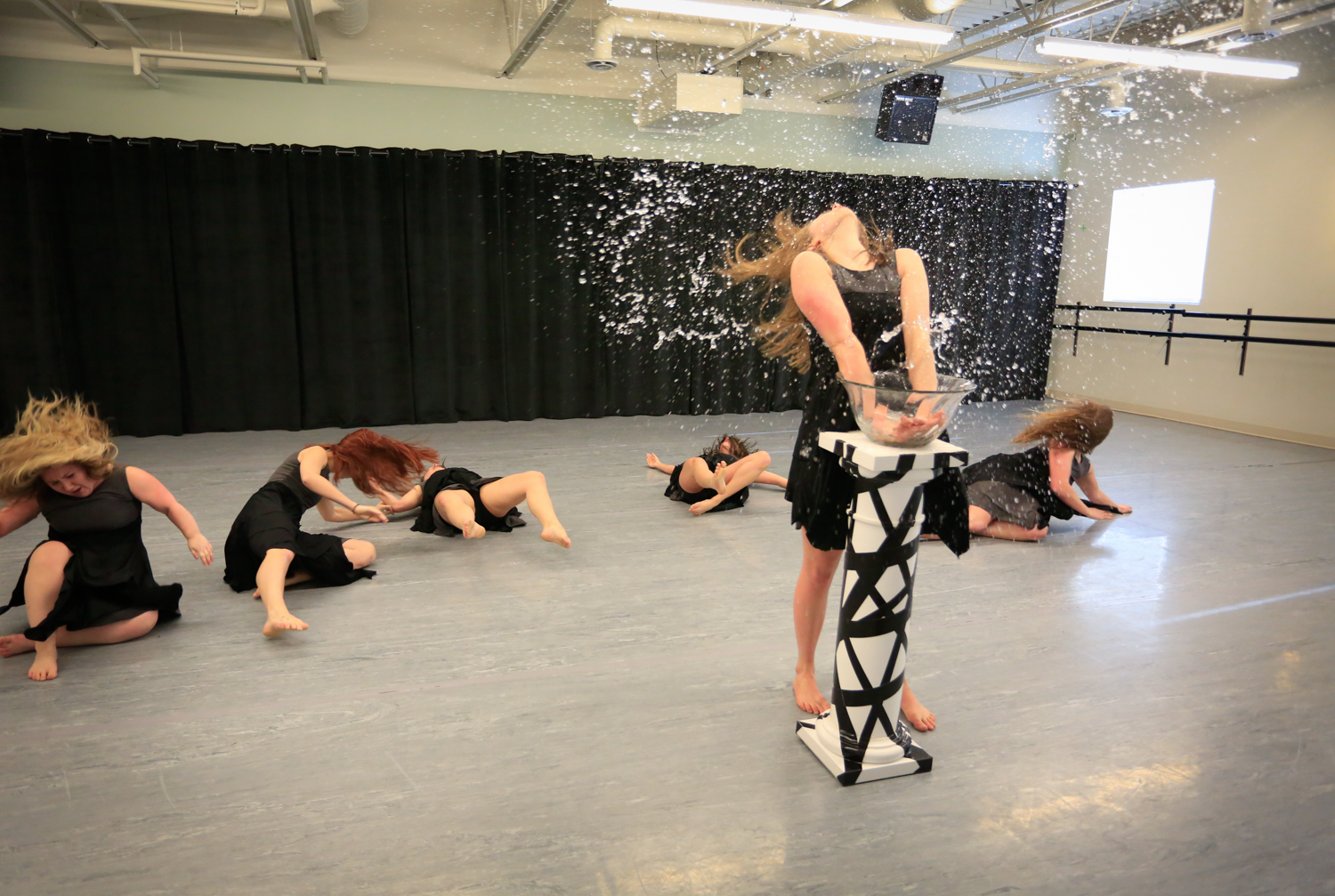
Corps Bara Dance Theatre rehearsing "Cleansing," one of six dance pieces in Absence. Photo Credit: Char G. Photography

Corps Bara Dance Theatre rehearsing “Cleansing,” one of six dance pieces in Absence. Photo Credit: Char G. Photography

What is the value of faith in a world full of injustices? This is one of many tough questions Fire Exit Theatre and Corps Bara Dance Theatre fearlessly tackle in Absence. Blending theatre and dance, Absence explores the doubt, fear, and perhaps even anger that some experience in their personal relationship with God.

Written and directed by Val Lieske, Absence stages three characters (played by Brendan Andrews, Jennifer Beacom, and Sarah Irwin) who feel utterly overwhelmed by the world. So overwhelmed by the world, in fact, that they are spiritually exhausted. For if God is everywhere, as he claims to be, then why do bad things continue to happen in our world today?

For these socially conscious youth, it is the poor and the downtrodden who suffer the most from God’s absence. And what frustrates the youth is that the marginalized are asked to remain firm in their faith. But how can one, the youth ask, trust in God when he has failed them, and so many others at home and abroad?

And their shared frustration reflects a larger phenomenon regarding youth and traditional teachings. For youth, of what relevance does the Bible have today in our chaotic world? How can we apply its teachings to unprecedented levels of disaster and conflict? And this scrutiny extends to the church where youth retention is a very present issue. What can the church do to help alleviate the dissatisfaction youth feel towards the Bible and its inadequacy to make sense of their everyday experiences? Lieske suggests that the church needs to modernize and acknowledge current affairs. Singing gospels can only get one so far in their spiritual journey, especially when there are so many questions to be asked. And so, the church needs to welcome and foster critical discussions where youth feel they can raise questions that challenge the foundations of faith.

Unfortunately, Absence lacks a central narrative to tie its main arguments together. The characters simply debate amongst themselves various positions regarding God’s inexplicable absence in the world. And they do so by making vague, heavy handed observations on politics, crime, and the media. So when there is a truly potent question raised, it has no support to carry it where it needs to go in order to have a real stimulating effect. Instead, the question becomes engulfed in an exasperating amount of talk.

Where the production does manage to hold our interest is in its six dance pieces led by Corps Bara’s dance ensemble (Laura Barcelo, Jessalyn Britton, Sarah Curtis, Valentia Dimitriou, Jason Galeos, Natalka Lewis, Sylvie Maquin, Caitlin Unrau). The reason being is that each piece is focused on one or two central ideas.

One particular piece that stands out is Cleansing, choreographed by Amy Meyers. Downstage centre, there is a bowl of holy water atop a pedestal. And the dancers each try to bring themselves to it, but they cannot for they feel unworthy. Externalized here is the spiritual agony that doubt creates. And it reads across the dancers’ faces and bodies as they frantically circle the holy water. The piece ends when finally, a dancer gives herself over and smashes the water with her hands. It is a striking image that brings the first act to a close.

And then, there is Cinch, choreographed by Krysten Blair. Setting up this piece is talk surrounding the debate between faith and reason; religion and science. And this piece explores this conversation with a recurring phrase of movement where the dancers pull apart threads or, depending on your perspective, split atoms. For once we apply scientific rationality to religious beliefs, we fall into an almost infinite series of questions that only lead to more questions.

These physical meditations of the soul are executed gracefully by the dancers.

But regardless, the sort of dramatic interest needed to fill an approx. two-hour run time is not here. The elements of the show operate in segments that result in a bland pattern of “acting/dancing/acting” and so on. There is no cohesion between the acting and dance segments until the end, but then it is too late. The audience is ready to exit the theatre.

Absence suffers from pacing issues and clumsy dialogue. While its dance pieces are exciting, the overall production lacks the necessary momentum to truly leave an impact on its audiences.


Fire Exit Theatre in partnership with Corps Bara Dance Theatre presented Absence at the Lantern Community Church, Feb. 25 – Mar 1, 2015.

For more information on
Fire Exit Theatre, visit: https://www.fireexit.ca/
Corps Bara Dance Theatre, visit: http://www.corpsbara.com/