Fully Functional Starts a Conversation About Disability, Sexuality, and Society

A co-production between Inside Out Theatre and MoMo Dance Theatre, Fully Functional is a new play that gives a voice and real presence to its artists of mixed abilities. Drawing inspiration from their own personal experiences, the artists/creators tell stories of love, sex, and romance through dance and movement.

Being late to a first date, sex poems and orgasmic shouting: it is fearless storytelling injected with humour.

But past the laughter and heartbreak of these stories, the artists ignite a conversation about how our society views persons with disabilities.

In a talk-back session after the performance, an audience member asked “what impact do you hope to have for people afraid to let others in? [I mean it’s] easy to say I want love, but to say I deserve love is a good place to start as well.”

Mark Ikeda, artistic director of MoMo Dance theatre, responded.

“We got together in a room…and talked how taboo the topic is about the intersection between disability and sexuality, and how not only does no one know how to talk about it but people are afraid to talk about it. We hope to start a conversation, start people thinking about…how certain preconceived notions or thoughts might be quite harmful”

Thomas Poulsen, one of the performing artists, followed Ikeda’s response with his own, saying “I think you indicated that fear is very much out there in the community – in the disability community.”

Fully Functional opened at the Joyce Dolittle Theatre inside The Pumphouse Theatre on December 3rd. Pictured (left to right): Stephen Henry, Gaelyn Thomson, and Kathy Austin. Photo Credit: Chantal Wall

Fully Functional opened at the Joyce Dolittle Theatre inside The Pumphouse Theatre on December 3rd, 2014. Pictured (left to right): Stephen Henry, Gaelyn Thomson, and Kathy Austin. Photo Credit: Chantal Wall

The fear Poulsen refers to is a fear of rejection that goes deeper than what one might assume. On a whole, persons with disabilities are marginalized and rejected by mainstream society.

Consider how we speak about disability.

The disabled – a homogenizing term that attempts to refer to all persons with disabilities. It is a term that ignores the fact that disabilities are various in their form and appearance. Above all, it is a damaging term that erases the individual and reduces them to a diagnosis.

Newspaper articles sometime describe wheelchair users as either “bound” or “confined” to their chair. Persons with disabilities are framed as ‘victims who suffer from’, rather than ‘persons who live with’ a disability.

And then, it is the distance “the able-bodied” maintain between themselves and persons with disabilities. This distance comes out of fear, anxiety, and discomfort. But yet, we feel comfortable enough to stare out of curiosity and to make assumptions about their lives (but never to assume that they might have their own desires for human intimacy).

So, how can one think that they deserve to be loved when they are confronted over and over again with this idea that living with a disability somehow makes you a lesser human?

On its surface, Fully Functional addresses the assumption that disability interrupts sexuality. What it also addresses is the lack of belonging persons with disabilities experience in society.

Fittingly, the play ends with a slow dance, but this time – unlike the first time – the artists invite members of the audience to come dance with them. The slow dance serves as an invitation to close the distance and to start connecting with one another.

After all, at the end of the day, we are all human beings who want to love and be loved.


Inside Out Theatre and MoMo Dance Theatre’s Fully Functional ran at the Joyce Dolittle Theatre inside The Pump House Theatre from Dec 3 – 6, 2014.

Fully Functional was created and performed by:

Kathy Austin
Emily Collins-Tucker
Stephen Henry
Thomas Poulsen
Gaelyn Thomson

Co-directors: Col Cseke and Mark Ikeda, artistic directors of Inside Out Theatre and MoMo Dance Theatre respectively.
Assistant Director: Jordan Dalley

Inside Out Theatre: http://insideouttheatre.com/
MoMo Dance Theatre: http://www.momodancetheatre.org/

Celebrating 45 Years: Dance Montage and The Importance of Community

For Wojciech Mochniej, Dance Montage’s Artistic Director, dance is more relevant than ever in our fast-paced, modern society. “[What attracts people to dance] is the connection to the human, to the three-dimensional world. With TV, we can cook, clean, and pick up the phone at the same time…but we are not meeting anyone. We are disconnected,” says the full-time dance instructor at the University of Calgary.

Celebrating its 45th anniversary this year, Dance Montage – presented by U of C’s School of Creative and Performing Arts – is an opportunity for both beginning and experienced dance artists to come together and create new work. Auditions are open to everyone of all skill levels; an invitation that extends to the community at large.

The secret to Dance Montage’s longevity, says Mochniej, is the opportunity it gives community members who are not thinking of dance as a profession to perform, to share ideas, and, in doing so, connect with their community.

It is the importance of community that inspired Matthew Hall to write and direct (Mis)Communication, one of several new dance pieces which will be presented at Dance Montage. “My uncle…he’s always sparking conversation with people on the C-Train,” the fourth year drama student shares, “no one is used to it nowadays, Everyone thinks he’s weird. Or they’re too busy or plugged into their phones.” It this disconnect brought on by technology’s rising influence that Hall explores in (Mis)Communication.

(Mis)Communication. Choreography by Meghann Michalsky. Directed by Matthew Hall. Music composed by August Murphy. Photo Credit: Wojciech Mochniej

(Mis)Communication. Choreography by Meghann Michalsky. Directed by Matthew Hall. Music composed by August Murphy. Photo Credit: Wojciech Mochniej

Of course, the dance piece would not have been possible without Meghann Michalsky and August Murphy, Hall’s choreographer and musical composer respectively.

In July 2013, the School of Creative and Performing Arts was created. Bringing together the former departments of dance, music, and drama under one school has allowed students more opportunity for interdisciplinary collaboration. Hall, Michalsky, and Murphy met last year during a production of Aesop’s Fables.

“To work with people outside my discipline…they challenged me way more to push my art and myself out of my comfort zone,” says Michalsky, a U of C dance alumnus (‘14). Murphy, a fourth year music student, nods her head in agreement. “I’ve worked with actors and dancers onstage as a performer, but this type of work…I learned how something may be clear to me as a musician, but it may not necessarily be clear to the dancers onstage. “We think of things differently, and I [needed] to find how to communicate in such a way that everyone understands,” explains Murphy who says this is her first time composing. The quality of their final product, all three agree, would not have been possible without the support of their fellow artists.

What does the future of dance and Dance Montage look like for Mochniej? Neither, he believes, are going anywhere any time soon, even with the rapid growth of technology. “I’ve been dancing for over 30 years…[and] even when you repeat the same things, you still discover something new about yourself, your potential, and your strength” says the dancer as he prepares to go teach one of his classes. “The community will always feel the need to perform, because dance is an organic experience.”

What else, Mochniej closes with, can give you such a connection to what makes us human?


The School of Creative and Performing Arts will present Dance Montage, from Thursday, Nov. 20 to Saturday, Nov. 22, 2014 in the University Theatre, located on the University of Calgary’s campus.

This 45th production will celebrate the life of Sigurd Hagen-Torn (1927-2011) who began his involvement with Dance Montage at the age of 50, dancing for the next 32 years until his last performance in 2009. He is remembered for his great spirit and passion for dance.

For more information on Dance Montage and how to purchase tickets, visit: http://scpa.ucalgary.ca/events/dance-montage-0

Dancers’ Studio West’s 33rd Annual Alberta Dance Festival Showcases Exciting Talent

Presented at the Pumphouse Theatre, Dancers’ Studio West’s 33rd Annual Alberta Dance Festival is a showcase of both emerging and established Canadian dance talent. This year, the dance festival is titled “Dance & The Image.” Nine choreographers workshopped their respective dance pieces over the course of a seven-day Creative Intensive with direction provided by the company’s artistic director, Davida Monk, and the Dance Action Group.

In this second week of the festival, six choreographers and their dancers take to the stage to present choreography influenced by various works of art.

First in the showcase is Choreographer Serenella Sol’s “Hollyhocks and Cacti,” an abstract piece that plays with the notion of female archetypes. Underscoring Sol’s piece are recited lines of Maya Angelou’s poem “Still I Rise” which play over the speakers. Valentia Dimitriou and Kimberly Powley, Sol’s two dancers in this piece, go on to embody various archetypes, like the Seductress.

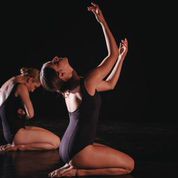
Choreographer Serenella Sol's Hollyhocks and Cacti. Dancers: Valentia Dimitriou (front), Kimberly Powley (back). Phototographer: Tim Nguyen

Choreographer Serenella Sol’s Hollyhocks and Cacti. Dancers: Valentia Dimitriou (front), Kimberly Powley (back). Phototographer: Tim Nguyen

As the piece goes on, however, there is a moment of rejection where the two dancers remove their dresses and show disgust towards them. We are left to wonder: what are they rejecting? If we accept dresses to be signifiers of femininity, then perhaps that is what the two dancers are rejecting: socially normalized ways of performing femininity. In only their body suits, the two dancers appear to find freedom and individuality; they no longer belong to any particular archetype.The act of rejection, then, can be taken as an act of defiance. This idea of defiance is supported by these lines of Angelou’s poem “You may write me down in history With your bitter, twisted lies, You may trod me in the very dirt But still, like dust, I’ll rise” which Sol’s piece closes on.

In the following piece, choreographer Oriana Pagnotta continues on the topic of femininity, specifically the everyday experience of women, with her piece “We Aren’t Always in Pieces.”

From the beginning, Pagnotta, performing in her own piece, Eva Biro, and Lindsay Oehlerking generate a strong sense of uneasiness. They move about the stage frantically with exaggerated, physical movements where they sometimes hit themselves with their arms. The dancers repeat phrases like “don’t cry” and “don’t breathe,” which they then answer back with “I won’t.” We gather that there is more to the anxious quality of the piece.

What Pagnotta’s piece culminates to is a commentary on the way society at large frames violence against women. The instructions repeated over and over again speak to negative attitudes toward female victims that hold them exclusively responsible for their own safety, that if only they had done “the right thing” they could have avoided being battered and/or sexually assault. The frantic, uneasy movement of Pagnotta’s dancers, in effect, come to be understood as discomfort of being in one’s own skin, of being forced to believe that they are the problem, and they do not belong to the space which they occupy.

Pagnotta’s piece hits hard as she successfully conveys through movement and a choice selection of words a powerful and relevant message to her audience.

Choreographed by Chelci Blais, Quinn Kliewer, and Sisa Madrid, “Seiten” – the third piece of the showcase – stages a critique of media and consumerism. In this piece, newspapers fill the stage. Dancers Kelsey Clement, Valentia Dimitriou, Emily Henley, Raine Kearns, and Tessa Mark each sit with their fair share of newspapers. However, a frenzied competition and control of the newspapers overtakes the dancers. They fight each other, tearing newspapers in the process, until they achieve satisfaction. But what is enough? At what point does one have enough? The question is lost to the dancers, but brought to our attention by the choreographers.

“Seiten” is a smart, fun piece. The dancers bring plenty of expression and vigor to their movement. Even in the chaos of newspaper being torn and thrown around, the dancers manage to keep the choreography tight. Blais, Kliewer, and Madrid also do well to make clear their narrative and views on the effects of consumerism. The piece ends with a surprise where the dancers reach a resolution – by way of an act of kindness through sharing – only to have a bundle of newspapers drop downstage. (The cycle begins anew).

The showcase’s final piece is Pamela Tzeng’s “to be or not to be: A Very Important Verb (Part 1).” Here, Tzeng struggles to make peace between her Canadian and Chinese identities.

The piece begins playfully with Tzeng listening to a “How to Speak Mandarin (Chinese)” learning tape. Tzeng attempts the various common phrases the instructor guides her through, but fails. Then, moving beyond sound, Tzeng tries to look Chinese. She manipulates her face, sculpting it to read as Chinese. The most striking change Tzeng makes is removing the round appearance of her eyes. But as she goes on, we can see that Tzeng realizes the futility of her efforts.

The futility of Tzeng’s efforts to embody (signifers of) foreigness leads to a heavy frustration. Tzeng’s frustration nears higher levels when she cannot fit her head through a traditional Chinese dress. But then, Tzeng, now undressed, lays the dress over her body and pretends that she, perhaps for once, is finally Chinese. The joy Tzeng expresses is great. Tzeng proceeds to lose herself in a delightful dance with a red umbrella. The act of appearing Chinese suffices for Tzeng. But then the conflict between her two identities resurfaces, leading to a frightening madness where Tzeng’s frustration is finally too much for her.

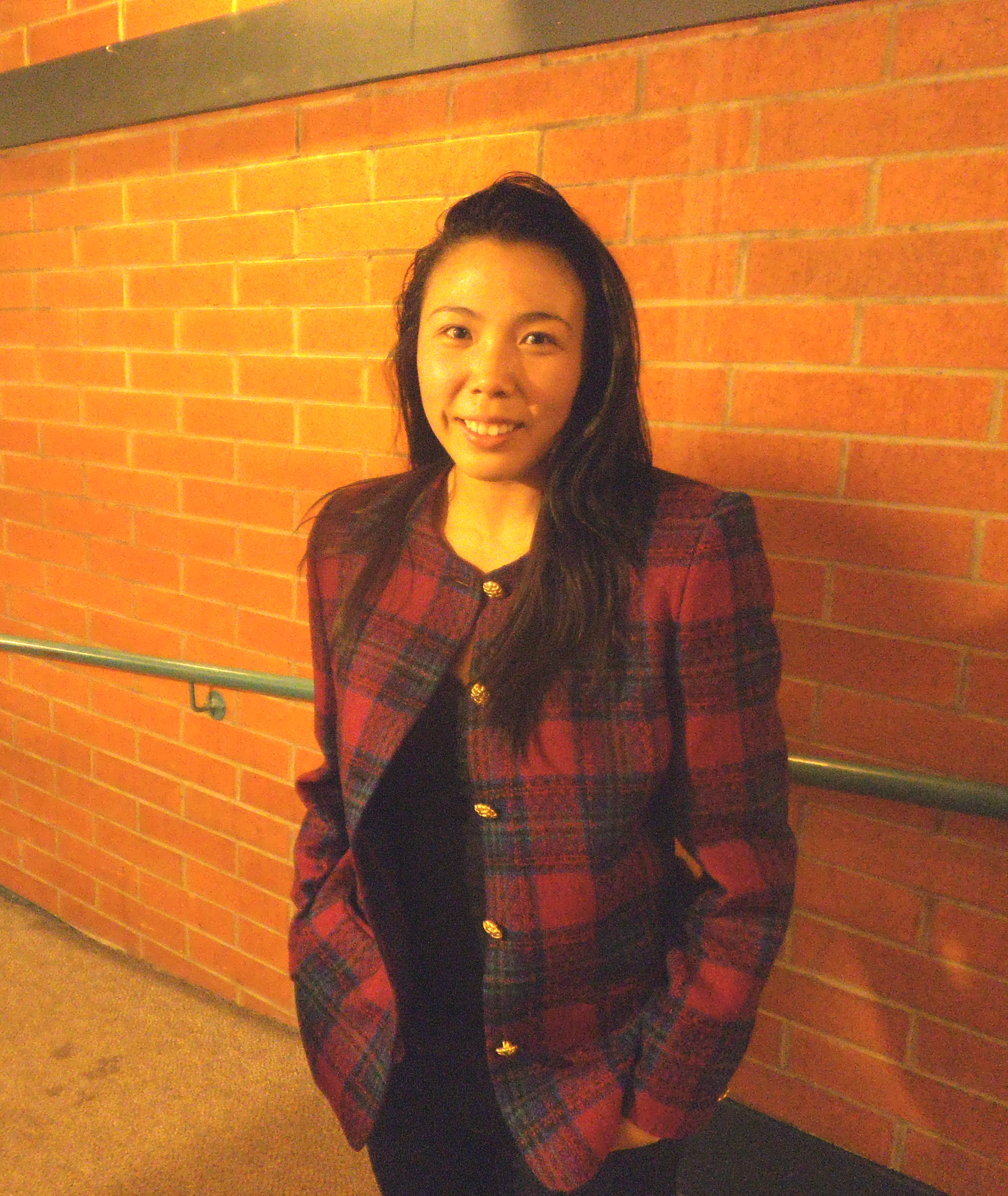
Choreographer/Dancer Pamela Tzeng, after the show.

Choreographer/Dancer Pamela Tzeng, after the show.

Tzeng does a good job of exploring questions of cultural identity. Is belonging to a culture simply speaking the language and looking the part, or is there more? And for those with two cultures, how does one reconcile the differences between that of their origins and their host? Is it truly a matter of one over the other? As this is only a 10-minute excerpt of the final product, it will be interesting to see what conclusions, if any, Tzeng comes to at the Fluid Movements Arts Festival where the piece is set to premiere.

But the experience of the festival is marred by the noise travelling from the neighboring room into the performance space. Loud conversations and laughter remove us from the intimacy of certain moments throughout the showcase. Hopefully, the company will resolve this issue for future performances.

Ultimately, however, the DSW’s 33rd Annual Alberta Dance Festival succeeds. The talent of the dancers is impressive. But it is the clarity of the choreographers who demand us to listen to what they have to say that truly capture our attention. It will be interesting to see what the choreographers do next in their artistic journeys.


Dancers’ Studio West’s 33rd Annual Alberta Dance Festival – Dance & The Image ran from September 11-13, 18-20, 2014.

For more information about DSW’s upcoming season, visit: http://www.dswlive.ca